France

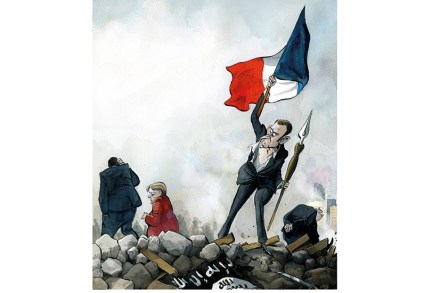
Emmanuel Macron is a Karen

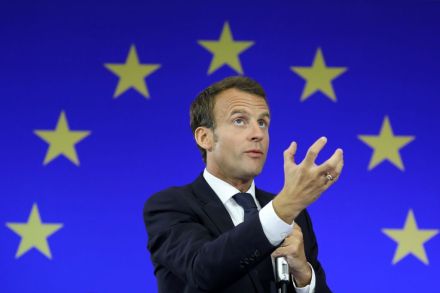
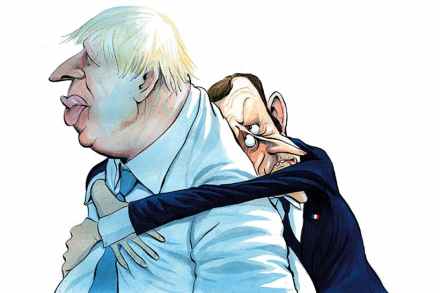
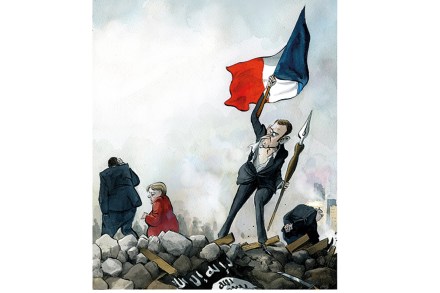
Cockburn dislikes the latent misogyny behind the rise of this term ‘Karen’, which is used to describe any white woman who is caught being aggressive on social media. Then again, Karens don’t have to be female; plenty of men fit the term perfectly. One of them is the President of France.Yes, Emmanuel Macron lost his rag again on Wednesday, this time berating a French journalist who dared to try to cover the President’s complicated maneuvers in Lebanon.

emmanuel macron

Office romance: I’m loving The Bureau

One of the many things I love about the horribly addictive French spy series The Bureau is that it never attempts to improve you with pious little homilies about how foreigners are just the same as us, with values just as worthy as our own, so they should be treated with the same amount of respect, for are we not all children of God? If The Bureau — about the DGSE, France’s equivalent of the CIA — had been made in the US, there would be a specially created nice, upstanding, Americanized Muslim character like the agent in The Looming Tower or the implausible black Muslim character in Jack Ryan.

bureau

Bad news from my oncologist didn’t spoil my joyous reunion with my grandson

From our UK edition

The Moulinards had inhabited the old stone hilltop house for centuries, ekeing out a hard living among the sun-baked boulders. They were peasants. In the winter of 1962 there was one Moulinard left. Henri: old, alcoholic, feeding the furniture into the fire for warmth. A delegation of relations came up the hill to persuade him to go into an old people’s home. When they’d left, old Henri took himself off to a large oak tree and hanged himself from a branch, dangling there for several days before being found. The house passed to a Marseille butcher who sold it on to an English couple who asked us to house-sit last week while they went on holiday to Austria. We were three: Catriona, me and my ten-year-old grandson, whom I hadn’t seen since Christmas.

The only things left worth watching on the BBC are foreign buy-ins like The Last Wave

From our UK edition

Soon, very soon now — even sooner than I imagined, if A Suitable Boy turns out to be as lacklustre as some critics are saying — the only things left worth watching on the BBC will be old repeats and foreign buy-ins like The Last Wave. A bit like The Returned (Les Revenants), The Last Wave concerns the effect of a supernatural event on a small community, not in the Alps this time but in a seaside resort on the Atlantic coast famed for its surf. During a competition, ten surfers are enveloped by a mysterious sausage-shaped cloud and disappear in the sea for five hours. They re-emerge, apparently unharmed yet subtly changed. One little boy’s eyes have turned electric blue; he also no longer requires glasses and can see through solid objects.

The difference between American and French wine-drinkers

From our UK edition

Is it safe to visit the continent? On the one hand, abroad is likely to be less crowded this August than in normal years. As for the virus, if one miscalculated, could that lead to lockdown in France profonde, or dolce far niente Tuscany? Hardly the worst outcome. Or would it mean cancelled flights, hours in airports, and then house arrest back in London? As government ministers do not appear to know the answer, how should the rest of us decide? While considering the options, I have consoled myself by remembering previous trips, stimulated by some recent tastings. When it comes to claret, I am very much on the left — of the Gironde, that is. Cabernet sauvignon stimulates the intellect as well as making demands on the palate.

A lament for the foreign correspondent’s house – and his hospitality

From our UK edition

Provence-Alpes-Côte D’Azur Until January the foreign correspondent lived in a late-18th-century house with a vineyard, olive grove and vegetable garden close to the village centre. You’d go through a gate, then another gate, and find yourself suddenly in the countryside and being yapped at by Mary, the most spoilt and spherical spaniel in Christendom, and then the foreign correspondent himself would appear in front of his lovely old house with arms open to welcome you. Usually the first thing he would say was that he was thinking about having a drink and why didn’t he go and fetch a bottle and glasses.

Has France been naive in its handling of Huawei?

From our UK edition

The controversy over the UK’s use of Huawei equipment in its 5G network has not abated, despite the government’s announcement that the Chinese manufacturer’s equipment will be stripped from the network by 2027. Conservative MPs continue to be unsatisfied by this half-way house, claiming that Britain will remain vulnerable to ‘back-door’ espionage by the Chinese state. They carry on threatening the government with an embarrassing, albeit symbolic, rebellion. But it is no secret that the real pressure to abandon Huawei equipment comes principally, and forcefully, from the UK’s ‘Five Eyes’ partners. The ‘Five Eyes’ network dates back to the Second World War and comprises the UK, the USA, Canada, Australia and New Zealand.

Jam and Opium on the Somme

From our UK edition

Phone calls aside, the only human contact I had on my ten-day Somme battlefield tour was with the lady who ran the bed and breakfast establishment. My bed was on the upper storey of a disused light railway station in a clearing in a beech wood. Madame lived with her husband in a modern bungalow 100 yards down the line, but came along each morning to cook my bacon and eggs. The greater part of her clientele consists of British Great War buffs. But Covid-19 had kept them away and I had the breakfast table, the old station and indeed the Somme battlefield entirely to myself. The dining room was once the waiting room.

Will Macron’s new sidekick help him get re-elected?

From our UK edition

It is just over three years since the election of Emmanuel Macron to the presidency of France. All of Gaul is united against him. All? No! From a village in the foothills of the Pyrenees, in a remote corner of Occitanie, Jean Castex, the irréductible mayor of the tiny commune of Prades (population 6,124), has emerged in a puff of smoke to become the President’s new prime minister. Castex is a previously almost unheard-of regional politician with a name that sounds as if he has leapt directly from an Asterix comic book. Being prime minister of France is probably the most thankless job in European politics. The president takes the credit for whatever goes right, while the premier takes the blame for whatever goes wrong. One wonders why Castex accepted.

Nuns, a maquisard and the Devil’s Own Rum: a Provençale pilgrimage

From our UK edition

Avid Spectator reader Mr Brown had endured the very strictest of lockdowns for family health reasons in Tunbridge Wells. Since March he had interacted only with delivery drivers, his wife and their two children. He was therefore quite unsocialised when he stopped with us for a night on his journey from Kent to the Pongo Delta in Guinea, where for the next 12 months he will be organising the security for a mining company trucking bauxite 200 miles through bandit country. I found him standing outside a village bar looking at his watch because I was an hour late. He heaved a shopping bag for life filled with booze and groceries into the boot of my car, urging that it must go into a fridge as soon as possible.

Anatomy of a fiasco: how Britain’s pandemic defences failed

From our UK edition

In October, a panel of 21 experts from across the world gathered for the first of what promised to be a series of reports assessing readiness for pandemics. ‘Infectious diseases know no borders,’ warned the Global Health Security Index. ‘So all countries must prioritise and exercise the capabilities required to prevent, detect and rapidly respond to public health emergencies.’ Every country was called to be transparent about its capabilities ‘to assure neighbours it can stop an outbreak from becoming an international catastrophe’. Two countries were held up as the best examples: Britain and the United States. If a league table were drawn up of countries that most failed to contain Covid deaths, the US and the UK would be pretty near the top.

What angry young French men want

From our UK edition

Chatting on the café terrace with my new friends Didier and Emile made me aware that certain political ideas, which before the Covid-19 pandemic I had comfortably assumed belonged on the wilder shores of political discourse, are now mainstream among the under thirties. I felt a little envy, perhaps, for Didier’s undoubting conviction that questions of equality, gender, race and white supremacy were the ultimate verities for humankind. But a single word often betrays a great design, and his supplementary advocation of voluntary euthanasia for the chronically sick and elderly indicated all too clearly in which direction his ideal post-Covid society would be headed.

Is left the new right?

From our UK edition

I took a table on the terrace of the reopened bar and ordered une pression from the waitress. ‘Back to normal, thank goodness,’ I ventured to the chap sitting alone at the next table. He was staring at the centimetre of lager remaining in the bottom of his glass. The cheapness of his clothes and the loneliness enveloping him like a caul was contradicted by his youthful glamour. ‘Normal?’ he said. ‘Normal doesn’t work. You can shove your old man’s normal up your backside.’ My sociable, celebrant spirit recoiled from the aggression. ‘I only meant that it was good to see the bars and shops open again,’ I said lamely.

My hairdresser cured my depression

From our UK edition

I walked to the salon in fiery sunshine. Gorgeous, zaftig Elody was wearing a short satin dressing gown of silver and gold. She was alone. ‘Ça va?’ she said, helping me into the gown. ‘Black dog,’ I said. ‘What is black dog?’ she said. ‘Cafard,’ I said. ‘A black ox trod on my foot.’ I sat in the chair, removed my glasses and stared in the mirror. The straps of my black face mask made my ears stick out. And strewth, the hair. ‘Two owls and a hen, four larks and a wren,’ I said. Elody speaks no English and my French is rudimentary. ‘What?’ she said. I had a stab at translating the limerick into French. She stared at me via the mirror with rapt, sceptical attention.

Rules for a deconfinement dinner party

From our UK edition

The most visible local landmark is a solitary two-headed Jurassic mountain called Le Bessillon, six miles long and 800 metres tall at the highest peak. These are unimpressive vital statistics for a mountain perhaps, but the Bessillon exerts a tremendous, almost uncanny presence on us all. The foreign correspondent and his wife have bought an 800-tree olive farm on a nearby hillside. From their outside dining table this great primeval slab and its forested sides can be seen in profile, like a finely drawn illustration in a Victorian encyclopedia. Between the dining table and the mountain is nothing but oak forest and pylons, and beyond it more oak forest until a distant village on a plateau. (The elegance of French electricity pylons and barbed wire makes me laugh.

The best way to cope with rejection is to write about it

From our UK edition

With more than a dozen acclaimed novels to her name, not to mention short stories, poetry, a memoir and a Booker nomination, you might think that Michèle Roberts could have counted on being published for life. But as so many ‘established’ authors know painfully well, in that ever-hungry-for-the-new world there’s no such thing as tenure. So when her latest novel elicits a lack-lustre response from her agent before being ‘sweetly’ but flatly turned down by her publisher, a stunned Roberts finds herself processing the humiliation in the only way she knows how — by writing about it. ‘My past successes counted for nothing,’ she mournfully observes: ‘There was only this smashed-up present.

My first post-lockdown party

From our UK edition

France is divided into a red zone and a green zone. We’re green. Green for go. From this morning we no longer need a signed and dated permit to leave the house; we can socialise with up to ten other people at a time; and we can travel up to 60 miles in any direction. In theory we could fill a minibus and go on a beano down to the coast tomorrow. And in spite of the government ordering bars and restaurants to remain closed, the village beer bar unexpectedly opened for business last Saturday, and the lights were on in the poshest village restaurant where people inside could be seen tucking in. Perhaps, in truth, the delicate decision about when to open the bars and restaurants has been quietly devolved to the local mayors’ offices.

League of nations: the race out of lockdown

From our UK edition

Uppsala Last week, Europe started its liberation from lockdown — and it all feels like a study in national political identity. Belgium took its first step towards ‘deconfinement’ but no one seems exactly sure what that means. France is opting for complexity rather than simplicity. Italy’s national plan for the easing of its lockdown is more convoluted still, but few regions bother to follow it anyway. Spain, goes a national joke, went more slowly and started with a reopening of the siesta. And in Germany, everyone is praising the country’s scientific approach to the pandemic, but as soon as they were allowed to roam freely again, many Germans headed for the beer gardens. Governments say their approach is ‘guided by the science’.

In praise of French doctors

From our UK edition

From my hospital bed in Hyères I could look out of the window and see the old town and Edith Wharton’s old house, the Castel Sainte-Claire, away on the hillside. Christophe, a male nurse, came in to welcome me and take my temperature, pulse and blood pressure. He was masked and gloved against possible infection from the old Covid Dix-Neuf and he spoke English. As he slipped on the finger thermometer and inflatable sleeve, he reminisced about his rugby-playing days. Thirty-five years ago, he said, he had competed against an English team who played rugby with a violence that was incredible.

Covid statistics are just politics by other means

From our UK edition

Statistics is the continuation of politics by other means, to misquote Clausewitz. One hundred and fifty years after the crushing of the revolutionary Paris Commune, historians still clash aggressively about the death toll. Was it as high as 40,000 or as low as 10,000? It matters because the Paris Commune is a shibboleth, a great left-wing site of memory and martyrdom, made famous by Karl Marx’s pamphlet The Civil War in France. He presented the Paris Commune as the first great experiment in communist government. Its crushing by the army of the conservative Adolphe Thiers is depicted in left-wing folk memory as the ‘reactionary, repressive forces of capitalism’ ending an idyllic experiment in socialism.