France

Low life | 2 May 2019

Santino was unusually short in the leg and, in his mid-twenties, was already rapidly losing his hair. He had recently come from Argentina to France to train as a tourist guide. He was earnest about his vocation and hoped one day, he told us, to become a guide specialising in Unesco World Heritage sites. To this end he was studying every night into the small hours, cramming into his head as much French history — and whatever else guides have to learn to pass the rigorous guiding exams — as he possibly could. When Santino smiled, his eyes closed automatically and the effect was endearing until one saw the abjectness.

In pictures: May Day protests in Paris turn violent

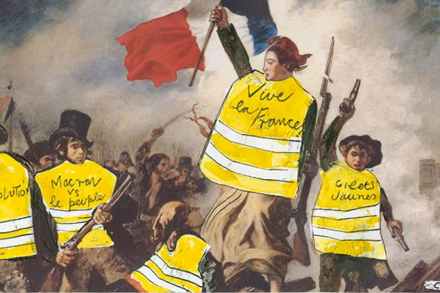
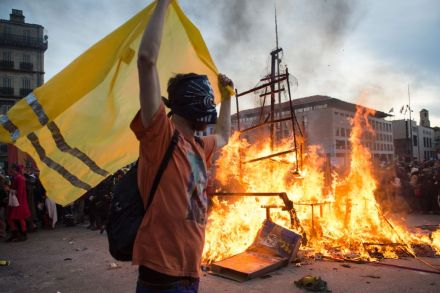
Hundreds of people have been arrested after violent May Day clashes in the centre of Paris. Tens of thousands of demonstrators took to the streets of the French capital to mark the event. Stone-throwing protestors clashed with police, as officers – more than 7,000 of whom were deployed – responded with tear gas. Gilets jaunes, who have held anti-government protests weekly since November, teamed up with May Day marchers.

Interview with Ismael Emelien: the man behind Macron’s rise

Behind the biggest recent upsets in Western politics lurk two influential advisors: one a scruffy far-right American ideologue who has become a household name; the other a clean-cut Frenchman just over 30 who has always avoided the limelight – until now. Without Steve Bannon, Donald Trump’s campaign boss in the final stages of the election, the US president might be promoting golf resorts and picking fights on Twitter full-time now, not running the United States. While in France, Emmanuel Macron’s extraordinary election victory in 2017, six months after Trump’s, would not have been possible without the discreet work of Ismael Emelien.

Why aren’t Corbynistas celebrating the gilets jaunes?

Why aren’t we Brits talking about the revolt just across the English Channel? Our silence on the gilets jaunes and their spectacular, sustained rebellion against the increasingly tyrannical rule of Emmanuel Macron has become pathological. There’s been barely any BBC coverage, no words of solidarity from Corbynistas, not a peep from the trade union movement. Hundreds of thousands of ordinary French people have marched, raged and clashed with the Macron government and Britain looks the other way. It’s bizarre. Our disregard deserves an explanation. This weekend was Act 24 of the gilets jaunes revolt. Named after the yellow vests that all motorists in France must have in their vehicles, the gilets jaunes revolt kicked off last November.

What next for Notre Dame?

Notre Dame is only important from a Shakespeare’s-birthplace point of view. Architecturally it is a nullity beside the cathedrals of Beauvais and Laon, Albi and Marseille, Rouen and Clermont-Ferrand (a sinister marvel of black tufa). The ashes of the cathedral are now the site of a proxy struggle between some of the greatest fortunes on the planet. The struggle has begun with the architectural competition announced by the widely loathed Macron and the so far less loathed PM Édouard Philippe. How will the competition be conducted?

Out of the ashes | 17 April 2019

‘Great edifices, like great mountains, are the work of centuries,’ wrote Victor Hugo in Notre-Dame de Paris. ‘The man, the artist, the individual, is effaced in these great masses, which lack the name of their author. Human intelligence is there summed up and totalised.’ The foundation stone of the cathedral of Our Lady of Paris was laid 850 years ago, but it was the work of generations, and took 200 years to complete. It soon became one of the greatest churches in Christendom and, as such, was ripe for desecration by the Jacobin fanatics of the French Revolution. In 1793, its altar was torn out in a ceremony that was too grotesque even for Robespierre.

Real life | 17 April 2019

An angry villager accosted me outside my house as I came through my front door. ‘You’re wrong about those horses,’ she called. By which she meant the 123 horses taken from a farm down the road by the RSPCA. ‘They were never fed!’ she shouted at me. ‘They were starved! We have been trying to help them for years!’ I sighed. ‘Just a moment, please,’ I said, putting my handbag in the car. I walked over to where she was standing. ‘Look, those horses were all fat if anything. I’ve got leaked photos of each one of them taken by vets in RSPCA custody days after seizure. They look perfectly fine. Would you like to come in and see the photos? Come on, I’ll show you.’ ‘No!’ she screeched.

What might Macron’s ‘even more beautiful’ Notre Dame be like?

24 August 2024 At the opening today of the rebuilt Notre Dame Cathedral, after the disastrous fire in April 2019, President Macron defended his decision to retask it with a new mission as a “house for all faiths, and also for those who have no faith.” “Notre Dame is a symbol of France, it has been reconstructed as a symbol of France, and so it is perfectly normal that its magnificence be accessible to everyone,” the president said. The new Notre Dame was even better than the old one, he said. The new Notre Dame is controversial and has divided critics. They have accused it of being little more than a tourist attraction. Wasn’t it ever thus? While it will continue to be free to admire the building from the outside, entry within shall now attract a hefty fee.

Notre Dame and Emmanuel Macron’s annus horribilis

“Paris outraged, Paris broken, Paris martyred, but Paris liberated!” intoned General de Gaulle on 25 August 1944 from the Hotel de Ville on his first appearance before the French people following the capital’s liberation. The following day he attended the Te Deum at Notre Dame Cathedral, that other high symbol and site of memory and meaning for Parisians and the French. The tragedy of the Notre Dame fire puts politics and politicians in perspective.

The shame of Notre Dame

The conversation in France changed abruptly last night. Perhaps the blaze in Paris was the wake-up call that France needed. My neighbours, and all of France, seem deeply shocked. Almost numb. The fire seems to have touched a nerve. Whether this sentiment is transient remains to be seen. Notre Dame cathedral will be rebuilt. It may even be better than ever. From an inferno in the heart of French Catholicism, it will be resurrected to inspire new generations of believers, and a million tourists a month. The means are not lacking. Hundreds of millions have been pledged. The rest will follow.

The symbolism of Notre Dame’s destruction won’t be lost on Macron

The timing of the burning of Notre Dame could not have been worse for Emmanuel Macron. The spire of the 850-year-old cathedral collapsed into the flames at 8pm, the time scheduled for his televised address to the nation. The president had planned to tell his people in the broadcast what measures would be taken after the three months of Grand Debate, the consultation launched at the start of the year in response to the Yellow Vest protest movement. Instead, Macron rushed to Notre Dame and looked on as the inferno consumed the country's most historic monument. "Notre-Dame is aflame," tweeted the president. "Great emotion for the whole nation. Our thoughts go out to all Catholics and to the French people.

The Spectator Podcast: where did things go wrong for Emmanuel Macron?

While Friday may mean the end of the working week for most of us, for many in France, it means the start of a long weekend out in the streets clad in a gilet jaune. As Emmanuel Macron pushes for a tough stance against the UK in Brexit negotiations in Brussels, domestic problems continue to mount unabated. Jonathan Miller writes in this week’s cover piece that, despite initial optimism about the golden boy of global liberalism, Macron’s only major achievement so far has been to unite his country in opposition to him. He is joined on the podcast by Sophie Pedder, Paris Bureau Chief for the Economist, and author of Revolution Française, a biography of Macron.

Will France cut taxes and boost the economy in response to the protests?

For 21 weeks now the Gilets Jaunes have taken to the streets of French cities to protest. It began as a demonstration against high and rising fuel taxes. These tax increases hit families getting children to school and the adults to work, and cut the earnings of the self-employed working from their vans and cars. The higher fuel taxes and slower speed limits were part of President Macron’s policy to curb carbon dioxide emissions. For his trouble the protesters put out of action a majority of the speed cameras, showing him what they thought of his wish to control their lives. The street actions have been stoked by some angry students and by committed protesters of the extreme left and right, but many of those protesting are doing so for the first time.

Theresa May must stand up to Emmanuel Macron’s Brexit posturing

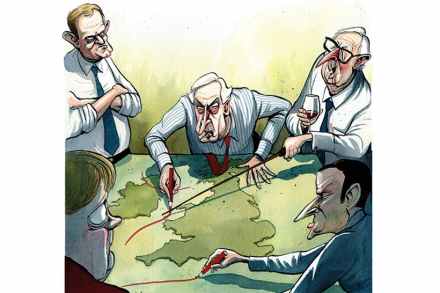
In this the 115th anniversary week of the Entente Cordiale, the French president and the British Prime Minister will meet twice, today at the Elysee Palace and tomorrow at the European Council in Brussels. But neither of those meetings will be to celebrate their countries friendship. When May goes to Paris and then to Brussels, she will instead be a woeful supplicant in the Brexit feuilleton. And the one thing the vicar’s daughter can count on is that she will be subjected to a severe bout of Macron lesson-giving and severe sermonising, as is his wont. And yet Macron is hardly in a position of strength. Both leaders are battling domestic crises that come to a head this week. The British PM’s Brexit woes are only too well known.

Low life | 28 March 2019

I’ve swapped my carer’s tray in Devon for a barrow and spade halfway up a cliff in the south of France. Right next door to the modernised, carpeted cave in which we live is a concealed cavern, home for hundreds of years to troglodytes (the ceiling is black with soot from their fires) and their domestic animals. The floor is feet-deep in accumulated manure and debris that has turned over the years to a fine black dust. I’ve dug down to rock and now I’m working forward towards the door with three electric fans at my back directing the rising dust out of the cavern entrance in a stream of smoke. It’s a filthy business. I spade the black dust into a wheelbarrow, then tip it over the cliff.

The real reason Macron is desperate to woo Xi Jinping

Chinese president Xi Jinping came to France and is taking home 300 Airbus jetliners, a large consignment of frozen chickens and a wind farm. A great triumph for France, declared Emmanuel Macron. And for Macron? Never mind that many of the planes will be built in China. Or that Airbus is no longer a French company but an international one, although headquartered in Toulouse. Or that the hens are unlikely to be free range. It’s hard to argue with a cheque for £30 billion. Or to stop a politician taking credit for a deal that’s been in the works for years. To cement his triumph, Macron hosts Xi today at an impromptu summit at the Elysée palace with Angela Merkel and Jean-Claude Juncker.

Emmanuel Macron has saved himself from political crisis – for now

Back in December, Emmanuel Macron was a man on edge. His poll numbers were spiralling down the toilet; hundreds of thousands of French who felt alienated from their government were taking to the streets to shout down the French elite in cities and towns across the country; and fires were burning all around Paris. Police officers and protesters-turned-rioters were on the frontlines trading rocks and rubber bullets, resulting in hundreds (if not thousands) of arrests. Macron, the blue-eyed, fresh-faced technocratic politician who marketed himself during the 2017 presidential contest as the Fifth French Republic’s aspiring saviour, was left twiddling his thumbs in the presidential mansion wondering how to address the turmoil around him.

Italians

For a few years before coming to Italy, I lived in Paris and I cannot tell you the life-enhancing difference I felt as I crossed the frontier from France into Italy in my metallic burgundy Honda Prelude. On arrival at the Italian motorway toll that stifling summer of 1998, I discovered I had no money and that the sun had melted my bank card which I had left on the dashboard. The charming young woman on the toll-gate simply gave me a form to fill in and waved me through with a smile. Isn’t this how we should run the world? I remember once being stopped by two Italian police patrol cars in the dead of night when well over the limit. Instead of them breathalysing me, we started to have a discussion about the Mussolini biography I had written.

‘They’re finally going to play my music’

According to his friend and fellow-composer Ernest Reyer, the last words Berlioz spoke on his deathbed were: ‘They are finally going to play my music’. It has taken time, but he was right. A century and a half later, Berlioz 150 is the watchword of the hour. That is as it should be. Berlioz was a devotee of the ancient world (‘I have spent my life with that race of demi-gods’), where it was believed that at the moment of death one might be granted foreknowledge of the future. Why has it taken so long? In his native France there were plenty of reasons. As a forceful, witty but sardonic music critic he inevitably put Parisians’ backs up with his attacks on modern Italian music, which he regarded as frivolous, formula-ridden and fatally undramatic.

Europe’s culture clash

Two weeks ago Luigi Di Maio, Italy’s vice-premier and Labour Minister and the top politician of the Five Star Movement (M5S), appointed a new commissioner for the UN cultural organisation Unesco. He chose the dog--whistling, bum-slapping sex--comedy actor Lino Banfi, star of How to Seduce Your Teacher, Policewoman on the Porno Squad and other films. The M5S was launched online by the 1980s comedian Beppe Grillo. It is run on the basis of a private computer operating system called Rousseau. Most Italians look at the M5S as either a breath of fresh air, a necessary gesture of defiance, or a ridiculous episode that will pass. But you need a sense of humour for that. French President Emmanuel Macron has lately shown himself unable to take the Italian government in his stride.