France

Even if he wins Macron could be facing disaster

From our UK edition

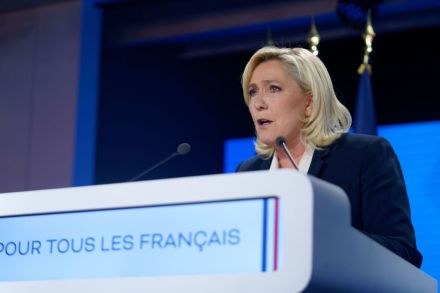
Unaccustomed as political scientists are to florid language, they have nevertheless come up with the ‘theory of the dyke’, to explain the continuing success of the nationalist and identitarian Rassemblement National. A dyke can hold back the flood for so long, but once water has overflowed there is no getting it back. When in 2002 Marine Le Pen’s father, against all odds, beat the socialists to go through to the presidential run-off against Jacques Chirac, there was no reversing the flow. Marine Le Pen’s score of 23.1 per cent in the first round of the election this week is the highest in the nationalist right’s 50-year history.

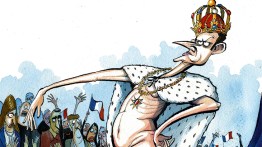
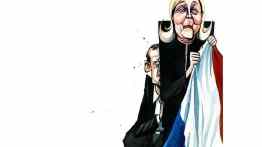
Marine Le Pen takes on the king of Europe

Last Sunday marked the beginning of the French presidential vote; the runoff election will take place on April 24, and incumbent president Emmanuel Macron winning again is no sure thing. If she plays her cards right, challenger Marine Le Pen has a legitimate shot at becoming the next president of France. Macron emerged victorious in the first round with 27 percent of the vote, followed by Le Pen with 23 percent. For the nationalist Le Pen, it is the second time she has qualified for the runoff, and thus the second time she is running against Macron. In 2017, she lost to Macron 66 percent to 33 percent, crushing once again the ambitions of her National Rally party. This year, however, will be a much closer call.

France is set for serious social unrest

From our UK edition

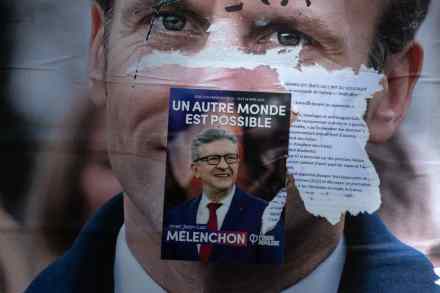
So it’s Emmanuel Macron and Marine Le Pen once again, and for many millions of French that is a deeply depressing prospect. There were violent protests in the Brittany city of Rennes shortly after the result of the first round of voting was announced, as an estimated 500 people vented their anger against ‘fascism’ and ‘capitalism’. Around the same time I received a call from my sister-in-law in the south of France. She was in despair, this working-class socialist, at once more being forced to choose between Macron and Le Pen. But it’s her ilk who will decide the outcome of the second round on 24 April. Jean-Luc Mélenchon received 21.9 per cent of the vote – approximately 7.

Like him or loathe him, Macron is Europe’s driving force

From our UK edition

If you want to know why Marine Le Pen almost certainly won’t win the French presidency on 24 April, listen to the speech of Jean-Luc Mélenchon, the man who came third in today’s first round of the presidential election. ‘We know who we will never vote for!’ said Mélenchon, the far-left autodidact who somehow outdid his strong 2017 performance and won more than 20 per cent of the vote tonight. ‘We’ll never give up our confidence in democracy.’ He then repeated, four times or more, as the crowd cheered louder and louder: ‘We mustn’t give a single vote to Marine Le Pen.

The mysteries and rituals of French democracy

From our UK edition

Montpellier I have never voted in an election for president of France, not being French. But as a councillor in my commune, before Brexit brought my promising French political career to a screeching halt, disqualifying me from municipal politics, it was among my duties to count the votes of others. It’s election day in France, the first round of the 2022 presidential race, and there are 12 candidates in the running. The top two will face off in a second round in two weeks. It’s expected that these will be the incumbent, Emmanuel Macron, and Marine Le Pen, in a rerun of the 2017 election that Macron won 66 to 34 per cent. Many here are saying, as they have for as long as anyone can remember, that the elections are fixed.

The strange revival of France’s Jean-Luc Mélenchon

From our UK edition

Jean-Luc Mélenchon is on the march once more, rising up the polls and laying bare the ineptitude of the Socialist party. While their candidate in the presidential election, Anne Hidalgo, is stuck on two points, Mélenchon is on 17, behind only Marine Le Pen, on 23, and Emmanuel Macron on 26. It was a similar story in the 2017 election when the veteran left-winger received 19.6 per cent of votes in the first round, while the Socialist party’s Benoît Hamon mustered a risible 6 per cent. There’s a contradiction to Mélenchon in that while at 70 he is the oldest candidate in the race, he is the most technical savvy in getting his message across.

Progressives vs populists: Macron, Orban and Europe’s faultline

From our UK edition

As soon as Emmanuel Macron was sure that Joe Biden had won the American election, he tweeted: ‘We have a lot to do to overcome today’s challenges. Let’s work together!’ There was no effusive tweet this week from the Élysée when 54 per cent of Hungarian voters re-elected Viktor Orban as Prime Minister for a fourth term. The silence from Macron was deafening. Not so his principal rival in France’s impending election. On Sunday evening Marine Le Pen tweeted an old photo of the happy couple shaking hands with the declaration: ‘When the people vote, the people win!

Macron has taken this election for granted

From our UK edition

Things are going from bad to worse for Emmanuel Macron, and for the first time political commentators in France are considering the possibility that he might not win a second term. The latest poll, carried out for Le Figaro, has him one point ahead of Marine Le Pen in the voting intentions of the people canvassed. Brexit and Trump have taught us not to put all our trust in polls but there’s no denying that Macron’s election campaign is in trouble. As I wrote yesterday, this time last month he was 18 points clear of Le Pen and a racing certainty for a second term. Where has it gone so wrong? Macron has only himself to blame.

Is France set for another Le Pen-Macron showdown?

The first round of voting in the French presidential election will happen Sunday — and despite expectations of the last few years, the run-up appears increasingly anti-climactic. But not all is said and done in the campaign. Over the last few weeks, Emmanuel Macron has extended his lead in the opinion polls, bolstered by the uncertainty of the war in Ukraine. The most recent poll has Macron ahead at 28 percent, in front of far-right candidate Marine Le Pen at 23 percent, and far-left contender Jean-Luc Mélenchon. Far-right independent hopeful Éric Zemmour (9 percent) and Republican nominee Valérie Pécresse (8 percent) had experienced boosts in the campaign’s early stages, which have both since died down.

Could Marine Le Pen actually win?

From our UK edition

Emmanuel Macron is worried. This wasn’t how he had envisaged the election. A month ago the president of France held a staggering 18 point lead in the polls and, as he looked over his shoulder in the home straight, he could barely make out Marine Le Pen in the distance. Now the gap is four points and she is breathing down his neck as the finish line approaches. Le Pen is one of Europe’s more interesting politicians. The daughter of Jean-Marie, the founder of her National Front party – which she rebranded National Rally in 2018 – and the aunt of Marion Maréchal, she has always been considered something of a political second-rater.

Was another tragic Jewish death covered up in France?

From our UK edition

Not for the first time in France the death of a Jew is dominating the news, and not for the first time there are whispers of an attempted cover-up. Several candidates in Sunday’s election have paused from their campaigning to air their views on the death of Jeremy Cohen, a 31-year-old who was struck by a tram in Seine-Saint-Denis, north of Paris. The candidates portrayed by the commentariat as ‘extreme right’ were the most direct. ‘Did he die because he was a Jew?’ tweeted Eric Zemmour, himself a Jew. ‘Why is this case hushed up?’ Marine Le Pen also wondered on social media if ‘what was presented as an accident could be an anti-Semitic murder’.

Could the Corsica revolts spread all over France?

From our UK edition

The Colonnas in Corsica are a bit like the Smiths in Britain. We are numerous. But in smart Parisian circles, the mention of this name sends a chill through the room. Yvan Colonna, a member of my extended clan (though not a known relative), was the most notorious Corsican nationalist of his time. He was convicted of the 1998 killing of a Préfét of Corsica, the highest republican official on the island. Last month, Yvan was himself murdered in a mainland French prison.  He was attacked by a fellow prisoner, an Islamist who had been arrested and brought over from Afghanistan. It was an especially gruesome affair. Colonna was beaten and then strangled for eight minutes.

Will Macron surrender to the mob?

From our UK edition

It has been a torrid few days in France. In the early hours of Saturday morning, a former Argentine rugby international, Federico Aramburú, was shot dead on a chic Paris street after an altercation in a bar. The suspect is a notorious far-right activist who allegedly told Aramburú that he didn’t belong in France. On Monday Corsican nationalist Yvan Colonna died, three weeks after he was beaten into a coma by fellow prisoner and infamous extremist, Franck Elong Abé, an Islamist who was captured fighting for the Taliban a decade ago. It is alleged that Abé justified his attack on the grounds that Colonna ‘had bad-mouthed the Prophet’.

France is strong where Britain and America are weak

From our UK edition

Emmanuel Macron unveiled his campaign manifesto in a carefully orchestrated press conference on Thursday and his pledges to cut taxes and reform the welfare system dominated the headlines on Friday morning. But the president also touched on defence, promising that spending – €32.3 billion when he came to power in 2017 – will rise to €50 billion by 2025. Some of that money will be invested in cyber warfare technology, as well, presumably, on ammunition; if reports are to be believed the French army would run out of ordnance after four days of a major war. It’s a favourite pastime of Anglophones to mock the French military, though only those who don’t know their history indulge in such juvenile antics.

The Macron Paradox

From our UK edition

With just 24 days to go before the first round of French presidential voting, the political landscape has become borderline surreal, a dream state of self-induced hallucinations. The war in Ukraine has utterly overshadowed the vote. Any resemblance to an actual democratic contest might now be regarded as coincidental. If the current polls are right, Macron will enter the second round with Marine Le Pen in a straight replay of 2017, with the same inevitable result. I have my doubts about these polls. But it might not matter much who faces Macron: unloved yet unbeatable. Macron isn’t even campaigning. He’s at 30 per cent in polls for the first round, campaigning through a torrential downpour of electoral bribes.

The shadowy charisma of the Mater Dei sisters

From our UK edition

Catriona has a commission to paint the 17th-century façade of the chapel of St Joseph’s. She’d made a start when she decided that a foreground figure would lend greater interest and perspective to the composition. Following an email exchange, one of the nuns agreed to pose on the stony path leading up to the chapel for a photograph, from which Catriona would complete the work. At the appointed time she clanked the bell beside the pointed nunnery door. I was her out-of-breath photographer’s assistant. After two long minutes, the door opened and the youngest and prettiest of the seven sisters stepped from the cloister into the windy world.

Putin’s invasion has collapsed the French right

From our UK edition

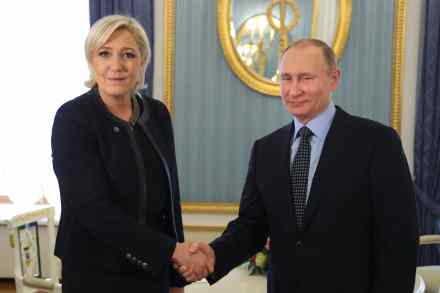
At the time it probably felt like a good idea for Marine Le Pen’s campaign team. A photo of her shaking hands with Vladimir Putin, taken when she met the Russian president in Moscow in 2017, would emphasise to the electorate that she was a serious player on the world stage. The photo was included in Le Pen’s campaign manifesto, over one million of which have been distributed the length and breadth of France. Now they are being hastily withdrawn by party members as Le Pen does her best to distance herself from the most despised man in the West. Le Pen is not the only presidential candidate to have been embarrassed by events in Ukraine.

Macron appears unassailable

From our UK edition

Emmanuel Macron, the President of France for whom few voters have expressed much affection, is suddenly the leader of a nation (and by dint of his presidency of the European Council, the EU) in a de facto state of economic war with Russia. He is wiping the floor with his opponents in the forthcoming presidential election, benefiting from the congruence of international events and his refusal to descend into the electoral arena. With 38 days to go before the first round of voting, the oxygen has been sucked out of the campaign. Macron’s efforts to diplomatically defuse the Ukraine crisis plainly failed – yet his approval ratings have skyrocketed, to over 50 per cent in one poll yesterday. His opposition is in danger of being reduced to a state of near irrelevance.

What’s behind the wave of French police suicides?

From our UK edition

Since Russia invaded Ukraine last week the western media has focused on little else. In Britain this concentration is understandable: the country has finally come out of Covid and there is a large gap to be filled on the airwaves and in the newspapers. Not so in France, still encumbered by Covid restrictions, where in just over five weeks voters go to the polls in the first round of the presidential election. As much as the French are troubled by events in Ukraine – a recent poll reported that 88 per cent of those canvassed were ‘shocked’ by the Russian invasion – they will vote on issues closer to home: the rising cost of living, immigration, the health service, and crime and violence.

Macron’s posturing as a global statesman will get him re-elected

From our UK edition

It is bordering on tasteless amidst the horror of war in Europe to question the political impact of the conflict on the first round of the French presidential election in 44 days. But it’s naïve to imagine that such thoughts are not occurring to the politicians themselves, not least Emmanuel Macron. As I write this on Friday, Macron has still to declare his candidacy for the presidency. He’s been letting his opponents on the right and left fight it out amongst themselves for as long as possible. He could declare tomorrow at the Salon d’Agriculture, where he is scheduled to make the customary presidential appearance. Or maybe not.