France

Can Mélenchon unite the French left?

From our UK edition

Paris Shortly before the first round of the French presidential election I was handed a campaign flyer by one of Jean-Luc Mélenchon’s activists. On one side was his photo and on the reverse the headline: ‘With Jean-Luc Mélenchon another world is possible.’ What sort of world? A leftist utopia in which the minimum wage would be raised from its current €1,302 to €1,400 net per month, new hospitals would be built, the retirement age would be lowered to 60, and there would be a fixed price for petrol, food and energy prices. Oh, and there would also be a Sixth Republic.

The call of opium-based analgesics and introspection

From our UK edition

On the morning of my last day in England, I drew back a curtain and there in the garden, browsing one of the flower beds, was a brown hare. It hobbled cautiously but not timidly among the spring bulbs, choosing thoughtfully like a discriminating shopper. I leaned on the window sill and watched it for perhaps ten minutes. The hare was in the process of exchanging its tatty winter fur coat for a shorter, smoother, lighter-brown one, visible underneath. Overnight late spring had turned to the softer air of early summer and I was sorry to be leaving the country at the exact point of the season’s changing. In the bedroom I regretfully set about packing my trolley bag for the flight back to Nice.

Portrait of the week: Twitter takeover, late nights for pubs and a row over leg-crossing

From our UK edition

Home Ben Wallace, the Defence Secretary, said Britain assessed that 15,000 Russians had been killed in the war against Ukraine and at least 530 Russian tanks, 530 armoured personnel carriers and 560 infantry fighting vehicles had been lost or captured. Sixty Russian helicopters and fighter jets had also been lost. He told the House of Commons that Britain was sending to Ukraine some Stormer armoured vehicles, with launchers for Starstreak anti-aircraft missiles. Liz Truss, the Foreign Secretary, called for aircraft to be sent too. In the seven days up to 23 April, 2,207 people had died with coronavirus, bringing total deaths (within 28 days of testing positive) to 173,693. In the previous week 1,289 had died.

The relentless march of Europe’s zombie centrists

From our UK edition

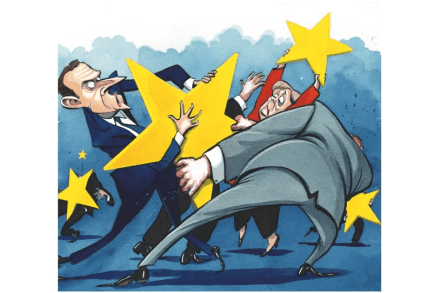
Journalists rarely had it so easy as when it came to writing up the final result of the French presidential election on Monday morning. The copy almost wrote itself: the triumph of moderation, demonstrated by a convincing win for centrist Emmanuel Macron over his far-right challenger Marine Le Pen; the clear defeat of disruptive extremist politics that might otherwise have threatened European stability; and the return to EU business as usual, with euroscepticism once again off the table and the re-establishment of a stable Franco-German axis in charge of Brussels. Easy, but ultimately unconvincing. Centrists who can be trusted not to be too radical may indeed be in power in France, as they have been in Germany since the installation of Olaf Scholz as Chancellor late last year.

France is eternally divided

From our UK edition

A lot happened in France last night. After a lacklustre performance, long disillusioned supporters were unable to summon any enthusiasm for Paris Saint Germain football team’s French league championship success. Emmanuel Macron was re-elected French President beating Marine Le Pen 58.5 to 41.5 per cent and the official disco party celebration organised beneath the Eiffel Tower finished early. A short distance away on the Pont Neuf police shot and killed two men who drove a car at them. Demonstrators took to the streets and threw fireworks in protest against Macron’s election in Paris, Lyon, Strasbourg, Rennes, Grenoble and a host of other French towns where teargas scuffles took place. Emmanuel Macron made the shortest victory speech of his career.

Where does Macron go from here?

From our UK edition

The French do not want Emmanuel Macron's party to win in the National Assembly, at least according to polls taken at the weekend. Expect revenge voting; Macron may lose his majority. How should he prepare for an eventual co-habitation of government and with whom? Macron promised in Marseille that his prime minister will be charged with implementing an ecological master plan, as proposed by Mélenchon. Does this mean a prime minister from the left? What if there is a better partner on the right around? After all, Macron has nothing to lose, since this is his last term as president, limited as he is by a two-term cap. But preparing for the after-Macron era will be part of his considerations. It will also depend on what will now happen on the left and the right.

Forget Le Pen 2027

From our UK edition

If Emmanuel Macron has any sense he will be back in the office this morning. Sunday night’s celebratory shindig was good while it lasted but the Fifth Republic has never faced such a parlous future, either socially or economically. One can only hope that the attack on a priest in a Nice church on Sunday morning, barely mentioned by the media, is not a harbinger of things to come for Macron’s second term. Of more general concern for France is the economic situation. Everything is rising, from the cost of petrol to the price of a baguette, and the war in Ukraine will only deepen the crisis in the months ahead.

Apres Macron, the radical left?

From our UK edition

Bof! That useful French word – an older and slightly less irritating version of the American-English ‘meh’ – is how many people feel about the re-election of Emmanuel Macron. The centre holds even as things fall apart – in 21st century France, anyway. It was inevitable and in the end easy. Mainstream commentators, almost unanimously pro-Macron, have spent the last few days trying to inject a sense of drama into the vote by suggesting the threat Le Pen posed was great. But it was painfully obvious that Macron would win. At 44, he will almost certainly still be President in 2027, when the constitution (as currently composed) will compel him to stand down. He isn’t loved. The abstention rate on Sunday is estimated to be 29.

The French have voted for the lesser of two evils

From our UK edition

Few scenes of jubilation as Emmanuel Macron was re-elected President. French voters held their noses and voted without evident enthusiasm for five more years. French exit predictions, based on actual voting, not exit polls, are invariably lethally on target. As the polls closed they forecast 57.6 per cent for Macron, 42.4 per cent for Marine Le Pen. The official result will be certified on Tuesday but there’s no doubt. Le Pen’s political career should now be over. Yet in her combative concession speech, she sounded as if she would go on and on We were supposed to pretend that we didn’t know who had won the French presidential election until after 8 p.m. when the polls closed in the bigger cities.

Privilege vs poverty in the French election

From our UK edition

In a few hours France will know who has won the presidential election. Macron, predict the polls – though Marine Le Pen’s National Rally remain convinced that the ‘voice of the street’ will sweep them to power. The truth, however, is that there will be no winner from this election. Macron told Le Pen during Wednesday’s live television debate that her wish to ban the headscarf would precipitate a ‘civil war’, but France is already at war with itself. Macron vs Le Pen is how it has manifested itself this month but the battle lines were first drawn a decade or more ago as the effects of globalisation began to bite in what is called la France Périphérique.

Is this the end of Marine Le Pen?

From our UK edition

Today’s election in France is likely to be a joyless, miserable affair for the electors who will dutifully turn out. The outcome is preordained. French voters who supported the re-election of Emmanuel Macron are unlikely to exhibit much enthusiasm when he wins tonight. If there are fireworks in the streets this evening, they’ll probably be aimed at the police. Those who voted for Marine Le Pen will have equally little to celebrate. They may avert the humiliation of the 66-34 per cent defeat in 2017. But this will be the third successive defeat for Mme Le Pen, following five failed runs by her papa, Jean-Marie Le Pen. This hereditary candidacy is well beyond its best-by date.

Will Russia sink Le Pen?

From our UK edition

Paris, France Marine Le Pen has changed her image. Five years ago, the veteran far-right leader lost her second bid for the French presidency to a virtual newcomer, Emmanuel Macron, who swept into office with two-thirds of the vote. This time, she has assured her anxious supporters that things will be different. She has retired her policy of pulling out of the EU, calling instead for it to transform into a federation of sovereign states. She has also sought to assuage fears she would bring back the Franc. Gone too are calls to end all immigration to France – legal and illegal – preferring instead a comparatively more mellow line about how open borders are causing ‘anarchy‘.

Narcissist vs fantasist: France’s gruesome choice

From our UK edition

Something strange is happening in advanced western democracies. In America and France, voters keep finding themselves choosing between candidates for whom they have very little affection. In America, we saw Clinton vs Trump, followed by Biden vs Trump. And in France this week, we have Macron vs Le Pen again. As many French voters now say, this is a choice between la peste (plague) et le choléra. Emmanuel Macron is disliked: arrogant and narcissistic to the point where he has compared himself to Jupiter, king of the gods. He has spent five years insulting and patronising voters and delivering mediocre results. His management of the epidemic was repressive and absurdist. He failed in Africa, failed with Putin, threw tantrums over Australia and Brexit.

Macron vs Le Pen debate: le verdict

From our UK edition

Who won Wednesday night’s debate between Emmanuel Macron and Marine Le Pen depends on who is doing the scoring. In the spin room and on the social networks, Team Macron claimed a victory for the President. With the second round of the presidential election on Sunday, my reaction is exactly the opposite. Le Pen was not crushed as she was in 2017. In a way, she won by not being terrible, leaving Macron unable to administer a coup de grace to her candidacy. She got stronger and more confident as the evening wore on; he seemed to become more defensive. It’s taken for granted that Macron is a master of his dossiers and the President’s performance wasn’t terrible To be generous, Macron was not on form.

Le Pen drives Paris mad. That’s why her voters love her

From our UK edition

When asked to define Marine Le Pen in a single word, a majority of French people came up with ‘cats’ rather than ‘extreme-right’. In the past five years, she has worked hard at ‘detoxifying’ her brand. She softened her platform so that she no longer advocates Frexit or even leaving the Euro. Unlike Eric Zemmour, the former Le Figaro columnist, she insisted Islam was compatible with the values of the Republic. It’s Islamism that isn’t, she said.  Having fired her then-85-year-old father for anti-Semitism in 2015, she tried to reshape the old Front National. She changed the party name in 2018 (to Rassemblement National or National Rally).

Marine Le Pen may reshape Europe – even if she loses

From our UK edition

It has been a truism since the nineteenth century that international affairs do not decide French elections. Yet last week, only three days into the run-off campaign, Marine Le Pen gave a press conference setting out her foreign and defence policy vision. At heart, it’s a classic Gaullist project. Even if she loses, it could seriously influence French policy, because much will depend on the size of Emmanuel Macron’s parliamentary majority and the strength of radical left and right groupings come the June legislative elections. Le Pen’s international project draws a clear line between her nation-state based realpolitik – in the ascendant in France and elsewhere – and waning globalist liberal internationalism, so closely associated with Macron.

The real danger Marine Le Pen poses to the EU

From our UK edition

As the French Presidentielle hots up for the final vote on Sunday week, both Macron and Le Pen are fighting bitterly for the support of the erstwhile supporters of the left-winger Mélenchon who came a very respectable third in last Sunday’s poll. From the great and the good, who detest Le Pen, there is a concerted call to all and sundry to form an anti-far-right alliance and vote for Macron (where necessary holding their noses) so as to replicate what happened in 2017. It is fair to say that much of what is said against Le Pen is misleading. Her economic policies are if anything more Mélenchon than Macron: lowering the pension age, reducing the burden on young families, and reducing the tax on fuel.

How much did Emily Maitlis cost licence fee payers?

From our UK edition

Off duty How many non-doms are there in the UK? – In the year ending 2020, 75,700 people filled in a tax return in which they declared themselves to be non-domiciled – down from 78,600 the previous year and 137,000 in 2008. – Of the 75,700 in 2019/20, however, only 62,200 were actually resident in Britain. – In spite of their non-domiciled status, which does not oblige them to pay tax on foreign earnings, the 75,700 people still paid £7.85bn in income tax, capital gains tax and national insurance. – The highest number of non-doms in 2019 were resident in London (45,200), followed by the South East (10,400). The fewest were in Northern Ireland (300), Wales (500) and the North East (500).

The French election should be a warning for Boris

From our UK edition

In just over a week’s time, Emmanuel Macron will most likely win a second term. He has the opponent he wants in Marine Le Pen, whom he believes will be too unpalatable for the French people. He hopes voters will fear that, unlike in 2017, she has a reasonable chance of victory – polls show just a few percentage points between the two candidates – and be persuaded to vote for him instead. If Macron’s strategy succeeds and he returns to power, it may seem as if nothing has changed in French, and indeed European, politics. But even if Macron sees off a populist challenger for the second time, a strong showing by Le Pen threatens to destabilise his administration. He may not keep his majority in the parliamentary elections.

The French elite are playing into Le Pen’s hands

From our UK edition

The cry of ‘aux barricades’ is reverberating around France as the country’s political elite rush to form a Republican Front. There is diversity in the ranks of those lining up to prevent Marine Le Pen reaching the Élysée. Communists, Capitalists and past presidents and prime ministers have mobilised for Emmanuel Macron ahead of the second round on Sunday week. Who would have thought France would see the day when Nicolas Sarkozy, President ‘Bling Bling’ as he was nicknamed during his time in office, would find common ground with Fabien Roussel, the Communist leader, or for that matter a pair of Socialists in former president François Hollande and his PM Manuel Valls?