France

How Miss La La captured Degas’s imagination

From our UK edition

‘Can you come Saturday morning to my studio, 19 bis rue Fontaine?’ Degas wrote to Edmond de Goncourt in 1879. ‘From 10.30 to half-past noon, I will have my négresse and her partner who will come expressly to be at your disposal.’ Not content with dangling from a rope by her teeth, she suspended a 300-kilo cannon barrel from her jaw It’s not what it sounds like. The ‘négresse’ in question was Anna Albertine Olga Brown, stage name Miss La La, an aerialist at the Cirque Fernando who had been sitting – or more accurately hanging – in Degas’s studio for a painting for that year’s fourth Impressionist exhibition. As his friend was working on a circus novel, he thought he might be interested in meeting her.

My dreams of Jeremy Clarke

From our UK edition

The other week my eldest daughter and I were staying with friends in Richmond for the launch of Jeremy’s third collection of Low Life columns. The night before the anniversary of his death – the day of the launch – I woke at 2 a.m. and unable to sleep was back in the cave holding Jeremy’s hand; machines clicking and beeping as his life ebbed unpeacefully away. He died at 9 a.m.  A few weeks after Jeremy died, I dreamt he walked into the house… he looked fit, strong and full of life At 9.05 a.m., in tears and still wearing a nightie, jumper and flip-flops, I ran downstairs, almost colliding with one of our hosts, out the back door to the bottom of the garden. Beyond the high wooden fence and gate a path ran parallel with the Thames.

Joe Biden’s D-Day performance is evidence of his mental unfitness

President Joe Biden spoke in Normandy on the eightieth anniversary of D-Day Thursday — and only slightly made a fool of himself. As he entered the event, it looked as if he entirely missed where he was supposed to sit, but played it off with a nice salute to a veteran. In the middle of a rousing speech, he talked about how many Russians died in Ukraine... for mysterious reasons. He did a bit of a squat in an invisible chair as the speaker Lloyd J. Austin III was introduced. The debacle ended with Dr. Jill Biden leading Joe away as the president of France, Emmanuel Macron, nimbly ran to greet D-Day veterans. And we can’t forget Biden’s subtle double fist pump after the jets flew over the ceremony.

d-day

Second life: Playboy, by Constance Debré, reviewed

From our UK edition

Playboy is part one of a trilogy that draws on the life of its author, Constance Debré. Part two, Love Me Tender, was published in Britain last year. The trilogy was inspired by Debré’s experience of leaving her husband, abandoning her career as a lawyer, and then losing custody of her child when she re-emerged as a lesbian (and a writer). In Love Me Tender we met a womaniser who referred to girls by numbers rather than their names; in Playboy, via her first female lovers, we witness her transformation into a queer Casanova. The novel is bold and brash and at the same time quietly controlled. Take this line: ‘We’re all selfish, parents, kids, he, I, it’s no big deal, that’s life, it’ll all be fine.

Marine Le Pen and Jordan Bardella are slowly conquering France

From our UK edition

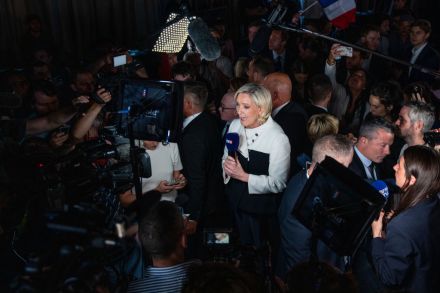
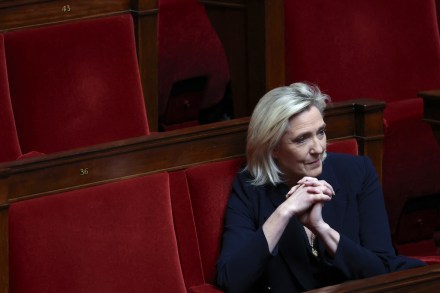
Marine Le Pen’s National Rally – formerly the National Front – is expected to triumph for a third time running in the European elections this weekend. The party topped the poll last time, in 2019, and in 2014. But its principal candidate, five years ago and today, is not the 55-year-old Le Pen but the youthful Jordan Bardella, whose story tells us a lot about the changing nature of the French right. The son of Italian immigrants, Bardella, 28, grew up on a housing estate in Seine-Saint-Denis, an impoverished area north of Paris. While Le Pen appeals to the middle-aged electorate, Bardella is the star attraction for younger voters. French politics is dominated by the bourgeoisie and Bardella is unusual in that he is working class.

Who will my wife marry next?

From our UK edition

Since I had a brush with death a couple of years ago, I have often wondered who my far younger wife, Carla, might marry after she has buried me. When I was out for the count in intensive care in Ravenna, the hospital’s duty priest, an Argentinian, even administered the last rites. ‘They do it just in case these days,’ Carla told me, as if it had all been a bit of a laugh, which I suppose it may well be if you believe, like her, that death is the prelude to eternal life. The other day, a herd of donkeys came charging into our garden out of the blue and I soon put two and two together They belonged to our nearest neighbour, Gianni, a farmer.

Why are French politicians obsessed with world war two?

From our UK edition

War talk is all the rage in France. The conflicts in Ukraine and Gaza are often cited, but the war that has come to increasingly obsess the political class in recent weeks is the one that began in 1939. Almost every day brings another reference to a period that barely anyone in the Republic experienced first-hand. The latest example was a radio interview on Tuesday morning between Marion Maréchal, Vice President of Eric Zemmour’s Reconquest party, and a journalist from France Inter, a radio station that describes itself as ‘progressive’. ‘What difference is there,’ the journalist asked Maréchal, ‘between the defence of the family that you propose and that proposed by Marshal Pétain?

France has become Europe’s Wild West

From our UK edition

New Caledonia must not become the ‘Wild West’ declared Emmanuel Macron last week during his flying visit to the Pacific Island. For two weeks the indigenous people, the Kanaks, have been in revolt against a voting reform they believe will marginalise them. The French President’s visit achieved little. Not long after Macron’s departure an insurgent was shot dead by police. Seven people have been killed in the unrest and the material damage is estimated at more than one billion euros. It is not only the Overseas French Territory that is in danger of resembling the Wild West. Mayhem has become a characteristic of Macron’s France, and rarely does a week pass without an act of barbarity. On Sunday afternoon in Lyon a man with a knife wounded four passengers in the metro.

d-day memorial day

This Memorial Day, reflect on your freedom

Last summer, I spent some time in and about Port-en-Bessin-Huppain in Normandy. The little fishing village and its surrounding towns on the English Channel (“La Manche,” “the sleeve” en français) is delightfully picturesque in that rugged, elemental way that proceeds from the collision of tempestuous sea and commanding headland. Expansive fields of corn and other crops ripened fast, orderly in their serried, midsummer ranks. Orange-red poppies punctuated the grassy, flower-strewn verge and complicated the landscape, heavy with age and history. Poppies are for remembrance — and there’s a lot to remember in these parts.

Cannes 2024: the highs and lows (so far)

Although this year’s Cannes Film Festival hasn’t concluded yet (it runs until this Saturday), there is a general sense that the true talking-point pictures have been frontloaded into the opening week, both in competition and out of it. Without doubt, the one that has attracted the most attention is Francis Ford Coppola’s sci-fi epic Megalopolis, which premiered last Thursday to a mixture of outright scorn and bemused but respectful appreciation, all of which suggests that, although it still lacks a US distributor, it will keep making waves upon its release later this year — although the chances of Coppola regaining anything like his $120 million investment are slim, to say the least.

demi moore cannes

Is Europe ready for Trump 2.0?

The 2024 presidential race between Joe Biden and Donald Trump is a dead heat. At most, a few percentage points separate them in the polls. Thousands of miles away, however, European leaders are operating as if Trump has already won, not wanting to be caught flat-footed yet again. When Trump defeated Hillary Clinton in 2016, European officials scrambled to establish contacts with the incoming administration. This time, the same wonks are proactively reaching out to Trump-friendly lawmakers and think-tankers, not only to understand what Trump’s foreign policy would look like in a second term but to press their own priorities. The Europeans, of course, are right to be worried.

Trump
Normandy

On D-Day at eighty

Traveling to Normandy fourteen years ago, we encountered a rare guide. He was a middle-aged Frenchman native to the neighborhood. I do not recall how long he had been at it, but he had learned something important about the guide business that was evident the day he shepherded us, and another American woman and her teenaged daughter, about the places made famous before any of us were born. He knew when to show, when to tell and when to relate something from his own experience that would enlighten ours. He took things in a certain order, which was not the order I would have guessed. First we stopped at the German cemetery at La Cambe, where 21,200 of the some-80,000 German soldiers who died in Normandy are interred. I remember few other visitors.

Oradour

A terrible tale of a French village

The new prime minister of France, Gabriel Attal, has promised to “take care” of Oradour-sur-Glane. The village, in west-central France, was the scene on June 10, 1944, of an infamous Nazi massacre of 643 men, women and children, shot or locked in the local church and burned alive. Only six villagers escaped to tell the tale; the last of them died in 2023. For years Oradour-sur-Glane has been a site where schoolchildren were taken to learn about what France endured during World War Two. Recently the abandoned village has become overgrown with vegetation, but with the eightieth anniversary this summer, the descendants of the victims are making sure they are not forgotten.

Must Paris reinvent itself?

From our UK edition

In this odd book, the Financial Times columnist Simon Kuper narrates his experience as an expatriate ‘uptight northern European’ living in Paris with his family. His American wife, Pamela Duckerman, also a journalist, is the author of Bringing Up Bébé, a culture-shock memoir about having children in Paris and discovering French child-rearing ways, which are often radically at odds with American ideas and habits. Impossible City touches on some of the same territory (Kuper’s French acculturation through his children’s schooling and socialising), but it aims at a more comprehensive portrayal of rapidly evolving 21st-century Paris, warts and all; or, as he puts it, in a phrase that some may find a little crude, running the gamut ‘from croissants to terrorists’.

Germanophobia is growing in France

From our UK edition

There was a time earlier this century when few politicians in France would dare criticise Germany. The country was the powerhouse of Europe and Angela Merkel was the de facto president of the continent. Today there is political mileage to be had in attacking Germany, and the assaults have increased this year as campaigning intensifies ahead of June’s European elections. Relations between the two countries are at their lowest ebb in decades In an interview last week Marion Maréchal, the European candidate for Eric Zemmour’s Reconquest party, said that as far as Germany is concerned, ‘France is looking more and more like a battered wife who can't manage to leave her husband... I think France needs to start looking at things differently’.

What we owe to the self-taught genius Carl Linnaeus

From our UK edition

Carl Linnaeus and Georges-Louis Leclerc, Comte de Buffon were both taxonomists, born in the same year (1707), but apart from that they had little in common and never met. Buffon was French, Linnaeus Swedish. Buffon was suave, elegant, tall and handsome (Voltaire said he had ‘the body of an athlete and the soul of a sage’), whereas Linnaeus was a bumptious little man (under 5ft), who was widely regarded as uncouth. Buffon’s funeral was attended by 20,000 mourners but Linnaeus died almost forgotten, after suffering from a brain disease for 15 years. Yet the Linnaean system of taxonomy has survived much better than Buffon’s, which was hardly a system at all.

Adrift on the Canadian frontier: The Voyageur, by Paul Carlucci, reviewed

From our UK edition

At the core of Paul Carlucci’s debut novel is a protracted medical experiment conducted by one human on another. Set on the Canadian frontier of the 1830s and inspired by historical record, the book takes the strange case of Dr William Beaumont’s tests on Alexis St Martin’s digestive system and spins a marvellously dark yarn around them, exploring the uses and abuses of an innocent. Alex is the innocent in question – the voyageur of the title. Our journey with him starts in raw boyhood, finding him living at the back of a Quebec harbour storehouse. His mother is dead, his beloved petit frère also. His grief-stricken father has sailed back to France, promising to return with enough earnings to start their dreamed-of peach orchard.

Macron vs Putin: this summer’s Olympic battle

From our UK edition

Dixmont, Yonne Last summer, Emmanuel Macron lashed out at France’s constitution because it prevents him from running for a third consecutive term in office. It is, he told his entourage, a ‘disastrous stupidity’. The majority of the French people would disagree. Macron’s approval ratings are dire, and a poll at the start of this month revealed that the youngest president in the history of the Fifth Republic has the support of only 7 per cent of the under-35s. Should anyone be surprised? Immigration is out of control, farmers have marched on Paris and teachers are at the end of their tether because of classroom intimidation. Anti-Semitic acts have surged since Hamas attacked Israel in October and drug cartels are extending their reach into towns and cities.

Letters: the real problem with a Labour super-majority

From our UK edition

Good trade-off Sir: I applaud your excellent editorial (‘Trading in Falsehoods’, 6 April) – a succinct and insightful essay on the role of Great Britain in the abolition of slavery and the slave trade. All are agreed that slavery in any form was and is reprehensible. As a white and proud Barbadian, initially educated there, I contend that some of my ancestors, who were probably slave owners, did not believe that they were involved in anything immoral or sinful, but were serving the economic interests of the Empire as they saw it at the time. You rightly point out that the huge cost in treasure and lives incurred by Britain and the Royal Navy in ending the slave trade is largely ignored.

The plot to bring down Emmanuel Macron

From our UK edition

Last week Emmanuel Macron inaugurated the Olympic aquatic centre that will host the swimming and diving events at this summer’s Paris games. The President was delighted with what he saw, boasting to the press pack that the centre is ‘exemplary from an environmental point of view’. Macron’s party expect the Republicans to make their move in the coming weeks. Unfortunately, from a financial point of view, the centre is anything but exemplary. The initial estimate in 2017 was that the centre would cost €70 million to construct, a figure that was soon revised to €90 million. the final expenditure was €188 million. It is not just the Olympic aquatic centre where French budgeting has gone awry. The Republic’s accounts are a mess.