Feminism

Meeting Margaret Cavendish

In the spring and summer of 1667, London began to see some odd goings-on. Seven years after the restoration of King Charles II to the throne — after England’s republican experiment under Oliver Cromwell ended in 1660 — and one year after the Great Fire had laid waste to the city, things were rather tense: the second Anglo-Dutch war was under way and, by the end of June, there would even be the fear of a Dutch invasion making its way up the Thames. But oddly, it wasn’t wars, invasion threats or geopolitical goings-on that caused the great and the good of London society to exchange frantic missives. At the beginning of April, a young man-about town wrote a rollickingly bizarre letter to his father.

The death of royalty

From our UK edition

The cohorts of Hamas have invaded my neighbourhood. I was walking my dog, Maxi, in the afterglow of a shower that had lit the pavements with a pearlescence you normally see only in the piazzas of Syracuse, when I paused to look at the posters of kidnapped Israelis that someone had hung opposite Gail’s. I was thinking that I should have brought flowers, when they were upon us. Two women, their faces slack with the stupidity of hate, started tearing at the sad tributes with their carmine fingernails, screaming obscenities about Israel and the Jews. I didn’t know what the etiquette was on occasions like these, so I picked up Maxi, whose ears were back, and shouted obscenities at the women as they disappeared into the night like monstrous beetles.

The new wave of woman hate

It was in the late 1990s, during then-President Bill Clinton’s scandal, when I first concluded that neither major political party actually cared about women. I watched — in horror — as the Democrats downplayed the allegations and defended Clinton’s actions rather than fully supporting Monica Lewinsky. Republicans exploited her testimony in order to discredit and weaken the president. Both parties used her to advance their own agendas at the expense of Lewinsky’s dignity and well-being. While the adults around me were concerned with the political fanfare, I only saw a young woman caught in the crossfire, enduring public scrutiny, humiliation and personal trauma while the media feasted on the spectacle.

woman

Set in a silver sea: the glory of Britain’s islands

From our UK edition

Islands always intrigue, hovering on the horizons of our imaginations – seen, according to your lights, as territories to be taken, ancient redoubts, repositories of secrets, even loci of lands of youth. Where there are no islands, we often imagine them – Plato’s Atlantis, the Celts’ Avalon, the Irish Hy-Brasil, Zeno’s Friseland, Columbus’s Antillia – and occasionally find them, like Terra Australis Incognita, postulated long before Europeans made landfall. Orkney was a trading station long before London, and Iona was the epicentre of Celtic Christianity Britain was once itself an imagined island – or rather islands plurally, called by Pliny Britanniae, one archipelago among others in the great geographer’s speculative world atlas.

White feminists are finding new problems with motherhood

Do you ever wish that your young children would stop asking you questions, constantly touching your body and being needy for your love and attention? That’s called being “touched out,” a new-age expression for the Extremely Online mother who can’t seem to reconcile with the idea that her life is going to be different after she has children. It’s also the title of Amanda Montei’s memoir-cum-cultural criticism on how modern motherhood in America is indistinguishable from the pervasive rape culture that permeates every aspect of a woman’s life in the country, including marriage, the workplace and yes, parenthood. Montei’s revelations about motherhood came to her after #MeToo took off.

Once Upon a One More Time is pat, prepackaged feminism

Britney Spears has always been mired in narrative, created by her managers, fans and the media as much as by herself. She has been, at different times, a virgin pop princess; a mega-stadium pop queen; a “cheating” girlfriend (on Justin Timberlake, no less — a falsehood drummed up by the tabloids); a girl gone off the rails; a mother; a “bad” mother suffering a mental health crisis. More recently, as interest in Spears has grown following her emergence from a thirteen-year legal conservatorship, the story is simpler: she was lost and now she is found. A victim and a hero. This summer another label got added to the list: feminist cultural icon with a legacy to protect.

spears

The glory of Paris has long past

From our UK edition

Gstaad A reader’s inquiry as to why I think Paris belongs to yesterday (12 August) has me remembering times past. When did the party end? According to many night owls it was when the ‘Queen of the Night’, Regine, shut down her club New Jimmy’z and moved to London in the 1970s, where she flopped. Others believe it was ‘les événements de soixante-huit’, the student-worker revolt against De Gaulle that did Paris in. Certainly, any way one looks at it, the events of 1968 did signal that the party was over; and it has stayed over ever since. Mind you, the high jinks had been waning for some time. I first arrived in Paris as a tennis player in 1957, but moved permanently to the City of Light on November 11 1958, Poppy Day. The place was jumping.

Will Orthodox Judaism accept female rabbis?

Bracha Jaffe, an American-Israeli, spent decades working in tech, focusing on software development and raising her family in Israel. But following a midlife career shift and a move to New York, she now also works as an assistant rabbi at the Hebrew Institute of Riverdale, a large Orthodox synagogue in the Bronx. Every day, she plays a key role guiding congregants during life cycle events, such as births and deaths. She teaches classes and visits the sick. “I think it’s still true that when someone says ‘Rabbi,’ what comes to mind is an older male, perhaps with a white beard,” she says. With her blonde bob, ever-present smile and warm demeanor, Jaffe is a far cry from this stereotype.

orthodox judaism

Dear Mary: how can I make my untidy twin look better? 

From our UK edition

Q. I have a public profile and have always looked after my personal presentation, but my identical twin has never bothered with hers. She wouldn’t dream of covering up the broken veins on her cheeks and her hair is quite grey and frizzy. Now I’m getting married and worry that my sister’s appearance could cause some of the clients I’ve invited to rethink my ‘relevance’. What should I do, Mary? – Name and address withheld A. Explain to your twin that after you had paid for a hair and make-up artist for the wedding, you came under pressure from a colleague whose hair and make-up-artist daughter could get urgently needed publicity from working with you. Would your twin mind taking the other appointment? It seems a shame to waste the money.

Dear Mary: should I ever pay for dinner on a date with a feminist? 

From our UK edition

Q. I took a girl out for dinner last week to a rather expensive restaurant. At first we got on well but then the conversation went on to politics and I spent the next 45 minutes listening to a fourth-wave man-hating feminist. Despite her stance that women should share every opportunity that men have (which I agree with incidentally), when the bill came she didn’t even gesture to put her hand in her pocket. Was I right to be so annoyed? – N.F., London SW7 A. I ran this past another fourth-wave feminist. Her view was that the girl’s ideology was not incompatible with your paying for her dinner on the grounds that ‘he probably suggested the restaurant and he is probably on a much higher salary than she is’.

A feminist finds fulfilment in derided ‘women’s work’

From our UK edition

Marina Benjamin writes with a frankness, depth and wisdom that recalls the self-exploratory but world-revealing essays of Michel de Montaigne. In A Little Give, she turns her exacting philosopher’s mind, and opens her capacious heart to, her own life. Her essays, Tardis-like in their complexity, depth and range, scrutinise what has made and unmade her feminism, and then enabled her to make anew the feminism that has given her life both its personal and political trajectory: While I’ve never stopped identifying as a feminist, I am less and less certain what it means to live as one. I don’t mean how to organise and mobilise collectively. I mean simply how to be.

The shock of the new in feminist art

From our UK edition

Lauren Elkin begins her book about bodily art with a charming ode to the punctuation mark that she in American English calls a ‘slash’ and we in British English call a ‘stroke’. She likes the way it expresses ‘division yet relation’. Brings disparate things together. Makes space for ambiguity. Blends and blurs. And/or. She writes: The slash is the first person tipped over: the first person joining me to the person beside me, or me to you. Across the slash we can find each other. Across the slash I think we can do some work. That work begins in Art Monsters with a lively and vibrant account of feminist art that articulates the everyday experience of having a body.

The surreal life of Leonora Carrington

"It’s the belief that nothing is ordinary, that everything in life is extraordinary. And being old is no more, no less, extraordinary than being young.” When the artist and writer Leonora Carrington was asked in 2006 what “Surrealism” meant to her, this was her reply. It was a remarkably frank statement from an artist who had, at other points in her career, declared that she “was never a Surrealist,” even memorably asserting that the Surrealist link between women (the femme-enfant) and the muse was “bullshit.” Perhaps it owes its frankness to the interviewer: sitting across the kitchen in Carrington’s house in Mexico City was her cousin, the journalist and author Joanna Moorhead.

carrington

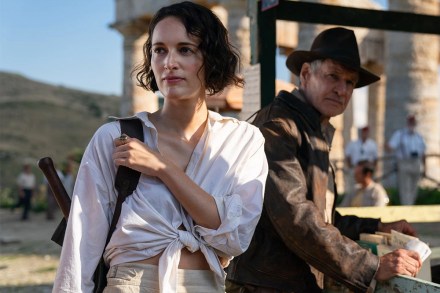
Phoebe Waller-Bridge is a franchise murderer — and Indiana Jones is her next victim

Phoebe Waller-Bridge must be destroyed before it's too late. The short-bob comedienne fond of wall-breaking and lazy edits has, in very short order, emasculated and destroyed multiple franchises thanks to the overwrought praise for her adaptation of her one-woman show, a descriptor that should itself elicit a bit of vomit in the back of the throat. Not content to politicize Star Wars as an irritating droid in Solo or to chop off the balls of James Bond in Daniel Craig's swan song whose name no one remembers, Waller-Bridge has now set her sights on a firmly American man to take down: Indiana Jones, whose fifth edition box office she will eradicate in spite of all the goodwill of these United States. https://twitter.

phoebe waller-bridge

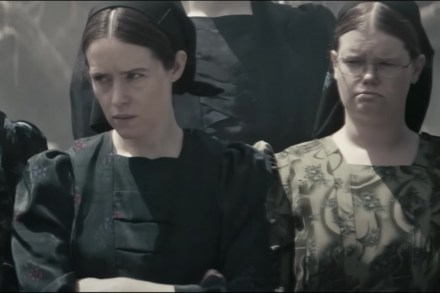
Women Talking bludgeons itself with its message

Sarah Polley’s Women Talking begins with a genuinely bone-chilling premise. Within a remote Mennonite “colony,” the women find themselves awakening from drugged slumbers, bearing the marks of violent sexual assaults in the night — blood, bruises, and mysterious pregnancies. Who’s responsible? Based on the promotional material, I expected this to be a story about secrecy and community. And that would be a very compelling story: women trapped in isolation form whisper networks among themselves, which finally reveal their common experience and allow them to bring their attackers to justice. Thematically, this would get at the intractability of human evil, even within “intentional communities,” and the harms of a subculture that treats bodies as shameful.

The shock and awe-inspiring art of Iraq

The road from Erbil consists of one large, tarmacked lane, no separation marks, no shoulder, despite seemingly never-ending ascents and descents and a barrage of trucks carrying huge oil tanks. As soon as the mountains of the Iranian border appear, the cars form a bottleneck into Sulaymaniyah, the “cultural capital of Kurdistan.” It leads to a maze of circular streets, where finding anything — let alone an old tobacco factory turned arts center — becomes a challenge, even for two journalists armed with Google Maps and a local fixer. Yet after some circling, a phone call, a bit of translating and the opening of two twelve-foot, light-beige metal gates, the artist Tara Abdulla appears, smoking a cigarette.

Where Jeanne Dielman went wrong

In the era of boring Hollywood-Marxist blockbusters like Avatar: The Way of Water, it’s quite refreshing to see Jeanne Dielman, 23, quai du commerce, 1080 Bruxelles, a half-a-century-old masterpiece of European art cinema, proclaimed the best movie of all time by the 2022 Sight and Sound poll. Chantal Akerman’s 1975 film reached the top after a long delay, thereby confirming the fact that each present era retroactively rewrites its past. Jeanne Dielman is fourth in the series of Sight and Sound's best films, preceded by Eisenstein’s Potemkin, Welles’s Citizen Kane and Hitchcock’s Vertigo. The film’s triumph is, of course, the result of a well-planned campaign to promote a woman to the top position.

jeanne dielman

Of course: all the great women in history were actually men

One of the great, pesky questions of human history has finally been answered. For thousands of years , as we all know, most great accomplishments were the works of men. But now and then there was an outlier, a woman doing great things. Esther in the Bible, Joan of Arc or Elizabeth I of England. It made no sense — but today, thanks to the tireless work of gender studies departments we know the truth: those weren’t women at all. They were actually men. This weekend we had further confirmation of this revelation from the New York Times which ran a piece revealing that Louisa May Alcott, author of Little Women, was a trans man. We know this because sometimes Alcott went by “Lou” and mentioned having a “boys' spirit.” I’m sold.

louisa may alcott women

Confessions of a Sight and Sound voter

As a film critic and historian who's written for Sight and Sound since 2011, I like to think that the greatest films of all time are always on my mind, but, in truth, they were particularly on my mind last summer. Last July, I received the official word that I was among the select group of critics picked to partake the Sight and Sound critics' poll to decide the greatest films ever made; a survey the British magazine first convened in 1952 and has repeated on a once-per-decade basis ever since. In the weeks before my deadline to vote, I meditated on what constituted a great film with unusual intensity and self-reflection.

sight and sound

Who needed who most? The complex bond between Vera Brittain and Winifred Holtby

From our UK edition

These letters between Vera Brittain and Winifred Holtby cover 15 years of a remarkable friendship that began at Somerville College, Oxford in 1919 and ended only with Holtby’s premature death from kidney failure in 1935. Brittain went up to Oxford in 1914, but left to serve as a nurse in the first world war. She returned freighted with tragic experience, having lost both her lover and her brother and tended the wounds of horribly injured soldiers close to the front. She disconcerted younger undergraduates with her fiercely competitive and forthright views combined with fragile looks and a general air of suppressed trauma.