Someone rid us of these ridiculous trousers!
From our UK edition
I think that we have reached the peak of the red trouser craze. A well-heeled reader sends this snap (above) from Ascot this weekend. Mr S passes it on without comment...
From our UK edition
I think that we have reached the peak of the red trouser craze. A well-heeled reader sends this snap (above) from Ascot this weekend. Mr S passes it on without comment...
From our UK edition
[audioplayer src="http://traffic.libsyn.com/spectator/TheViewFrom22_24_July_2014_v4.mp3" title="Mark Mason and Ed Cumming discuss whether wearing sunglasses 24/7 should be the preserve of the mafia" startat=1392] Listen [/audioplayer]A question to ask yourself on sunny days: are you, as you conduct your conversations with people, trying to convince them that you are Laurence Fishburne in The Matrix? You’re not? Then will you please take off your sunglasses? Hardly anyone does these days. For whatever reason, it seems to have become acceptable over the past couple of years to engage in social intercourse with the upper half of your face entirely concealed behind several hundred quid’s worth of metal and glass.
From our UK edition
Those of us who have been struggling to endure the recent heat should turn to L.P. Hartley’s classic coming-of-age novel The Go-Between for some advice. ‘There’s no such thing as bad weather, only unsuitable clothing,’ Alfred Wainwright wisely said, and L.P. Hartley’s young Leo couldn’t have agreed more. He arrives at his friend’s smart country house without summer clothes and, as the mercury soars, suffers in his Eton collar, Norfolk jacket, breeches, black stockings and boots. ‘You are looking hot,’ everyone tells him, until at last Marian — the daughter of the house — takes him shopping for a cooler suit.
From our UK edition
So far, I am disinclined to vote for Ukip in the forthcoming Euro-elections. Our area has been represented for many years by the great Daniel Hannan, the leading practising Eurosceptic of our times, so I have resisted the Faragiste temptation. But I felt a bit wobbly after reading an interview with Nigel Farage in the Guardian. According to its author, Decca Aitkenhead, Ukip supporters — though not the libertarian Nigel himself — want to make dressing up for the theatre compulsory. They are so right. It is now almost compulsory not to dress up for the theatre, even in the West End. This has had the predictable result that theatre-goers pay less attention, eat and send texts all through the performance.
From our UK edition
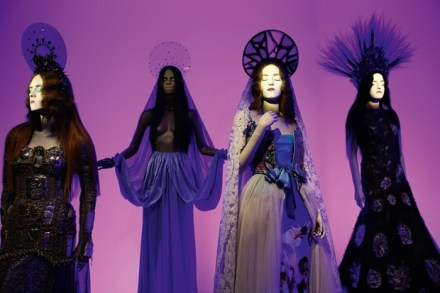
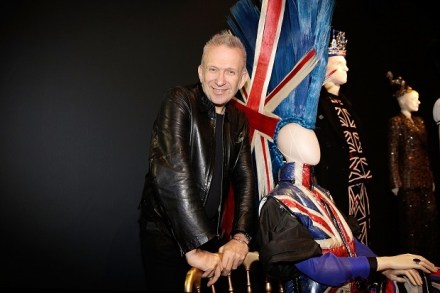
‘London,’ says Jean Paul Gaultier, ‘was my vitamin. I love the freedom of London...The energy, the character, all the people that are different.’ It was perhaps inevitable, then, that the first major exhibition of his work should come to the city that so inspires him. From the moment you enter the Barbican, you are struck by the sheer energy of Gaultier’s designs. He’s called the enfant terrible of fashion, and his amazingly imaginative works — from tribal feathered headdresses to bondage wear and men in skirts — demonstrate why. Gaultier has become most famous for his love of pop culture: from punk mohicans to Amy Winehouse, his influences are obvious.
From our UK edition
If the French are flocking to Britain, it's not just down to a 75 per cent tax hike on the super-rich. Multi-millionaire designer, Jean Paul Gaultier comes to the UK for a different reason. “The British have a lot of connection with the sexual, which is something that I appreciate. None of this ‘No sex- we are British.’ It is more like ‘A lot of sex- we are British!’” The designer, who opened a retrospective exhibition in the Barbican this month, told Mr S that the French are “snobbish” and he comes to London to “to have fun”. “Britain represents iconoclastic creativity, individuality - things that we don’t know so much in France.” Tax that President Hollande.
From our UK edition
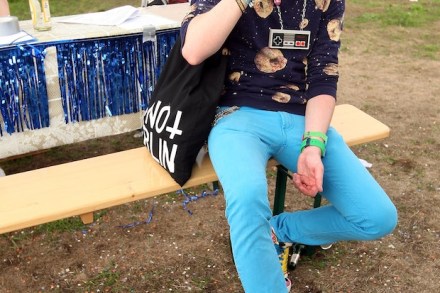
I can see one now. (They’re hard to miss.) Face the colour of mayonnaise, Gameboy dangling from one ear, gerbils for shoes, an alpaca for a hat, glasses the size of a window frame. It’s what we call in the profession an arse. Don’t mock him. Hold that snigger. He may be an arse, but he's a important arse. A vital member of our community. An engine room of creativity. Future fashion norms – norms that you and I will take for granted – will be developed and stabilised by this sad, desperate, sex-starved arse. Like Jesus, their sacrifice is for mankind. Ridiculed, jeered at, shunned, they must forgo the possibility of making friends, getting laid and meeting anyone without them laughing their face off.
From our UK edition
People will go to extraordinary lengths to get into a nightclub. Nowadays you must wear something tight, and look slinky. But, as Club to Catwalk: London Fashion in the 1980s at the V&A shows (until 16 February), a handful of Eighties doormen were into something a bit more deviant. The combination of a new London Fashion Week, a vibrant club scene and a coterie of ambitious designers emerging from the London art schools was potent. On Thursdays and Fridays, St Martin’s was deserted. Everybody was at home working on their costumes for the weekend. Over two floors, a mixture of clubbing outfits and catwalk designs are showcased. There is a mirror with the slogan ‘Would you let you in?’ stamped across it.
From our UK edition
I recall a male friend telling me about an encounter he once had with Bindy Lambton, the eccentric estranged wife of the late Lord Lambton. They had been to the same party and it was snowing outside. ‘Would you mind coming home with me?’ she enquired. ‘I’m not propositioning you. I’m too old. It’s just that I need someone to undo the back of my dress'. On asking how she managed to undress when alone, Lambton answered breezily, 'I go out on the street , hail a taxi and ask the driver to unzip me. But it’s too cold to do that tonight.’ Oh, the perils of dressing, and undressing for parties, particularly during what is called the festive season.
From our UK edition
There is no better measure of the pivotal importance of 1963 than to recall what Britain was like in the early 1950s, as we slowly emerged from the shadows of the second world war. The great Labour experiment of 1945 had petered out in a grim slog through years of austerity and rationing. With Winston Churchill back in No. 10, life had begun to crawl back to ‘normality’. Conservative values ruled: respect for tradition, discipline and authority. The old class structure still stood. No extramarital sex or homosexuality. In the cinema we were entertained by cosy Ealing comedies and films portraying the ‘stiff upper lip’ spirit which had won the war. Pop music, hardly ever allowed on the BBC, centred on crooners such as Frankie Laine and adaptations of folk songs.
From our UK edition
The most extraordinary thing about the scandal of Unite at Grangemouth and in Falkirk is how long it took the outside world to notice. Partly, this is an effect of devolution: almost nothing Scottish is now considered news in London, even if it is of kingdom-wide importance. Partly, it results from the loss of media and political attention to trade union affairs. So successful was Mrs Thatcher in taming union political power that newspapers laid off the labour correspondents who, in the 1970s and early 1980s, had been the aristocrats of the news room. As for the Tories, they have forgotten the Cold War arts of keeping dossiers on subversion.
From our UK edition
‘This’ll make you laugh,’ said my husband, sounding like George V commenting on an Impressionist painting. ‘Someone in the Telegraph says that the French shouldn’t borrow English words.’ Once I had managed to wrest the paper from his dog-in-the-manger grasp, I found it didn’t quite say that, but rather that foreigners ought not to plaster advertisements and clothing with English words if they didn’t know their meaning. I had been thinking something similar. The example that had been annoying me was the name of a medium-trendy Spanish clothing chain, Pull & Bear, which has been spreading over Spain like Chalara fraxinea in England. At first I thought it was meant to be a pair of invented surnames.
From our UK edition
The moment that a Downing Street spokesman recommended wearing a jumper to reduce high energy bills, you knew that two things would happen. As sure as night follows day, the Labour leader spun a line criticising the ‘out of touch government’: Their crime policy used to be ‘hug a hoodie’. Now their energy policy appears to be ‘wear a hoodie’ - @Ed_Miliband — Labour Press Team (@labourpress) October 18, 2013 Then the internet spent Friday afternoon in stitches: Cameron heard about #jumpergate whilst in his car. Pull over!
From our UK edition
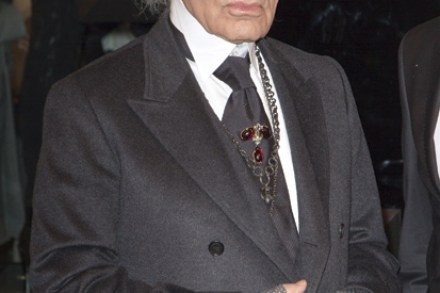
Every fashion era has its monster and in ours it’s Karl Lagerfeld, a man who has so emptied himself on to the outside that there is no longer any membrane between what he is, what he does and what he looks like: a macabre dandy for the electronic age, a Zen businessman as effective as Andy Warhol or Michael Jackson or David Bowie in propagating product and persona as one. ‘I enjoy the luxury of being at the centre of this complete universe that’s mine,’ he says with the concentrated generosity of a narcissist who wants to thrill the whole world in order to make it his pool.
From our UK edition
Marketing types are desperately jostling for a piece of the action at London Fashion Week, which starts at the end of the month. Take an irony-free press release trying to flog ice cream off the backs of catwalk models. This is not any old ice cream but ‘the world’s first protein ice cream’, inspiringly called ‘Wheyhey’. The blurbers say that Wheyhey ‘will be keeping sweet-toothed models and fashionistas satisfied’. Given that it apparently contains no fat, no sugar and the same amount of protein as a small chicken breast, Mr S has his doubts about that. Most of these ‘sweet-toothed’ yet stick-thin models could do with a box of Krispy Kremes; but Wheyhey appears to have got the stamp of approval.
From our UK edition
Is this the end of business attire? The slow degradation of the standard issue suit has reached the Institute of Directors — the Pall Mall-based bastion of all things business. Its website says that members should ‘make the decision on what they would normally wear to do business, as long as it is not deemed indecent.’ So, what does that mean? ‘Members will be permitted to wear jeans, T-shirts, shorts and all variants of footwear. There is a very mixed view about the dress code and this will be for a trial period of 3 months.’ The trial is advanced: my mole says that there have been at least seven noted ‘incidences’ of short-wearing, which sounds positively Californian.
From our UK edition
Topless men. What does that mean, then? I was opposite one on the tube the other day, heading north from Finsbury Park, and I just couldn’t stop -staring. In terms of sheer comfort, I was quite jealous. There was me, sweating in my shirt and suit trousers, and there was him, open to the air in shorts and nothing else. He was sweating too, of course. As I watched, a rivulet of the stuff ran from his neck and through the thicket of his chest to hang as a globule from a thatch of hair above his right nipple. Frankly, that globule made me anxious. Any moment, I knew, our train would burst into the overland sunshine of Arnos Grove and I feared it might function as a lens, perhaps even setting him alight. Men are stripping off.
From our UK edition
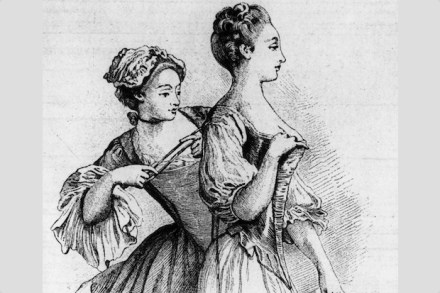
The key thing in 18th-century France was to get the hair extremely high. Perching on a small ladder behind his client, a Parisian hairdresser could pull off all sorts of engineering feats. Once the hair was three foot in the air, the coiffeur could add props — ribbons, shepherdesses, feathers, mythical allegories. After a French naval victory in 1778, some of the more patriotic women took to sporting a ship riding on the waves of their hair. Extravagance was frowned upon after the Revolution, but innovation continued; some ladies of fashion took to wearing their hair very short like the hair of those condemned to the guillotine. The style was called ‘à la victime’.
From our UK edition
Doesn’t it all seem a long time ago? For years, the 1960s remained a key cultural reference, universally understood. But then, at some point, probably around the turn of the millennium, the Eighties took over and the Sixties began to fade into a psychedelic version of 1920s sepia. The two periods, separated by the shame and loon pants of the Seventies, were both about being young and “cool”. They were also about being bang up-to-date and liberated from “old” thinking. And, in the way of things, both have aged badly. The Mods of 1960s Britain were a social movement wrapped up in a fashion statement. Modernism, by contrast, is timeless.
From our UK edition
Over 80 and almost blind, Diana Vreeland was wheeled around a forthcoming costume exhibition at the Metropolitan Museum, issuing instructions all along the way about hats, shoes, lights and mannequins. She seemed, recalled the writer Andrew Solomon, an impossible old lady who couldn’t let go of her control and who was making everyone’s lives miserable for no good reason. And they did everything she’d said, and it was transformed. Her nearly sightless eyes could pick out things my youthful vision could not; enfeebled, she was still supreme at the discipline of chic. From childhood, Diana Vreeland had operated with deep faith in the power of self-presentation.