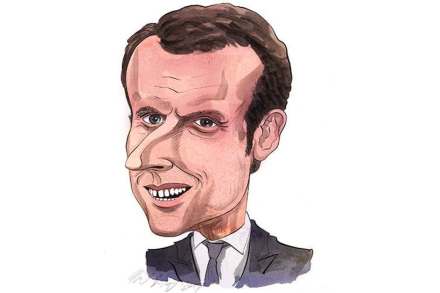
Emmanuel macron

Emmanuel Macron is wrong to think his election victory is a foregone conclusion

From our UK edition

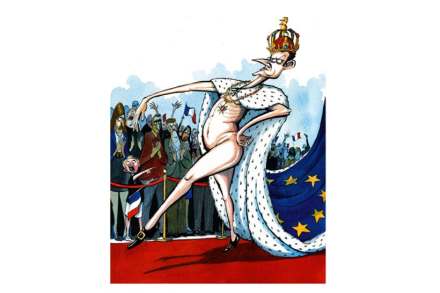
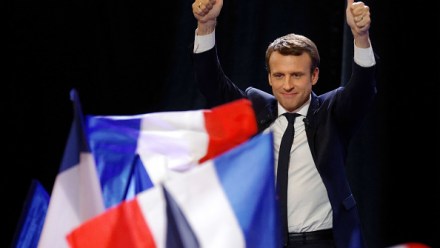
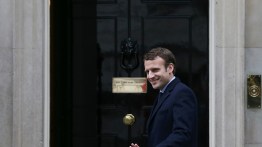
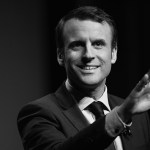
France is in a flap and Emmanuel Macron is to blame. On Sunday evening the En Marche! leader looked for all the world like a man who believed he'd already been crowned king. Bounding onto stage with a wink, a wave and a smile to his adoring supporters, after his first round victory, he then partied the night away at a Parisian bistro surrounded by the great and the good of France's liberal elite. Marine Le Pen, meanwhile, after a brief speech to her supporters in the northern town of Henin-Beaumont, left to start plotting her second round campaign.

A little too perfect

From our UK edition

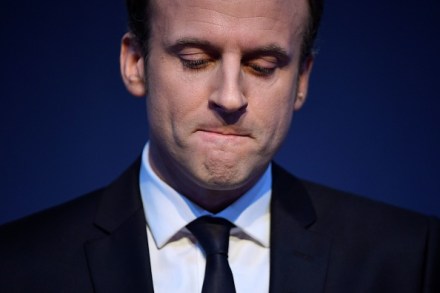
Emmanuel Macron is going to be the next president of France. I know people are saying Marine Le Pen isn't out of the race and it's important to keep the suspense going as long as possible. But I see no scenario in which the French will vote her into the Elsyée.  Le Pen's attempt to distance herself from the toxic National Front founded by her father, declaring herself an independent, just like Macron, is entertaining. But it will change nothing. The French may claim to be revolutionaries but they are terrified of change and Marine scares them. Avec raison.  So the serious questions are, who is Emmanuel Macron, the future president of the republic, and what should we expect from his forthcoming quinquennat?

What’s the matter with Macron?

From our UK edition

Coming out of a celebratory dinner at a Montparnasse brasserie after topping the poll in the first round of the French presidential election on Sunday, Emmanuel Macron had a brief brush with the press. A reporter asked: ‘Is this your Fouquet moment? This referred to a notoriously showy celebration by Nicolas Sarkozy at Fouquet’s restaurant after his own victory in 2007. The 39-year-old centrist was visibly cross. He simply wanted to thank his secretaries, security officers, politicians and writers, he said. Then came the dig. ‘If you don’t understand that,’ he said, ‘you understand nothing about life. I have no lessons to learn from the petit milieu Parisien.

Capping prices to win votes is no substitute for a serious energy strategy

From our UK edition

Is capping domestic energy prices an equitable way to help the ‘just about managing’, or an electoral gimmick with a whiff of anti-free-market ideology? When it was Ed Miliband’s idea, it was certainly the latter. Now it’s likely to be included in Theresa May’s manifesto, offering a potential £100 saving for millions of homes on ‘standard variable tariffs’, it is defended by the ever-plausible Sir Michael Fallon as a matter of ‘intervening to make markets work better’. And that, after all, is what the Prime Minister said she would do, wherever necessary, in the interests of fairness.

France wants a new saviour. Will it be Macron or Le Pen?

From our UK edition

After having given themselves and the rest of us a fright, France’s voters have, by a worryingly small margin, stepped back from the brink. Some polls indicated a possible victory for the two extremists, Marine Le Pen and Jean-Luc Mélenchon, either of whom would have meant disaster for France. Instead, the next President will almost certainly be the youthful centrist, Emmanuel Macron, the nearest to a viable establishment candidate. Though this is certainly a far lesser evil, it is evident that the political system of Europe’s oldest large democracy has gone spectacularly wrong.

Macron’s marriage shows how different Britain and France really are

From our UK edition

If Emmanuel Macron were British, would he be a Tory, Lib Dem or a Blairite? Or would he be blubbing into a handkerchief in a TV studio calling himself a ‘survivor’ of seduction by his teacher while his wife was banned from the teaching profession, if not put through the mill by investigators from Operation Yewtree? If anyone doubts the gulf in societal attitudes between Britain and France, the relationship between Macron and his wife Brigitte Trogneux provides a rather good illustration. While there is no suggestion they had sex while he was a minor, enough is known about the couple to know how the nature of their meeting would have gone down this side of the Channel.

What does Emmanuel Macron mean for Brexit?

From our UK edition

It was a badly kept secret in Westminster that very senior figures in the UK government wanted Francois Fillon to win the French presidential election. He was regarded as being the best candidate for Britain, and the one most likely to be pragmatic on Brexit. But with Fillon out, attention switches to Macron—the overwhelming favourite. Macron is emotionally and ideologically pro-EU. He has been clear that he doesn’t want a sweetheart deal for Britain. On his campaign visit to London, he talked aggressively about luring businesses to France post-Brexit.

Jean-Claude Juncker’s joy at Macron’s win shows the EU’s big problem

From our UK edition

Emmanuel Macron’s victory in the first round of the French presidential election is the good news the EU was waiting for. After Brexit and Trump, Brussels is delighted - so much so in fact that European Commission President Jean-Claude Juncker ditched the convention of staying out of ongoing elections by calling Macron a ‘pretty obvious choice’. But perhaps Juncker and his allies in Brussels would do well to take the hint from the millions of voters who backed anti-EU parties at the ballot box. Even from Dover, ‘you could almost hear the popping of champagne corks’ after Emmanuel Macron triumphed, says the Daily Mail. ‘In Brussels…the elation was unbounded,’ the paper says.

Is Emmanuel Macron doomed to be a lame duck President from the start?

From our UK edition

Emmanuel Macron is on the verge of becoming the youngest president in French history. If he is successful in defeating his far-right opponent, Marine Le Pen, it will also be the first time since 1974 that France elects a centrist president. But even in its early days, Macron's presidency will face a huge test: his En Marche! movement is still very much in its infancy and it is unclear whether it will morph into a full-blown political party before June's legislative elections. If it doesn't, one of the main questions that voters will have is whether Macron will be able to govern in the absence of a clear parliamentary majority.

Meet France’s answer to Nigel Farage

From our UK edition

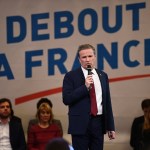
The success of Emmanuel Macron's 'En Marche', a party which is barely a year old, has taken some by surprise. But Macron wasn't the only alternative party candidate to do well in the first round of voting in the French Presidential elections. Nicolas Dupont-Aignan, or NDA as the French call him, is the leader of Debout La France - probably the closest thing in French politics to Ukip. The mayor of Yeres, a commune which sits in the suburbs of Paris, is firmly eurosceptic and anti-euro. For some, he is France's answer to Nigel Farage. And yesterday, he picked up 4.7 per cent of the vote - compared to 1.8 per cent in 2012.

An unlikely alliance of Communists and Catholics could yet spoil Macron’s coronation

From our UK edition

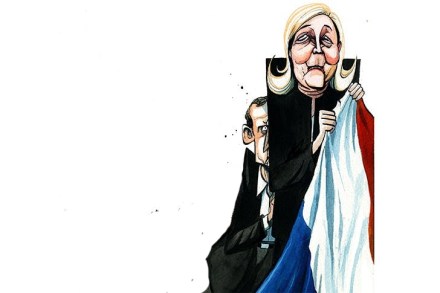
After their humiliation with Brexit and Donald Trump, the pollsters returned to form in France with their predictions of a Macron and Le Pen first round victory. If the polls are as accurate with their forecast for the second round, then the new president of France will be the centrist Emmanuel Macron. The 39-year-old is the overwhelming favourite. But nonetheless, there are reasons for the National Front to hope that they could still replicate the political earthquakes of 2016. For that to happen Marine Le Pen will have to attack Macron on two fronts with the purpose of attracting votes from both the far-left and the conservative right.

The real winner of the French presidential election? François Hollande

From our UK edition

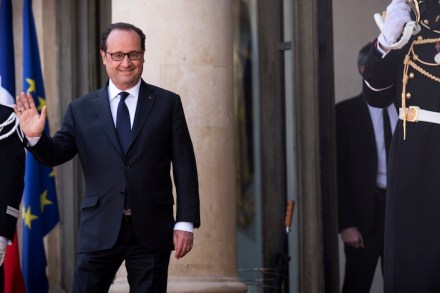
In the biggest comeback since Lazarus, French president François Hollande has installed Emmanuel Macron as his certain successor, with the collusion of the media, the magistrates and less than 25 per cent of the voters. If Hollande has been a terrible president, the result of the first round of voting confirms that he is a master political technician, with a specialty in dirty tricks. It seems impossible that he will now retire quietly from public life. Whether he will have an official role, or merely be a Svengali-like figure in the shadows of the presidency remains to be seen. One by one, obstacles to Macron’s succession were ruthlessly eliminated and Hollande’s fingerprints are everywhere.

Macron and Le Pen win first round of the French presidential election, exit polls forecast

From our UK edition

It's still rather a cheerful vibe at the French ambassador's residence in sunny Kensington this evening. The crowd here would have preferred the exit poll to show Macron and Fillon to go through, but they'll take Macron versus Le Pen, especially with Macron in the lead. There were sharp intakes of breath when Le Pen popped up on screen in second place. But Macron being ahead is good news as far as these Londoners are concerned. A huge number of French voters abroad turned out today – a good chunk of them in London, where people queued up outside the French Lycée in Kensington for up to three hours to cast their ballots. And French Londoners tend to be socially mobile, affluent types -- not the sort of people who vote for Le Pen or Melenchon.

Who will win the French election – and does it even matter?

From our UK edition

Who will win the French presidential election? Does it even matter? Nothing in the programmes or personalities of the leading contenders gives confidence that any of them can fix the Fifth Republic and the corruption, dysfunction and stagnation that it has inflicted on the French. At Marie-Trinité’s café in the southern French village where I am an elected councillor, the mood before the voting is one of weary resignation and disgust. Yet this election does matter, and it can make a difference, not only because all of the probable outcomes threaten to make things even worse, but because almost all of them have the potential to be particularly painful for Britain, whatever the result of our own election on June 8.

France’s deplorable election has unified voters in disgust

From our UK edition

I popped into the village pharmacy this morning with a prescription for valium. Not for me, I hasten to add, but for my epileptic dog. But I am sorely tempted to divert one or two doses for my personal use, as I prepare to help count the votes on Sunday night in the first round of the French presidential election. I do not think it is exaggerating to wonder if, on the eve of voting, the fifth republic is going to collapse with a bang or a whimper. It may not even be necessary to wait for the second round of voting in a fortnight. There is a scenario in which it could all start to fall apart as soon as Monday morning, if the leading candidates in the run-off are Marine Le Pen and Jean-Luc Mélenchon.

France braces itself for the backlash if Marine Le Pen triumphs

From our UK edition

With less than twenty four hours before polling booths open in France, the country's security forces are on full alert for another attack by Islamist extremists. More than 50,000 police and 7,000 soldiers have been mobilised as part of the massive security operation but they still lack the resources to safeguard every polling station. In Paris, for example, only 400 of the 896 polling booths will have security personnel on duty. But it's not just Islamists who are menacing France. The far left has called for a 'Night of Barricades' [a reference to the May demonstrations of 1968] to begin on Sunday at 6pm, to oppose what they describe as this 'masquerade of an election...between liberalism on the one side and fascism on the other'.

Jean-Luc Mélenchon is the dark horse in the French election

From our UK edition

The lovely Dordogne village of St Pompon that is my holiday hide-away has only 350 voters, but is a perfect predictor of presidential elections. It voted heavily for Jacques Chirac against Jean-Marie Le Pen in 2002, marginally for Nicolas Sarkozy against Ségolène Royale in 2007, and 59-41 for François Hollande against Sarkozy in 2012. So I’d love to tell you who’s going to win this time on the strength of the chatter at the Good Friday market. But the only national event the locals seemed interested in was a mountain bike championship just up the road.

Emmanuel Macron’s refusal to talk about Islamic extremism could cost him dearly

From our UK edition

Last night, an Islamic terrorist opened fire with an assault rifle on a police van on the Champs Élysées in Paris, killing one policeman and wounding two others before he was shot dead. Islamic State has claimed responsibility for the attack and according to the French newspaper, Le Parisien, the gunman was a 39-year-old called Karim C, also known as Abu-Yusuf al-Baljiki, who in 2003 had been sentenced to twenty years in prison for the attempted murder of three men, two of whom were policemen. At the same time as the police came under fire, Marine Le Pen was being interviewed on French television.

The Spectator Podcast: Election special

From our UK edition

On this week's episode, we discuss the two European nations that are are heading for the polls in the next couple of months. First, we look at Theresa May's shock decision to hold a snap election, and then we cross the channel to consider the French election as they get set to whittle the field down to just two. With British news set to be dominated until June 8th by election fever (yet again), there was no place to start this week but with the fallout from the Prime Minister's stunning U-turn on an early election. It's a gamble, James Forsyth says in his cover piece this week, but with a portentially enormous pay off. James joins the podcast along with Bobby Duffy from Ipsos MORI and Richard Angell director of Progress.