Ed miliband

What is the point of the modern Conservative party?

Who are the Conservatives? No, really, who are they and what do they stand for? Once upon a time – as James Kirkup points out in a typically astute post – we had a pretty decent idea about David Cameron. He was young. Polished. Presentable.  Dutiful. Unthreatening. Fiscally-conservative-but-socially-liberal. Modern (whatever, as Prince Charles might say, that means). Above all, he was neither Michael Howard nor Gordon Brown. Ah well. That was all a long time ago. Let sunshine win the day is the soundtrack to another era. Such are the trials of government. Time – and power – tarnish everything. What does David Cameron believe in now? He remains more popular

Will UKIP ever win?

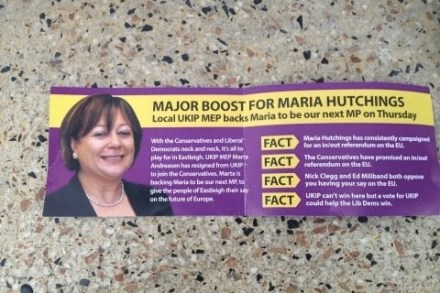
A couple of reflections upon Eastleigh. Firstly it was indeed an appalling night for Labour; midterm the party came second in this constituency in the early 90s. It received the votes a joke candidate might expect this time around. Maybe that’s because they put a comedian in the seat. I have no objection to John O’Farrell’s writing at all; but maybe one reason for Labour’s failure – and probably not the most important – was his candidature. He is the sort of thing London Labour loves; metropolitan, cool, ever so witty. Ever so PC. Does any of that play outside the M25? I don’t think so. And the result would

Eastleigh by-election: a bad day for Labour too

While the Tories are taking a public beating for their performance in Eastleigh, Labour also have little to be proud of. Despite the party currently floating around 11 points ahead of the Tories in the national polls, they only managed to add 0.2 points to their 2010 general election result and came in fourth place. Their candidate John O’Farrell blames voters being anti-politics, not anti-Labour. Either way, the result is disappointing for Ed Miliband. Although it was unlikely Labour would ever take the seat, the party still threw its weight behind a full campaign. Lord Ashcroft’s latest polling suggests Labour were putting in similar effort to the main contenders. 89

David Cameron sails through what should have been a difficult PMQs

Today’s PMQs should have been a tricky one for David Cameron. Ed Miliband had the ratings downgrade with which to attack the Prime Minister. But Cameron sailed through the questions about the loss of the triple A rating. Following George Osborne’s lead from Monday, he mocked Labour for its ‘policy to address excessive borrowing by borrowing more.’ This failure to capitalise on the undoubted embarrassment for the government of the credit downgrade should worry Labour. listen to ‘Cameron vs. Miliband at PMQs, 27 Feb 13’ on Audioboo

The Adventures of Ed

Steerpike is back in this week’s edition of The Spectator. Here is a sneak preview, as ever: ‘Ed Miliband, meeting Denmark’s prime minister, Helle Thorning-Schmidt, gobbled up his Danish pastry double-quick so that he could immortalise their interview on Twitter. ‘Discussed growth, living standards and how to make Europe work for its people,’ he told his followers. The technical term, ‘people’, here refers to beneficiaries of the gargantuan EU bureaucracy like Glenys and Neil Kinnock who, by an apt coincidence, are the parents-in-law of Ms Thorning-Schmidt. Mr Miliband then sprinted off to a top-level seminar on innovation. This prompted another newsflash. ‘Hearing about Laila Ohlgren who invented the call button

Labour’s southern mission

How can Labour win back voters in the South East? At the 2010 general election, Labour took ten southern seats outside of London, compared to four times that in 1997. Like the Tories in the North, Ed Miliband needs to offer policies that will ease the concerns of these lost southeastern voters; to convince them Labour is once again on their side. Miliband has tried to address the problem. The catalyst came from John Denham, who urged Miliband, as Giles Radice did with Neil Kinnock in 1992, to remember the ‘6:14 from Basingstoke’ voter and avoid using ‘north-south’ language. Instead, Denham suggested Labour should present policies that appeal across the whole country. The Labour leader

Hilary Mantel did not attack Kate, she defended her.

Like grief, stupidity has a hierarchy. So, on balance, Ed Miliband’s response – if it can be so dignified – to Hilary Mantel’s essay about the mystery and magic attraction of royalty was even dumber than David Cameron’s. Neither, plainly, had read what Mantel had written. The Leader of the Opposition at least had the advantage of playing second. Having seen the Prime Minister make a chump of himself, Miliband would have been wise to resist the temptation to demonstrate his own chump credentials. This was beyond him. In modern British politics you cannot allow the existence – or even mere appearance – of a Chump Gap. Then again, it

Labour’s mansion tax debate won’t be a crunch vote (or very interesting)

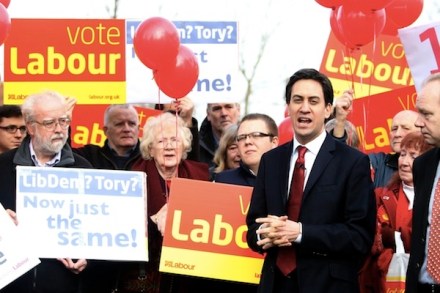
So Labour is going to force a vote in the House of Commons on the mansion tax. It’s the key announcement trailed as part of Ed Miliband’s visit to Eastleigh today, and yet it’s the sort of thing that only really excites people who look forward to hearings of the Public Accounts Committee rather than the average voter who has a more normal perspective on life. The idea behind these Opposition Day debates is that Labour flushes out any rebels or unhappy Lib Dems, or that its MPs can later tweet ‘Lib Dems voted against their own policy in the Commons tonight #evil #nevertrustalibdemagain’. Miliband says that very thing today:

No 10 attacks Miliband’s ‘admission of economic incompetence’

Here’s an interesting thing: Number 10 has released a statement on Ed Miliband’s 10p tax rate pledge. The Downing Street press machine hasn’t been in the habit of doing this sort of official reactive spinning, although this may be in part because Miliband’s speeches thus far have been pretty light on anything you can actually react to. This is what a No 10 spokesman said: ‘This is a stunning admission of economic incompetence from Ed Miliband and Ed Balls – that their decision in Government to scrap the 10p tax rate hurt millions of working families. People will never trust Labour again. The low income working people who lost out

Labour’s Valentine’s policy gimmick

At long last, Ed Miliband delivered us a Valentine’s Day present that everyone in the political world has been waiting for: a new policy! And a tax policy at that! Not just content with maintaining support for a temporary VAT cut, reversing the Coalition’s tax credit restraint and reversing the 50p tax rate cut (all of which would worsen the deficit), the Labour leader has nailed his colours to a new mast. He wants to bring back the 10p rate of income tax, which his former boss Gordon Brown abolished, paid for by a mansion tax on homes worth £2 million. Now, there are many observations which can made about

Ed Miliband’s bold redistributive rebuke to Brown

Those close to Ed Miliband stress that if elected, Labour will introduce a mansion tax to pay for the return of a 10p tax rate. I’m told that ‘short of publishing the manifesto two years early, we couldn’t be any clearer’. This new 10p band will apply to the first thousand pounds of income, making it a £100 a year tax cut. (Although the Cameroon think tank Policy Exchange calculates that low-paid working families would actually only be 67p a week better off under this policy.) The politics of the move, which has been in the works since Christmas, is fascinating. It is both a bold redistributive gesture and a

Miliband steals a march on Tory tax campaign

Ed Miliband has just started his economy speech in Bedford, so as he gets underway, here’s a quick thought on his plan to reintroduce the 10p tax band. Doing this steals a march on a brewing Conservative campaign. Robert Halfon has been pushing over the past couple of months for the restoration of the 10p tax band to help those on low incomes. He’s badged it the ‘Great Gordon Brown Repeal Bill’, and David Cameron set some pulses racing yesterday at PMQs when he told Yvonne Fovargue that ‘we will not forget the abolition of the 10p tax rate that clobbered every hard-working person in the country’. But on yesterday’s

PMQs sketch: In which Cameron both chooses and answers the questions.

Whoosh! Crasshh! Ploophm! Crummppp! The personal attacks came pounding in on David Cameron today. Ed Miliband asked about declining living standards and set about portraying the prime minister as an out-of-touch toff surrounded by plutocratic parasites. He cited the recent Tory Winter Ball where a signed mug-shot of Mr Cameron had been auctioned for the Warhol-esque sum of £100,000. ‘Then the prime minister declared, without a hint of irony, that the Tories are no longer the party of privilege.’ Cameron ignored the issue of living standards and told Miliband he’d raised the wrong topic. ‘If his question is – have you had to take difficult decisions to deal with the

Why Ed Miliband’s Reagan-esque attack won’t work

Ed Miliband has taken inspiration for his 2015 attack line from an unlikely source: Ronald Reagan. In 1980, a week before the election between himself and incumbent President Jimmy Carter, Reagan told voters to ask themselves: ‘Are you better off than you were four years ago?’ At PMQs today, Ed Miliband told the Prime Minister ‘In 2015, people will be asking “Am I better off now than I was five years ago?”’ His hope, clearly, is that voters will decide the answer is ‘no’ — and that they’ll vote against the government as a result. Miliband’s hopes are pinned on Office for Budget Responsibility forecasts, according to which average earnings

The Tory 2015 message: times are tough, but they’d be worse under Labour

Today’s PMQs was not, as James says, a tricky one for David Cameron. He had some good jokes and embarrassing gossip to poke Ed Miliband with, even though the Labour leader chose to attack on the thorny issue of living standards. The key to the next election will be whether voters feel their lives have improved under the Coalition far more than it is about the latest ONS release on GDP. And the key challenge for the Coalition is to be clear that though things won’t be rosy – as Miliband pointed out, the squeeze on living standards will still be taking place when polling day arrives – they would

PMQs: Ed Miliband fails to bowl Cameron out

I suspect that David Cameron was in a better mood at the end of PMQs than at the start. He sailed through the session with relative ease. Ed Miliband went on living standards, his specialist subject, but his delivery was oddly flat. It was as if he was giving Cameron throw-downs in the nets rather than trying to bowl him out. Cameron, who has been bested on the joke front these past few weeks, also had the better one liners. He gleefully read out an email from the Labour press office inviting people to a Miliband speech on the economy but warning there was no new policy in it. Labour,

IDS accuses Miliband of pathetic scaremongering over ‘bedroom tax’

The political row over the changes to housing benefit, labelled the ‘bedroom tax’ by opponents, intensified this evening. In an open letter to the Labour leader (reproduced below), Iain Duncan Smith accuses Miliband of ‘a pathetic exercise in political point scoring and scare mongering’. In the feisty letter, Duncan Smith argues that the taxpayer is currently paying for close to a million spare rooms. He argues that taxpayers ‘should not be paying for what is effectively a benefit subsidy for empty rooms’. He also takes issue with the personal case stories that Labour are using. He alleges that Miliband is seemingly unconcerned about ‘children having to stand to do their

PMQs sketch: Ed Miliband vs David Cameron on the ‘bedroom tax’

It was cynical. It was shameless. It was low-down politics in every way. But Miliband’s stunt at PMQs very nearly worked. His theme was the reform of housing benefit that will affect those in homes with unoccupied bedrooms. Ed Miliband calls this ‘a bedroom tax’. He kicked off by asking David Cameron about the case of ‘Alison’ who has twin sons serving in the army. While her boys are fighting abroad, Alison will be charged £25 extra per week for their bedrooms. It’s wrong to call this a tax, said Cameron, it’s a necessary change to an unaffordable system. Miliband was waiting for him. ‘I’d like to see him explaining

PMQs: Ed Miliband’s ‘bedroom tax’ attacks ignore the facts

At a particularly unedifying PMQs today, one Labour MP even suggested that ministers need cognitive behavioural therapy. The cause of all this rancour: the so-called ‘bedroom tax’. Now, the ‘bedroom tax’ is not actually a tax. Rather, it is a reduction in the amount of housing benefit paid to those who — according to the local authority — have spare capacity in their homes. If the Labour leadership genuinely does not grasp this distinction, then this country is in worse trouble than we thought. Ed Miliband peppered Cameron with questions about difficult cases. It was an effective debating tactic as there was little Cameron could say without knowing all the

Labour prepares to enter the battle of the best ideas

Tony Blair usually grows rather awkward when asked about the current direction of the Labour party under Ed Miliband. Clearly afraid of appearing a backseat driver, the former Prime Minister tries as hard as he can to avoid delivering any kind of verdict, other than a vaguely supportive bundle of words. He certainly did the latter in his interview on Marr this morning, but Blair also made some important points about how crucial this year will be for Labour. He said: ‘So I understand the Labour party message. And by the way, what Ed’s trying to do is tougher than what I had to do. When I became Labour leader,