Economy

Making work pay | 16 July 2010

What is the purpose of the welfare state? To protect British people from unemployment, or to protect them from jobs like fruit-picking and working in Pret A Manger? I listened to Farming Today* earlier, in which they interviewed the Eastern Europeans that we import en masse to do jobs that Brits used to do. Having done the job myself in my younger days (I come from a part of the world where the October break is called the ‘tattie holidays’ so kids can dig potatoes), I can attest that it’s bloody hard work for a paltry reward. But it pays no less than the minimum wage. Without immigration, we’d be
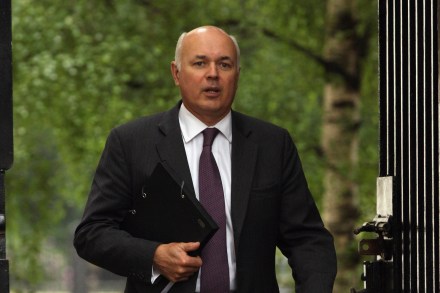
McFadden talks sense

Pat McFadden, the sullen-looking Shadow Business Secretary, has given an important speech to the Fabian Society. He said: ‘Fight the cuts is a tempting slogan in opposition, and there are indeed some that must be fought. But if that is all we are saying the conclusion will be drawn that we are wishing the problem away.’ He is the first shadow minister to recognise that Labour’s current approach is counter-productive, and Ed Balls’ philosophy is suicidal. He notes: ‘In fact, that is the position the Tories and the Lib Dems would prefer us to adopt. They want Labour to retreat to its comfort zone and allow them to say that

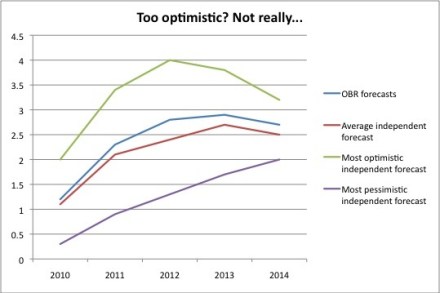
Are the OBR's growth forecasts too optimistic?

Much ado about the Office for Budget Responsibility’s growth predictions in the Treasury Select Committee earlier, especially as an OBR official admitted that the cuts and tax hikes in the Budget could conceivably tip us into a double-dip recession. So are the OBR’s official forecasts too optimistic, as some are now claiming? Only time will tell, but we can get a decent sense of things by comparing them with the independent forecasts that the Treasury collect here. And this is the result: In other words, the OBR growth forecasts stick pretty closely to the average independent forecast, although they are a touch more optimistic. Admittedly, these independent forecasts were collected

Hard going for the government

A tough morning for the government at the hands of Tyrie, Fallon and rest of the Treasury Select Committee. Sir Alan Budd apologised for his naivety, Robert Chote described the Budget as ‘regressive’ in the main and the banking levy has been criticised on the grounds that is de-stabilising banks’ capital bases, which will affect lending. The government would prefer silence on these issues but the damage was far from total. Budd was an interim figure and the spat that has developed around him is largely political – there is no question that Budd was ‘nobbled’. Robert Chote deserves his reputation but he is not infallible. And Treasury Chief Economic

Send for Chote

And so it continues. The FT reports that Sir Alan Budd has denied that George Osborne cooked the OBR’s job loss forecasts. ‘It was genuinely a forecasting correction with no ministerial interference,’ he said, blandly. The correction was the result of the OBR’s use of a narrow definition of public sector workforce than is employed by other statisticians. That is not abnormal: statisticians are a law unto themselves. But, as the saying goes, it doesn’t look good. The OBR’s figures supported the government and the story is beginning to emit of a whiff of mendacity. Once more, George Osborne is in a mess of his own making. His political instincts veer

Osborne must make the workings of the OBR even more transparent

Forget the hubbub about Gove’s schools list, the most damaging story for the government this week could well be on the cover of today’s FT.  Alex Barker does a great job of summarising it here. But the central point is that the Office for Budget Responsibility changed its forecasting methods just before the Budget, with the effect of reducing how many public sector jobs would be lost due to the government’s measures. This isn’t damning on its own: statisticians constantly tweak their forecasting methods. But when you consider that the OBR’s new methods incorporated policies which haven’t even been announced yet (including one which pre-empts the findings of John Hutton’s

The briefest of stints

Well, that was quick: after only three months in the role, Alan Budd is to step down as the head of the Office for Budget Responsibility.  A shame, too.  In a quiet sort of way, he had become one of the defining figures in these early days of coalition government – helping to establish the OBR as one of the most significant actors on the political landscape.  It is certainly, now, a more effective body than I previously thought it would be. Although Budd’s contract was for three months, there was some idle Westminster speculation that he’d stick around – so the rumour mill is puffing away at his departure

About those job losses…

Much ado about the Guardian’s scoop this evening: a leaked Treasury document which forecasts that up to 1.3 million jobs could be lost as a result of the spending cuts in the Budget.  Or, to put it in the words of the document itself: “100-120,000 public sector jobs and 120-140,000 private sector jobs assumed to be lost per annum for five years through cuts.” You can expect Labour to get stuck into these numbers, and the fact that they were previously hidden from public view, with no uncertain relish.  Ed Balls has already described them as “chilling”.  But it’s worth making a couple of points, by way of context: i)

Obama wants ‘global concert’ to delay cuts

G20 summits are usually turgid affairs, but this one has some (limited) potential. Relations between the White House and Britain and the White House and Europe have been frosty of late. Afghanistan, BP, the Falklands, Merkel and Sarkozy’s irritation at Obama’s personal and political aloofness, all of these have been contentious. Diplomatic tension has now developed an economic arm. The broadly centre right governments of Britain, France and Germany are committed to cutting public spending now. Each has introduced an austerity programme, and Cameron has made retrenchment is his international cause. Obama still stands for stimulus. The President said: ‘This weekend in Toronto, I hope we can build on this

The true meaning of Osborne's Budget

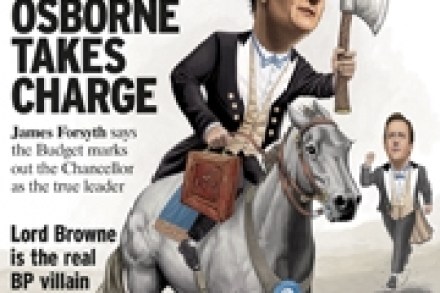
To understand the budget properly, read James Forsyth’s cover story in The Spectator today. Sure, it was about reducing the deficit – but within it lie several political strategies which explain how George Osborne hopes to win a majority Conservative government. James says that those around Cameron will not entertain this notion – they “have been persuading themselves that coalition government is the best possible result”. But Osborne, he says, finds it deeply unsatisfactory and has a twin mission: fix the economy, and win outright next time. “He has been observing recently that Gordon Brown spent 13 years successfully creating Labour voters — mainly through state dependency — and that

The road to recovery | 23 June 2010

This is a slow-burning budget. Not because Osborne has concealed, like Gordon Brown did, but because the reverse is true. The budget is, as Osborne says, a third of the size but with three times the amount of information. It has layers: some policies and language are there just to assuage the LibDems. Some are pure Tory. James has a brilliant cover piece in tomorrow’s magazine which spells out the political, rather than economic, forces at work in this budget. Osborne, that great player of three-dimensional chess, sees in this budget plans to restore a Tory majority government. The Red Book itself is, for wonks like myself, a joy to

A credible start

Today’s Emergency Budget announced the most ambitious fiscal consolidation programme in decades.  It sets out a framework returning the government broadly to a state of fiscal solvency by 2014.  To do this, George Osborne announced a deficit reduction programme amounting to just over £100 billion in real terms – entirely in line with our recommendations.  The ratio of spending cuts to tax rises – 74:26 is largely in line with the international best practice model (which we also endorsed) of 80:20.   Instead of government living well beyond its means for the next four years, we estimate that the Chancellor’s plans will reduce the structural deficit – in other words,

What Harriet Harman won't tell you

By her usual standards, Harriet Harman was quite effective in her response to George Osborne’s Budget earlier.  She was clear, direct and had a few gags at Vince Cable’s expense.  And she also benefitted from what, on the surface, was a strong central attack: the Office for Budget Responsibility, she said, has downgraded its jobs forecasts on the back of the Budget.  And so, she followed, this is a Budget which destroys jobs. But there were a few things that Harman wasn’t letting on.  First, as Jim Pickard points out at the FT, the OBR forecasts haven’t shifted by all that much from their previous incarnation.  And, second, they are

George Osborne must put spending cuts ahead of tax rises

In 2009, Britain borrowed more, as a share of its national income, than any country that isn’t being bailed out by the IMF and the Eurozone (Greece) or already making drastic spending cuts (Ireland).  That huge deficit is the critical challenge to our economic stability that George Osborne needs to tackle with the Budget today.  We have got away with high borrowing so far on the understanding that cuts are coming now the election is out of the way.   If you think tax hikes are the answer, then you’re asking the wrong question.  Our present fiscal crisis is built on a decade of bumper rises in spending, not tax

Back into the black

George Osborne has an historic opportunity to begin to turn the UK’s public finances back into the black. As Reform noted in an alternative budget released last week, while this will require making the toughest spending choices for a generation, history will smile on him if he does this in the right way. What the right way is will largely reflect three key things. First, George Osborne’s Budget needs to be ambitious in its timeframe for reducing the deficit. Setting out to, say, simply “eliminate the bulk of the structural deficit in the term of this Parliament” will not be enough. Delay will make fiscal consolidation harder as interest payments

Osborne makes the "progressive" case

During the Brown years it was “stability,” but it looks as though the watchword for Chancellor Osborne’s first Budget will be “progressive”.  This is the word that’s being bandied about behind-the-scenes, and the coalition seems confident that it has the policies to match the rhetoric.  As the Guardian reports today, it’s likely that the personal income tax allowance will be raised by £1,000 or so, to help shield the least well-off from tax rises elsewhere.  And the paper quotes a Tory aide saying that the richest will pay more, “both in absolute terms and as a percentage of their income.” Whether he drops the p-word or not, the arguments behind

Osborne's massive opportunity

I’m quite optimistic about George Osborne’s budget – in the same sense that one might have been optimistic when Churchill took over from Chamberlain. Not because the situation is good, or because you think the road ahead will be easy or enjoyable, but because the road no longer leads to disaster. Not that Osborne is a Churchill – even though he will have his own fair share of blood, sweat toil and tears for us on Tuesday. I’m pretty confident he’ll head in the right direction, and at the right speed. I discuss this in my News of the World column today, but will say a little more here: 1.

The Budget: compromise and non-compromise

It’s hard to overestimate the significance of Tuesday’s Budget. George Osborne’s statement won’t just determine the course of our economy for the next few years, but also the political life of this government. Spending cuts and tax rises may not inevitably “fracture the coalition,” as Peter Oborne puts it in the Mail today. But they certainly have the potential to. Happily for the coalition, the current political mood is so geared towards fiscal restraint that there will be little immediate opposition to Osborne’s general plans.  That will come once the effects of spending cuts are felt in individual constituencies  – months, even years, down the line. But there are a

The Big Society reincarnated

The Big Society is a great idea. But its problem has always been that it lacks definition; voters and even some Tory MPs aren’t quite sure what it means. But an idea being floated today gives you a sense of its practical and political potential. It is being suggested that the community right to buy, the idea that the community should have first refusal on any asset being sold off, should be applied to the port of Dover. The last government wanted to privatise the port but the new MP for Dover, a Tory called Charlie Elphicke has proposed that a community trust be allowed to buy the port and