Economy

The staring contest over Greece

Now that negotiations have broken down in Athens, and there will be another election, we face the prospect of an almighty staring contest. On one side, the Eurocracy, who will be urging Greek political parties — and particularly the left-wing coalition Syriza, which is ahead in the polls at the moment — to soften their anti-austerity stance. On the other, the Greek politicians, who might be hoping that the eurozone relents to some extent, and allows the cuts to be decelerated. The question is: who will blink first? As it stands, it’s difficult to come up with an answer.

How Britain is using spin to con the bond markets

Austerity, austerity, austerity. The A-word is cropping up everywhere at the moment, whether in France or Greece or Germany. And the UK isn't immune from it either. If there is anything on which Britain’s political factions agree, it is the reality of fiscal austerity. Whether it's Ed Balls banging on about ‘too far and too fast’, or the coalition saying that their programme of painful austerity is essential if the UK is to defend its triple-A ‘safe haven’ status, this is something on which our political class has reached consensus.   But, as we at Tullett Prebon argued in a briefing paper yesterday (available here as a pdf), the tale of ‘big’ cuts in public spending is a bare-faced deception.

Greece is still the word

Remember when Europe’s leaders were basically saying, ‘Don’t worry, it’s all sorted’? Remember when they were putting out communiqués that started ‘The euro continues to rest on solid fundamentals’? No doubt they’ll do so again, but those past shows of certainty still look kinda funny this morning. Despite some last-minute concessionary efforts by Europe’s beancounters, it still appears that Greece’s main parties will be unable to form a coalition, and are heading for another election. And we know what that could mean: victory for the left-wing Syriza coalition, a severe swing against austerity, Greece’s exit from the euro, etc. etc.

The Chinese lantern is dimming

Does anyone believe Chinese GDP figures? Officially, the economy is roaring at 9 per cent a year. But thanks to WikiLeaks we know that Chinese Politburo member Li Keqiang thinks that the official GDP data is ‘for reference only’ — and that if you want to know how fast China is growing you should look at electricity consumption, rail cargo volume and bank lending etc. So today’s announcement of China’s electricity consumption figures for April showing a year-on-year growth of 3.7 per cent is quite significant. This is growth beyond George Osborne’s wildest dreams, but by recent Chinese standards is pretty paltry. Last year China’s electricity consumption grew 12 per cent. Put into historical perspective, this 3.

Pickles struggles for an answer on growth

The government is desperate for economic growth but where can it find it? This was the question posed to Eric Pickles on the Sunday Politics today, but sadly he was unable to provide much of an answer. The Communities and Local Government secretary gave a blustering interview, where he reaffirmed William Hague’s view that ‘growth will come from government creating conditions for us to work a little bit harder.’ But when pushed by Andrew Neil on what this (slightly condescending) idea actually means, Pickles jumped on the chance to blame Labour for the ‘something for nothing culture’. Pickles did add that the government’s chosen sources of prosperity are business investment and, relatedly, the stripping back of regulation.

Lies, damned lies, debt and Nick Clegg

Does it matter if the Prime Minister and his deputy mislead the country about what they are doing to the national debt? Neither of them seem to think so, if today’s Essex Relaunch today is anything to go by. First, Cameron: ‘The problems of over-spending and too much debt can’t be solved by even more spending and even more debt.’ He chose his words for consumption by the ordinary voter, the factory workers who formed his backdrop. Who, listening to that, would guess what Cameron and Clegg are doing with the national debt? Clegg, I’m afraid, went far further and suggested that the debt was being eliminated.

Can Merkel and Hollande meet in the middle?

This afternoon, it’s even clearer that the French and Greek elections are a significant moment in the life of the Eurozone. It’s not just the nervous market reaction to yesterday’s results, but also the way how the supranational debate has now changed. More so than ever, there are now two clear oppositional fronts. On one side, broadly speaking, are those who say that austerity is a prerequisite for growth. On the other, those who say that austerity must be relaxed for growth to arrive. It’s a situation dripping with black humour. When David Cameron kept Britain out of Europe’s fiscal pact a few months ago, it was portrayed as a case of us against them. Now it’s more a case of them against themselves.

Cameron faces a political storm

For the Cameroons, the political weather at the moment is about as appealing as the prospect of a Bank Holiday trip to the beach. The Tory party is having a very public debate about its future strategy. The Alternative Queen’s Speech being promoted by David Davis, John Redwood and Tim Montgomerie is a reminder of how vocal the leadership’s internal critics are prepared to be. The worry for Cameron has to be that there is this much sounding off just two years into the coalition. One wonders what it will like be a year from now.

Hollande, Cameron and the 21st arrondissement

While David Cameron has good cause to be glad of Sarkozy’s defeat, he has even better cause to be nervous about this trend of lefty nerds being elected. Much of the Cameroon’s re-election hopes are pinned on the idea that their boss will trounce the geeky Ed Miliband. Nowadays, the argument goes, these ex-special advisers who have no charisma and alarming leftist policies just don’t win modern elections. But, as Ben Brogan argued in the Telegraph last week, the French may well be about to prove that even dullards can get elected — if the incumbent fails to deliver the change he promised. At least Hollande says he’ll balance the books by 2015, which is more than Osborne is planning to do.

What Hollande’s victory means

Tonight’s election results mark the next challenge to the euro. In France, the Socialist candidate François Hollande has won. Having campaigned on changes to the fiscal compact, Hollande will have to deliver something on this front. But Angela Merkel, with her own elections next year, will not want to agree to anything that appears to be a watering down of the pact. I doubt, though, that there’ll be that much market reaction to Hollande’s victory. City sources say that it has been priced in for while and that there is an expectation that Hollande will merely accept some window-dressing about growth being added to the agreement. But what could set off a reaction are the results in Greece.

Balls wants you to trust him

It's only ten days or so since Ed Balls was last quizzed by Andrew Neil, but there he was rehashing many of the same lines on the Sunday Politics today. Among the things that stood out was this: the shadow chancellor’s argument on the public finances is ever more cleaving into two halves. First, he accuses George Osborne of borrowing £150 billion more over this Parliament than originally planned. (Although there’s a detail that often, conveniently, gets obscured: namely, that borrowing is still going down year-on-year under Osborne's plan). Second, that Balls's plan would decrease borrowing in the medium-term even though it would increase spending and reduce tax revenues in the short-term.

Osborne brings it back to the economy

It wasn’t, as expected, Nick Clegg on Marr this morning but George Osborne as the coalition attempted to move the argument back onto the economy. Osborne kept stressing that the government would focus on the things that ‘really matter’ to people; code for we’re not going to spend too long on Lords reform. Indeed, given that Nick Clegg has turned down a compromise on that, we now appear to be heading for — at most — a referendum on the subject. Osborne defended his deficit reduction programme, arguing that the lack of growth was a result of the Eurozone crisis and the oil price spike. But he did concede that a Tory government would be going far further on employment law reform than the coalition is.

Mervyn’s mini mea culpa

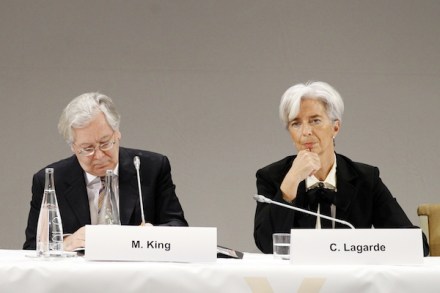
The newspapers and internet today are full of headlines about Mervyn King admitting the Bank of England was ‘late to the game’, and that central bankers should have ‘shouted from the rooftops’ regarding the financial blow-up. It’s true, the BoE governor did make these ‘mea culpa’ remarks — but they came rather half-heartedly, and couched within a radio lecture that seemed to point even more fingers at other parties.   King was giving the Today Programme Lecture 2012, which he addressed to a Radio 4 theatre audience yesterday evening. Early in the half-hour speech, he gave an anecdote from 1997, in which then-governor Eddie George and him, Merv, celebrated Gordon Brown’s proposal for Bank independence.

GOD isn’t good enough for Threadneedle Street

When Gus O’Donnell was running the civil service, he was known by his initials — GOD. It seems to have gone to his head. He says in this week’s House magazine that he’s considering applying to be Governor of the Bank of England, and in the same interview exposes his failure to grasp modern economics by saying it would be dangerous to put income tax back to 40p (which was the plan even under Gordon Brown). It is striking that the technocrats like O’Donnell now want to run the show explicitly (as his endorsement of a civil service candidate for Mayor, Siobhan Benita, demonstrates).

Fears heighten as the Eurocrisis rumbles on

For all the coverage of hacking, pasty tax and the like, the continuing crisis in the eurozone remains the most significant political story. Until it is resolved, it is hard to see how the UK returns to robust economic growth. I suspect that the market reaction to a Hollande victory will be limited as it is already pretty much priced in. Those expecting a degringolade will be disappointed. However, if Hollande does actually try and implement some of his more extreme ideas, the markets could take fright. What is far more worrying than France is Spain. There’s a growing sense of inevitability that the Spanish banks will need a bailout before the autumn.

Waiting for Growth

With apologies to the Beckett Estate... Two tramps appear on stage. They are dressed in white tie and tails and wearing top hats. Their clothes are dirty and shabby; their hats gleam. The stage is bare, apart from a mound of earth and a tree. Which appears to be dead. ACT ONE: David: [gloomy] It's too much for one man. On the other hand what's the good of losing heart now, that's what I say. We should have thought of it a million years ago, in the nineties. George: What do you expect, you always wait till the last moment. David: [Ponders this] The last moment... Hope deferred maketh the something sick, who said that? George: It is an election, isn't it? David: [Despairingly] Why don't you help me? George: There's nothing to show. David: Suppose we repented?

Cameron’s Euro line

One line jumped out at me in David Cameron’s Marr interview this morning. When Andrew Marr asked him if he thought we were halfway through the Euro crisis or nearing the end of it, Cameron replied: ‘I don’t think we're anywhere near half way through it.’ Cameron clearly does not believe that any resolution to the crisis is in sight. Given that, as long as the Eurozone crisis rumbles on it is hard to see how the British economy returns to robust growth, this is immensely significant. It does, though, make me wonder if the government’s approach to the crisis should now change.

Cameron on the defensive

‘As things stand, I don’t believe Jeremy Hunt broke the ministerial code,’ said David Cameron to Andrew Marr earlier this morning. But the prime minister reiterated that he would act if new evidence came to light when Jeremy Hunt gives evidence to the Leveson inquiry. Cameron also indicated that he would not wait until Leveson reports in October to punish a breach of the ministerial code. And if Leveson does not clear up the issue, then the Hunt case would be referred to Sir Alex Allan. ‘I know my responsibilities,’ Cameron said time and again. In addition to putting Jeremy Hunt on probation, Cameron took the opportunity to defend his own conduct with News Corp executives.

Osborne’s turning point

As Paul Goodman suggests, there is something significant about Liam Fox's article for the Daily Telegraph this morning. It's not that we haven't heard similar from the former Defence Secretary before — we have. It's more that his economic prescriptions are being made, we learn from the Sun, with the ‘explicit approval’ of his buddy George Osborne. And what are those prescriptions? Well, the main one is for further spending cuts, and Fox also waxes enthusastic about greater deregulation and about protecting the defence budget (at the expense of international aid). He also has some firm advice for the Lib Dems.

The Austerity Myth

On the global scale of hackish irritation, the American left's persistent determination to misdiagnose the reasons behind Britain's faltering economy cannot be considered the most grievous pundit-crime. Nevertheless, it remains annoying. Here, for instance, is Joe Klein: Word now comes that Great Britain has slipped back into recession after several years of David Cameron’s austerity experiment. It seems, yet again, that John Maynard Keynes has been proven right. Real Keynesianism–government deficit spending–is essential when economies go bottom up. This can mean more government programs or lower taxes, or a combination of the two. That would seem to be plain vanilla logic, right?