Economics

A growing argument about the 50p rate

From our UK edition

With the Eurozone and American economies both at risk of a double dip recession, how to get the British economy moving again is going to be one of the defining political arguments of the autumn. A first salvo in that fight has been fired this morning with a letter to the FT from 20 economists calling for the immediate scrapping of the 50p rate because of the harm that it is doing to the economy as a whole. This letter will, one suspects, be privately welcomed by the Chancellor who is looking for ways to, at the very least, cut the rate. He has become increasingly convinced that it is making it harder to get a proper recovery going. But, politically, offering a tax cut to the rich is a hard sell at the moment.

Irish Green Shoots?

From our UK edition

Could it be that Ireland has passed through the worst of the storm? Writig in the Financial Times yesterday David Vines and Max Watson argue that maybe, just maybe, it has. [T]he first and most important thing about Ireland is that it is swiftly restoring its competitive edge. Indeed it is moving rapidly towards a sizeable current account surplus – in a range of 3 to 4 per cent of gross domestic product. Of course, recession has also played a role in turning external accounts around, but a steady uptrend in exports has been underway for some time. The second element is that Ireland’s net public debt will probably peak at somewhere around 110 per cent of GDP.

Brown still hovers over the 50p tax debate

From our UK edition

A number of papers report today that George Osborne is minded to replace the 50p tax with Gordon Brown's original proposal: a 45p tax. How the ex-PM will be laughing. As he knows, even the 45p tax will lose money — that's why Labour didn't raise the top rate until the final four weeks of its 13 years. But the Tories haven't worked that out yet, and the Treasury is still working on the false assumptions he programmed into it. In short, the amount of money that either tax rate will raise depends on what's called the "taxable income elasticity," or TIE — a figure suggesting how responsive various taxpayers are to rate changes. It varies for income groups. The lower-paid are less able to move their labour or money around than the rich.

How do you measure cuddles?

From our UK edition

There's been a lot of fuss about this morning's GDP numbers, but if David Cameron has his way we'll soon be fretting about an entirely different set of statistics. The Prime Minister has given the data-crunchers at the Office for National Statistics a new mission: measure the nation's well-being. The idea is to create new stats to accompany economic figures like the Gross Domestic Product as an additional gauge of how well things are going in the UK. It's an idea that makes a great deal of sense. After all, the shortcomings of GDP are well-known. As Bobby Kennedy put it back in 1968: "It measures neither our wit nor our courage, neither our wisdom nor our learning, neither our compassion nor our devotion to our country.

Could the Greeks leave and then rejoin the euro?

From our UK edition

The Harvard economist Martin Feldstein proposes an intriguing solution to Greece’s problems in his latest column: “A temporary leave of absence from the eurozone would allow Greece to achieve a price-level decline relative to other eurozone countries, and would make it easier to adjust the relative price level if Greek wages cannot be limited. The Maastricht treaty explicitly prohibits a eurozone country from leaving the euro, but says nothing about a temporary leave of absence (and therefore doesn’t prohibit one). It is time for Greece, other eurozone members, and the European Commission to start thinking seriously about that option.

Alan Greenspan doesn’t exist

From our UK edition

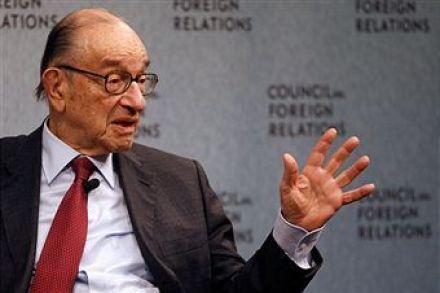
Five years have passed since Alan Greenspan stepped down from the most influential banking job in the world. (Now that’s how to leave at the right time.) Described in books, interviews and profiles too numerous to mention as ‘the most powerful regulator/person on earth’, he served as Chairman of the Federal Reserve for 19 years. For reasons of sheer longevity, perhaps Greenspan deserves to be called the architect of the modern global economy more than any of his elected contemporaries.

Slums Are A Feature of Success

From our UK edition

Meanwhile and continuing our population theme it may be worth spending a moment on population density in the developing world too.  Commenting on this post Axstane writes: This logic tells us that Nigeria, South Africa, Mexico and Brazil are all very well off indeed since they have dramatically increasing populations. Their slums, crime rates and unemployment are all features of a healthy society?  Actually, yes they are. Apart from any other consideration, urbanisation will most probably reduce birth-rates in the developing world, not increase them. Moreover, the great migration to the city is evidence of urban success and rural failure, not the other way round.

Robin Hood and the Laffer Curve

From our UK edition

I've been assuming that Ridley Scott's interpretation of the Robin Hood saga must be terrible. After all, it's nearly a decade since Black Hawk Down, Scott's last properly good movie. But now AO Scott pops up in the New York Times to suggest, though he may not mean to, that the movie has something going for it after all: You may have heard that Robin Hood stole from the rich and gave to the poor, but that was just liberal media propaganda. This Robin is no socialist bandit practicing freelance wealth redistribution, but rather a manly libertarian rebel striking out against high taxes and a big government scheme to trample the ancient liberties of property owners and provincial nobles. Don’t tread on him!

Keynes vs Hayek: The Rematch

From our UK edition

Today's boxing theme continues: This is excellent. Perhaps someone can do something similar for George Osborne and Ed Balls? The first fight, if you missed it, is here.

Economists vs Politicians

From our UK edition

Tyler Cowen has a fairly downbeat assessment of the UK economy's likely future performance (manufacturing base eroded, tourism not enough, too dependent on finance etc) but he makes a pair of characteristically good points about trimming public spending: 1. The case for the cuts is not that they will spur growth, but rather forestall a future disaster.  That’s hard to test.  A second part of the case is that not many political windows for the cuts will be available; that’s hard to test too.  On that basis, it’s fine to call the case for the cuts underestablished, but that’s distinct from claiming that poor gdp performance shows the cuts to be a mistake. 2.

Getting the balance right

From our UK edition

Branko Milanovic is the lead economist at the World Bank’s research department, a professor at the University of Maryland and a grand fromage at the Carnegie Endowment for International Peace too. Branko Milanovic is the lead economist at the World Bank’s research department, a professor at the University of Maryland and a grand fromage at the Carnegie Endowment for International Peace too. He is not, it turns out, a very light-hearted man and that’s a particular misfortune because The Haves and the Have-Nots was clearly designed to be the easy-reading version of his far more weighty tome on global inequality, Worlds Apart.

What Irish Austerity?

From our UK edition

Next time you hear a Labour politician arguing that the markets are punishing Ireland despite its austerity drive (and therefore Britain should not rush to cut its own deficit) you might kindly point out that, because of the horrors at Anglo Irish and elsewhere, you can certainly argue that there hasn't actually been an Irish austerity drive: In a statement, Mr. Lenihan conceded that the bank bailout would have an immediate and dire effect on Ireland’s budget deficit, pushing it up to an extraordinary 32 percent of G.D.P. Taking out the bank costs, Ireland’s deficit is expected to be around 11 percent, despite two years of an austerity drive.

Ireland Tries to Pacify the Bond Market

From our UK edition

Thursday is an important day for Ireland and, in the end, another reminder that Ireland's economic woes and the measures taken to alleviate them don't offer much of an example for other countries or their governments. The Irish government is going to have to announce its plan for bailing out (or not) Anglo Irish Bank's bondholders. None of the options - outlined by the FT here - seem attractive. The political cost of meeting the bond market's hopes will be severe; the economic cost of not doing so could be equally horrendous.

Hibernian Woe

From our UK edition

As Iain Martin notes, it didn't take Labour long to welcome the news that the Irish economy shrank by 1.2% last quarter*. Welcome isn't quite how they put it but since Irish economic pain is a weapon with which the opposition can attack the coalition, Irish misery is a price worth paying so Ed Balls can feel vindicated. At least those who think fiscal restraint is needed at times such as these and who were perhaps too quick to welcome last quarter's healthy growth in Ireland can say they want to see Ireland do well. In truth, both sides of the British (and for that matter American) debate are too fond of treating the Irish as though they were nothing more than tiny lab rats subjected to a series of interesting economic experiments.

Irish Austerity Update

From our UK edition

Paul Krugman is back banging a familiar drum: austerity is not a good idea. Anywhere. As always, Ireland is one of his favourite examples: [V]irtuous Ireland never did better than malingering Spain. And now, Ireland’s risk premium has exploded, here; Spain’s not so much, here. Of course, it’s not at all a clean experiment; Ireland’s banks were arguably second only to Iceland’s in their irresponsibility, and the Irish government’s blanket guarantee has exposed it to huge losses. But bear in mind that when Ireland seemed, briefly, to have regained the trust of the markets, this was touted as proof that austerity will be rewarded. Funny about that. As always, I'm not sure what Krugman's alternative is.

Spiv on a grand scale

From our UK edition

He insisted that he was not a pornographer but an entertainer, and told the Daily Herald that the Folies Parisienne (sic) — one of his early shows, featuring the ‘Harlem Nudes’ and their ‘taunting, scantily clad Native Mating Dance’ — was intended for family audiences, and that children were taken along by their ‘doting elders’. When he booked a celebrated American stripper to appear at the Raymond Revuebar (‘The Athenaeum of Strip Clubs’ — Spectator), she was appalled to learn that he and his wife proposed to let their five-year-old daughter watch the show. This family image was rather dented by such assurances as ‘this theatre is disinfected throughout with Jeye’s [sic] Fluid’.

Why a public sector pensions levy makes sense

From our UK edition

Today's papers are awash with stories that a public sector pensions levy will be announced in tomorrow Emergency Budget. Trade unions have already issued dire warnings, ranging from the PCS's promise to "organise the widest possible popular opposition," to Bob Crow of the RMT’s rather prosaic: "when someone’s winding up to give you a kicking you have a clear choice — you can either take them on right from the off or you can roll over and hope that they go away."  Public sector workers, however, should not be so dismissive.   In our report, released on Friday, we argue for an "Irish style" graduated public pensions levy of 7.5 percent.  We estimate this will ‘save’ 322,000 jobs.  Why?

Why Cameron must never say “deficit”.

From our UK edition

Listening to BBC news, it's striking how they are still using Labour's politically-charged vocabulary. When the universities are kicking off about their budgets being cut, the BBC newsreaders are told to talk about "investment" in higher education, rather than spending. Why, though? An "investment" would be to put £1 billion of taxpayers’ money into an Emerging Markets fund, and hope it grows. Giving it to universities - many of which serve neither students nor society - is not an investment. But using the word "investment" is Labour code for "good spending". There is one particularly frequent example if this: the BBC regularly confuse the words "deficit" and "debt" - a bugbear of mine, and something James Forsyth deals with in his column in this week's magazine.

How much attention should politicians pay the competing groups of economists?

From our UK edition

The recession has been intellectually thrilling, and I write that without a note of sarcasm. First, politicians argued as to whose understanding of Keynes was greatest; and now they’re in Keynes versus Hayek territory, over the timing and depth of cuts. The Chancellor and his Shadow have marshalled the various authorities who support their respective cases. The science of economics, if it is science, is in its adolescence. Should necessarily equivalent government policy be detirmined by pure intellectual opinions and reputations, especially as those are being forged for posterity by current events? Economics is as much history as science - like Coleridge’s lantern on the stern of the ship; it illuminates the waters through which we have sailed.

The Naked Economist

From our UK edition

As a mild econo-sceptic, I enjoyed James Buchanan's short essay,  Economists Have No Clothes: Economists do not really understand what they are doing as they seem forced to make efforts to control aggregate variables that are not controllable in any direct sense. For example, the rate of employment (or unemployment) cannot readily be shifted by governmental mandate. At best, small and peripheral changes may be made while the emergent aggregate generated by the working of the large and complex economy remains stubbornly immune, or worse, to wrongly conceived reform efforts. And: How do markets work? Standing alone, this is an inappropriate and unanswerable question.