Donald trump

Never Trumpers are back. Here’s why they will fail again

From our UK edition

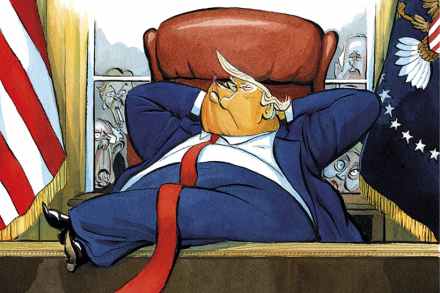
From the moment Donald Trump stepped onto the escalator in Trump Tower to announce his candidacy for president of the United States, there have been people in the Republican party who have sought to bring him down.   During the 2016 GOP primary, Republican national security officials wrote scathing and embarrassing open letters against him. Conventional Republican strategists and commentators like Karl Rove, Bill Kristol and Spectator USA’s own Rick Wilson blasted him as an incompetent, indecent, moron who shouldn’t be ten miles from the Oval Office. Trump’s primary opponents even tried to scuttle his nomination at the convention, an attempt that fizzled out before it really began. Three years later, these Never Trumpers are at it again.

It’s easy to see why Trump wants to buy Greenland

From our UK edition

When the news broke of Donald Trump’s interest in acquiring Greenland from the Danes for strategic, mining and perhaps golf course development purposes, it was a perfectly timed affirmation of what had otherwise looked an eccentric choice of summer holiday destination — namely to spend three days last week exploring part of the island’s east coast. When friends asked ‘Why Greenland?’ I explained that Iceland had served as the gateway drug. A fortuitous visit to Reykjavik a few years ago to advise on a new budget law had prompted return trips, not least for the food but also to explore the country’s fabled natural landscape. But it wasn’t enough. Surely you must have something else behind the counter, you know, a little harder…?

Tony Slattery is still a miraculously gifted comedian

From our UK edition

Some of the marketing efforts by amateur impresarios up in Edinburgh are extraordinary. I was handed a leaflet for a poetry show called Don’t Bother. I didn’t. Tony Slattery appears in Slattery Will Get You Nowhere (a good pun that advertises the content), in which the ageing comic takes the audience back to the 1990s. In those days he was a handsome, clever, charismatic wag who suffered from an excess of self-regard. Now he’s a grizzled, ramshackle presence, jowly and ill-shaven, like a forgetful pensioner on his way to the day centre. He starts his show with a lot of banter about wine but he doesn’t drink on stage. Alongside him sits a friendly interviewer who guides him through the rougher bridleways of his anecdotes.

America’s shootings aren’t Trump’s fault

From our UK edition

The BBC’s flagship news and current affairs programme wasn’t in any doubt about who to blame for America’s latest bout of mass shootings. Newsnight’s report began with footage of Donald Trump addressing the faithful at a rally. ‘This is an invasion,’ he warned, referring to the refugees massing on the Mexican border. ‘When you see these caravans starting out with 20,000 people, that’s an invasion.’ It then cut to Emily Maitlis in the studio. ‘That was in May,’ she said. ‘Today, Donald Trump called on Americans to condemn racism, bigotry and white supremacy.

Designer’s Notebook

From our UK edition

‘Volcanic temper… suspicious of everyone… irritability, mood swings… terror stalking the shadows… devastating collapse of Europe’s economy… rampant insecurity, unbridled hypochondria…’ Trump? No, it’s Henry VIII, according to Robert Hutchinson. But the ‘king’ across the water is uncannily like the Tudor tyrant; the discarded wives, the wenching, the rival heirs, the fawning, the flattery, the broken treaties. Palm Beach is his jousting ground; Mar-a-Lago his gaudier Nonsuch.

Diplomacy by deference

From our UK edition

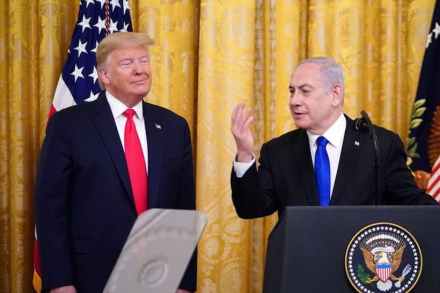
Iran’s seizure of a British-owned oil tanker transiting the Persian Gulf has let loose a fresh round of media war chatter. Yet should another Persian Gulf War actually occur, who would benefit? Not America, that’s for sure. The central theme of present-day US policy regarding Iran is deference. Nominally, US policy is made in Washington. Substantively, it is framed in Riyadh and Jerusalem, with the interests of the United States figuring only minimally in determining the result. I am not suggesting that President Donald Trump supinely complies with secret marching orders from Saudi Crown Prince Mohammad bin Salman and Israeli Prime Minister Benjamin Netanyahu.

Is China really the enemy?

From our UK edition

China is a nation with values deeply at odds with the West. The Chinese spy, steal and bully. They don’t really care about human rights yet are getting disgustingly rich, and — well, I’m sure you’ve heard the rest. The western media likes to depict China as the new enemy — both morally and politically. It seems as if a new iron curtain is coming down, with my country (and family) on the wrong side of the divide. Of course, Britain is my country too: I’ve lived here longer than I did in China. But I have to confess that this fundamental ‘clash of values’ — described in such vivid terms by Mike Pompeo, the US Secretary of State — is one that passed me by. To be British--Chinese is not to be torn in two by competing value systems.

Portrait of the Week – 18 July 2019

From our UK edition

Home In a televised debate between the rivals for election by members of the Conservative party as their new leader (and hence prime minister), Boris Johnson said of the Irish backstop, ‘It needs to come out,’ and Jeremy Hunt said that it was ‘dead’. This was described as ‘significant’ by Dominic Grieve, who said he was ready to bring the government down rather than see a Brexit without any agreement. Theresa May, the Prime Minister, said that she would continue to sit as an MP after her resignation on 24 July. Ffordd Pen Llech in Harlech was recognised as the steepest street in the world, at 37.45 per cent beating Baldwin Street in Dunedin, New Zealand, at only 35 per cent.

Hatred is in the eye of the beholder

From our UK edition

There’s a broad mainstream consensus on both sides of the Atlantic: Trump’s tweet telling four hard-left minority Congresswomen to ‘go home’ to the crime-ridden countries they’re from, when three of the four were born in the US, was racially inflammatory and staggeringly ill-judged.  But the first question that would be raised in the UK if a British politician committed such a gaffe is the last question raised in the US: was that post ‘hate speech’? The First Amendment to the American constitution guarantees five basic freedoms, including freedom of speech, and these principles ought rightly to pertain in other democracies such as Britain.

The Spectator’s Notes | 11 July 2019

From our UK edition

When I last talked to Sir Kim Darroch, he was a slim young private secretary, so it was a long time ago; but I can categorically state that President Trump is wrong to call him ‘wacky and a very stupid guy’. His particular sort of mandarin ‘Rolls-Royce mind’ intelligence does, however, amount to a form of stupidity when confronted with Mr Trump. Intellects like Sir Kim’s are slower than those of ordinary mortals to spot Trump’s communicative genius. They cannot see that it keeps him ahead of the game. It is really remarkable that a 73-year-old man can be such a master of forms of social media which did not exist until his sixth and in some cases his seventh decade.

The ties that bind

From our UK edition

It seems a fitting end to an ill-fated premiership. As Theresa May prepares to leave No. 10, a major quarrel erupts between her government and its most powerful ally, the United States of America. Leaked diplomatic cables show Sir Kim Darroch, the British ambassador in Washington, calling President Donald Trump ‘inept’, ‘insecure’ and ‘uniquely dysfunctional’. The funny thing is, the words in his memo are just as applicable to Theresa May’s leadership. Within days, Sir Kim resigns. But every diplomatic crisis is a political opportunity, as President Donald Trump well understands. He even spelled this out in one of his Twitter rants. ‘The good news for the wonderful United Kingdom is that they will soon have a new Prime Minister.

Boris’s most important appointment

From our UK edition

After being backed by a majority of Tory MPs, Boris Johnson now looks set to win over party members by an even larger margin. Surveys suggest he will hoover up between two thirds and three quarters of the vote. A Tory leader with such a mandate would, normally, start his premiership with huge amounts of political capital and be able to dictate terms to their opponents within the party. But Johnson will have to watch his back from the moment he crosses the threshold of No. 10. Most new prime ministers arrive with a decent majority. Johnson will be clinging to power from day one. Even with the DUP, the government has a working majority of just five MPs. That might go down to just three after the Brecon and Radnorshire by-election next month.

The invisible man | 11 July 2019

From our UK edition

The Brink is Alison Klayman’s documentary portrait of Steve Bannon, Donald Trump’s former chief strategist (he shaped the ‘America First’ campaign, proposed the Muslim travel ban, etc.) and former boss of Breitbart News, the place where unsuccessful white men go to whine. The film follows him for 15 months from the autumn of 2017 as he attempts to organise far-right European parties into a ‘populist nationalist’ movement, and you may wish to look away when Nigel Farage smarms all over him as it’s not a pretty sight. (I’m a delicate flower, so could only watch from behind my hands.) But it is not insightful and, alas, utterly fails to capture the man behind the persona, if there is one. (He seems to have no personal life but did once try golf.

Go, West

From our UK edition

My plan to cut the BBC out of my life entirely is working well. Apart from the occasional forgivable lapse — that excellent Margaret Thatcher documentary; Pointless and Only Connect because they’re the only programmes we can all watch together as a family — I find that not watching or listening to anything the BBC does is making me calmer, happier and better informed. I’m also learning stuff about myself that I never imagined possible. Like the fact that I have a massive man crush on the rap star Kanye West.

On Trump, President Xi had no idea what was coming

From our UK edition

When Donald Trump took the US presidency in 2016, China was wary, but hopeful. Here's was a businessman for whom money was important, and China could offer economic growth for both countries through trade. But three years on, Trump has waged a trade war against China and boycotted its national tech champion, Huawei. The Wall Street Journal's Editor at Large, Gerard Baker, writes this week's cover piece, and argues that this is just the tip of the iceberg when it comes to the containment policy that America is taking against China. He joins Isabel Hardman on the podcast. We also hear from China expert Yu Jie from Chatham House, who points out that, like many of us, the Chinese leadership hasn't quite got its head around Trump's America.

Ignoring Iran

From our UK edition

Crises in the Gulf and Conservative leadership elections come around with unnerving regularity. It is not unknown for both to coincide — that happened in 1990, when Margaret Thatcher was overthrown in the lead-up to the first Gulf War. On that occasion, drama on the domestic front did not smother Britain’s response to the international crisis — unlike now. It is bizarre to have a US president threatening to ‘obliterate’ Iran while our Foreign Secretary hardly bothers to respond, preferring to pose with fish and chips and Irn Bru on the campaign trail.

Chasing the dragon

From our UK edition

It will be all smiles when Donald Trump meets President Xi Jinping this week in Osaka at the annual meeting of the G20: a show of comity for the cameras and financial markets. The two are midway through one of the biggest trade wars that the world has seen in recent years, with the US imposing tariffs on $250 billion of imports from China and Beijing retaliating in kind. It’s possible that some sort of truce will be reached, as it was when the two men met late last year. The next stage of escalation — additional tariffs, or worse — may be postponed again. Don’t be misled. The tariff fight is only the most visible, outward sign of a much larger struggle.

Boris Derangement Syndrome

From our UK edition

I switched on the radio last week and caught the tail end of a discussion about the Conservative leadership election. The presenter, who seemed to be in a highly agitated state, was talking about one of the contenders: ‘A man who’s lied to both of his wives, all of his mistresses, every constituent, every employer, every party leader, every colleague, every interviewer, every journalist he’s ever encountered, he’s not just lied to them, he’s actively agitated to deceive them…’ On it went. Even by left-wing shock jock standards, it was unhinged. He could only have been talking about Boris Johnson. In the US, Trump Derangement Syndrome, or TDS, is a well-established phenomenon.

Trump’s re-election campaign never stopped

From our UK edition

 New York The great ceremonial game of poll dancing is gearing up for its quadrennial orgy. Headlines across the fruited plain bark out numbers and percentages in mystic confabulation. Votaries sway back and forth as the modern magi of the press repeat the results of this contemporary incarnation of taking the auspices. Was any medieval or ancient devotee of numerology more besotted by the task of squeezing significance out of numbers than our pollsters and their marks, or clients, are today? I doubt it. During the First Punic War at the naval battle of Drepana in 249 bc, the commander Publius Claudius Pulcher grew impatient when the sacred chickens failed to signal divine approval for the battle by refusing the grain they were offered.

Diary – 13 June 2019

From our UK edition

It was when the kindly folk at the Theatre Royal Haymarket said ‘You’ll be in Paul Whitehouse’s dressing-room’ that it sunk in: the epic biting off of more than I could chew. But there was no going back. In a couple of hours, I would be on stage — and this time, I’d sing. Exploring Paul’s stuff didn’t do much to keep the stage fright at bay: comedy-friendly hats and break-a-leg cards were in massed array. Kindly messages from my friends featured the words ‘gosh’ and ‘brave’. A couple of months ago, the stunt had seemed a bright idea. I have a new book to push, Wordy, one of those literary tapas samplers which despite its miscellany (or possibly because of it) readers seem to enjoy.