Dogs

Home alone

From our UK edition

The Secret Life of Pets is the latest animation from Illumination Entertainment, which also brought us Minions and Despicable Me, but whereas they were smart, funny, charming and original, this is not that smart, not that funny, not that charming and not that original. It’s an average caper that feels familiar and suffers mightily from an excess of chase scenes although, in the interests of full disclosure, I should add I attended the screening with a six-year-old who said afterwards: ‘I loved it.’ Six-year-olds. We are fond of them and all that, but they just don’t ever get the bigger picture, do they? This is set in Manhattan and concerns Max, a little terrier as voiced by Louis C.K. (The dogs speak, but to the human ear it sounds like barking.

The dogs of peace

From our UK edition

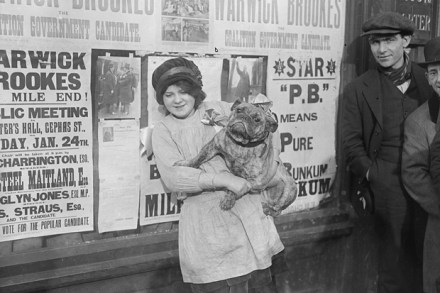
From ‘Food dictatorship’, The Spectator, 27 May 1916: Nobody would like to see the whole race of dogs exterminated, but there are undoubtedly more dogs maintained in this country than can reasonably be justified, and a substantial addition to the Dog Tax would diminish the number, and pro tanto economise the consumption of food.

My soppy, dopey, deadly predator

From our UK edition

Leo, the Hungarian Vizsla my wife brought home unexpectedly last year, is approaching his first birthday and not getting any easier to manage. Caroline decided to buy him on the spur of the moment because she ‘liked the way he looked’, by which she means he looks like her. Not the face, obviously, but his figure — thin, athletic, muscular, big ears, big feet. Indeed, she was walking Leo in Gunnersbury Park a few days ago when another dog -walker, spotting them together, burst out laughing. ‘I don’t think I’ve ever seen an owner who looks more like her dog,’ he said. This may have been his attempt at flirting — always hard to tell with dog owners. She noticed he had a pug, but managed to avoid the obvious -rejoinder.

Memories, dreams, reflections

From our UK edition

Heart of a Dog is a film by Laurie Anderson and it’s a meditative, free-associating rumination on life, loss, love and dogs, with particular reference to her and her late husband’s (Lou Reed, who died in 2013) beloved rat terrier, Lolabelle (who died the same year). It follows no linear logic. It’s a visual collage, a cine-poem, a dreamy documentary essay that was screened in London earlier this week to owners and their dogs — to rave reviews. ‘It’s great!’ said a golden retriever, but as he said the same of ‘a ball’ and also ‘a pizza crust’, he may not be the most reliable of critics. (This is why you never see golden retrievers on Film 2016 or writing for Sight & Sound.

Clumber spaniels

From our UK edition

For the first time in more than 30 years we have no Clumber spaniel. We have had five: Henry, Judith, Laurie, Persephone and Wattie. The last of them, Wattie the gentlest and sweetest of dogs, died a few months ago. We feel bereft. Clumbers are special: beautiful, affectionate, wilful, sometimes difficult, never dull. They take their name from Clumber Park in Nottinghamshire, once the seat of the Dukes of Newcastle. Different in appearance from other English spaniels — heavier, low-slung, with large sagacious heads — their origin is uncertain. According to one story, they came from France, being a gift from a French friend, the Duc de Noailles, to his fellow duke.

Inside of a dog

From our UK edition

Before I read this book, I thought I knew what a dog was. It barks, it wags its tail, it fetches sticks, it craps on the carpet. However, now that I’ve finished this learned tome, I realise there’s a bit more to it than I thought. As well as the domestic dog (Canis familiaris), the genus Canis also includes wolves, jackals, dingoes and coyotes. They all seem very different, yet domestic dogs can breed with all of them. According to Darwin, this makes them all members of the same species. Now can you see why I’m confused? Raymond and Lorna Coppinger don’t want you to make a snap decision about what a dog is — or what it isn’t. They want to make you think about how zoologists classify things: why we decide to call an animal one thing and not another.

Chips with everything

From our UK edition

When Laura Rennie was told that the cat she lost as a kitten had been found 18 years after it wandered off, she was overjoyed. An animal welfare officer turned up at her home to say the tabby had been located and traced to her, thanks to its microchip. Toby had been hit by a car, but was alive and at a local vet’s. Even if it were just to say goodbye, or take charge of his veterinary care, Ms Rennie would at least be able do the best for Toby. What a wonderful story, you might say, and what great proof, as complaints mount over the compulsory microchipping of dogs which became law this week, that pet microchipping is a much-needed resource.

Your problems solved | 4 February 2016

From our UK edition

Q. My husband-to-be and I both work full time. We are getting married from his family HQ and his kind mother has effectively done all the planning. She’s done it all with superb taste and efficiency so I am loath to be critical about the one thing I don’t like. She has ordered laminated name badges for all the guests, to be handed to them as they arrive at the reception, and is adamant they must be worn. She says they will help the elderly guests, but these make up only a tiny percentage: most are in their twenties or thirties. Do you agree that name badges would give an unromantic corporate flavour to our wedding reception? How can we overrule her with tact? — Name withheld, London SW10 A. Your concern is misguided.

Send in the clones

From our UK edition

How much do you love your dog? Do you secretly wish, as he or she grows older, that you could have another just the same? I’ll bet that tens of thousands of Brits feel this way — and soon their dreams could come true. When most of us last thought about it, cloning was an off-putting and futuristic prospect. Dolly the sheep was the poster girl, and things didn’t turn out too well for her. But times change, science creeps on, and last year a Brit called Rebecca Smith had her beloved dachshund, Winnie, cloned in South Korea. The going rate for Mini-Winnie would have been £60,000, but Rebecca won a competition and so — except for the obligation to appear in a TV documentary about the process — Mini came for free.

Cry havoc

From our UK edition

If you love dogs and or live with one — I declare an interest on both counts — there is enough here about what the authors too often call ‘doggies’ to keep you interested. But what I liked about this book, despite its trickle of cute language, is that the title exactly tells the story. The dogs indeed went to war, and they were trained to do unpleasant things, including committing suicide by charging into German strongholds carrying bombs, seeking out and identifying landmines, finding bodies under rubble, and guarding bases. But according to Clare and Christy Campbell, war dogs’ effectiveness, despite much heroic, sometimes false, publicity, is doubtful.

Your problems solved | 17 September 2015

From our UK edition

Q. Some years ago, while appearing as a barrister before a bench of three magistrates in the youth court, I encountered a problem. As I rose to address the chairman of the bench I found myself looking at an entirely androgynous figure with short brown hair, soft features and any physical indications of sex obscured beneath a large woolly jumper. After a moment’s panic — the custom is to address the court through the chairman using ‘sir’ or ‘madam’ — I fell back on the anachronism ‘your worships’, a phrase only used by the most pompous and elderly of police officers, thereby making an utter fool of myself. What else could I have done, Mary? — M.H., Monmouth A.

All from nothing

From our UK edition

Andrew Haigh’s 45 Years stars Charlotte Rampling and Tom Courtenay as a long married couple whose relationship is disturbed by a letter relating to his first girlfriend, a German who died in the Swiss alps 50 years earlier. Aside from that, not much happens. A shopping trip to Norwich is about as exciting as it gets, on the action front. But this is one of those ‘inaction films’, as I call them, in which nothing happens, but everything happens; it is simple yet absorbingly profound. And it will resonate. It will resonate afterwards and it will resonate the next day and it will resonate the day after that. In fact I am still resonating, and rather wish I wasn’t, so I could move on with my own life. It’s rare for a film to affect me in this way.

Letters | 2 July 2015

From our UK edition

How to fix Detroit Sir: When I last flew over my native Detroit five years ago, vast tracts of it still resembled Machu Picchu. From the ground, it was little better; in what had been a prosperous Italian-American neighbourhood when I lived there in 1964, there were only five houses left standing. Stephen Bayley (Arts, 27 June) marvels that ‘You could buy an entire house for $10,000’ — but in truth the taxes needed to support Detroit’s notoriously corrupt governments are so high that you can’t give them away unless they are in one of the few islands colonised by the middle classes. Indeed, the city filed for bankruptcy in 2013, with debts estimated at around $20 billion. I have no problem with gentrification, and I’ve done a fair bit of it myself.

Real life | 25 June 2015

From our UK edition

Why won’t the middle classes shout at their dogs any more? My suspicion is that the bleeding heart liberals, having succeeded in stopping right-minded people from shouting at their children, have moved on to stopping us from emotionally scarring animals. The result, of course, is that our four-legged friends are becoming about as unpleasant as your average infant. The spaniel and I take our lives in our hands every time we venture on to Tooting Common, running the gauntlet of ADHD dogs throwing their weight about as their owners cower in the distance calling politely at them to desist. These are not dangerous dogs, in any official sense, you understand. I did once see a pit bull being walked by a hoodie.

In praise of the pit bull

From our UK edition

Last night I saw a woman dancing with a pit bull terrier. It was about 9 p.m. and her curtains were open, lights on. Music must have been playing, though I couldn’t hear it through the glass, because she was singing as she danced the dog about, leaning back to balance his considerable weight. Her arms made a seat for him, as you might carry a child, his paws on her shoulders. The woman gazed down lovingly at the dog, who looked embarrassed but patient, as if this wasn’t his first dance and wouldn’t be his last. I watched them for a while, standing unseen in the street, half-wondering whether to take a photo — not for fun or for Facebook, but to show to all the crosspatch busybodies who support the ban on ‘devil dogs’.

How (not) to poison a dog

From our UK edition

Deadly to dogs An Irish setter was allegedly poisoned at Crufts, using beef containing slug pellets. Some other substances with which dog-show rivals could poison your pooch: — Chocolate contains theobromine, a stimulant which dogs cannot metabolise, and which causes the heart to race. It takes just 1 oz per pound of body weight of milk chocolate and a third of an ounce per pound of body weight of dark chocolate to kill a dog. — Grapes and raisins can cause kidney failure in two thirds of dogs. The link was discovered by America’s Animal Poison Control Center in 2004 after the fruit was linked to the deaths of 140 animals in one year, though the chemical involved is not known.

A dog to remember (and the wine he inspired)

From our UK edition

Meeting to taste wine, we started by talking about dogs. Roy Hattersley is good on the subject, which ought to be impossible. For he is opposed to shooting, and the partnership between gun and gun-dog, the dog’s tail-wagging joy as it luxuriates in its master’s approval, is one of the highest expressions of man’s commonwealth with the animal kingdom. Well, tot sententiae. But Roy understands one point. Human life is enfiladed by tragedy and the brief span of animal life is one aspect of that. In our relationship with animals, love and loss are intertwined. There was a splendid labrador called Hector, bred in Lincolnshire by Sir Brian Wyldbore-Smith. A general, he was an equally formidable Tory fund-raiser a generation ago, partly because he exploited an asset.

It’s dark days for dogs and their owners

From our UK edition

So who is poisoning all the doggies, then? I assumed, when the first horrible reports came through from Crufts, that it was either the Russians or the Muslims. Russians seem unable to go more than a few days without feeling the need to bump somebody off. Perhaps they’d run out of businessmen to kill and thought, during this morale-sapping lacuna, it would be wise to keep their hand in by murdering a few dogs.

Dear Mary: How will Joan Collins introduce herself now she’s a dame?

From our UK edition

Q. We enjoyed the Christmas University Challenge series featuring mature graduates, some of whom were more in the public eye than others. I was a little surprised that one team captain, a broadcaster at that, introduced herself as Dame X. I was always told that I must not introduce myself as Mr and that it was a title bestowed by others and not by oneself. I expect the same to apply should I ever become a Sir. As that is extremely unlikely, I ask merely out of interest and for the benefit of our beloved and newly be-knighted Dame Joan of these pages. I am sure she knows the protocol already but I should hate to think less of her if my logic is incorrect. — R.B., London SW3 A. Of course Dame Joan knows the protocol.

A miracle: French hotels actually like dogs

From our UK edition

The first time I checked in to a French hotel with a golden retriever — his name was Gregory, predecessor of the incumbent Douglas — I left him, clearly unhappy, in the bedroom when I went to dinner. Then I realised that every other party already in the dining room included a dog, in some cases a lapdog enjoying morsels direct from its mistress’s plate. So I fetched Gregory, shoved him under the tablecloth and told him to keep quiet. But each time a tasty dish went past, his big hairy head emerged and sniffed the air. Eventually the maitre d’hotel approached. ‘You’re in trouble now,’ I whispered (to Gregory). ‘Ah, quel beau chien,’ said the maitre d’. ‘Would he like to order anything?