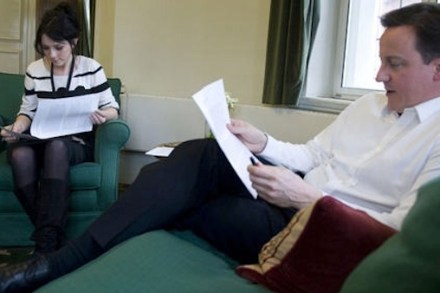
David cameron

The May machine

From our UK edition

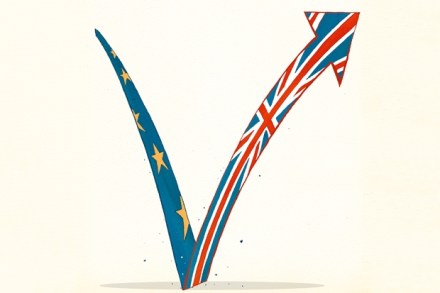
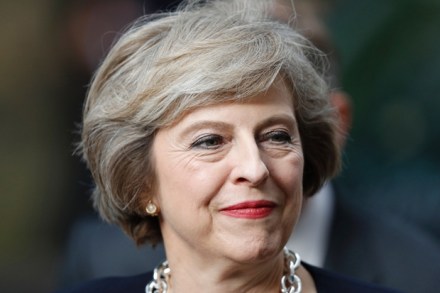
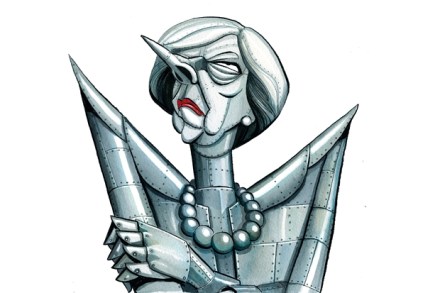
Theresa May isn’t much given to shows of emotion. When Andrea Leadsom called her to concede in the Tory leadership race, May was preparing for the first event of her nationwide campaign. She went ahead and delivered her speech, giving nothing away. But even May might be tempted to do a victory jig upon entering the leader’s suite at the Conservative party conference. Only a year ago, her leadership chances were being written off. Her ambition was a source of much amusement to Cameroons and her cabinet colleagues (including some now holding very senior jobs in her government). They thought her speech warning that ‘it’s impossible to build a cohesive society’ when immigration is too high was at odds with the one-nation, optimistic theme of that conference.
Doctor’s orders

From our UK edition

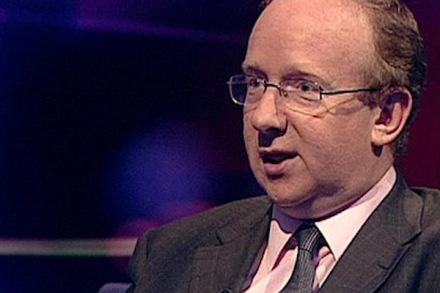
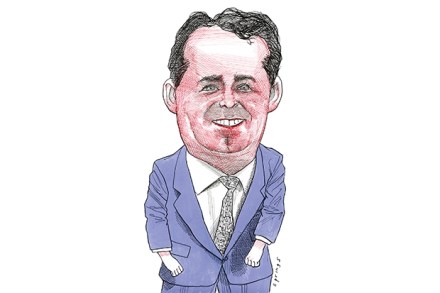
Second acts in British politics are vanishingly rare these days and Liam Fox, restored to the cabinet by Theresa May, is determined to make the most of his. We meet at his central London flat at half-past four on Sunday afternoon and even then the International Trade Secretary is beavering away: preparing for his meetings at the World Trade Organisation in Geneva the following day and finishing off his conference speech. He offers us a drink — red wine? pink champagne? — but pours a cup of tea for himself. Fox, as ever, is full of fizz. He clearly loves being back at the centre of things, and immediately starts contrasting Theresa May’s premiership with that of David Cameron. ‘We think similarly,’ he says.

Cameron’s old chum appointed UK Ambassador to France

From our UK edition

Although David Cameron's political career took a nose dive after the EU referendum result, he has been doing his best to ensure that his old chums don't too badly out of the situation. Take for example, Ed Llewellyn -- Cameron's former Chief of Staff. As well as being given a peerage in Cameron's resignation honours, Llewellyn has been appointed her Majesty’s Ambassador to France. While it had been previously reported that Cameron was lining up his mate for the plum job, the news has been confirmed today with a statement from Boris Johnson: 'Ed Llewellyn is hugely well qualified for this post and I look forward to working with him. He has served his country in Bosnia and Hong Kong and has extensive experience of Europe.

Women – and transwomen – should fight on the frontline

From our UK edition

My favourite quote of all time comes from John Stuart Mill: ‘War is an ugly thing, but not the ugliest of things. The decayed and degraded state of moral and patriotic feeling which thinks that nothing is worth war is much worse. The person who has nothing for which he is willing to fight, nothing which is more important than his own personal safety, is a miserable creature and has no chance of being free unless made and kept so by the exertions of better men than himself.

The Brexit bounce continues – ten forecasters up their predictions for 2016 growth

From our UK edition

The Brexit bounce continues. HM Treasury has today released forecasts of the economists it follows, as it does every month. Last time, there was a flurry of downgrades and forecasts of an immediate recession. Now, these forecasts are being torn up by everyone, including by the FT (although you can bet the FT won't report on the upgrades as eagerly as it did the downgrades). The average new forecast suggests GDP will grow by 1.8 per cent this year, far better than the 1.5 per cent forecast last month. This back to where the consensus was before the Brexit vote. The OECD, which had previously predicted "immediate" uncertainty after a Brexit vote, has today also upgraded to 1.8pc for this year, saying instead that the pain will be felt next year (it predicts 0.9pc growth).

Revealed: Danny Finkelstein was David Cameron’s stenographer

From our UK edition

There’s a great scoop in The Times today. A political columnist, former chief leader writer of a national newspaper was, unbeknown to readers, acting as David Cameron’s chief stenographer for six years. In his columns he’d present himself as a former Tory official, retired and out of action. Full of self-deprecating anecdotes about what happened back in the day when he was working for William Hague. What he failed to disclose was that, in between writing opinion pieces for his newspaper and acting as its Executive Editor, he was scurrying off to Downing Street to take dictation for the Prime Minister on a monthly basis. He recorded Cameron’s ramblings, hoping a to use them for a memoir for which the PM is keen to bag a million quid.

Defending Dave’s legacy

From our UK edition

It is too early to tell what sort of Prime Minister Theresa May will turn out to be, but we already know who she does not wish to be. From the moment that she arrived in Downing Street she has been inclined to define herself as the Conservative antithesis of David Cameron. She has developed a code for it, saying she’s for ‘the many, not the privileged few’ — as if she is still seeking to portray the Tories as a Nasty Party that must wash away the memory of its old leader. David Cameron got the message and resigned this week: next, he’ll be airbrushed out of No. 10’s photographs to complete his transition from Prime Minister to unperson.

Will David Cameron only be remembered for Brexit?

From our UK edition

At the moment, the consensus is that Brexit will be Cameron’s legacy, that the thing people will remember about his premiership is that he called a referendum on the EU and lost it. But I don’t think this will necessarily be the case. As I argue in the magazine this week, if Brexit -- to use a phrase -- turns out to be a ‘success’, then that will allow attention to turn to other parts of Cameron’s career. It will allow people to reflect on how, after three successive general-election defeats, he turned the Tories back into the natural party of government. On how he made them more comfortable with modern Britain and more representative of it. The irony of all this is that Cameron’s legacy depends on him being proved wrong on the dangers of Brexit.

Inside David Cameron’s personal Brexit

From our UK edition

In the days following David Cameron’s resignation as prime minister, Michael Gove tried to persuade the Cameroons to back Boris Johnson for the job. He argued that the former London mayor was the real continuity candidate. While Johnson would strike a very different path on Europe, Gove argued, he would keep Cameron’s domestic agenda going in a way that Theresa May would not. This was something Gove got right. But the referendum result was far too raw for this argument to work. The rest, as they say, is history. Since May became Prime Minister, it’s been clear that she does not represent continuity. May is her own woman.

David Cameron is only partly to blame for Libya’s problems

From our UK edition

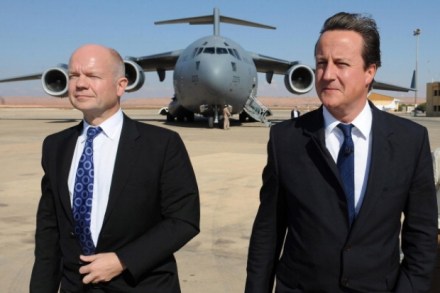
David Cameron is not having the best of weeks and the Foreign Affairs Committee’s highly critical report on his Libya intervention will not improve his mood. When the Chilcot Report came out, Cameron made much of how the National Security Council structure that he had put in place had improved policy making. But the FAC report states that despite the National Security Council, there was still no coherent strategy for the intervention. Indeed, it calls for an inquiry into how the NSC actually makes policy. The Libya intervention might have prevented a massacre in Benghazi. But the chaos in Libya since, the migrant crisis and the increase influence of Islamic State there mean that it cannot be judged a success.

Cameron resigns, again. Breaks his word, again. Trashes his reputation, again

From our UK edition

Is David Cameron trying to trash his own reputation? First came the worst resignation honours list for decades, which seemed designed to confirm everyone’s worst fears about his chumocracy. And today, he has handed a gift to those who denounced him as a career politician, someone with no sense of public service, whose interest in politics ran out when he thought it could no longer be useful to him. "Brits don't quit," he told us a few months ago: now he has quit, twice. After telling us several times that he'd stay, to fulfil a duty to parliament and his constituents. Even Gordon Brown fought another election after leaving No10 but Cameron has bolted, saying he has now decided that he'd be a “distraction”.

Coffee House shots: David Cameron quits backbenches and Witney

From our UK edition

David Cameron chose a rather blustery Oxfordshire afternoon to announce that he was stepping down as MP for Witney with 'immediate effect'. Cameron had previously suggested that he would stay on in Parliament, telling the BBC it was 'very much [his] intention' to continue as an MP. Pundits have linked Cameron's surprise u-turn to Theresa May's announcements about grammar schools at the end of last week, which undermined a key feature of Cameron's social policy. So what should we make of this move? And where does it leave May and the remaining Cameroons in the Commons? In this edition of Coffee House shots, Fraser Nelson tells Isabel Hardman that: 'I guess he's stopped caring about what people think about him. He's checked out from politics mentally.

David Cameron resigns as MP for Witney

From our UK edition

David Cameron is quitting as an MP. The former Prime Minister has just told ITV’s Chris Ship that he is resigning with immediate effect, prompting a by-election in Witney. Cameron’s decision is a surprise. It had long been assumed that Cameron would be the anti-Blair, staying on as the MP for Witney for some time after leaving Number 10. In that famous 2015 interview with James Landale, when he committed to not standing for election as Prime Minister again, Cameron waxed lyrical about his connections with Witney and the importance he attached to them. By going with immediate effect, Cameron has missed the opportunity to demonstrate to voters the importance he placed on being a good constituency MP.

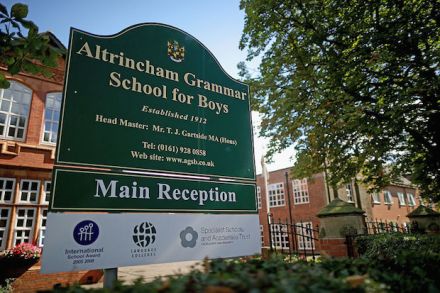
Before anyone sounds off about grammar schools, ask first where their children go to school

From our UK edition

There’s a good reason and a bad reason why David Cameron hasn’t added his mite to the argument about the reintroduction of grammars, which his Education Secretary, Nicky Morgan, sounded off about yesterday. The good reason is that it would be the worst of form for the former Tory PM to diss his successor, even if he disagrees with her. The bad reason is that he’s got a dog in this fight; his son Elwen. You remember all the fuss about the rumour that little Elwen might be going to a feeder prep to St Paul’s, the private school? The Camerons invoked media privacy to see off discussion of that topic. Well, if true, and I haven’t checked since, it gives Mr Cameron a very particular take on the matter of academic selection.

Cameroons fume about May’s grammar school plans

From our UK edition

Theresa May has picked the first defining fight of her leadership—and it is the same one that David Cameron chose. But, as I say in The Sun today, she has picked the opposite side from him: in favour of, not against, more grammar schools. Cameron’s opposition to more grammar schools infuriated many Tories, particularly those who were grammar school educated. They objected to a privileged public school boy telling them that they couldn’t be more of the schools that had done so much for them. May, by backing grammars, is sending out a very different message. She is showing these Tories that she’s one of them, a grammar school girl. As one Number 10 source puts it, ‘It is a bit of red—or blue—meat for the party’.

The Cabinet’s Brexit talk

From our UK edition

So, where are we at on Brexit? Well, we know that Theresa May wants immigration control as part of the deal which essentially rules out a Swiss or Norwegian style deal. But, as I report in The Sun, beyond that little is settled. As one Cabinet Minister said to me after the away day at Chequers this week, ‘The truth is that, at the moment, we’re still in the preparatory stage’. Cabinet Ministers were struck by how open the discussion was at Chequers. Unlike in the Cameron era, there was no early indication as to what the Prime Minister wanted the meeting to conclude. According to those present, one of the most forceful speakers was the Chancellor Philip Hammond. He emphasised that growth would be lower next year.

Letters | 1 September 2016

From our UK edition

Against Boris Sir: In discussing my attitude to Boris (‘The Boris-bashers should be ashamed’, 27 August), Mary Wakefield is too kind — to Boris. She claims that I am agin him because he has no plan and no philosophy. Not so: my criticisms are nearer those of the Oxford contemporaries whom she cites and who described Boris as a ‘sociopath’. He is a charismatic narcissist in a long tradition stretching back to Alcibiades. Such characters have no moral, intellectual or political integrity, but have a sublime confidence in their ability to charm themselves out of every embarrassment. Mary goes on to claim that David Cameron had no plan either, and surrounded himself with ‘yes men’. David was once asked about his overall objective.

In praise of free schools

From our UK edition

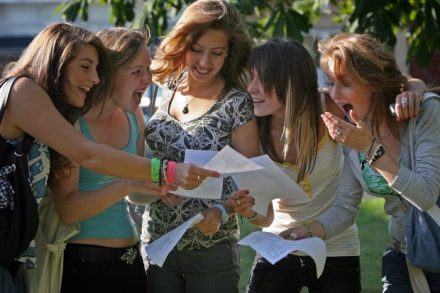
Congratulations to all those free schools who got their GCSE results this morning. We don’t yet have the full picture, but early reports are good. Top marks to Tauheedul Islam Boys' High School in Blackburn, a free school that opened in 2012. Ninety-five per cent of its pupils achieved five A* to C grades in their GCSEs, including English and maths, a metric known as '5A*–CEM'. To put this in context, last year’s 5A*–CEM national average was 56.1 per cent. Another school that has done well is Dixons Kings Academy in Bradford. It was one of the first 24 free schools to open in 2011 – it was originally called King Science Academy – and was taken over by the Dixons Academy chain after financial irregularities were brought to light by a whistleblower.

Osborne’s gone. So why’s Carney still around?

From our UK edition

Did you see that odd photo of George Osborne looking shifty, queuing up in the Vietnamese jungle for the chance to fire an M60 machine gun? I found it interesting for a number of reasons. One, obviously, is that it’s probably the first time in five years Osborne hasn’t been pictured wearing a hard hat and goggles. Another is what it tells us about his earnings prospects on the US speaker tour circuit: those guns can fire up to 650 rounds a minute — so at the local tourist rate of £1 a bullet that’s quite an expensive cheap thrill. Mainly, though, what struck me about that snap was just how quickly fortune’s wheel can turn.

David Cameron’s larynx comes to his defence on childhood obesity

From our UK edition

Theresa May was once seen as the continuity candidate to succeed David Cameron. However, since becoming Prime Minister she has gone on to sideline or backtrack many of Cameron and George Osborne's pet projects. As well as delaying Hinkley Point and leaving the Northern Powerhouse's future up in the air, she has provoked anger this week over the Government's childhood obesity strategy. While Cameron made clear that childhood obesity would be a flagship issue for his government -- with Jeremy Hunt even promising to take draconian measures -- May appears to take a different approach. In the report -- pushed out in recess -- May has scrapped plans to curb junk food advertising and created confusion over Osborne's sugar tax now that it will no longer be a tax on consumers.