David cameron

The human factor | 22 October 2015

From our UK edition

Just over 30 years ago, Margaret Thatcher’s government decided to look at local government finance. A young aide, John Redwood, outlined ‘some kind of poll tax which is paid by every elector’. Discussions continued, and bright young men (including the young Oliver Letwin) assured the Prime Minister that the figures would all stack up. Unpopular to start with, perhaps, but necessary. Later, Kenneth Baker had a niggle: ‘If I’m on Question Time and I’m asked “Why must the Duke and the dustman pay the same?” there’s no answer.’ Last week the energy secretary Amber Rudd was on Question Time.

Will Theresa lead the Out tribe?

From our UK edition

[audioplayer src="http://rss.acast.com/viewfrom22/thedeathoffeminism/media.mp3" title="James Forsyth and Isabel Hardman discuss whether Theresa May will lead the Out campaign" startat=1050] Listen [/audioplayer]Who is the most politically interesting member of David Cameron’s cabinet? There’s a good case to be made for Michael Gove. He is as intent on reforming the justice system as he was our schools. If he succeeds, it will be the biggest transformation in Britain’s approach to criminal justice since the Roy Jenkins years. The prison population will begin to fall.

Iran’s hidden war with the West – and what we can do to fight back

From our UK edition

When British troops were on patrol in Iraq and Afghanistan, we faced many enemies, from jihadis to press-ganged civilians. But for me, the most terrifying ones lay buried. Bullets usually miss. Improvised explosive devices – IEDs — don’t. They are frighteningly simple. Old munitions wired together or plastic bottles packed with fertiliser and ball-bearings could destroy a vehicle and kill its passengers. During my four years in Afghanistan I saw IEDs evolve: first came remote triggers, then pressure plates and then low-metal-content devices. Curiously, IEDs evolved in a similar way in Iraq. This should be no surprise, since the groups trying to kill British troops shared one common resource: Iranian support. For years, Tehran has armed insurgents.

Listen: BBC’s Laura Kuenssberg confronts President Xi over China’s human rights

From our UK edition

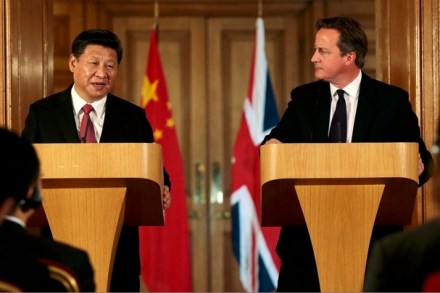
One of the clever things that politicians try to do is to redefine words and concepts that everyone thought they knew the meaning of. Take today’s ‘press conference’ that David Cameron and Chinese President Xi held in Downing Street. That ‘press conference’ consisted of statements followed by two questions, though dozens of journalists had turned up. Fortunately, the question from the British media came from the BBC’s Laura Kuenssberg, who asked the Prime Minister how he thought a British steel worker would feel that the Chinese president was being ‘ferried down Whitehall in a golden carriage’ and whether there is ‘any price that’s worth paying in order to further our business interests with China?

The British public agrees: China is buying our foreign policy

From our UK edition

A few weeks ago, the Dalai Lama gave an interview to The Spectator where he summed up what he regarded as David Cameron’s policy of not seeing him again, so as to not upset his new friends in Beijing. ‘Money, money, money,’ he said. ‘That’s what this is about. Where is morality?’ A powerful point – and one that we put on the cover of the magazine. Now YouGov has put his words to the public in an opinion poll, and asked if they are a fair reflection of Cameron’s policy on Tibet and China. The result: 69 per cent said he was right, and just 8 per cent said he was wrong. With President Xi signing deal after deal today, the Dalai Lama can now consider his verdict amply vindicated. [datawrapper chart="http://static.

Lionel Barber strengthens his ties with China

From our UK edition

Last night's state banquet saw Jeremy Corbyn join David Cameron, President Xi Jinping and Her Majesty to raise a glass to the beginning of a golden era of partnership between China and the United Kingdom. With Corbyn meeting the Chinese president earlier in the day to raise grievances regarding the country's human rights track record, his encounter with the president at the dinner appeared to be a civil one.

PMQs: Corbyn fails to sustain the pressure on Cameron

From our UK edition

PMQs was a rather ill-tempered affair today. With tax credits and steel closures dominating proceedings, the two sets of benches went at each other with vigour. This was much more like an old-style PMQs than the other Corbyn sessions. The Labour leader began on the tax credits issue. His questions were beginning to rile Cameron, who — in a poor choice of words — said that he was ‘delighted’ that tax credit cuts had passed the Commons. But Corbyn then changed tack to ask about the steel industry. This eased the pressure on the Prime Minister and allowed him to regain the initiative. Corbyn finished his set of questions by demanding that Cameron cooperate with a UN investigation into how Britain treats the disabled.

A Chinese bailout won’t save Hinkley Point, our latest nuclear disaster

From our UK edition

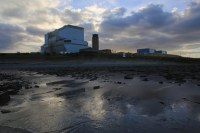
How easy it would be to scorn the environmentalists who are up in arms about George Osborne’s new pet project, the Hinkley Point C nuclear power station. You can understand their anxiety: subsidies for green energy are being slashed, yet the Chancellor will do anything — and pay anything — to get this project up and running. He is happy to force households to pay artificially high prices for a form of energy which brings all kinds of risks — of which the world was reminded this week when Japan found the first cancer case liked to the Fukushima disaster of 2011. ‘Has the Chancellor lost his mind?’ they ask.

Is our foreign policy being dreamt up by the James Bond screenwriters?

From our UK edition

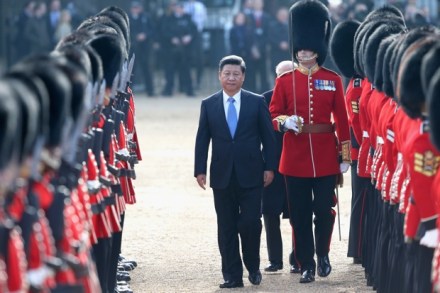
If there's one thing that the James Bond films has taught us it is that the Chinese are not our enemies. We should perhaps remember this as President Xi Jinping polishes his heels on our red carpets this week. Our enemies are cold war Russians, jewel-encrusted North Koreans, ex-Nazi rocket scientists, fat Europeans obsessed with gold, and, of course, bald Polish-Greek crime lords called Ernst with a love of bob sleighs and white cats. The imminent release of the twenty fourth Bond film is a handy reminder that if we're looking for threats, we should really look closer to home.

Cameron tells Cabinet renegotiation will quicken soon

From our UK edition

The Cabinet met this morning, but it didn’t manage to discuss two of the biggest political problems for the Tories at the moment, according to the Downing Street read-out of the meeting. The growing row on tax credits was only referred to when the discussion of parliamentary business touched on the fact that there is an Opposition Day debate on the matter later today, and there was no discussion of the demands from a number of those present at the table for collective responsibility to be suspended during the EU referendum. Not surprising, perhaps, given this was Cabinet rather than political cabinet, but a reflection of the way rows don’t always make their way into the formal discussions between ministers.

Isabel Oakeshott on David Cameron: he said he would trash whatever we wrote

From our UK edition

The launch party for Call Me Dave proved to be an eventful affair as it was revealed that Lord Ashcroft was unable to attend after falling critically ill around the time of the book's launch. As guests munched on cocktail sausages and sipped champagne, his co-author Isabel Oakeshott took to the stage to give a speech. To kick things off, Oakeshott recalled David Cameron's advise to her when she first planned to help Ashcroft write the biography. Oakeshott, who was the Sunday Times political editor at the time, says he warned her against joining the project: 'We had a conversation about my plans to help Michael with his book, I recently looked at the transcript of our conversation and was struck by his dark warnings about me getting involved.

The government’s new counter-extremism strategy is careful and rigorous — albeit with one major flaw

From our UK edition

The British government has published its counter-extremism strategy, unencumbered by the Liberal Democrats who held a similar strategy up for five years of coalition. There is much to be said about this strategy, a strategy which is to my mind the most advanced, careful and rigorous counter-extremism strategy anywhere in the Western world. While the US government remains unwilling to even identify the major source of extremism in the world today, the UK government is taking a lead in being willing to both identify and tackle Islamist extremism as the major source of concern, while acknowledging that other concerning types of extremism also exist. Crucially the strategy strengthens the powers of Ofcom, the Charity Commission and other bodies to do the job they need to do.

David Cameron’s EU renegotiations appear to be underwhelming his own MPs

From our UK edition

David Cameron has just delivered a statement to the House of Commons on last week’s European Council meeting. Cameron stressed that any visa liberalisation programme for Turkey would not apply to Britain as this country is not part of Schengen. He also reiterated his condemnation of President Assad and accused the Russians of predominantly striking other rebels groups in Syria not Isil; he said that only 20 per cent of Russian strikes in Syria had been directed against Isil. But the most politically significant part of the statement came when Cameron again set out his renegotiation demands.

David Cameron expected to give eurosceptics their free EU vote – after letting them put up a fight

From our UK edition

Will David Cameron allow senior ministers to take whatever side they wish in the EU referendum? There are reportedly six Cabinet Ministers pushing for a free vote on the matter, and today Liam Fox added his voice to the calls, telling the Daily Politics that even if the Prime Minister refused an official suspension of collective responsibility, ministers would find other ways of making their views heard. He said: ‘Ultimately the legitimacy of the result will depend on whether the voters think they have heard all the arguments openly and fairly and I think any attempt by any side to restrict people's voice in that debate will limit how people feel the legitimacy of the referendum has gone and I think that’s really important.

Steve Hilton takes a swipe at the Tories over China

From our UK edition

Chinese President Xi Jinping arrives in Britain today to embark on his official state visit. While the visit aims to build on George Osborne's own trip to China to reinforce trade relations, Jeremy Corbyn is expected to ruffle feathers by bringing up the country's bad track record on human rights when he meets the president this week. Government figures are hoping Corbyn will spare them blushes by using a private meeting with the president for the conversation rather than Tuesday's state banquet, with China's ambassador to the UK warning that he expected British people to know how to behave at the dinner. However, should Corbyn give off a frosty demeanor at the lavish do, he will find an unlikely supporter in David Cameron's former head of strategy Steve Hilton.

The Age of Nicola: Sturgeon maps out the road to independence

From our UK edition

The problem with Nicola Sturgeon is that she is, by the standards of contemporary politics, unusually straightforward. There is little artifice and even less deceit about Scotland's First Minister. What you see is what you get; what she says is what she mostly means. That is, even when she's sidling past the truth it's clear what she really means. And so, there it was, out in the open at last: a clear confirmation that Jeremy Corbyn and his Labour party are Nicola Sturgeon's useful idiots. Sure, there may not be any need for another referendum on independence before 2020 - not least because, as matters stand, that referendum might, like last year's plebiscite, be lost - but there will be another referendum at some point. And it will be won.

When will the EU referendum be?

From our UK edition

David Cameron is in Brussels today with the European Commission not hiding its irritation at the slow pace of the British renegotiation. One member of the Cabinet committee handling the renegotiation admits that ‘We were hoping to be further ahead than we are now’. Though, they blame the hold-up not on Britain being unclear about what it wants but on the migrant crisis taking up the time and attention of European leaders and the EU institutions. The upshot of all this, though, is that the date for the referendum is slipping back. At the moment, autumn 2016 is the government’s preferred date. But members of the Cabinet, including those on the Europe committee, are increasingly talking about a 2017 date.

Could George Osborne come out for the Out campaign?

From our UK edition

[audioplayer src="http://rss.acast.com/viewfrom22/thedisasterofthesnp-silliberal-one-partystate/media.mp3" title="James Forsyth and Isabel Hardman discuss the current state of the EU referendum" startat=1038] Listen [/audioplayer]Westminster may have been guilty of ignoring the Scottish referendum until the last minute, but no one can accuse it of doing the same with the EU one. No one knows when this vote will take place, yet every conversation about the politics of this parliament revolves around the subject. The referendum, and its aftermath, will determine not only whether Britain stays in the European Union but also who the next prime minister will be and whether the Tories win a landslide in 2020.