David cameron

Europe podcast special: what would Brexit mean for British business?

From our UK edition

This podcast was sponsored by King & Wood Mallesons. Would a vote to leave the EU help or hinder British businesses? In this View from 22 special podcast, The Spectator's Fraser Nelson discusses the upcoming EU referendum with Matthew Elliott, co-founder of the Vote Leave campaign, Richard Reed, the co-founder of Innocent Drinks and a patron of the Stronger In campaign, and Stephen Kon, senior partner at King & Wood Mallesons. How are British business feeling about a potential Brexit sometime before 2017? Aside from the major corporations, are smaller businesses more inclined towards remaining in or leaving the EU? Where does the greater danger lie: the uncertainty of leaving the EU or remaining in and facing more integration with Brussels?
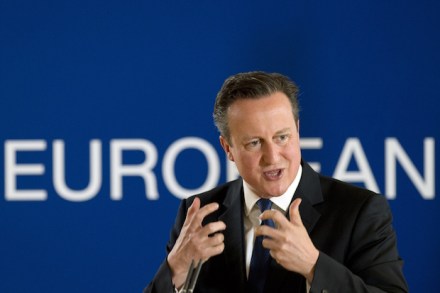
David Cameron will secure all of his EU reforms — because they will alter nothing

From our UK edition

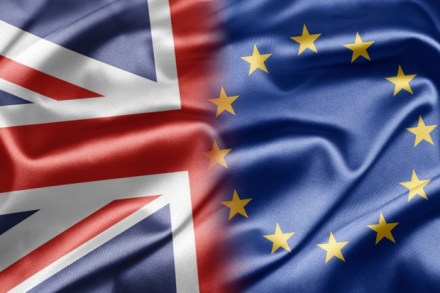
I have no doubt that David Cameron will secure 100 per cent of his stated aims vis-à-vis the EU. The reason he is stating them in public is that the other members have already agreed to them in private. They have done so cheerfully, incredulous at how little is being asked. The other heads of government know, as the PM knows, that his four 'reforms' will alter nothing. Think about it. 1. Opting out of the words 'ever closer union' Just the words. Not the fact of ever closer union. The real way to opt out would be to end the automatic supremacy of EU over British law. As long as European Commissioners and judges, who loudly proclaim that deeper integration is their supreme goal, can over-ride UK statues, nothing will change. 2.

Watch: David Cameron heckled during EU speech

From our UK edition

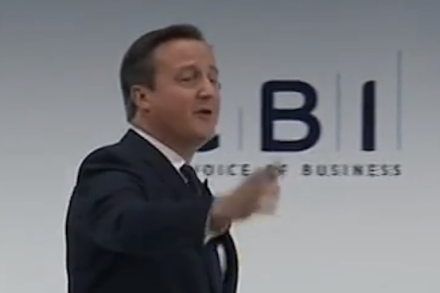
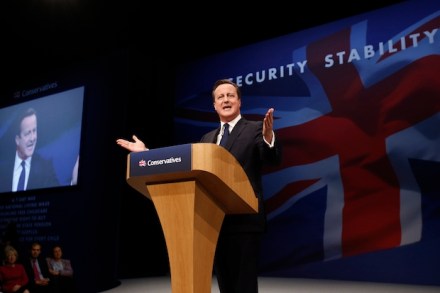
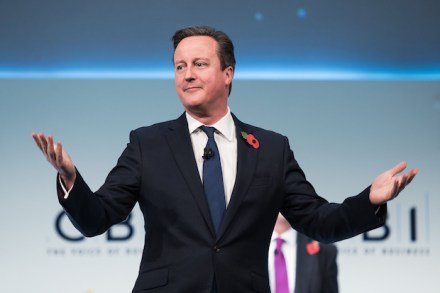
Oh dear. David Cameron's speech to the Confederation of British Industry got off to a shaky start today after he was heckled by Brexit protesters. While the CBI had opted to leave members of the Vote Leave campaign off of the invite list, two protesters managed to sneak in and get their own anti-EU message across. As the Prime Minister gave a speech in which he said that he could work with business leaders to keep 'Britain in a reformed Europe' after a successful renegotiation, protesters held up a banner and shouted that the CBI is the 'voice of Brussels': https://twitter.

Why an EU referendum in June 2016 is unlikely to happen

From our UK edition

The EU referendum looks set to be held next year – it’s now a question of whether it's in the summer or autumn. Today’s Times reports that Whitehall is preparing for a referendum next June, if EU leaders are on side with David Cameron's proposed reforms at December's European Council meeting. The Prime Minister is set to deliver a speech at the CBI today, where he will describe the vote as ‘the biggest we will make in our lifetimes’ and will say the decision isn’t about whether Britain can ‘survive outside’ of the EU but whether it ‘adds to our economic security or detracts from it’.

In pictures: Spectator Parliamentarian of the Year 2015

From our UK edition

After a year of surprises across the board from the Tory majority to Labour's new leader, Westminster's rebels and insurgents descended on the Savoy Hotel to celebrate The Spectator's Parliamentarian of the Year awards. With the awards presented by Alex Salmond — last year's winner of Politician of the Year, the former First Minister of Scotland made sure to put Scottish independence firmly on the menu, namechecking his country's struggle several times in his speech. With Jeremy Corbyn unable to be there in person to collect his gong for Campaigner of the Year, it fell on his fellow comrade Diane Abbott to do the honours. The Labour frontbencher found time in her tribute to warn audience members not to underestimate the size of Jeremy Corbyn's mandate.

Spectator Parliamentarian of the Year 2015: the winners

From our UK edition

The Spectator’s 32nd Parliamentarian of the Year awards, sponsored by Benenden, took place at the Savoy Hotel this afternoon. Here are the winners – and a few extracts from my speech. The awards were presented by Alex Salmond. The winners' speeches, and my spiel, are below: 1. Speech of the year – Johnny Mercer Our winner is a former serviceman – and, briefly, a male model – whose maiden speech was theatrical, magisterial and moving. 'A great stain falls upon our nation,' he said, 'when more soldiers take their own lives than die in action.' Our winner completed three tours of Afghanistan, now serving his first tour of duty for the Tories. 2.

Cameron’s Syrian stew

From our UK edition

[audioplayer src="http://rss.acast.com/viewfrom22/civilwarinthecatholicchurch/media.mp3" title="Fraser Nelson and Isabel Hardman discuss whether MPs will ever vote to bomb Syria" startat=864] Listen [/audioplayer]David Cameron doesn’t do regret. It is not in his nature to sit and fret about decisions that he has taken and can now do nothing about. But there are still a few things that rankle with him. One of those is the House of Commons’ rejection of military action in Syria two years ago. This defeat was a personal and a political humiliation for Cameron. For months, he had been pushing for action against Assad. President Obama had finally accepted that something must be done following the Syrian regime’s use of chemical weapons.

PMQs: jeering Tories let themselves down

From our UK edition

Today’s session of Prime Minister’s Questions was pointless. Describing any session as pointless is in itself a little pointless, as it takes you into the sort of territory where, like the author of Ecclesiastes, you end up declaring everything meaningless. But today really was a pointless session. The most obvious example of pointless behaviour came from the Tory side, with Conservative MPs deciding that they should return to the old days of roaring and jeering just as Jeremy Corbyn was asking questions about cuts to tax credits. David Cameron helped them out by chortling with exasperation as he responded without answering to yet another question from the Labour leader about whether he could guarantee that no family would be worse off as a result of the tax credit cuts.

No10 insists that Cameron may still seek vote on bombing Syria

From our UK edition

Number 10 is this morning pushing back against the reports that David Cameron has abandoned a vote on extending British military involvement in action against Isis to Syria. Sources insist that they do not recognise the stories that have appeared in a number of papers and that nothing has changed. Those reports suggest that Cameron was struggling to persuade sufficient numbers of Labour MPs to back his stance. This is not particularly surprising given it was always going to be difficult to be confident that MPs from another party would definitely do as they said. The Tory whips can hardly apply the same methods to those MPs in the Opposition party as they do to those on their own side. Cameron has always said he will not bring a vote until there is consensus.

Is Benedict Cumberbatch the new Russell Brand?

From our UK edition

With Russell Brand no longer an active revolutionary, having officially retired from politics after failing to make an impact on the general election, there's a vacancy for a new celebrity champion of fashionable political causes. Thankfully Benedict Cumberbatch appears to be doing his best to fit the bill. The Sherlock actor made the news last week after he ranted on-stage about the government's response to the refugee crisis following a performance of Hamlet at the Barbican. According to the Daily Mail, Cumberbatch let it be known that he thought the government's pledge to take 20,000 refugees was not enough, before -- eloquently -- concluding: 'f--- the politicians'.

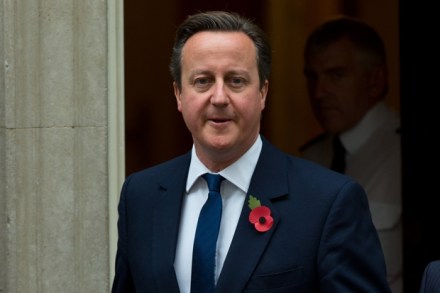
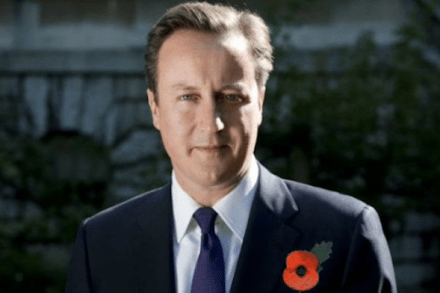
David Cameron finds himself in hot water over poppy photoshop

From our UK edition

After the actress Sienna Miller became subject to vitriol over the weekend for failing to wear a remembrance poppy during an appearance on the Graham Norton Show, politicians and celebrities alike are now doing their best to show off their poppies at any opportunity. Today 10 Downing Street even changed their Facebook profile photo to one of David Cameron sporting a poppy. However, Cameron's remembrance efforts have since been questioned as Number 10 have been accused of photoshopping a poppy onto an old photo: https://twitter.com/dylanhm/status/661228417803755520 The original photo from July had no poppy: https://twitter.

Cameron should consider offering a twin-track EU negotiation

From our UK edition

A big problem with the coming European Union referendum is that voters won't know what voting 'leave' means. If we do decide to quit, it will be a leap in the dark that could cause huge damage to the country. There is, therefore, a strong democratic case for spelling out the terms of our departure before it becomes final. The best way of achieving this would be for David Cameron to launch a double negotiation. As well as trying to improve the terms of our membership - the focus of his current talks with the EU - he would clarify our potential divorce deal. The voters would then get to compare two clear options and choose the one they prefer. If something like this had been done with Scotland, we wouldn't still be wrangling over the Scottish issue.

Club class won’t fly any more

From our UK edition

I’m getting a lot of abuse on Twitter for saying that having been a member of the Bullingdon is more of a hindrance than a help in contemporary Britain. My comment was a response to a piece by Charlotte Proudman in the Guardian on Monday that Oxford and Cambridge’s drinking clubs ‘cement the succession of power and influence in Britain among a narrow elite’. In response to my claim, numerous people have pointed out that the Prime Minister, the Chancellor of the Exchequer and the Mayor of London were all members of the Bullingdon. The problem with this rebuttal is that merely pointing out that Cameron, Osborne and Johnson are successful politicians doesn’t, by itself, prove their membership wasn’t a hindrance.

Portrait of the week | 29 October 2015

From our UK edition

Home After it was twice defeated in the Lords on its plans to reduce working tax credits, the government announced a review of the workings of Parliament, to be led by Lord Strathclyde, the former leader of the House of Lords. Peers had voted for a motion by Lady Hollis of Heigham to delay the measures until the introduction of ‘full transitional protection’ for those who would suffer loss, and for a motion by Lady Meacher to delay them until the government had responded to an analysis by the Institute for Fiscal Studies. The IFS had said that three million working families would be on average £1,300 a year worse off.

Chilcot Report will be published in June or July 2016

From our UK edition

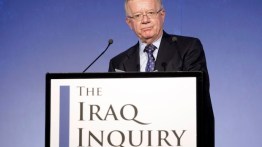
Finally, Sir John Chilcot has announced when his inquiry into the Iraq war will arrive. He has written to the Prime Minister this morning to say the findings of his inquiry will be published in June or July next year. After years of increasing pressure from the public and government, Chilcot says the text will be finished the week commencing 18 April 2016 and the report will then be checked by national security staff. When it finally arrives, it is going to be a long read: 'The very considerable size of our report – more than two million words in total — means it will take some weeks to prepare the report for printing and publication.

Lords of misrule

From our UK edition

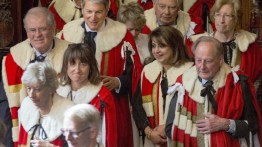
A few days after the general election, I bumped into one of David Cameron’s longest-standing political allies, one of those who had helped him get selected for Witney back in 2000. I remarked that he must be delighted that Cameron had now won a majority. To my surprise, he glumly replied that it would only be significant if Cameron were to create a hundred new peers. Without them, he warned, the govern-ment’s most important measures would end up bogged down in the Lords, where Labour and the Liberal Democrats combined comfortably outnumber the Tories. Now, normally when people urge the Prime Minister to create new peers it is because they hope that they will be on the list themselves.

Cameron rekindles collective responsibility row with EU comments

From our UK edition

David Cameron’s decision to make it clear that he is definitely not ruling out Brexit by saying that ‘people need to understand there are significant downsides’ to being outside the European Union has been greeted with derision in eurosceptic circles. Campaigners argue that the Prime Minister clearly doesn’t think he’ll get much from his renegotiation if he doesn’t think it’s worth continuing to threaten that he could possibly campaign to take Britain out of Europe in order to spook EU leaders into giving him what he wants.

David Cameron’s ‘milk and honey’ intervention on the EU could be a mistake

From our UK edition

David Cameron’s decision to wade into the EU debate by dismissing the Norway option and warning that there is no ‘milk and honey’ alternative to EU membership is one of the most significant political moments of this parliament. It is Cameron entering the referendum fray, and long before the renegotiation has been concluded. On one level, Cameron is correct. There are Eurosceptics who have advocated the Norway option. In his keynote speech on Europe last year, Owen Paterson — who is on the parliamentary planning committee of Vote Leave — declared: ‘This brings us to the only realistic option, which is to stay within the EEA agreement. The EEA is tailor made for this purpose and can be adopted by joining EFTA first.

PMQs: Corbyn hones his skills as Leader of the Opposition, but not as an election winner

From our UK edition

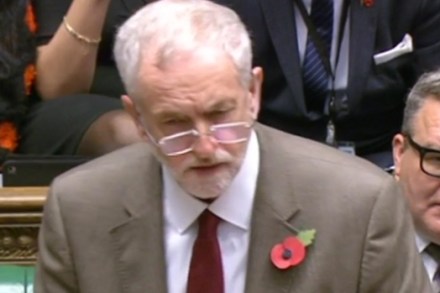
Jeremy Corbyn’s growing confidence at Prime Minister’s Questions is almost perfectly in step with his growing unpopularity outside the Chamber. He has perfected his geography teacher stare of disapproval to the extent that Tory MPs now automatically fall silent when he talks for fear of being kept behind after class. And he isn’t leaping all over the place with a phone-in format that doesn’t hold the Prime Minister to account. This week, the Labour leader focused on tax credits, and highlighted David Cameron’s inability to answer his questions about whether he could guarantee that no-one would be worse off as a result of the changes.

Revealed: how Jeremy Corbyn caused a scene at the China state banquet

From our UK edition

Last week Jeremy Corbyn appeared to be on his best behaviour when he attended the state banquet at Buckingham Palace in honour of China’s President Xi Jinping. While he opted to attend the event solo, the republican Labour leader did manage to don white tie, and appeared to successfully make small talk with both the Royal family and members of the Chinese delegation. Alas, word reaches Steerpike that Corbyn's efforts during the dinner were not so well received. Mr S understands that he actually broke one of the most basic rules of dining etiquette during the lavish do: no mobile phones at the dinner table. Party guests were surprised to spy the Labour leader texting on his phone during the dinner.