David cameron

Mundane duties interrupt Field Marshal Cameron

From our UK edition

Cameron was at pains to disguise it, but his impatience finally gave way at PMQs today. What a contrast with the last 24 hours. The nemesis of Gaddafi, the terror of Tripoli, the champion of the rebels, the moral conscience of the West, the world’s latest and greatest international tyrant-buster had to return to earth, and to the House of Commons, to deal with enterprise zones, disability benefits, carbon trading price structures and all the belly-aches of the provincial grockles who put him where he is. What a chore. Ed Miliband had a pop at him on police numbers. The Labour leader asked a clear and simple question. ‘Will there be fewer front-line police officers in future or not?
An explosive session

From our UK edition

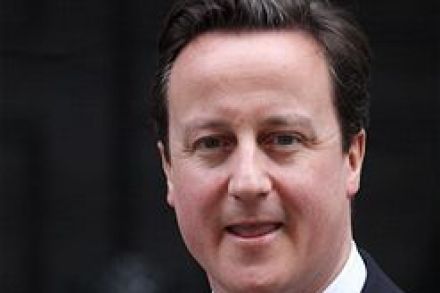
This PMQs will be remembered for the Cameron Balls spat. As Cameron was answering a question from a Labour MP, he snapped at Balls who was heckling him, shouting ‘you don’t know the answer, you’re not properly briefed, why don’t you just say you’ll write to her’. A visibly irritated Cameron shot back, ‘I wish the shadow Chancellor would shut up and listen for once’. At this the Labour benches erupted, their aim at PMQs is always to get Cameron to lose his temper and they had succeeded. Cameron then produced a brilliant comeback, saying that Balls was ‘the most annoying person in British politics’ and ‘I suspect that the leader of the opposition will come to agree with me.

PMQs live blog | 30 March 2011

From our UK edition

VERDICT: What happened there, then? The Prime Minister often has a confident swagger about him when it comes to PMQs — but today it went into overdrive. He simply couldn't conceal his glee at taking on Eds Miliband and Balls; the first over his appearance at the anti-cuts demonstration, the second for just being Ed Balls. It was a little bit Flashman from the PM, perhaps. Yet, on this occasion, it also helped him sail through the contest more or less untroubled. Aside from the theatrics, the serious talk was reserved for whether the coalition should help arm the rebels in Libya. The PM's official position was that we shouldn't rule it out, although, if anything, he sounded as though he quite favours the idea.

Danny Alexander’s duty

From our UK edition

In the aftermath of the Budget, the Lib Dems were keen to let it be known that the idea of a windfall tax on North Sea oil companies to pay for ending the fuel duty escalator was Danny Alexander’s idea. But, as Andy Sparrow notes, this claim has ended up causing them some problems. In the chief secretary’s native Scotland, where the Lib Dems are already worrying about a humiliating set of election results on May 5th, the idea has not gone down so well as it has south of the border. The Scotsman reports,  that Lib Dems in Scotland have been scornful of the move. The Lib Dem MP Malcolm Bruce has even accused Alexander of being “economically illiterate". I rather suspect that this line might pop up at PMQs today.

Cameron’s Libyan double standard

From our UK edition

After the Libyan blood money scandal at the LSE, inquiries were bound to be made about other universities. Robert Halfon, the Conservative MP for Harlow, has exposed how Liverpool John Moores University (LJMU) agreed to contracts with Gaddafi’s Libya worth at least £1,272,000.00. (He has since been threatened with a defamation suit for pointing this out, but that’s for another time.) He raised the issue in parliament and the Prime Minister replied: ‘I think that there are lessons to be learned. As I have said, I think that it was right (of the previous government) to respond to what Libya did in terms of weapons of mass destruction, but I do not think that the way in which that response was handled was right.

The rebels press on in Libya, but questions remain

From our UK edition

As Nato takes full military responsibility in Libya, the rebels surge onwards in the direction of Tripoli. According to one of the group's spokesmen, Gaddafi's hometown of Sirte — some 280 miles east of the capital — fell to their attacks last night; although there are reports, still, of explosions there this morning. In any case, the tidal shift that took hold at the beginning of the weekend is continuing. The rebels are now seizing ground, rather than ceding it. All this is, if not vindication for the Western leaders who pressed for a no-fly zone, then at least encouragement. It suggests that the one-two combination of Nato air support and rebel ground attacks can leave Gaddafi reeling.

Why Cameron is so keen on start ups

From our UK edition

Cabinet ministers were relatively relaxed about yesterday’s march against the cuts—and rightly so. It did not make a sea-change in British politics and merely served to underline the lack of a credible alternative to what the coalition is doing. But what does worry ministers is where the growth is going to come from in the economy. The corporation tax cuts and the planning law changes are designed to help big business. But what the Prime Minister is more interested in is small businesses; hence tomorrow’s launch of Start-Up Britain by the Prime Minister. The scheme is designed to offer help—both technical and financial—to those looking to start a business.

From the archive: the consequences of Nato bombing Kosovo

From our UK edition

There are two reasons to return to the Kosovo Conflict for this week's hit from the archives. First, of course, the surface parallels with Libya: Nato involvement, bombing raids, all that. Second, that yesterday was the 12th anniversary of Nato's first operation in Kosovo. Here's Bruce Anderson's take from the time: Milosevic has Kosovo, Nato has no idea, Bruce Anderson, The Spectator, 3 April 1999 There is a precedent for Kosovan conflict: Suez. Then, as now, our indignation was inflamed by misleading historical analogies; Milosevic is not Hitler, any more than Nasser was. Then, as now, we were afflicted by geopolitical tunnel vision, and lost all contact with the wider strategic realities.

Cleggballs

From our UK edition

Amid allegations of Clegg being a Tory stooge, this Brown-esque mic-boob is likely to run. It'll also be reprised at the next election, whoever leads the Liberal Democrats. Hat-tip: Channel Four.

Cameron’s €4 billion Portuguese challenge

From our UK edition

As if the budget and Libya weren’t enough, the UK Government woke up today with another major challenge on its hands – yet another flare-up in the eurozone debt crisis, which has been continuing to bubble away under the radar.   Yesterday, Portugal’s Prime Minister José Sócrates literally walked out of Parliament, during a debate on EU-backed austerity measures. The austerity package was subsequently voted down and shortly afterwards Sócrates announced his resignation. Portugal is now facing the prospect of being without a government for months, as its electoral rules require a 55 day break between the dissolution of Parliament and new elections.

Dave’s rave

From our UK edition

Friskier than a spaniel. That’s how Cameron seemed at today’s PMQs. The Gadaffi debacle has given him a Falklands bounce – prematurely one senses - and he was glowing like freshly made toast from the praise lavished on his performance on Monday. He seemed to want to share the good cheer with everyone else, even his opponents, and he offered thanks to Ed Miliband for his contribution, ‘which I thought was extremely powerful.’ Miliband sensed that attacking Cameron today would be like serving a writ on a man at his birthday party. He tried to pester the PM for ‘removing the mobility element from DLA’ but Cameron cut him down glibly. ‘The short answer is we haven’t,’ he said.

PMQs live blog | 23 March 2011

From our UK edition

1232: And that's it. And here's my quick verdict: a solid performance from Cameron is what was, on the whole, a sedate session. The Main Event starts now, follow our live blog here. 1228: More fire from Cameron on the NHS. "Do you want to save ... lives," he quivers," or do you want to stick with the status quo." The PM's rhetorical confidence in this area is striking, particularly given that it is one of his most criticised policy areas. 1226: Matthew Hancock questions why the Labour government used PFI contracts to build hospitals, when there were better value alternatives. The Tories have spent the past few days emphasising Labour waste, as the blame game heats up ahead of the Budget.

Ending Cameron’s War

From our UK edition

The coalition is now in danger of coming unstuck — not because of failure, but because of its success. It needs to urgently decide how to run itself and what its aims are. Before it runs out of targets. Neither is easy to do. The US may want to handover control of the mission but there is not really anyone they can transfer authority to. NATO is being blocked from assuming control, the EU does not have the wherewithal — its naval mission off Somalia's coast is already run out of Permanent Joint Headquarters in north London — and the UK and France would struggle to run the mission, either jointly or individually.

The state of public opinion ahead of the Budget

From our UK edition

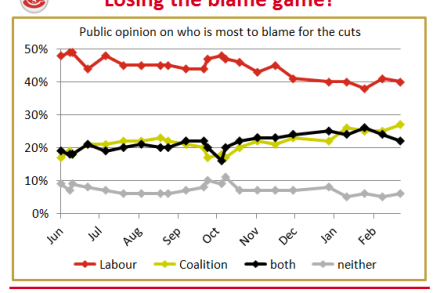
It's a point that I've made before, but here it is again: Budgets don't tend to shift opinion polls, at least not the headline numbers. But opinion polls can give some insight into how Budgetary decisions will go down with the public. So by way of a catch-up with some recent polls, and ahead of tomorrow's Main Event, I thought CoffeeHousers might appreciate a quick overview of public opinion on matters fiscal. Here goes... 1) Who's to blame? When it comes to the overall flow of British politics, the question of who's to blame for the cuts carries clear — and dangerous — implications.

Cameron promises that Libya is ‘not another Iraq’

From our UK edition

Discussion of military action brings a different atmosphere to the chamber of the House of Commons: quieter, less disputatious, more consensual. In opening the debate, the Prime Minister took a huge number of interventions including a large number from those MPs who are most sceptical of this intervention. All were heard respectfully and answered respectfully. Cameron’s desire to find consensus was part of his broader message that this is ‘not another Iraq.’ He stressed that the action in Libya was necessary, legal and right and that any kind of occupying force is ruled out. He argued that the intervention had been ‘in the nick of time’ to prevent a massacre in Benghazi.

Obama’s nervousness makes life difficult for him and his allies

From our UK edition

Gingerly, gingerly — that's how the Americans are approaching the presentational battle over Libya, if not the actual campaign itself. There is no bombast in the official broadcasts from Washington, nor categorical intent. Instead we have Robert Gates emphasising, as he did yesterday evening, that the US will soon handover "primary responsibility" for the mission to us or the French. Or there's Mike Mullen, the Chairman of the Joint Chiefs of Staff, saying that "potentially one outcome" is for Gaddafi to stay in power (see video above). The idea of regime change, or of deeper US involvement, is being downplayed all round. What's clear, perhaps even understandable, is that Obama & Co. are eager not to exhume the ghosts of Iraq.

Cameron’s achievement

From our UK edition

Just last month, David Cameron declared that you “can’t drop democracy from 40,000 feet.” He’s right. It’s more like 400 feet: this is the cruising altitude of the 112 Tomahawk missiles fired from British and American submarines earlier this evening, low enough to dodge Gaddafi’s radars and take out some 20 targets. Given that Obama and Cameron have both ruled out ground forces this will be, as Kosovo was, a bombing-only campaign. And launched on the eighth anniversary of the Iraq war. The US Navy, which was always itching to proceed with the no-fly zone, is now leading the operation; hence its briefing, on CNN, above. There is one British submarine and 11 other US warships in the region.

Allied military intervention in Libya has commenced

From our UK edition

Reports are coming in that French jets have fired the first shots in the UN-supported intervention in Libya. The coming conflict will determine, in the short term, whether the Gaddafi regime is toppled and, in the longer term, whether the international community rediscovers its appetite for intervention which had been so diminished by the controversies over Iraq and the difficulties of the Afghan mission. That there is intervention at all in Libya is down in no small part to David Cameron and William Hague. Hague played a key role in ensuring that Arab countries were prepared to commit to putting planes in the air in this operation, something that was crucial to moving the vacillating Obama off the fence.

Allies’ statement on Libya demands more of Gaddafi than just a cease-fire

From our UK edition

A statement has just been issued by the sponsors of last night’s Security Council resolution, it reads: “Resolution 1973 lays out very clear conditions that must be met. The UK, US, France and Arab States agree that a cease fire must be implemented immediately. That means all attacks against civilians must stop. Gaddafi must stop his troops from advancing on Benghazi, pull back his troops from Ajdabiyah, Misratah, and Zawiyah, and re-establish water, electricity and gas supplies to all areas. Humanitarian assistance must be allowed to reach the people of Libya. These terms are not negotiable. If Gaddafi does not comply with the Resolution, the international community will impose consequences, and this Resolution will be enforced through military action.

Does Sarko deserve more credit than Cameron?

From our UK edition

Just as the British press is venerating David Cameron in the aftermath of last night’s UN resolution, so too the French press is praising President Sarkozy. In fact, the whole administration is basking in his reflected glory. Le Figaro describes Sarkozy’s and Prime Minister François Fillon’s roles in obtaining the UN Resolution and preparing the French military for action; the Defence minister also receives a hearty appraisal. Even the Presidency’s determined adversaries have expressed more than grudging respect. The left-wing newspaper Libération applauds Foreign Minister (and grand old man of Gaullism) Alain Juppé’s success in bringing the fractious United Nations to resolution.