David cameron

The Dame departs

From our UK edition

Pauline Neville-Jones was a first. She was one of the first women in the Foreign Office to climb the department's male-dominated ladder, serving as Lord Tugendhat's chef de cabinet at the European Commission, obtaining the coveted post of Political Director and eventually becoming JIC Chairman. She led the British delegation at the Dayton Peace Accords and she probably thought she would be the first British National Security Adviser. But it was not to be. Her usefulness to the Prime Minister seems to have been mainly in opposition, where she could add a voice of knowledge to a Shadow Cabinet with very little governmental experience. The Tory Green Paper on National Security was all the more serious for her drafting it. But it was not always easy.
A leadership contest might be just what the Scottish Tories need

From our UK edition

That's it, the full house. Alex Salmond has seen off all three main opposition party leaders before the Scottish Parliament has even convened for the first time in this new session. Yesterday afternoon, Scottish Conservative leader Annabel Goldie joined her Labour and Liberal Democrat counterparts (Iain Gray and Tavish Scott) in standing down. The Conservatives did not do quite as badly as either of the other two opposition parties in the election – they went down two seats, from 17 to 15 – and many will see that as the reason Miss Goldie delayed her resignation for a few days, to work out of she could continue. But, in reality, Miss Goldie always seemed destined to resign after this Holyrood poll.

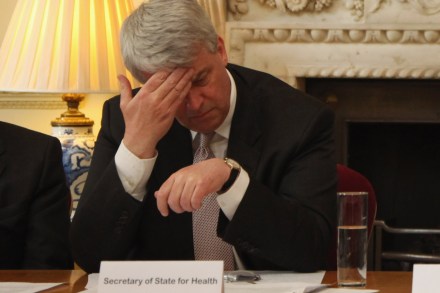
Can Lansley stay?

From our UK edition

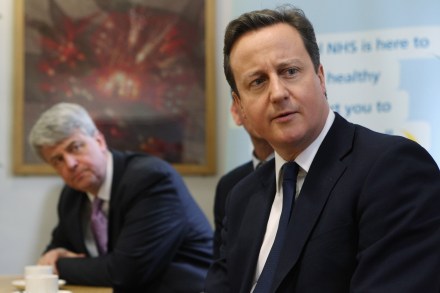
The Prime Minister, it seems, is now finally accepting what everyone else has been saying for a long time: that the NHS reforms were dangerous and would hurt the government. If Nick Clegg forced a re-think — even one that is supported by many Tories — then he may, in the end, play a greater part in delivering the next election for Cameron's party than many triumphalist right-wingers now realise. For CameronCare was badly-timed, poorly-delivered and strikes at the heart of the PM's message that the Conservative Party can be trusted. Large-scale reforms need time. Time for people to accept a problem. Time for people to accept the solution.

The gulf between public opinion and Westminster opinion on Europe

From our UK edition

It's Europe Day today, where the flag of the EU will be flown by 26 of its 27 member states. David Cameron is refusing to join in* — and rightly. Why celebrate an institution to which the British public is hostile? I've always found it strange that Euroscepticism is caricatured as a fringe, minority position when the polling evidence is so overwhelming. The European Commission anxiously monitors this, conducting identical polling in all member states — the largest poll in the world. The results are never publicised in Britain because they make clear the depth of public hostility. We have dug a few out, from the Eurobarometer data archives, and print them below.

The Tories’ intellectual dishonesty over the NHS

From our UK edition

Why should Cameron ditch the Lib Dems? Coalition has made his party more radical, more electorally successful – and the worst ideas in the Cabinet come from men with blue lapels. Take Andrew Lansley. His press release today would have been shocking had it come from a Lib Dem, and denounced as dangerous leftist nonsense that renders the government's overall message incoherent. Ed Balls' arguments against cuts have routinely been challenged in Coffee House. So we can hardly be expected to applaud when his arguments are plagiarised by a Tory. The hapless Lansley, whose needless and complex heath reform bill has stalled, is today trying to win back the initiative by attacking Balls and Miliband from the left.

Huhne on the rack

From our UK edition

It may not be reflected in the popular vote, but politics is still mostly about the Liberal Democrats this morning. We have Ed Miliband's latest sally for their affections. We have the usual veiled threats and dread innuendo from Vince Cable. And then there's the weird, but piercing, accusation on the cover of the Mail on Sunday: Chris Huhne pressurised others – and, specifically, a constituency aide – to take speeding points on his behalf, as he didn't want to lose his driving licence. The accusation, it is said, is inspired by rumours spread across Westminster – and now by testimony from Huhne's former wife. While, for his part, the Energy Secretary is denying it all. Whomever you believe, the story has flared up at an intriguing time.

The winners and losers from Thursday’s elections

From our UK edition

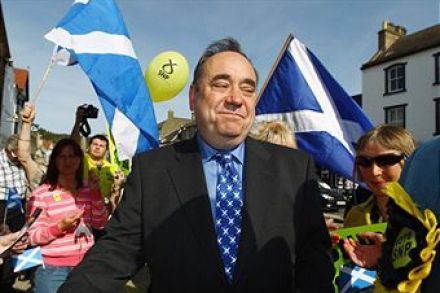
After every election, the political stock exchange goes into a frenzy trying to work out who is a buy and who is a sell. Thirty-six hours after the polls closed, it is a little clearer who the winners and losers of this election season have been. Here are our selections: Winners Alex Salmond, the biggest winner of Thursday night. Salmond has achieved what the Scottish electoral system was meant to prevent, an overall SNP majority in the Scottish parliament. Salmond now has the votes he needs for a referendum on independence.

Salmond’s next stop: testing the Act of Union

From our UK edition

Fresh from his astonishing victory in Holyrood, Alex Salmond has declared his next stage is an independence referendum. This is scoffed at: technically he has no powers to do so and a maximum of a third of Scots back independence. But it's a brave man who'd bet against Alex Salmond right now, and there are many reasons to take seriously the prospect of Scottish independence. Here are some.   1) Scotland is making a mockery out of received wisdom. A few weeks ago, Labour was cruising towards victory. When the Scottish Parliament was designed, the prevailing wisdom suggested that the SNP could never win a majority because the electoral system was rigged against them. Even the SNP believed this.

Three points from a remarkable night

From our UK edition

This has been a remarkable election night. To my mind, there are three big stories out of the polls. First, the George Osborne masterminded campaign for a new Conservative majority is on track. AV, barring some shock, has been defeated and the Conservative vote has held up remarkably well in the English local elections. Indeed, right now the Tories have actually gained councilors in England. Add to this that the next election, if the coalition lasts to 2013, will be fought on new constituency boundaries that are more favourable to the Tories and things are looking promising for the party.    The coalition looks secure. Even after last night's drubbing, the Lib Dem leadership is not considering leaving government.

Surprise, surprise … the Lib Dems are taking a battering

From our UK edition

If you fell asleep expecting heavy losses for the Lib Dems, then you will not have been disappointed upon waking up. At time of writing, around 100 English councils, comprising roughly 2,400 councillors, have declared their results – and the yellow brigade have already lost four of them, along with 270 councillors. There's some way to go yet, so the picture could alter, but Labour appear to making sweeping gains, while the Tory vote is holding unexpectedly firm. As it stands, the local wing of Cameron's party has actually gained a council, along with 22 councillors in the process. Stir in the likely result of the AV referendum, and the Tory leader is looking like a net winner on the night.

It’s all over bar the counting

From our UK edition

The polls have now closed tonight. But there’s no exit poll and no results are expected for a few hours yet. Indeed, I’m almost tempted to say we could do with some of those much talked about electronic counting machines. We are, though, already seeing recriminations over the AV vote. Paddy Ashdown, who is in very fiery form on Question Time, has already told The Guardian that ‘So far the coalition has been lubricrated by a large element of goodwill and trust. It is not any longer.’ In an attempt to bring the temperature down, a no gloating order has come down from Tory high command. Expect to hear an awful lot in the next few days about what the Lib Dems bring to the coalition.

Boris takes on Dave over London’s strikes

From our UK edition

The Telegraph's James Kirkup has already highlighted Boris's suggestion, yesterday, that the coalition is being "lily-livered" over strike laws. But, as there has been no let up in the Mayor's rhetoric today, we really ought to mention it here too. "The government needs to get a move on," is how he put it this morning, in reference to the sort of legislation that might hinder the RMT and their persistent Tube strikes. Boris's latest broadsides against the coalition are all the more notable because he and Cameron were united, arm in arm, against the unions only a few months ago. In a joint piece for the Sun in January, they raged that, "you can try to drag this country back to the 1970s, to a time when militants held our country to ransom, but you will not succeed.

Calamity may lead to concessions for Clegg

From our UK edition

If the expected happens today, the political debate will rapidly move to whether Cameron should offer some concessions to Clegg to bolster his position. I hear there are two camps in Downing Street on this question with Steve Hilton a particularly ardent advocate of the no more concessions line.   Hilton’s position may surprise some but makes sense when you consider how his public service reform programme has, as Ben Brogan writes today, already been diluted for political reasons.    My current expectation is that there won’t be many concessions to Clegg. One well placed Tory told me last night that "Clegg picked the question and the date. He can have no complaints.

Election day is here at last

From our UK edition

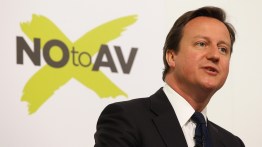
The usual form, on mornings such as these, is to put up a post setting the scene for the elections ahead – although, really, there's not much more to add than was said yesterday. Apart from a readers' survey in the Metro this morning, the only poll to hit after yesterday's ICM bombshell is a YouGov one for the Sun, and it gives No a 20-point lead. Even given the complications of turnout and geography, it looks as though Team No are heading for a straightforward victory. As if to underline his increased personal involvement in the campaign, and perhaps tie himself that little bit closer to the eventual result, David Cameron has not one, but two, comment pieces in the papers today – in the Mail and in the Sun.

A session of Dickens, Ernie the Milkman and Jack Dromey

From our UK edition

There was an eerie, eve-of-battle calm about today’s PMQs. The real bust-up isn’t due till Friday. The votes will be in, AV will be out, Clegg will be down and Huhne will be calculating his next move. Before today’s session everyone expected Labour to co-ordinate an ambush and try to light Cameron’s ever-combustible fuse. But the chamber was under-populated and the opposition hadn’t troubled to devise a battle-plan. Miliband carried the fight to the PM. With an assured forensic performance he methodically built up the case against Cameron as a promise-breaker, a question-dodger and a budget-slasher. Cameron dealt with the assault by absorbing rather than repulsing it.

A very quiet exchange

From our UK edition

PMQs today was dominated by the parties trying to get their lines out ahead of the voting on Thursday. David Cameron accused "Labour local authorities of playing politics with people's jobs" and urged voters "not to let Labour do to your council, what they did to our country." He received plenty of chances to make his local election case as Tory backbenchers served up one patsy question on councils after another. Ed Miliband jibed that the coalition was no longer two parties working together in the national interest but "two parties threatening to sue each other in their own interest," a reference to Huhne’s hyperbolic threat to sue over the No campaign’s claims. The Lib Dems were oddly quiet today.

PMQs live blog | 4 May 2011

From our UK edition

VERDICT: A sedate sort of PMQs today, particularly in comparison to the fizz and fire of recent sessions. The reason is simply the date: with the local elections tomorrow, much of the emphasis was on making a straightforward pitch for votes. Miliband's was to attack the "broken promises" of the coalition — a charge that, if not exactly new, is one he is deploying more and more. Whereas Cameron's was to emphasise that councils can make cuts while improving services — and that Tory councils have been particularly successful in doing so. Both men broadcast their messages today, without really scarring the other. The winners and losers will be better judged on Friday morning. 1231: And that's it. My short verdict soon.

CIA director blasts Pakistan’s intelligence service

From our UK edition

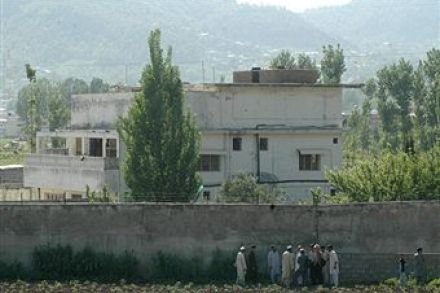
"It was decided that any effort to work with the Pakistanis could jeopardise the mission. They might alert the targets." There have been few blunter, nor more high-profile, condemnations of Pakistan's intelligence operation than that made by Leon Panetta, the CIA chief, in interview with Time magazine today. And there are plenty of other noteworthy nuggets in the article as well: among them, Panetta's claim that the US has seized an "impressive amount" of raw intel from Bin Laden's compound. And how about this: "Intelligence reporting suggests that one of bin Laden’s wives who survived the attack has said the family had been living at the compound since 2005, a source tells TIME.

Clegg’s implicit attack on the Tories

From our UK edition

Up until a few months ago, David Cameron and Nick Clegg tried to avoid doing big set piece broadcast interviews on the same day. This was driven by a desire to both maximise the coalition’s dominance of the media agenda and to avoid having to give a running commentary on what the other had said. But this rule has gone out of the window as the AV referendum has got rougher and rougher. So, following on from their both doing separate interviews on Andrew Marr on Sunday, they both were on the Today Programme this morning. Clegg even told Justin Webb to ask Cameron about the split between the two of them on internships when he was on in forty minutes time.   Clegg isn’t, unlike Cable and Huhne, openly attacking the Tories. But he is doing so implicitly.

Huhne lays into Cameron and Osborne at Cabinet

From our UK edition

At Cabinet this morning, I am told that Chris Huhne directly challenged David Cameron and George Osborne about the claims that the No campaign have been making. He asked them both in turn, if they were going to — or could — defend them. Osborne responded by telling Huhne that his behaviour was inappropriate and that Cabinet wasn’t the place for such disputes. The fact that this row broke out in Cabinet shows just how badly relations within the coalition have been damaged bv the AV campaign. That Huhne is leading the anti-Tory charge even within Cabinet will also stoke the rumours about what the Energy Secretary is planning to do after Thursday’s referendum.