David cameron

Ferry and Marr dream team

From our UK edition

Bryan Ferry CBE was on form last night, for his only UK appearance this year, at Guildford’s terribly middle-class Guilfest — the only festival I have ever seen that had a Pizza Express on site. The sixty six year old rocker still has it, even if he did have to ruin the look with a cashmere scarf after the sun went down. Mr Steerpike was not alone in wondering why the set had an edgier feel to it than the greying Roxy Music fans might have been used to. All was revealed toward the end when Ferry announced the extra guitarist with the badly dyed black hair, and the worst outfit on the stage, was none other than Smiths strummer Johnny Marr. I hear that Marr has collaborated on Ferry’s new album, due out next year.

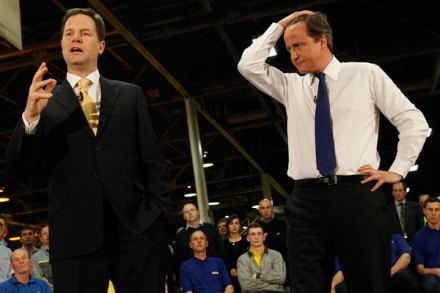
Cameron and Clegg push the pro-coalition line

From our UK edition

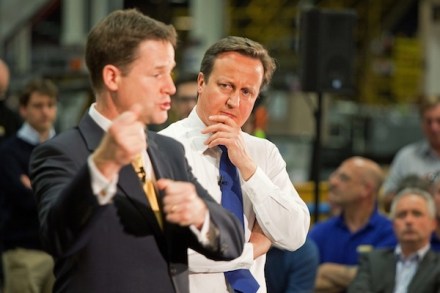
This morning’s press conference by David Cameron and Nick Clegg marked an attempt to scotch all the talk of the coalition moving to confidence and supply sometime before the next election. Cameron declared that he was more committed to the coalition than he was back in 2010. He also stressed that he believed Britain needed stable government ‘throughout this term’, an implicit rebuke to all those Tories talking about a move to minority government in 2014. Nick Clegg, for his part, spoke about how this was going to be a ‘proper coalition government for a full five years’.

Cameron’s coalition healthcheck

From our UK edition

The coalition is doing pretty well, thank you very much. In case last week's rebellion of the 91 on Lords reform and continuing tensions over Europe had you fooled, up pops the Prime Minister this morning with a soothing comment piece in the Sunday Times.  David Cameron tries to shrug off Lords reform within three paragraphs of his op-ed. 'What's far more significant is that we are working together on so much else - and after last week, it's vital that everyone reminds themselves of that fact,' he argues. As part of his health-check piece, the Prime Minister details signs that the coalition is functioning well. When he mentions the reforms the two parties are working together, the piece is very carefully worded. He starts with investment in infrastructure.

The View from 22 – Cameron on the run

From our UK edition

Have the Tories' manoeuvres over Lords reform signalled the end of the coalition? In this week's magazine, our leader argues that Tuesday's rebellion shows that Tories are back in full force, while James Forsyth writes that a coalition break-up date before 2015 is now not a case of if, but when. But Nick Clegg is not the only party leader to suffer from Tuesday's Lords revolt. In this week's View from 22 podcast, recently-resigned PPS Conor Burns MP accuses David Cameron of not appealing sufficiently to his own party: You see this so often when you watch interviews on television - someone speaking for the coalition, you see someone speaking for the Liberal Democrats but you rarely see someone who is poised to speak for the Conservative Party.

The real rebel problem

From our UK edition

The post-match analysis of last night's vote on the House of Lords Reform Bill shows the Prime Minister has a bigger rebel problem on his hands than he might have initially thought. It is true that there is a significant hardcore within the Conservative party of rebels who happily defied the whip on the other big rebellion of this Parliament - October's vote on holding a referendum on Britain's membership of the European Union. But that group only accounts for 57 per cent of last night's rebels. The 81 in October did not simply increase by 10 to 91 last night. The table below shows that there were 39 MPs who walked through the 'no' lobbies who had obeyed the whip on Europe, and 29 EU rebels who voted with the Government last night.

Cameron should be proud of jobs rise

From our UK edition

David Cameron said in Prime Minister's Questions today that there have been 800,000 more private sector jobs under his government. This is almost true, and — I thought — worthy of elaboration. Government cannot, of course, ‘create’ jobs — all it can do is move jobs from the private to the public sector. Every penny of public sector salary is taken from the real economy, and is a penny that someone isn't being paid (or isn't being spent). Now, if you're the BBC it doesn't seem that way. It seems like the sky is falling in, because your own state-mandated budgets are being cut.

Cameron tries to calm troubled waters at the 1922 committee

From our UK edition

By tradition, David Cameron stands outside meetings of the 1922 waiting to be summoned in. This meant that several late-arriving rebels had to walk past him on their way in. By and large, things were fairly cordial. But there was some tension at various points. Cameron started with a tribute to the Chief Whip, which got the MPs banging the desks. Some are taking this as a signal that Patrick McLoughlin is to be retired in the reshuffle. But those present thought it was more of a public admission that the whipping problems of the last few weeks have not been caused by the Chief but by Number 10 and coalition. There was, as usual, much talk of taking the fight to Labour.

Cameron’s attack on Jesse Norman will backfire

From our UK edition

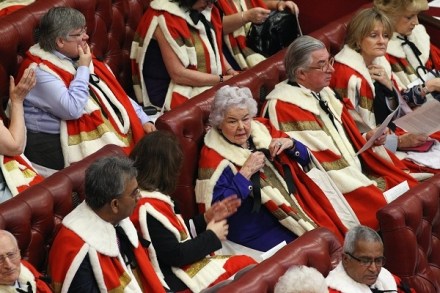
Jesse Norman became the hero of the hour yesterday afternoon when the government admitted defeat against the Tory rebels and dropped the programme motion on Lords reform. Norman was keen to claim the victory for his rebel operation, making an early intervention to say: 'Let me make it clear from the Conservative benches that the very substantial opposition from within the Conservative party, not just that from Labour, was responsible for the withdrawal of the motion. That should be perfectly clear and reflected in the record.' As leader of the rebel camp, and a member of the 91 who voted against the second reading of the Bill late last night, Norman was the toast of his colleagues after the programme motion failed.

Cameron’s leadership is bruised by Lords rebellion

From our UK edition

'Shouldn't we just go home?' the SNP's Pete Wishart asked Sir George Young this evening after the Leader of the House revealed the government was dropping its programme motion on the House of Lords. 'You know it's all over. They know it's all over,' he added. But they didn't go home, and the Commons has just voted in favour of the second reading 462 votes to 162. Early reports suggest that there were 86 Conservative MPs who defied the whip, which would make this the biggest rebellion in this parliament. Nick Clegg paused from trying very hard not to grimace on the front bench to cheer as Mark Harper told the chamber shortly before the division that this legislation belonged to the coalition. But the speeches from MPs throughout the evening gave a very different message.

Cameron will pick party over coalition on Lords reform

From our UK edition

The government’s apparent decision to pull the programme motion on the Lords Reform Bill is an admission that it would have lost the vote tonight, and heavily. The rebel numbers have more than held up today and by mid-afternoon even previously loyal MPs were contemplating jumping in to the rebel camp. The question now is what the coalition does next, does it plough on with the bill and try to guillotine it at a later date or quietly drop it. Certainly, the Tory opponents of the bill are in no mood to back down. They are making clear that even if the government comes back offering twenty days of debate they’ll still oppose it.

Is the coalition’s time drawing to a close?

From our UK edition

There’s long been a certain amount of speculation in Westminster about how long the coalition will last. This topic used to be the sole preserve of those who were sceptics of it; it was a question hoping for the answer not that long. Enthusiasts for coalition, took it as a given that it would last to 2015. But today Matthew Parris, one of the commentators who has been most welcoming of the coalition, writes, ‘I’m close to despair and no longer confident that the coalition can continue even into next year.’   When even the coalition’s friends are saying this, then it is time for the Prime Minister and deputy Prime Minister to take notice.

‘David Cameron stands for being Prime Minister’

From our UK edition

'What do you think David Cameron stands for?' a Tory MP asked me recently. Unsure of his point, I burbled something about 'responsibility' and couple of other random abstract nouns. The MP shook his head grimly. 'No,' he said. 'I'll tell you what David Cameron stands for.' I leant forward, intrigued. 'David Cameron stands for being Prime Minister.' It turns out that this MP isn't the only one who thinks this way about Cameron's motives. A survey of ConHome readers, published today, found that 50% believed he was only interested in being Prime Minister and did not have a strong vision for the country. The list of questions the site asked its readers has produced some fascinating results, and it is well worth reading it in full here.

The Tory fight for Lords reform

From our UK edition

Last night a group of Liberal Democrat and Conservative MPs met to discuss Lords reform. Public outbursts from the Conservative backbench have so far focused on opposition to the bill and the programme motion that the whips are trying to impose on the legislation, but the group of pro-reform MPs, who have informally dubbed themselves the Democratic Majority, are optimistic that the legislation will make a successful passage through the House of Commons. There are 27 Conservatives on board at the moment along all the Lib Dems, standing up the list of 100 MPs that the rebel leaders claim to have among their number.

Ed’s ahead with banking inquiry

From our UK edition

Low party interest parading as high political principle. That was the theme of today’s PMQs as the party leaders clashed over the scope and nature of the inquiry into the Libor scandal. David Cameron’s pungent language was intended to reflect public anger at the banks. He spoke of ‘spivvy and illegal activity’ in the City, and he promised that crime in financial centres would be pursued as rigorously as crime on the streets. One of the grandest of Tory grandees, Nicholas Soames, warned him that new regulatory mechanisms mustn’t be allowed to damage the City, ‘which remains a vital asset for our country.’   And he was followed by the very grandest of all the Tory grandees, Sir Peter Tapsell himself.

Is Michael Gove the government’s only true radical?

From our UK edition

I have been waiting more than two years for this government to say or do something really radical. By this I don’t mean taking the Blairite revolution to its logical conclusion (or is it reductio ad absurdum?) by introducing pseudo-markets deeper into every area of the public sector and reforms to the welfare state New Labour certainly considered but never dared to carry out. But what was genuinely counter-intuitive for the Labour Party is not necessarily so for the Conservatives. For Tony Blair to embrace the private sector, distance himself from the trade unions and challenge the received wisdom of Labour’s state-ism was a genuine break with the past. For David Cameron to do so is merely to embrace tradition.

Cameron hints at Coalition split on EU review

From our UK edition

Yesterday the Prime Minister made a point of showing his backbench how very willing he was to listen to their concerns about the European Union. Today, as he gave evidence to the Liaison Committee, David Cameron made a point of suggesting his Liberal Democrat coalition partners are a little less willing when it comes to reviewing the EU's powers.  Asked when he would launch the balance of competencies review, which will examine the impact of EU law on Britain, the Prime Minister said: 'I hope that we will be able to start the process before the summer, but we need to seek full agreement before we launch it.'  He added: 'Some preliminary work has been done but there does need to be proper coalition agreement before full work goes ahead.

Cameron’s position on Europe grows clearer

From our UK edition

David Cameron’s position on Europe is becoming clearer. ‘Fresh settlement, fresh consent’, the soundbite he kept using, is simply a euphemism for renegotiation followed by a referendum. It seems that this renegotiation will span the next election. Indeed, it will start as soon as a new EU treaty is proposed. In response to a question from Peter Lilley, Cameron said he will try to use any forthcoming treaty to attempt to bring powers back to this country. Those close to Cameron say that the plan is to get as much back before the next election and then accelerate the process as soon as there is a treaty negotiation under a Conservative-only government. When the referendum does come, it will most likely offer a choice between the new terms and out.

Warm words on a referendum won’t kill off UKIP

From our UK edition

Has David Cameron now shot the UKIP fox? The Prime Minister has now put a referendum on the political agenda. No.10's thinking, as revealed by James Forsyth weeks ago, is that the weekend's high-profile posturing will see off the UKIP threat. The PM has given it a decent amount of welly in the Commons today too, calling for a 'fresh deal' and 'fresh consent' on Europe. We can take this to mean renegotiation followed by a referendum on membership. But today, Cameron also made clear he'd campaign for an 'in' vote, stating: 'I don't believe leaving the EU would be right for Britain, but nor do I believe voting to maintain the status quo would be right either.

Cameron feeds the eurosceptic beast

From our UK edition

Nick Clegg won’t be sitting next to the Prime Minister in the chamber for today’s statement on the EU Council. He has, I’m told, got other meetings to attend. This absence might be for the best given what Tory MPs are planning to ask Cameron. As Isabel revealed earlier, a string of Eurosceptic backbenchers are planning to push the Prime Minister to go further than he did in his Sunday Telegraph piece. Number 10 is also expecting a question from Liam Fox. Tory MPs are being reassured that they’ll like what they’ll hear from Cameron on a referendum. It does seem that the statement will be firmer than what William Hague said on the Andrew Marr Show on Sunday morning. The dwindling band of pro-European Tory MPs is in despair.

Ideologues and pragmatists

From our UK edition

Over at the books blog, former Tory MP Jerry Hayes has reviewed James Hanning and Francis Elliott’s Cameron: Practically a Conservative. The key to Hanning and Elliott’s analysis resides in their title. David Cameron is a practical politician, not an ideologue; his quiet values instilled by a comfortable upbringing and a natural talent for conciliation. Jerry concludes: ‘Personally, I would hate to be governed by an ideologue who had to jump through self-imposed Jesuitical hoops before making a decision. I much prefer someone who tries to do the right thing, even if they don't always succeed.’ I recommend reading the review in full (and Jerry recommends all to read the book, even those who can’t stand Cameron).