David cameron

Today’s PMQs fails to interrupt the mini-Tory revival

From our UK edition

There has been a distinct shortage of PMQs recently and after today, there’s only one more until June. This will add to Ed Miliband’s disappointment that he didn’t shift the political mood today, nothing happened to interrupt the mini-Tory revival. Though, tomorrow’s GDP figures will be crucial in whether it continues. Miliband went on the NHS, one of Labour’s strongest subjects, only for David Cameron to counter that if Labour got in again there would be another Mid-Staffs. This was a distinct change of tone from Cameron’s initial response to the Francis Report, when he went out of his way to avoid trying to blame the previous government. The questions planted by the Tory whips were, tellingly, nearly all about benefits.

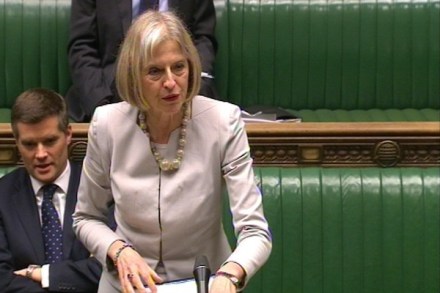
How far will the government go to deport Abu Qatada?

From our UK edition

This morning, after the Sun and the Mail reported that ministers might go as far as to leave the European Convention on Human Rights in order to get their way, the Prime Minister's official spokesman refused to rule out such a move. He said: 'The government will explore every option in seeking to deport this dangerous individual and that's what we are going to keep doing. 'The Prime Minister met with the Home Secretary, the Justice Secretary and the Attorney General yesterday to discuss the case. I'm not going to get into specifics as to what the Government is considering, as I say, we are going to explore every option.

PM and Osborne prefer their ‘own words’ to describe miserable economy

From our UK edition

George Osborne might have used Justin Welby's comments on the problems with the banks this morning as a sign that he has at least one ally out there, but this afternoon, the Prime Minister's official spokesman distanced the government from the Archbishop's use of the word 'depression' to characterise this country's current economic circumstances. He said: 'The Prime Minister agrees with the point the Chancellor of the Exchequer was making when he was asked that question this morning. What the Chancellor said was that he agreed with the Archbishop's analysis that we have a slow and difficult recovery because of the problems in the banking system and those are the problems that need addressing.

No, the Tory Detoxification Project is Not Complete.

From our UK edition

There are times, I confess, when I wonder about politicians. They are a rum breed and it still seems possible to rise to quite elevated heights without possessing very much of an idea about anything. Consider the cabinet minister quoted in this Telegraph article: Mr Cameron won the leadership promising to modernise the party, but one Cabinet minister said it should now “move on” to more “traditional” Conservative issues such as welfare reform and immigration control. “The 'toxic’ issue has been neutralised,” the minister said. “Now we can move on to the red meat Conservative issues.

Margaret Thatcher’s funeral unites the political class

From our UK edition

Where there has been discord, Mrs Thatcher’s funeral brought harmony. From my seat in the gods at St. Paul’s, I watched as Westminster’s lesser mortals gathered in front of the altar to shoot the breeze in the hour before Lady Thatcher’s coffin arrived. Gordon and Sarah Brown were first to arrive. They plonked themselves down, but soon jumped up to chat to a passer-by. Quick as a flash, Ed Miliband and his wife Justine pinched the Browns’ vacated chairs. Time rolled by, and Miliband found it impossible to shake the shadow of his old master as he walked around the nave. How’s that for art imitating life? The pews soon filled up with cabinet ministers.

David Cameron: We’re all Thatcherites now

From our UK edition

David Cameron is giving a reading at Margaret Thatcher's funeral later today, but this morning he gave his eulogy on the Today programme. He made the quite striking observation that 'we're all Thatcherites now'. In one sense this is quite an obvious comment: as countless commentators have observed over the past week and a half, Margaret Thatcher didn't just change the way the Conservative party viewed economics and the state, she also changed the way Labour sold itself as a party. Cameron said: 'I think in a way we're all Thatcherites now because - I mean - I think one of the things about her legacy is some of those big arguments that she had had, you know, everyone now accepts.

Tax transparency: Cameron says relax

From our UK edition

When dolphins hunt fish, they gang up on them as a school, chasing them into the shallows. So it happens at the daily lobby briefing: when a morsel of a story appears and someone lets down their guard, the whole pack of journalists jumps in. Today the Prime Minister's official spokesman was chased into the shallows on the plan, which appears rather dead in the water, to publish ministers' tax affairs. The plan had been for the most senior members of the Cabinet to do this, and David Cameron, George Osborne, Nick Clegg and Vince Cable had agreed on it last spring. But nothing has happened.

Grant Shapps on the Tories and Thatcher

From our UK edition

It is one of the paradoxes of modern British politics that in the post-war era the power and hold of political parties have declined and our system has become more presidential. But the two most electorally successful leaders of this era have both been deposed by their respective parties. This has created problems for both parties, as today’s Sunday Politics with Andrew Neil demonstrated. After John Reid had been on to discuss Tony Blair’s comments on Ed Miliband, Grant Shapps was up to be questioned on Margaret Thatcher’s legacy for the Tories. Shapps was reluctant to declare that the Tories are a Thatcherite party. Trying to suggest that it is but only to the extent that it is also a John Major party.

Where are today’s titanic Cabinet battles?

From our UK edition

Reading Norman Fowler’s recollections of the Thatcher years in the Telegraph, whose coverage this week has been simply superb, is to be reminded of how much debate there was in her Cabinet. Take Fowler’s account of the pre-Budget Cabinet in 1981: “Jim Prior described the proposals as ‘disastrous’, adding that they would do nothing for growth and send unemployment figures above three million. He was supported by the so-called economic ‘wets’, such as Ian Gilmour and Peter Walker, who on this occasion were joined by Francis Pym and Christopher Soames. Even Keith Joseph had his doubts as he argued for more private investment in public industries.

Tory local election broadcast focuses on cost of living

From our UK edition

The Tories have released a local election broadcast, to be shown on the TV tonight. Unlike previous ones, it doesn't have any awkward confusion between debt and deficit, preferring instead to focus on people looking a bit confused as they try to remember what the government has or hasn't done on council tax, income tax and the cost of living, accompanied by some cheesy guitar music. It's actually quite a snappy piece of work as it sells the party's key achievements at a national level to voters in a rather understated way, partly by admitting that not all of them have noticed what's going on, then driving home the key messages in capital letters across the screen. It also features David Cameron at the start and finish, underlining how important he is to the Tory brand.

Cameron confident of common ground with Merkel

From our UK edition

David Cameron is setting off with his children to visit Angela Merkel on Friday. It's part of his EU reform mission that started and was thrown off course on Monday following the death of Margaret Thatcher. As I blogged back then, the circumstances aren't perfect, and one of the reasons for that is that France and Germany recently snubbed an invitation to be involved in the UK's 'balance of competences' review. But today Cameron tried to play down the significance of this. He told Adam Boulton: 'Our review of competences was always and will be a British exercise. We didn't particularly, that story was… anyone's free to feed into our review, but that piece of work is a British piece of work. For years people said you'll never have the European budget cut, I've got it cut.

The Tory modernisers are Margaret Thatcher’s true heirs

From our UK edition

Margaret Thatcher’s death has inevitably prompted intense reflection among Tories about what lessons the party should learn from her time in office. ‘We must finish the job’ is the refrain on the lips of Thatcherite ministers, and there are more of those today than there were a year ago. The experience of office has had a radicalising effect on the Cameroons. To be sure, today’s circumstances are not the same as those of 1979 or ’89. Her exact policy prescription is not what is required. This is something that Thatcher, a politician who relished fresh thinking, would have appreciated. But what the party does need is the spirit of Thatcherism, that understanding of what a centre-right party should be in the modern age.

Evidence-based politics: the case of the incredible shrinking Tory Party

From our UK edition

Here is something those who rely on political commentators will not have expected to see. The latest poll from TNS BMRB has the Tories down to just a quarter of the vote: CON 25% (-2), LAB 40% (+3), LD 10% (nc), UKIP 14% (-3). The Opinium/Observer online poll had LAB 38, CON 28, UKIP 17, LD 8% at the weekend. YouGov for the Sunday Times on the same day had CON 30, LAB 40, LD 11, UKIP 13. (The Tories were just 1% above their low point with firm.) How can this be? All these polls were taken during the raging welfare debate. Commentator after commentator wrote articles assuring us that Labour was on the wrong side of public opinion, and the Tories had at last found an issue that would move the voters their way. Unanimity gripped the punditocracy.

David Cameron places himself in Margaret Thatcher’s tradition

From our UK edition

‘For many of us, she was, and is, an inspiration’, David Cameron said of Margaret Thatcher in his tribute to her. It was him, firmly — and proudly — placing himself in her tradition. Cameron has moved in Thatcher’s political direction as leader. He has become —partly, through circumstance and necessity — less interested in being a unifying figure, and more interested in getting things done. There has, in recent years, been an end to any attempts to distance the party from her legacy. Thatcher’s life-story is a truly remarkable one. Cameron rightly dwelled on the sexism she had to take on to become Tory leader. But she also had to overcome the class prejudice of large sections of the Tory party. Parliament will be recalled on Wednesday.

David Cameron’s tribute to Margaret Thatcher: full text

From our UK edition

Today we lost a great leader, a great Prime Minister and a great Briton. Margaret Thatcher didn’t just lead our country – she saved our country. And we should never forget that the odds were stacked against her. She was the shopkeeper’s daughter from Grantham who made it to the highest office in the land. There were people who said she couldn’t make it; who stood in her way; who said a woman couldn’t lead. She defied them all. She fought her way to a seat in Parliament…to the leadership of her Party…and then to lead our country…winning the backing of the British people three times in a row. She will be remembered for the big political battles she fought. Taking on the union barons.  Privatising industry.

David Cameron and the Union

From our UK edition

Alex Massie asks why I didn’t mention the Union in my piece in this week’s magazine on what David Cameron’s legacy will be. It is a good question. Indeed, one former Cameron aide told me that he thought that the likely preservation of the Union would be Cameron’s greatest achievement. But the reason I didn’t mention it was because Cameron’s strategy on Scotland has been to keep a relatively low profile. He has, deliberately, not made it his fight. He realised that Alex Salmond wanted to present himself as the opposition to an English Tory Prime Minister who was, in Nationalist-speak, imposing his will on Scotland—and has simply refused to play that role.

Nuclear weapons, Scotland and the future of the United Kingdom

From our UK edition

David Cameron – who, in case you’d forgotten, leads the Conservative and Unionist Party – made a rare visit to Scotland yesterday. He spoke about defence. His message was clear: an independent Scotland could not expect to win defence contracts from what remains of the United Kingdom. Jobs and expertise, therefore, would be lost. Vote no. This is, as Iain Martin notes, smart politics. The Nationalists are weakest on those briefs which are the central functions of a nation state: defence, foreign policy and welfare. Cameron, as the British Prime Minister, should make more of this natural advantage. (Incidentally, Alex Massie has an excellent account of the referendum battle. It’s by far and away the best guide to the subject.

David Cameron’s Legacy? Preserving the Union or presiding over the Break-Up of Britain

From our UK edition

Politics is at least partially a matter of perspective. The same object can look very different depending upon the angle from which it is viewed. Which brings me to Brother Forsyth's latest column. I bow to no-one in my admiration for James's reporting and astute analysis. Nor do I dispute much of what he says in his analysis of David Cameron's legacy. No, what's interesting is what isn't there. The Union. I know. Scots go on and on and on about this stuff. It is true that the Caledonian gene is strong on self-absorption.

The View from 22 — North Korea and Asia’s arms race, and Owen Jones vs. Toby Young

From our UK edition

Are Iain Duncan Smith's welfare reforms necessary to bring fairness to our benefits system? This week's Spectator leading article argues the work and pensions secretary returned to front-line politics for one reason only — to end the present waste of human potential. Author and Independent columnist Owen Jones disagrees; he debates with our associate editor Toby Young on this week's View form 22 podcast (10:38). Will IDS' reforms radically change the welfare system for the better? Is the government striving for more or less equality? And will the coalition's legacy stand up to closer scrutiny from the left at the next general election? Clarissa Tan discusses her cover feature on Asia's arms race (0:41).

Key David Cameron aide to quit Downing Street

From our UK edition

Sky News has revealed tonight that Rohan Silva, one of the Prime Minister’s key advisers, is leaving Downing Street. Silva might not be a household name but he has been a hugely influential figure there these past few years. In opposition, he worked for George Osborne before moving to work for David Cameron in government. He has been the driving force behind spending transparency, Tech City and crime maps. There have been few more pro-enterprise and pro-reform voices in this government. His departure is a big blow to Tory radicalism. One of the things that marked Silva out was a thirst for new ideas that is all too rare in British politics.