Crime

Viktor Yanukovych’s palace is full of tasteless treasures – and London auction-house tags

From our UK edition

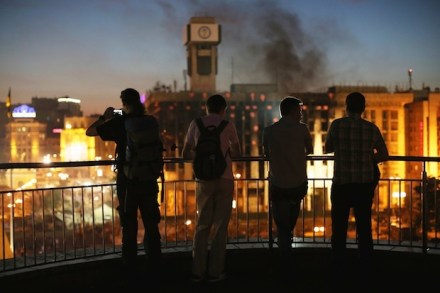
 Kiev On a cobbled street above the Maidan, an elderly man dressed in fatigues rubs his stubble in the morning sunshine. Would I like a lesson in throwing Molotov cocktails? He picks up a bottle with a long wire loop for a handle, and leads me to a burnt-out public lavatory. A match to the rags stuffed in the bottle’s mouth; an overarm swing, and the bottles smashes against the far wall, flames licking round broken stalls. Would I like to pose for a photo? A young American who has stopped to watch takes up the offer. Three months after protests toppled Ukraine’s president, Viktor Yanukovych, the Maidan has turned into a tourist attraction. The scene of the protests is still an impressive sight.

I’d rather have a German next door too — and I have the figures to show why

From our UK edition

Should we be worried about the vast numbers of German-born people living covertly in the United Kingdom? The Office for National Statistics estimates that in 2011 some 297,000 Germans were resident here, the fifth largest non-British-born contingent (after Indians, Poles, Pakistanis and the Irish respectively). What the hell are they all up to? Sitting in smartly furnished homes, biding their time, and waiting, waiting. That’s what I suspect. A report in the Guardian a while back suggested that our German community tended to ‘stay under the radar’, an ability which mercifully eluded them 70 years ago.

What’s the difference between German and Romanian immigrants?

From our UK edition

Nigel Farage is in the papers again today – unbelievably! – this time with a full-page advert in the Telegraph responding to his remarks about Romanians on LBC radio. Such was the universal media condemnation over his interview with James O’Brien that on Saturday even the Sun had an editorial on anti-Romanian racism. You couldn’t make it up. Farage was stereotyping, and his tone of ‘you know what the difference is’ hit the wrong note, which lost him the argument over a fairly reasonable point; that is, the typical profile of a German migrant is very different to that of a Romanian migrant.

Spectator letters: Why Aids is still a threat, elephants are altruistic, and crime has gone online

From our UK edition

Aids is still deadly Sir: Dr Pemberton (‘Life after Aids’, 19 April) subscribes to the now prevalent view that we have turned the corner on Aids. Well only up to a point, Lord Copper. There are now about 100,000 HIV carriers in the UK, and in London, where Dr Pemberton works, as in the rest of the UK, reports of new diagnoses of HIV infection are continuing at much the same rate as before. These diagnoses are too often of individuals who have been infected for years, and are liable to have passed HIV on to others. It is also estimated that as many as one fifth of all HIV-infected individuals in the UK remain undiagnosed. Dr Pemberton is right to say that anti-retroviral treatment has greatly extended survival with HIV infection.

Spectator letters: On wind turbines, Churchill’s only exam success, and the red-trousered mayor of Bristol

From our UK edition

When the wind blows Sir: Clare Oxford’s piece (‘Gone with the wind turbines’, 12 April) is both timely and sad. Those who applaud the use of these infernal machines are prone to eulogise their efficiency by saying (in the same annoying, dumbed-down way in which commentators always compare the size of something with the number of football pitches it equates to — presumably on the basis that a normal person is unable to conceive of anything larger) that the number of machines to be erected ‘could provide power for x thousand homes’.

British justice the envy of the world? Tell that to Nigel Evans

From our UK edition

I am utterly delighted that Nigel Evans has been acquitted of serious allegations of sexual assault. He is a good, kind, gentle and decent man and a very old friend. I hope that he will be able to reconstruct his political career. Hope? Well yes. He might have been acquitted but the stigma is still there. The country has been salivating at tales of hands down trousers, drunken groping and late night romps. And there is a vociferous group of militants who believe that whatever the decision of a jury, any man accused of rape must be guilty. So in the eyes of some, Nigel's acquittal is meaningless. If nothing else this case highlights the need for anonymity of defendants in cases of sexual assault and rape. Ah, some will say, this will prevent other victims coming forward. Not so.

Spectator letters: Interpreting Islam, and Spectator-reading thieves

From our UK edition

Chapter and verse on Islam Sir: Irshad Manji’s generally very sensible article on ‘Reclaiming Islam’ (29 March) suggests using the Qur’an sura 3:7 as a verse to challenge Islamists who claim a fundamentalist reading. She quotes the verse as saying that ‘God and God alone knows the full truth of how the Qu’ran ought to be interpreted’. I don’t speak Arabic, but unfortunately in my English translation this isn’t quite what the verse says. What it says is ‘only God and insightful people know their true meaning’.

We need to know the truth about Gerry Adams’s alleged involvement in the ‘disappearance’ of Jean McConville

From our UK edition

Readers will know that I am interested in the subject of post-Good Friday agreement 'justice' in Northern Ireland. Having been one of the few people to have followed the possibilities of justice over Bloody Sunday, I also recently wrote about the apparently one-sided amnesties which the last Labour government appears to have given to Republicans not convicted of crimes but counted as 'on the run'. It has long been my contention that justice cannot only be applied to one side or one group of people. Investigate the 1st Battalion of the Parachute Regiment for what happened in January 1972 and you have to investigate the leadership of Sinn Fein – IRA for their activities.

FGM is a shaming indictment of multiculturalism and mass-immigration

From our UK edition

A number of interesting things have happened recently: The Law Society has provided legal guidance to ensure that Muslims in Britain can have their wills judged according to Sharia. BBC Newsnight hosted an in-studio row between three Muslims over whether one Muslim should be allowed to say or do anything that is deemed religiously insensitive by any other Muslim. Majority opinion seemed to be ‘no’. Then there has been huge excitement that, after decades during which tens of thousands of girls in Britain were genitally mutilated, charges have for the first time been brought against some suspected perpetrators of this horrific crime. Just in case anyone is lost in all this – this is Britain in 2014. So what do these things have in common?

Six months as a TV critic, and I’ve seen enough corpses to last a lifetime

From our UK edition

It was Shetland that tipped me over the edge. Not the place, but the TV series. Although that’s set in the place. So both, really. It’s a crime drama, see, and people keep getting murdered. Roughly speaking, so far, there’s been a corpse every episode. Which by the end of the series will mean eight corpses. Which, given that there are only 20,000 people in Shetland, means that Scotland’s most northerly islands have a murder rate roughly comparable with that of Belize. Or higher, even, because my calculations assume that a series happens in a year, and that we are seeing all the murders there are, rather than just the ones that Dougie Henshall gets called out to. Frankly, it makes the place seem terrifying. But then a lot of places are.

On the trail of a Victorian femme fatale

From our UK edition

Kate Colquhoun sets herself a number of significant challenges in her compelling new book, Did She Kill Him? Like Kate Summerscale before her, Colquhoun mines the rich seam of legal archives to give her readers the fascinating tale of a Victorian courtroom drama: that of Florence Maybrick, accused, in 1889, of murdering her husband. Colquhoun achieves expertly all the things one could hope to expect in such a historical account. She paints a picture not only of a woman on trial, but of the complicated world of late 19th-century England. We get a sense of a woman’s changing place in the world, we see Liverpool society on display, we learn about the press, about science and justice and politics.

Alexander McCall Smith’s diary: Meeting Babar’s creator

From our UK edition

As any author will tell you, literary festivals differ widely. If you are invited to Willy Dalrymple’s Jaipur Festival, with its renowned final party, you say yes within minutes of receiving the invitation. Other invitations you might take a little longer to accept. The Key West Literary Seminar, which took place a couple of weeks ago, is one of the glamorous ones. I was ready for Florida, as Scotland had been visited by gale after gale and accompanying driving rain. As luck would have it, we arrived in Key West at exactly the same time as the polar vortex that had frozen the entire United States, including a normally balmy Florida. No matter: Key West was, for the duration, one huge literary celebration. I was invited to lunch at a house in the old part of the town.

Douglas Carswell, crime fighter

From our UK edition

Mr S has long admired Essex Tory MP Douglas Carswell. Not only does the rebel with a cause bring a fascinating aspect to the political debate, it also turns that out the lawmaker fights lawbreakers: Just chased and caught a shop lifter in Clacton..., waiting for police — Douglas Carswell MP (@DouglasCarswell) January 24, 2014   This will do wonders with his local paper. One less vote, though. PS: General Boles - or Bright Blue Boles, as he styles himself now - has produced the marvellous picture above.

The President, his mistress and the Mob

From our UK edition

There was a moment when it looked like French Closer had done President Hollande a favour. His poll ratings have been abysmal and the economy has tanked. What better distraction than a little ooh la la? Scandals such as these reveal the character of a nation and its politics. If a British minister had dispatched his chauffeur to fetch post-coital croissants, there would have been delirious uproar about the misuse of taxpayers’ money. But the French have never really cared about politicians wasting their money: National Assembly Deputies take home the equivalent of £211,000 in pay, and enjoy completely unaudited expenses. Most Parisians seem more surprised that the much derided president had it in him. After the initial tittering, the story began to take darker turns.

Diane Abbott’s idiocy reaches new levels

From our UK edition

On the evening of the Mark Duggan verdict, Diane Abbott MP tweeted the following: If the #duggan jury believe that he did not have a gun in his hand when he was shot, how can they find it was a lawful killing? #baffled — Diane Abbott MP (@HackneyAbbott) January 8, 2014   Well, Diane, your bafflement is because you weren’t inside the court room for three months listening to the evidence, were you, you idiot?  Does she think her tweet was helpful? Why does she not devote herself to tackling gun crime within the young black male community – or does she think that it is not a problem, a disproportionate problem, and that the reason we hear about it so often is because we’re all racists?

The only way to end the war on drugs is to stop fighting it

From our UK edition

It’s surprisingly boring, legalising weed. In Colorado, where recreational doobie has been utterly without censure for, ooh, about a week and a half now, the Department of Revenue (Marijuana Enforcement Division) has published Permanent Rules Related to the Colorado Retail Marijuana Code, which is 136 pages long and no fun at all. Were I actually in Colorado, I suppose I could always spark something up to help me get to the end. ‘The statutory authority for this rule is found at subsections 12-43.4-202(2)(b), 12-43.4-202(3)(b)(II), 12-43.4-202(3)(b)(III), and 12-43.3-301(1), C.R.S,’ it drones, at the top of the final page. If you like, imagine that read out by a posh girl in a breathy voice over a drum beat, like they used to do in the Orb.

Ten things that went badly right in Britain in 2013

From our UK edition

This was supposed to be the year of strife, strikes, misery and more. Instead, to the surprise of Britain's politicians, things have instead gone badly right. I look at them in my Telegraph column today, and here are the top points:- 1. Crime plunges With the austerity and the unemployment, internal government reports predicted that Brits would respond by unleashing a crimewave. Instead, recorded crime has fallen to the lowest level in 25 years: [datawrapper chart="http://www.seapprojects.co.uk/charts/3571387552215.html"] 2. We're doing more with less People think public services are getting better, in spite of substantial cuts in local authority spending. The doomsayers were wrong - thanks to resourceful British public servants, more is being done with less. 3.

Old England died in 1963

From our UK edition

There is no better measure of the pivotal importance of 1963 than to recall what Britain was like in the early 1950s, as we slowly emerged from the shadows of the second world war. The great Labour experiment of 1945 had petered out in a grim slog through years of austerity and rationing. With Winston Churchill back in No. 10, life had begun to crawl back to ‘normality’. Conservative values ruled: respect for tradition, discipline and authority. The old class structure still stood. No extramarital sex or homosexuality. In the cinema we were entertained by cosy Ealing comedies and films portraying the ‘stiff upper lip’ spirit which had won the war. Pop music, hardly ever allowed on the BBC, centred on crooners such as Frankie Laine and adaptations of folk songs.

Chris Grayling gets a relatively easy ride over reoffending rates

From our UK edition

Theresa May accepted her Spectator Politician of the Year award with the quip: 'It used to be a joke that I lock them up and Ken Clarke lets them out, now they say I lock them up and Chris Grayling throws away the key.' The right wing press, as Ken Clarke is given to calling it, is much enamoured with Grayling and May. ConservativeHome’s Mark Wallace describes them as the ‘dynamic duo’, and writes a long appreciation of their ‘increasingly strong message on crime’. There is, of course, as Wallace concedes, more to governing than messages. The Mail on Sunday carries a small item about reoffending rates under the headline ‘scandal of prisoners who strike again’.

What will history make of Britain’s treatment of Chowdhury Mueen-Uddin?

From our UK edition

‘A historic catastrophe’ is how Martin Bright describes it. He is referring to the policy by which successive governments in the UK, Conservative, Labour and coalition, are accused of having promoted the worst people into the positions of Muslim community leaders. The specific case that sparks this reflection is the case of Chowdhury Mueen-Uddin. Since leaving Bangladesh and becoming a British citizen he has been at the very pinnacle of Britain’s interfaith and moderate Muslim industry. Here he is with Prince Charles at the Islamic Foundation in Leicester. Major politicians of all parties as well as numerous ‘faith leaders’ have rubbed shoulders with him.