Covid-19

Macron eyes up a new career

From our UK edition

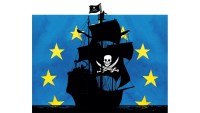
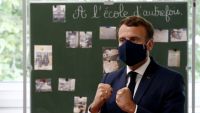
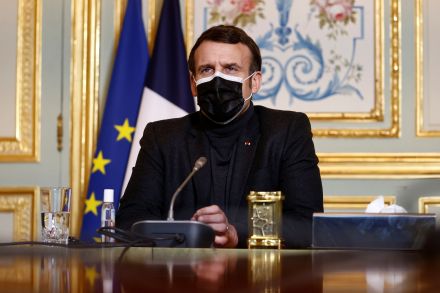
How is France dealing with its latest Covid wave? Not particularly well, if you listen to the director of epidemiological research at the Pasteur Institute in Paris. Earlier this week Arnaud Fontanet, who sits on the French version of Sage, said that Macron's approach risks repeating the 'tragedy of the English' as the Kent variant spreads across the country.  So how are those in the Élysée reacting? Macron shut all bars, restaurants and gyms back in October — but scientists like Fontanet want him to consider new restrictions. After all, France has been painfully slow at rolling out the vaccine, managing just 3.3 citizens per 100 compared to the UK's one in five.
Boris Johnson sets out the new normal on vaccines

From our UK edition

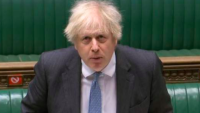
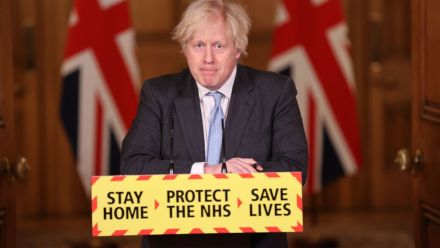
Despite Keir Starmer's attempts to coax Boris Johnson into committing to a variety of economic measures, Prime Minister's Questions brought with it little clarity on what will be in next month's Budget. However, Johnson was more forthcoming when it came to vaccines.  Vaccine orders go well beyond the number of doses required to vaccinate the entire adult population Following recent comments from ministers and government scientists over the likelihood of a booster shot being required to protect the public against new variants, Johnson said the public would need to 'get used to the idea of vaccinating and then revaccinating in the autumn, as we come to face these new variants.

Von der Leyen has learnt nothing from the EU’s vaccine fiasco

From our UK edition

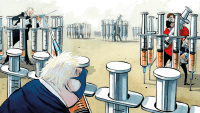
As non-apology apologies go, it was right up there with the best of them. Speaking to MEPs today, the president of the European Commission Ursula von der Leyen accepted that some ‘mistakes had been made’ in the procurement of vaccines against Covid-19.  Apparently the Commission had been a little too late authorising some of the shots, it had been a tad too optimistic about production, and not everything had gone according to plan. But, heck, these things happen, she went on to argue. And perhaps most crucially of all, the alternative would have been far, far worse.  'I can't even imagine if a few big players had rushed to it and the others went empty-handed,' she said.

How effective are the Covid vaccines?

From our UK edition

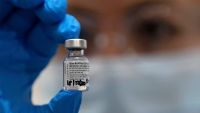
Reports have filtered through this morning about Public Health England’s assessment of the efficacy of the two vaccines so far administered to the public. The results have not yet been published, but the efficacy rates quoted in the Sun suggest that the Pfizer vaccine has proved to be between 79 and 84 per cent effective at stopping symptomatic infection after two doses. After one dose – which is all that most people have had so far – efficacy is reported as 65 per cent. Among the over 80s it is very similar, at 64 per cent. No figures are given for the AstraZeneca vaccine but it is suggested that the efficacy is 'similar'.

The class of Covid will pay the price for years to come

From our UK edition

Schools in England, it seems, will reopen fully on 8 March at the earliest – a full two months after they closed. The Prime Minister has declined to bring this forward, in spite of new Covid cases falling at a rate of 25 per cent per week. The Scottish and Welsh governments have both said they will partially reopen schools in February. What was looking like being half-a-term's lost schooling is now looking to be closer to a full term's worth. That comes on top of over two months of school closures last year – and some interrupted education in the autumn terms as teachers and pupils were forced to self-isolate on many occasions. What will be the long-term cost of the lost months of education? The OECD has had a go at estimating it.

Hancock launches his quarantine crackdown

From our UK edition

The search for the right balance on border policy continues, as Health Secretary Matt Hancock announced this afternoon a host of new measures that travellers coming to the UK will face. From Monday, all arrivals will need to take two PCR tests: one on day two and another on day eight of self-isolation. This will apply to everyone, regardless of where they are travelling in from or whether they are quarantining in a hotel or in their home. This means anyone arriving in the UK will now be taking a total of three Covid-19 tests, as a negative test within 72 hours of travel is also required.

Isolation nation: how Australia is dealing with its pandemic

From our UK edition

At 6.20 p.m. on Friday evening, Scarborough Beach, an oceanside suburb of Perth, looked like it always does: families picnicked on grassy dunes overlooking the Indian Ocean, queues were forming outside bars lining the shore, and inside restaurants, groups chatted casually over cold beers. Given the bustle, it’s hard to believe a city-wide lockdown ended only 20 minutes earlier, triggered on the Sunday before after Western Australia recorded its first domestically transmitted case of coronavirus in ten months. The country’s pandemic strategy would look alien to many in Europe, which has been more akin to New Zealand’s or Asian countries like South Korea and Taiwan.

Matt Hancock’s ‘don’t panic’ press conference

From our UK edition

After a day of worrying headlines over the potential risk of the South African variant, the takeaway of Monday's press conference was clear: don't panic. Both Matt Hancock and deputy chief medical officer Jonathan Van-Tam were at pains to reassure the public over the threat the new variant presents. With a small sample study suggesting the Oxford vaccine has a lower efficacy against the South African strain, Hancock urged the public to stick with the current vaccination programme.

Lockdown has added to the pain of my mum’s Covid death

From our UK edition

Last week, my mum died. In just a few short minutes, she went from being a living, breathing human, to a mere number on the list of daily Covid stats. She’d been on a ventilator in ITU for three weeks, unconscious and fighting for her life. But then, on Thursday, her organs failed, and the machines were switched off. Her name was Mary and she was 74. My overriding feeling is one of immense grief, obviously. No matter how old you are, nothing ever prepares you for losing your mum. But I also feel sadness that she had not been able to properly live her life for the past nine months, and then she died anyway. She got the call up for her vaccination just last week. It’s the kind of irony that would once have made us both laugh out loud.

Sunday shows roundup: Zahawi ‘confident’ over-50s will get jab by May

From our UK edition

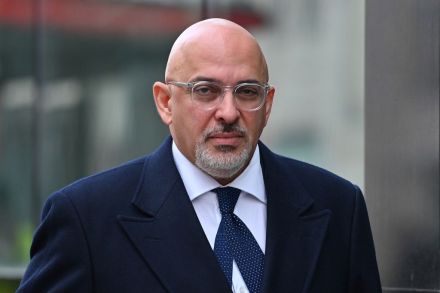
Nadhim Zahawi – ‘I’m confident’ all over 50s will get jab by May Vaccines minister Nadhim Zahawi was sent out to bat for the government this morning, at a time when over 11 million people have received a first dose of an approved Covid vaccine. Zahawi told Sophy Ridge that he was certain that, despite any possible disruption caused by the European Commission’s aborted jab grab, the government was still on course to meet its targets. The first four priority groups are forecast to be vaccinated by mid-February; and groups five-nine are estimated to be offered a jab at some point in the spring:  https://twitter.com/RidgeOnSunday/status/1358346263822012418?

What the EU still doesn’t understand about Britain’s vaccine strategy

From our UK edition

Since the outrage caused last Friday, when the European Union looked set to undermine the Northern Ireland protocol less than one month after the Brexit deal came into force, there has been little apology from those in charge. This is not terribly surprising: European Commission President Ursula von der Leyen has a reputation for passing the buck whenever possible. It’s also thought that last week’s mistakes are particularly hard for the EU to grapple with: desperate to prove Brexit was a mistake, it has been difficult for Brussels to watch Britain's reputation for handling the Covid crisis change so quickly for the better. Yesterday we got a hint of acknowledgement from von der Leyen that perhaps there are some benefits to being outside the EU.

Vaccination is pushing England’s population immunity to new heights

From our UK edition

England's population immunity to Coronavirus now stands at almost 39 per cent — a rise of 25 per cent since Christmas. The effects of the vaccination campaign are beginning to show. This is the latest finding of the PCCF model developed at Bristol University, and its results offer important insights into how much progress is being made. Immunity can take four forms, not all of which are officially recorded: Immunity after infection, with antibodies: This can be sampled via antibody tests and covers between 15 and 16 per cent of the population as of mid-January, according to the latest ONS report.

It’s time to call last orders on Britain’s rubbish pubs

From our UK edition

Oxford is famous for its pubs. Inspector Morse reveals that they are as much a part of the city’s life as any of its colleges. The insatiable undergraduate demand for cheap beer has meant that pubs like the Turf Tavern and the Eagle and Child have permeated (and intoxicated) the minds of students for centuries. So when the Lamb and Flag closed last week, it was as much a story as any of those bizarre murders John Thaw used to stick his nose into. No Jag-driving detectives are needed to work out why it has shut. A year of missed terms and lockdowns dramatically cut the pub's revenue. Owned by neighbouring St John’s College, the pub has stood on its current spot since 1615. C.S. Lewis and J.R.R.

France is furious at the EU’s vaccine bungle

From our UK edition

Ursula von der Leyen has clung to an increasingly implausible narrative this week: that the EU made the ‘right decision’ with its vaccine strategy. It’s the clearest sign yet that Brussels is going into panic mode. The Commission president is reported to have turned down requests to hold a public debate in the European parliament on the vaccine roll-out. Von der Leyen decided to only answer questions behind from a select group of MEPs behind closed doors. Finally, left without much choice the Commission president seems to have grudgingly accepted to appear before the European Parliament on Wednesday. The Commission feels increasingly cornered, and rightly so, for the EU’s vaccine struggle may well turn into an existential crisis.

Do May elections hint at faster lockdown easing?

From our UK edition

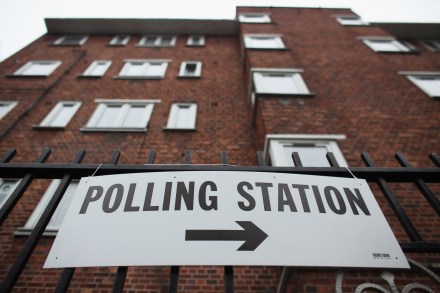
The news that the local elections will go ahead as planned on 6 May has increased optimism in the Conservative parliamentary party about the roadmap out of lockdown. Despite rumours that the vote could be postponed on the grounds that Covid restrictions would prevent them from effectively campaigning, UK Constitution Minister Chloe Smith has said it will go ahead on the grounds that 'democracy should not be cancelled because of Covid'.  But MPs aren't just pleased because the vote is on. Several are taking it as a sign that the lockdown will be eased sooner rather than later.

Covid could force a major schools shake-up

From our UK edition

At some point in the next few months, life will return to something approaching normality. When that happens, the UK will have to confront all the problems that Covid has left behind: bruised public finances, long NHS waiting list and the rest. But the problem that Boris Johnson is most worried about, as I write in the Times today, is the effect on children of having been out of school for so long. This pandemic has probably wiped out a decade of progress in narrowing the attainment gap. There would undoubtedly be resistance from the education sector The government is hoping that small group tutoring can help make up much of the lost learning; it looks like the school day will be extended as part of this.

Von der Leyen gets that sinking feeling

From our UK edition

HMS Britain seems to be a nippier beast after her Brexit refit. That is, at least, according to EU Commission President Ursula von der Leyen.  Earlier today the embattled Eurocrat admitted that when it comes to Covid vaccine procurement, the European bloc is a 'tanker' by comparison to the UK's 'speedboat'. When asked about her ability to get hold of life-saving jabs, she told reporters:  I'm aware that a country might be a speedboat and the EU more a tanker. If we conclude a contract, we need another five days for the member states to say, 'yes' — and these are five days, five working days.So, obviously, of course a decision taken by 27 lasts longer than if you just go by yourself, but I am deeply convinced that the European approach is the right one.

The French lesson that shames Britain

From our UK edition

Emmanuel Macron has become the pantomime villain for much of the British press after his hissy fit last week in which he questioned the efficacy of the AstraZeneca jab. It was the latest in a series of snipes at the British that has made the French president the scourge of Fleet Street. 'Bargain-basement Bonaparte,' was how the Daily Mail described Macron, while the Sun plumped for 'pint-sized egomaniac'. He's none too popular among his own people, either, the figurehead of the French failure to be the only member of the UN Security Council incapable of producing their own vaccine. No wonder a recent opinion poll suggested Marine Le Pen is a stronger threat than ever ahead of next year's presidential election. But the president of France should be lauded for one triumph.