Cooking

I’m a Christmas pudding convert

From our UK edition

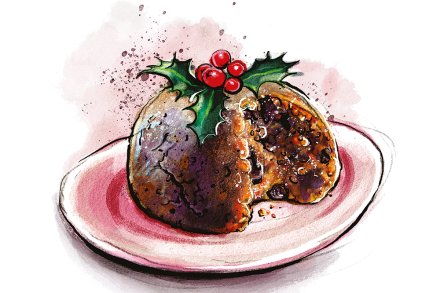
I used to be a Christmas pudding denier. I couldn’t see the attraction of a dense pudding made mostly of currants; frankly, I’d rather have a trifle. Of course, I was wrong: I was judging Christmas pudding by poor examples, those that sat on the edge of a Christmas lunch tray at school or were half-heartedly doled out by other pudding sceptics (I’m looking at you, Mother). My conversion came about thanks to a party – a Christmas pudding party. Not a party for eating Christmas puddings but rather one where the guests made Christmas puddings. It was hosted by my friend Kate and I went along out of love for her, rather than love for the pud. Under Kate’s keen eye, and following her great-granny’s recipe, we creamed kilos of butter and sugar in a big plastic tub.

The glory of gravy

From our UK edition

In Robert Louis Stevenson’s Treasure Island, when Ben Gunn is found by Jim Hawkins, sunburnt and wide-eyed after three years of being marooned on the island, the first thing he asks Hawkins for is cheese: ‘Many’s the long night I’ve dreamed of cheese – toasted mostly.’ As a greedy person prone to daydreaming, I’ve often wondered what my ‘cheese – toasted mostly’ would be. A dozen oysters? A cold negroni in a fluted tumbler? A perfect quivering soufflé? I think it’s gravy. That’s my desert island dream, the idea I can’t shake, the touchstone I’d return to. I’d take gravy in any form: thick and rich, made from meat scraps, a thin, boozy jus whisked up from pan scrapings, even the ‘from granules’ stuff, stirred in a plastic jug moments before serving.

Anne of Green Gables perfected the kitchen mishap

There’s something wickedly entertaining in reading about other people’s kitchen debacles, whether actual or fictional. They’re just so relatable. The jelly that won’t jell in Louisa May Alcott’s Good Wives is cruelly hilarious, but the best culinary catastrophe in classic fiction, for my money, is in Anne of Green Gables. Stylish guests, including the upper-crust Mrs. Chester Ross, are dining at Green Gables and our ebullient Anne is on her very best behavior. All goes well until Marilla arrives with the pudding and a pitcher of pudding sauce. On spotting the pudding sauce, our heroine’s eyes grow wide and terrified.

kitchen mishap

How to get Britain eating healthily again

From our UK edition

Another week, another government offensive against childhood obesity. This time it’s a fresh round of pleas for new levies on junk food. And right on cue, out come the sympathetic pundits with a familiar lament: the poor simply can’t afford to eat well. Carrots are unaffordable and broccoli is a luxury that only the middle class can stretch to. It’s a predictable narrative. It’s also wrong, or at least, far from the whole truth. I say this having lived the messy reality of fostering, where I’ve had the privilege, and sometimes pain, of stepping into lives different from my own. For more than 20 years, I’ve cared for children pulled from homes where parenting skills are scarce and where ‘dinner’ might consist of a handful of sweets and a packet of crisps.

How to make the perfect pecan pie

From our UK edition

A pecan pie has been on my kitchen table for the past few days, due to circumstances rendering every other surface or shelf unusable, thanks to badly timed building work and an absent fridge. A mixing bowl sits over it, protecting it from dust and sticky fingers. I’ll tell you what I’ve learned: everybody loves pecan pie. Everyone who has walked past it has stopped dead, done a double take, and then rhapsodised unprompted about the pie’s virtues. At one point, excitement was generated simply by the pie being in the background of a video call. Pecan pie, one of America’s traditional celebration (especially Thanksgiving) puddings, is adored by children, but it has a dark, complex sweetness that wins over grown-ups too, and the toasty nuts bring texture as well as richness.

How to make five dinners for £5

From our UK edition

No matter how much the cost of convenience food rises, the idea that it’s still cheaper than cooking fresh food at home somehow refuses to go away. People can fool themselves as much as they like. But it’s (overpriced) pie in the sky.  To be economical, choose chicken thighs over breast; lamb shoulder over leg. Veg offcuts such as broccoli stalk (for soups) and ginger peel (to flavour Asian stock). Leftovers for egg fried rice. Stale bread for croutons. The freezer is your friend: not just for peas and berries, but spinach and an ice cube tray of leftover wine for cooking too. Oxo over refrigerated supermarket stock; Bird’s over fresh custard; lard over butter. It's handy to also use ingredients that don’t differ wildly between basic and premium versions.

Enough with the Aga-shaming

From our UK edition

The headline smacked me between the eyes. ‘I can’t afford to turn my Aga on this winter,’ a nice writer called Flora Watkins whinged in the Telegraph last weekend (she once wrote a Spectator piece about the sublime awfulness of cockapoos that I wished I’d written myself). The sub-head continued: ‘Our writer’s once cosy Norfolk home is feeling the chill as energy bills rise – how will she and her family cope?’ There was a fetching picture of our tragic protagonist in cardi and layers clutching a mug in front of her Aga and an impressive batterie de cuisine. Watkins had also swathed her pretty neck in the Diana-sheep-jersey scarf (white sheep on red, and one dear little black sheep).

Never put your pots and pans in the dishwasher

From our UK edition

I don’t know how many teenagers are given a frying pan for their 18th birthday. Perhaps my friends managed to intuit my food-writing future, despite my party piece back then being an extremely tomato-heavy bolognaise. Twenty-five years on, having somehow survived university halls of residence and flatmates using – the horror – metal utensils in it, that beautifully thick-bottomed frying plan lives at the bottom of an excessively large pile of frying pans, well past its best. But even as the pile threatens to get taller than the cupboard, I can’t bear the idea of throwing it away. I’ve loved and lost too many pans to count. I had a little milk pan, perfect for a single portion of porridge, until the surface started flaking off.

The secrets of sachertorte

From our UK edition

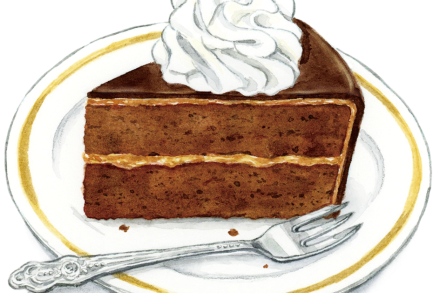
My theory is that sachertorte is a victim of its own success. Over the past 150 years, it has become an Austrian icon and, as such, can be found throughout Vienna. And that’s the problem: its ubiquity means that inferior versions abound. It has developed an unfortunate reputation for being dry, dull, tasteless – a pale imitation of a chocolate cake. It is often described – even by its supporters – as a ‘grown-up’ chocolate cake or an ‘elegant’ chocolate cake, but I feel like this does it a disservice. Both feel a little like euphemisms for ‘not that nice’, but this couldn’t be further from the truth.

Bacon and egg pie, the perfect throw-it-together, please-the-whole-family dish

From our UK edition

There are a handful of elements that make me nervous about tackling particular classic recipes. First, if it’s a dish that I didn’t grow up with and can’t speak to personally; secondly, if it’s a dish that a lot of other people did grow up with, and feel very strongly about. Thirdly, if it requires an ingredient that we don’t have in Britain, which I then have to imitate, or simply ignore. That can be pretty restrictive. I didn’t encounter a Staffordshire oatcake until I was 28, so they’d be out. Risotto, which I’m fairly sure doesn’t hail from the north-east coast of England, would be untouchable. Gorgeous vintage puddings like bananas Foster or pecan pie would be out of the question, too.

The secrets of a British apple pie

From our UK edition

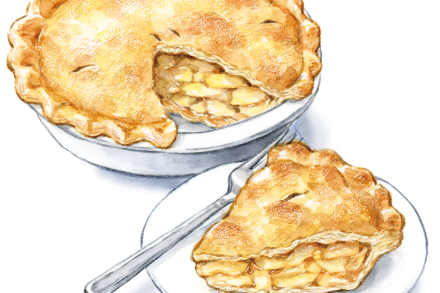
‘As American as apple pie’, or so the saying goes. But what happens if the apple pie in question isn’t actually American? America is the source of many of my most beloved vintage recipes, especially puddings, and particularly pies. But the knock-on effect is that sometimes they can overshadow similar dishes that come from other places. The British apple pie is not quite an underdog in this fight, but it’s certainly less celebrated than its cousin from across the pond. It took a while for apples to take hold in the US. Only crab apples were native to America, and they were small and sour – no good for baking with.

Whatever happened to chicken à la king?

From our UK edition

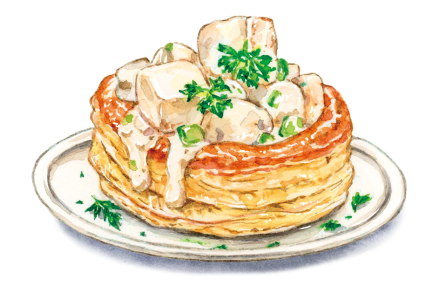
As sure as eggs is eggs, what was once comfort food will be reinvented as fine dining. Lancashire hotpots will be turned fancy, served with teapots of lamb jus. Fish and chips will become canapés, spritzed with atomisers filled with malt vinegar. French onion soup will be served in teeny-tiny shots; Scotch eggs gussied beyond recognition. I once ate a (large and unwieldy) single bite of shepherd’s pie from a Chinese soup spoon at a posh party. Chefs just can’t resist the joke. Chicken à la king – chicken braised in a cream sauce with onions, mushroom and peppers – has gone in the opposite direction, from fine dining to comfort food.

The glorious richness of rillettes

From our UK edition

I admit to feeling a little intimidated by charcuterie. I have a clutch of books on my shelf all laying out in step-by-step detail how to craft your own salami or whip up a perfect pancetta. They’re well-thumbed, but not a single one has a cooking stain on it. I’m just too nervous when it comes to the scary stuff. I’m talking about the drying-sausages-hanging-from-the-rafters kind of charcuterie. I’m talking about jerry-rigging anti-pest guards to protect your hams. I can’t quite get past the fact that charcuterie requires hanging meat somewhere in my house, which feels at best frightening and at worst like I’m actively inviting botulism into my home. I’ll say it: I’m a charcuterie coward.

The magic of Danish dream cake

From our UK edition

I am, for the most part, a rule follower and a people pleaser. It’s one of the reasons I love baking, which essentially amounts to a set of instructions designed to make something to be shared and bring joy. But if someone recommends something to me, I can be resistant to it for ages. The farcical element is that once I capitulate and try out the novel, TV show, restaurant or biscuit recipe, I inevitably discover that my tastes are extremely mainstream, and I love whatever it is. It took me years to listen to Taylor Swift before immediately accepting her greatness and becoming her no. 1 fan. There’s no good reason for this.

Should family history, however painful, be memorialised forever?

From our UK edition

Be under no illusions: this is not a food memoir. Chopping Onions on My Heart is a linguistic exploration of belonging; a history of the Jewish community in Iraq; and an urgent endeavour to save an endangered language. Above all, it is a reckoning with generational trauma. The subjects of Samantha Ellis’s previous books include the life of Anne Brontë, heroines of classic literature, feminism and romantic comedy. She is the daughter of Iraqi Jewish refugees, and the language she grew up around, the language of her people and culture, is dying. Judeo-Iraqi Arabic ‘came out of the collisions of Hebrew-speaking Jews and Aramaic-speaking Babylonians, and then absorbed linguistic influences from all the other people who conquered Iraq’.

I love sausages!

From our UK edition

‘Sausages,’ my son says to me, leaning forward from the back of the car, with the authority and confidence only a three-year-old can truly muster. ‘Sausages?’ I reply distractedly, while navigating a particularly awkward roundabout. We’ve been talking about my job, but I assume his train of thought has taken a lunchier direction. ‘Yes, sausages. You write about sausages. And… things like sausages.’ He sits back, satisfied in his career analysis, probably contemplating whether lunch can indeed also feature sausages.

How do I feed my children now my wife has gone on strike?

From our UK edition

Caroline has gone on strike. At least, as far as cooking is concerned. Her case for downing spatulas is that she’s been cooking steak, chicken and bacon for my three sons and me for the best part of 25 years and, as a vegetarian, she’s had enough. Henceforth, she’s going to prepare vegetarian meals. If we’d like to share those with her she’s happy to make enough for all, but if we want something meaty we’re on our own. Now, I wouldn’t mind the occasional nut cutlet and sweet potato – I can even stomach tofu and scrambled egg. But for Caroline, a ‘vegetarian meal’ consists of a fried egg on toast and some spinach leaves. It’s what my sons and I would call a ‘snack’ – and a pretty dreary one at that.

Confection of sex, bad history and nonsense: Apple TV+’s Carême reviewed

From our UK edition

Antonin Carême was known as the ‘chef of kings and the king of chefs’. His patrons and employers included Talleyrand, Napoleon, the Prince Regent, Tsar Alexander and the then richest man in France, James Rothschild. He popularised the tall ‘toque’ hat worn by chefs; he either invented or perfected culinary classics including the vol-au-vent, the profiterole and the mille-feuille, as well as sauces including velouté and béchamel. All this he managed to achieve despite having come from a desperately poor background, raised in a shack in revolutionary France and sent off as a young lad to help make ends meet as a kitchen boy and later as apprentice to Paris’s best patissier. A fascinating rags to riches story, you might think.

Cooking up a storm of memories – Bee Wilson’s kitchenalia

From our UK edition

When Bee Wilson’s husband abruptly called time on their 23-year marriage, she was left with a house full of memories embedded in the everyday objects around her. Two months after his departure, the heart-shaped tin of the title – in which she’d baked their wedding cake – clattered to the floor for no apparent reason. Symbolic or what? That leap inspired another, sending Wilson on a quest to explore our relationship to objects, specifically kitchenalia. After years of use, all possessions hold symbolic memories and actual DNA, and kitchen tools are handled more than most household items, from wooden spoons and cooking pans to salt shakers and china.

Something to relish: in praise of Patum Peperium

From our UK edition

In a social media age, certain ingredients – long esteemed by those in the know – suddenly burst on to the scene. One morning we woke up to all the supermarkets stocking Mutti tinned tomatoes. Ortiz sardines and Perello Gordal olives are now in the limelight. I wonder – given the current zeitgeist for all things umami – whether Patum Peperium (Latin: ‘peppered paste’) could be next. Then again, the ‘Gentleman’s Relish’ – an anchovy paste made with butter and spices – isn’t for everyone. Much like Marmite, it has embraced this contentious reputation: ‘Dividing opinions since 1828’ it declares in its branding. After almost 200 years on the scene, it has started popping up in trendy spots, like a debonair rake sauntering into a party fashionably late.