Cooking

Don’t spare us the asparagus

Asparagus inspires gentle thoughts, or so said Charles Lamb in an essay about grace before meals. Other vegetables had come to pall on him, but a noble affection for asparagus still lingered in his heart, a reminder of simpler and more innocent times. One can only surmise that he didn’t much care for the vegetable. Who feels melancholically virtuous when eating greens? People who don’t really like them, that’s who.

asparagus

The wonder and mystery of Mexican cooking

Mexican food is my comfort food. My devotion stems from memories of my mother’s enchiladas. I used to love watching her fry the tortillas in oil. They would bob about like lily pads, sizzling gently. Then when the bubbles formed with little pops, Mom would lift each tortilla out of the hot oil and place it on a paper towel. At the same time, she’d be heating salsa roja on the gas stove and, when it was ready, she would dip a spoon in the pan and put a dollop on a tortilla, swirling the spoon to coat the whole tortilla, then turn it over and do the same on the other side. She was such a careful cook, and neat. The bowls of fillings sat ready and waiting on the kitchen island, each with its own spoon.

mexican

Cost-cutting in the kitchen with Budget Bytes

Have you heard about the latest food trend sweeping the nation? It’s called “whimpering over your grocery bill.” In the early days of 2023, Americans are spending 70 percent more on eggs than one year ago. Chicken, dairy and bread prices outpaced inflation as well, increasing by double-digit percentages. What’s an adventurous home cook to do? The answer is Budget Bytes, a website I first turned to as a broke twenty-two-year-old with a galley kitchen in Queens. I didn’t know, before an acquaintance tweeted a link to a coconut vegetable curry, that you could make a tasty, filling meal, complete with leftovers, using almost entirely canned or frozen goods. Budget Bytes taught me to cook.

budget

Confessions of a TikTok tradwife

Estee Williams was studying meteorology at college when she dropped out to follow her dream: being a stay-at-home housewife. Now, while spending her days packing her husband’s lunchbox and scrubbing the skirting boards, she films videos for TikTok in flowy dresses where she promotes a return to "traditional" values. Think Betty Draper minus the melancholy. She is the figurehead of the #tradwife movement. If you’re not familiar, the online tradwives are the product of a marriage between Instagram models and Fifties TV moms. They reject however many waves of feminism there are now and long for a return of the traditional nuclear family that once existed in America (for maybe forty years).

tiktok tradwife estee williams skibidi tradwife

Dips: Chef Andrew Gruel’s answer to your Super Bowl party food dilemma

Does it seem these days that everyone you know suffers from a food allergy, sensitivity or intolerance (don’t ask me to explain the difference)? It seems inevitable that eating out in a group entails someone in the party requesting a menu item be made vegan, keto, gluten-free, dairy-free, tree nut-free, sulfite-free, etc. (I usually just hope the meal itself is free). Blame it on seed oils, soil depletion, genius marketing, the Liver King — whatever. The fact is that our toxic world makes party-planning a royal pain. How do you accommodate a bunch of people whose dietary restrictions turn menu-making into a culinary Sudoku puzzle? Fortunately for you, The Spectator associates with a lot of cool, accomplished, clever people — one of whom is Chef Andrew Gruel.

andrew gruel

Ali Slagle’s low-stress supper

Who is Ali Slagle? A fan of New York Times Cooking might recognize the name: nine of their fifty most popular recipes of 2022 are credited to her, the most of any of their contributors, including household names like J. Kenji Lopez-Alt and Melissa Clark. But despite the tremendous popularity of her recipes, Slagle herself is a bit mysterious. She crops up, cheerfully and occasionally, on NYT Cooking channels. Her 142,000 Instagram followers are a mere fraction of the followings of her food-celebrity contemporaries, like Molly Baz, Alison Roman, or Claire Saffitz. She doesn’t appear to be developing a platform; she has no Twitter, no Substack, no YouTube channel. She appears to live in a camper van.

ali slagle

A salt for all seasons

It takes four people, according to the French, to get a salad dressing right: a spendthrift for the oil, a miser for the vinegar, a wise man for the salt and a lunatic for the pepper. A tough cast to assemble, you might think, but the freehanded, the tightfisted and the insane aren’t such rare birds. The true needle in the haystack is the wise man who would have anything to do with a recipe involving four chefs. Cooks, broth, too many — enough said. Most wise men would be out of town before you could say “smoked oak salt flakes” ten times fast. But the point stands: getting the salt right isn’t a walkover. The rookie has to steer a tight course between undersalted Scylla and oversalted Charybdis.

salt

The Menu serves up clever and tangy social commentary

Several years ago, after I passed the bar exam, my wife and I went to dinner at Pineapple and Pearls — probably Washington, D.C.’s second swankiest restaurant. I recall eating some excellent duck, as well as imbibing a selection of craft cocktails served in ever-more exotic glasses and alembics. But what I remember most was dessert: a single gooseberry lacquered with honey. Yes, a single berry. (We ordered Domino’s when we got home.) The Menu is a lacerating bit of social commentary that doubles as a satire of this kind of fine dining — not all that surprising a blend, given the presence of Adam McKay on the production team.

The unruly chef

Joshua Weissman’s number-one bestselling An Unapologetic Cookbook is misnamed. You won’t catch the potty-mouthed, long- haired chef saying sorry for making a mild ethnic slur against Italians or a penis joke, but in a philosophical sense, apologetics is exactly what he’s doing: he champions the joys of home cooking to an uninitiated audience. Weissman’s unlikely following is made up of the type of guys who consume a lot of quasi-educational content on YouTube and Wikipedia. They won’t buy the latest Barefoot Contessa volume, but they are curious about how things are made, whether it’s bridges or Big Macs.

weissman

Serving up a Half Baked Harvest feast

As one of eight children, I feel deep kinship with others who come from big families. Bunk beds, hand-me-down clothes, abject chaos at dinnertime — these are the staples of big-family life. Tieghan Gerard, the author of the food blog and cookbook series Half Baked Harvest, is one such kindred spirit. She comes from a family of ten, and began cooking as a tween to help with frenzied mealtimes. She soon started creating her own recipes for a food blog, which became three bestselling cookbooks and a four-million-follower Instagram. Her big-family backstory blends with her wholesome, rustic aesthetic: feeding a crowd, after all, involves creativity, resourcefulness and well-loved tools. I hoped I’d recognize some high-volume cooking tricks in Half Baked Harvest: Super Simple.

harvest

Barbecue is America’s food

Summer is fading fast, and though, according to my calendar, “the Autumnal Equinox” (is that the newest model of Hyundai?) isn’t until September 22, all the things we love about the season — swimming, county fairs, outdoor drinking, the August congressional recess — are essentially over after this weekend. And while people mark Labor Day in different ways, one of the best is with a barbecue, one of the few culinary traditions America can truly call its own. Smithsonian Magazine tells us barbecue has its origins in the first indigenous tribes Christopher Columbus encountered, who had a “unique method for cooking meat over an indirect flame, created using green wood to keep the food (and wood) from burning.

Eating well at a time of inflation

Inflation having topped 9 percent this summer, Americans are looking for ways to cut their spending. Rising prices at the grocery store are impossible to avoid, but we can learn to adjust. There’s no better inspiration than M.F.K. Fisher. Fisher, a food writer who hung around with Julia Child and James Beard during her lifetime, felt the pain of wartime rationing acutely. Her 1942 book How to Cook a Wolf addressed the problem of hunger — “the wolf on the doorstep” — with a few clever recipes and a great deal of philosophy. Survival of the crisis, she predicted, would require first and foremost an attitude of abundance. Fisher ascribes virtues like honesty, dignity and nobility to simply prepared foods.

The assorted joys of nasturtiums

It’s still amazing to me how Instagram photos can bring such unexpected responses. And instantly! It happily happened to me last May and my creative juices — green, yellow, orange — started flowing. I had just posted a photo of the nasturtium pesto I’d made from the flowers and leaves in a nod to the exigencies of Covid-19: self-quarantining, fear of food shopping and the constant barrage of advice for oldies like me to not mix or mingle. I was going to forage for food, fool about with flavor and fun. Within minutes, Caroline, the flower girl at my Swiss wedding fifty years ago, commented, “Do you remember that you and Maman would take me foraging in the meadows above Lausanne for wild nasturtiums for salads?

nasturtium

Spring’s perfect roast

When I first moved to the country, I was intrigued by the sight of people walking sheep on a leash round and round the front garden of a neighboring farmer. City girl that I am, I wondered if they were receiving some kind of special therapy. Equine interaction is supposed to help with certain anxiety disorders, why not sheep-walking for, say, insomnia? It turned out, however, that the sheep-walkers were members of the local 4-H club preparing to show their market lambs at the fair, an event I was later privileged to witness. But I was put to the blush when the judge, a tall, competent-looking man in a checked shirt and green boots, commented loudly on the fine chops displayed by the winning entrant.

lamb

The pan handler

I have become a pan handler — a handler of cast-iron pans. I can think of few hobbies that are as rewarding as collecting and cooking on cast iron. Skillets, griddles, muffin tins, Dutch ovens, waffle irons, corn-stick pans and much else: there was a time when America produced the finest cast-iron cookware in the world. The iron ore was abundant. So was the coal to melt it. Foundries went up across this great land. American cuisine developed around it. From fried chicken to cornbread, the American menu should still be cooked on cast iron. Southern cooks never forgot this. The same goes for soul food; black America has always prized its cast-iron inheritance. Now I find I have little need to cook on anything else.

pan

The millennial kitchen

However else we may criticize the late 90s and early 00s — its politics, its fashion, its music — this was undeniably the golden age of the celebrity chef. Barefoot Contessa, 30-Minute Meals and The Iron Chef franchises all debuted in the first decade of this millennium, minting stars like Bobby Flay, Guy Fieri and Nigella Lawson. I once found a collection of my brothers salivating over Giada de Laurentiis making meatballs on Everyday Italian, though they’d never demonstrated more interest in cooking than microwaving the odd Hot Pocket. The mid-aughts brought on the glory years of the “hands and pans” videos: the aerial-view clips of disembodied hands assembling cheeseburger pretzel balls or eighteen-layer taco dip.

millennial

What’s good from the goose

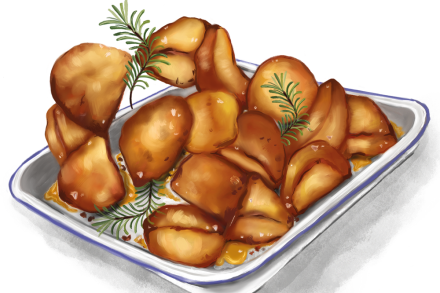
One of the more curious habits of the British is their tendency to publish opinion polls in national newspapers about their own food habits. Which way round, for example, are you meant to dress your scone? Is it clotted cream first, then jam — or jam first and cream second? Well, the Queen does it jam first, so that must be the way. Or that other national debate, tea and then milk, or the opposite? When I first arrived in the UK thirteen years ago, I was amused to see how worked up the British get about such questions. Try asking them sometime and see what happens. A new poll reveals that 58 percent of the British public admit to preferring roast potatoes over turkey. “How could you?” we’re supposed to gasp. “Everyone knows Christmas dinner is about the turkey!

goose

The culinary wisdom of charity cookbooks

Joy’s Toasted Parmesan Canapés: mix four tablespoons grated Parmesan cheese with half a cup of grated Swiss (or any other mild cheese that will melt), add mayonnaise enough to make a spread, season with salt and oregano or basil, spread on bite-sized rounds or squares of thin-sliced white bread, top with a slice of green olive (optional), broil until bubbly, serve immediately. Caveat, sophisticates: the ‘Parmesan’ likely as not was that pale yellow powder dispensed from the green Kraft cylinder, the Swiss was from Wisconsin, the mayonnaise was aka Miracle Whip Salad Dressing, the spices dried ones from the McCormick jar and the bread courtesy of Pepperidge Farm (if you were lucky). Not a whiff of anything cordon bleu or ‘artisanal’ here, the latter a term not yet dreamt-up c.

cookbooks

The diversity dinner

Growing up in a mixed American household of Indian, Italian and Puerto Rican descent, I never questioned the varying menu each night for dinner. Until I was a teenager, I hadn’t realized my family’s weekly meals were different from those of my friends — until they began begging me to eat at my house on weekends after I told them what was being cooked. For me, dietary normalcy meant chicken curry on Mondays, arroz con habichuelas on Wednesdays and lasagna on Fridays. My Puerto Rican and Italian American mother Loretta had married my father Roop, an Indian immigrant, in 1981. I always admired my mother for her fearlessness in crossing cultural lines during an era when interracial marriage was less common than it is today.

family diversity dinner

All I dream of is becoming a tradwife

‘A woman’s place is in the House and the Senate’, read the shirts assembled by slave labor in Myanmar, the messaging likely dreamed up by graduates of a small liberal arts school whose annual tuition would make a generous stimulus package for a city in any developing country. I like seeing women in the Senate, don’t get me wrong. I just see the former option, the house, as much more preferable for myself for a variety of reasons. I went through my Girl Boss phase in my late teens — my hard working immigrant parents, the descendants of a long, long line of ‘tradwives’, wanted different things for their only daughter.

tradwife