Contemporary music

The Arts Council’s bleak vision for the future of opera 

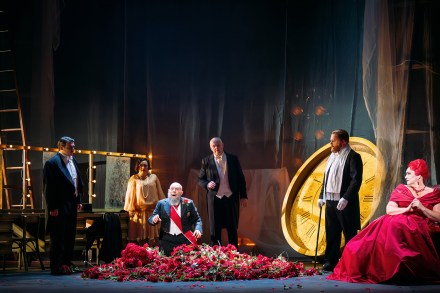
English National Opera’s first production created in Manchester is Angel’s Bone, a one-act opera by Du Yun and the librettist Royce Vavrek. It was premièred in 2016 in New York and subsequently won the Pulitzer Prize, but we shouldn’t hold that against it. Musically, at least, it’s certainly more interesting than recent US imports like Jeanine Tesori’s Blue – worthy, sub-minimalist Yankslop addressing the fashionable issues of the day. (It’s funny how the classical music world imagines that the way to reach British audiences in 2026 is to programme stuff that was relevant to Americans in 2016.) It was a pretty horrible experience nonetheless. Daytime TV-fixated suburbanites Mr and Mrs X.E.

The British modernist who was airbrushed from history

Elsewhere in British music in 1960: William Walton was writing his Symphony No 2, Benjamin Britten his opera on Midsummer Night’s Dream and Michael Tippett was about to start King Priam. Meanwhile in Cambridge, an ex-pat composer from Catalonia, Roberto Gerhard, was puzzling out how to knit together a new large-scale piece for orchestra and electronics. Simon Rattle and the London Symphony Orchestra are about to give that work, Gerhard’s Symphony No. 3, Collages, a rare outing at the Barbican on 21 May. It’s a mind-stretching piece, both very much of its time and of the future. Gerhard’s electronics gurgled, bleeped and cracked their knuckles, as he atomised the orchestra, finding a kaleidoscope of inventive ways to cement its working parts back together.

A playful, big-hearted, intelligent new opera

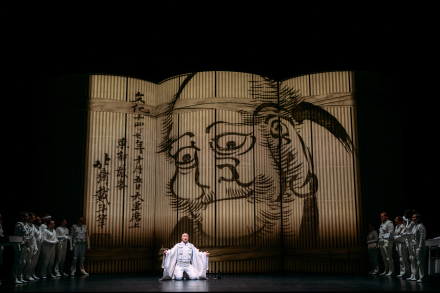
Some people like art to have a message. So here’s one, delivered by Katsushika Hokusai near the end of Dai Fujikura and Harry Ross’s new opera The Great Wave. ‘Remember art won’t change the world,’ sings the great painter (as incarnated by the baritone Daisuke Ohyama), and for that line alone I’d gladly have given the show five stars, if the Spectator did anything as barbaric as award stars. Words to live by, at least if you’re an artist; and the very private bliss of a life devoted to creativity is the heart, mind and dramatic engine of The Great Wave. Is that enough to sustain a full-length opera?

Richard Jones’s Boris Godunov feels like a parody

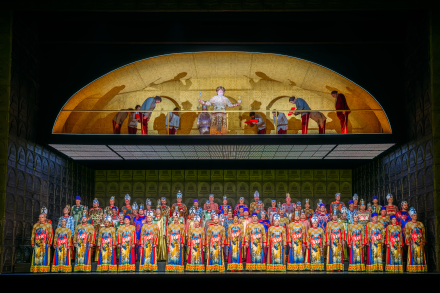
Mussorgsky’s Boris Godunov is back at Covent Garden, and there are ninjas. This isn’t a spoiler. There hasn’t been a note of music at this point, and it’s almost the first thing you see. A ginger child in a weird mask is playing with a spinning top when the black-clad assassins stalk on and slit his throat. Cue gasps. Well, the director is Richard Jones, after all; quirky, garish and occasionally macabre is what he does. And the (alleged) murder of a child pretender to the Russian throne is the horror that drives the entire plot, at least in the first (1869) version of the opera, which is what we’re given here.

The genius of Morton Feldman

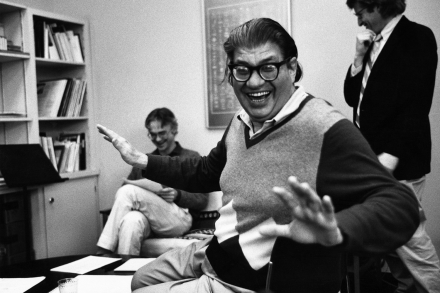
To accompany an exhibition of paintings by Philip Guston at the Royal Academy of Arts in London in 2004, a performance was arranged of Morton Feldman’s composition written in homage to Guston, for which I was persuaded to page-turn. For Philip Guston runs non-stop for four hours and the thick A3 bundle of manuscript paper balanced precariously on a flimsy music-stand was a matter of concern: what could possibly go wrong? Once the performance ended, I snatched the bundle of £20 notes that I’d been promised, sprinted to the bathroom, then fortified myself with the chunkiest slice of cheesecake I could find in Patisserie Valerie on Old Compton Street. Nothing had gone wrong but, boy, did I need a sugar-kick.

Bruckner on Ozempic – and the première of the year

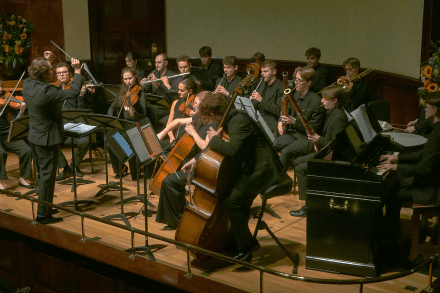
Bruckner at the Wigmore Hall. Yes, you heard right: a Bruckner symphony – his second: usually performed by 80-odd musicians – on a stage scarcely larger than my bedroom. How? Welcome to Anthony Payne’s very smart 2013 chamber arrangement. Bruckner on Ozempic. Composition is an Alice in Wonderland activity. A key duty is mastering how to make things bigger and smaller, how to stretch and compress and bend – time and space and sound. Bruckner understood this well. If you know anything about his symphonies, it’s that they’re vast – and that critics are mandated to compare them to cathedrals or mountain ranges. What survives after such an extreme trim? More than you expect. The long sightlines remain; paradoxically, the reduced forces sharpen the sense of depth.

The rise of cringe

No one wrote programme notes quite like the English experimentalist John White. ‘This music is top-quality trash,’ proclaims his 1993 album Fashion Music. ‘We kindly ask the users of this CD to play it at the volume of a suburban Paris soundmachine or a London underground discman earphone as used by the kid next door.’ Track titles included ‘Epaulette’ and ‘Latin Flutes’. From what I remember – my copy vanished a long time ago – the music was cheap and very funny: tinny and dumb. I was reminded of White recently because trash is back. Everywhere I go, I find composers producing shamefully terrible music. Some deliberately, some inadvertently. What flavour of terrible? Not ugly or discordant. Not camp. More tonal and naff: works woven from the worn-out and iffy.

The excruciating tedium of John Tavener

The Edinburgh International Festival opened with John Tavener’s The Veil of the Temple, and I wish it hadn’t. Not that they were wrong to do it; in fact it was an heroic endeavour. Drawing on three large choirs, members of the Royal Scottish National Orchestra and a sizeable team of soloists, this eight-hour performance was the sort of occasion that justifies a festival’s existence – the kind that, done well, can transform your perceptions of a work or a composer. It was certainly done well, and it certainly transformed mine. I’d never much minded the music of John Tavener. By the fifth hour of The Veil of the Temple, I was beginning to detest it.

Thrilling: Garsington’s Queen of Spades reviewed

Tchaikovsky’s The Queen of Spades is one of those operas that under-promises on paper but over-delivers on stage. It’s hard to summarise the plot in a way that makes it sound theatrical, even if you’ve read Pushkin’s novella, and I’ve never found a recording that really hits the spot. And yet, time and again, in the theatre: wham! It goes up like a petrol bomb. With a good production and performers, Tchaikovsky hurls you out at the far end feeling almost hungover – head swimming, and wondering where those three hours went. The cast and staging at Garsington are very, very good.

RIP to new music’s gentle, smiley radical

Danish composer Per Norgard – whose death at the age of 92 was announced this morning – was a towering presence in European new music, and the shine-bright timbres and heady narrative drive of his eight symphonies posed crucial questions about what it meant to be a symphonist during the late 20th century. In 2000 I was despatched to interview Norgard for a magazine and found a man as gentle and thoughtful as his music suggested he would be, with eyes that gleamed just like his woodwind writing. He had been in London to hear a performance of one his works – I forget which – but under discussion that afternoon was a new recording: the violin concerto he'd written in 1987, Helle Nacht.

Igor Levit’s 12-hour performance of Satie’s Vexations was far too short

So, in the end, it was long but not that long. Twelve hours, compared to the 20 hours-plus many of us had been anticipating. The fastest on record? Very possibly. Igor Levit had started Satie’s Vexations just after 10am on Thursday 24 April, and completed repeat number 840 of this niggly little bastard of a phrase around 10.30pm, preventing any kind of mass sleepover at the Queen Elizabeth Hall. No screens were required in the end either – screens that the Guardian had reported were scheduled to appear around the pianist to hide his modesty when the toilet beckoned. (The logistics of this seemed ambitious.) Instead whenever Levit decided it was time for a loo break he simply walked off stage.

Igor Levit performing Satie's Vexations. Image: Pete Woodhead

‘I’ve seen controllers come and go’: Radio 3’s Michael Berkeley interviewed

A few years ago I had a panic-stricken phone call from a female friend. ‘Help!’ she wailed. ‘Remind me what classical music I like. I think I’m going to be a guest on Private Passions.’ I could understand her anxiety. The programme, which celebrated its 30th birthday this month, is BBC Radio 3’s lofty version of  Desert Island Discs. Eminent writers, scientists, artists and businessmen, plus the occasional book-plugging celeb, explain how music – mostly but not exclusively classical – is, well, one of their private passions. Even if, as in the case of my friend, it isn’t. It’s an honour to be asked on the show, which is presented by Michael Berkeley – the first classical composer since Benjamin Britten to be elevated to the House of Lords.

The liberating, invigorating music of Pierre Boulez

‘When you’re not offensive in life, you obtain absolutely nothing,’ declares a twinkly-eyed Pierre Boulez in one of the archive films that the Barbican were screening to celebrate the composer’s centenary. What a joy to be reminded of the young Boulez – the unashamed elitist, the unbeatable snob. Not even allies such as Schoenberg (too trad) and Messiaen (‘vulgar’) were safe from his tongue. To Boulez, pop music wasn’t good or bad; it didn’t exist. Ditto his own life. ‘I will be the first composer without a biography’, he proclaimed. Forget that Boulez was entangled in a love triangle with Camus’s mistress and for most of his time on earth screwing his valet, Hans… The music was everything.

The liberating force of musical modernism 

It’s Arvo Part’s 90th birthday year, which is good news if you like your minimalism glum, low and very, very slow. Lots of people seem to. The London Philharmonic’s concert on Saturday night was a reminder of an earlier, less ingratiating Part: the dissident composer in Soviet-controlled Estonia. Hannu Lintu revived Part’s First Symphony of 1963, and there’s nothing remotely minimal about its opening. There’s a swagger of brass, machine rhythms and an onslaught of string chords in which the dissonances don’t feel aggressive so much as mischievous. This is a young composer taking a manic glee in piling on the wrong notes just because he can.

A dancing, weightless garland of gems: Stephen Hough’s piano concerto reviewed

Stephen Hough’s new piano concerto is called The World of Yesterday but its second ever performance offered a dispiriting glimpse into the world of tomorrow. A couple of minutes into the finale Hough stopped playing and the orchestra fell silent. ‘I’m very sorry,’ he explained. ‘My iPad is going crazy.’ A murmur of sympathy, mingled with laughter; then Hough signalled to the conductor Mark Wigglesworth and the Bournemouth Symphony Orchestra and they carried on, this time without mishap. But we’d seen it happen, and until last week I’d have told you it was inconceivable. This wasn’t some rash experiment: professional musicians have been using electronic scores for well over a decade, generally without problems.

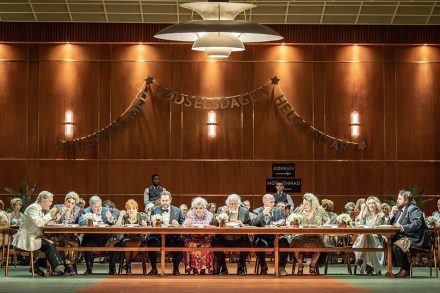
Spreads emotions like jam: Festen, at the Royal Opera House, reviewed

Mark-Anthony Turnage’s new opera Festen opened at Covent Garden earlier this month, and reader, I messed up. I broke my own golden rule with new operas: don’t do any homework, don’t try to memorise the plot, and whatever you do, don’t revisit the source material. The aim is to experience the new work on its own terms. That’s hard enough, given the PR onslaught that precedes any Royal Opera première – the way the classical establishment circles the wagons, and the unspoken consensus that certain living composers (including Adès, Benjamin and Turnage, though not Judith Weir, curiously) are simply too big to fail. But no: I rewatched Thomas Vinterberg’s 1998 Dogme movie, twice, and it was the wrong decision. Inevitably, and unfairly, you cross-reference.

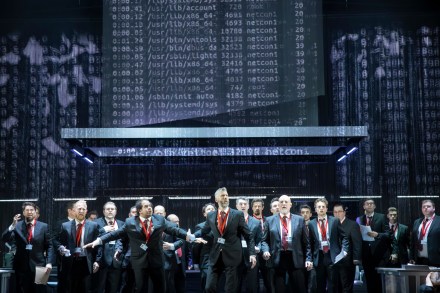
Opera North’s Flying Dutchman scores a full house in cliché bingo

The overture to The Flying Dutchman opens at gale force. There’s nothing like it; Mendelssohn and Berlioz both painted orchestral seascapes but no one before Wagner had flung open the sluices and let the ocean roar into the opera house with quite such elemental power. Garry Walker and the orchestra of Opera North dived into it headfirst, while images of waves were projected on the curtain. If you believe that opera audiences can’t handle an overture without visual distraction (and most opera directors do appear to think this) it’s as good a solution as any. A strong start for a new production. Then the curtain rose and we were in the Home Office.

The thankless art of the librettist

Next week, after the première of Mark-Anthony Turnage’s new opera Festen, the cast and conductor will take their bow. All being well, there’ll be applause; and then a brief lull as the creative team takes the stage. There’s often a ripple of curiosity in the audience at this point, because it’s rare that we get to see just how many people it really takes to make an opera. Standing near the composer will be Lee Hall, the writer of Billy Elliot and The Pitmen Painters, and now part of the most maligned – and indispensable – profession in all of music. He’s the librettist. In short, Hall wrote the words, and in the world of opera there’s no more thankless task. ‘There’s this snobbery about it, an English snobbery, I suppose,’ he says.

Classical music has much to learn from Liverpool

They do things their own way in Liverpool; they always have. In 1997 the Royal Liverpool Philharmonic Orchestra launched a contemporary music group called Ensemble 10:10 (the name came from the post-concert time-slot of their early performances). For a decade now, they’ve also administered the Rushworth Prize, an annual competition for young composers based in the north-west. And while classical fads and crises have come and gone, the RLPO has held its friends close and tended its garden. The result? The kind of artistic self-assurance that lets you put your chief conductor in charge of a première by a novice composer, and then call in a Barenboim to guarantee a full house.

The BBC Singers Centenary Concert was toe-curling

When does a new opera enter the repertoire? Judith Weir’s Blond Eckbert has only had a couple of UK productions since its première at English National Opera in 1994, but it’s been doing reasonably good business on the continent, where its source material – a story by German writer Ludwig Tieck – presumably has more cultural currency. In any case, it’s back now, as part of English Touring Opera’s autumn roster, and both the staging (by ETO’s general director Robin Norton-Hale) and the performances deserve to make Weir’s haunted, oddly unsettling opera a lot better known. If my toes had curled any harder I think I’d have dropped a shoe size As it should be: this is a small opera that makes a bigger and darker impression each time you see it.