Conservative party

A Grieve error

The Conservative leadership claims that a British Bill of Rights would serve to guide judges in interpreting the European Convention on Human Rights and so give Britain some discretion in how the rights which exist in the Charter — many of which are vague — are applied in this country. But in the new issue of Standpoint the eminent legal commentator Joshua Rozenberg reports that Dominic Grieve, the shadow justice secretary and a firm supporter of the ECHR, thinks that a British Bill of Rights would only be introduced towards the end of a Cameron first term and might well not be on the statue book by the end of

The Euroball is rolling

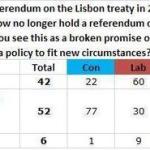
Well, it hasn’t taken long, but outright opposition to the Tories’ new stance on Europe is underway. Conservative Home has a copy of an email sent by Bill Cash calling for a full referendum on the Lisbon Treaty. Here’s the key section: ‘As David Cameron has said, we need an association of member states. In order to achieve this, we cannot simply cherry-pick individual aspects of the treaty and call for renegotiation of those. We need a full referendum on Lisbon as we were promised and as we voted in the House of Commons. No ifs or buts. This is about the Government of the United Kingdom operating in line

The Tories’ new line on Europe

Tim Montgomerie has the scoop that the Tories will not hold a referendum on Lisbon if it has been ratified by the next general election. A vote on Lisbon once it had been ratified would only have had moral force so the Tory policy shift is not a betrayal of Euro-scepticism. However, the party will seek a ‘manifesto mandate’ to begin negotiations to repatriate powers. The challenge for the Tories is to persuade the other member states to allow Britain to take back powers.  As Tim says, the Tories will need a savvy negotiator with strong Euro-sceptic instincts to take charge of this process. To my mind, Theresa Villiers, a

Until Ashcroft is clear about his tax status, the press will make a mountain out of everything he does

I have long thought that the secrecy surrounding Lord Ashcroft’s tax affairs is a strategic liability for the Conservative party. The Conservatives should be able to say if their party vice-chairmen is domiciled in this country for tax purposes. Indeed, openness about this point should be a condition of him holding the position. The Observer today has a front page story about Ashcroft’s involvement in William Hague’s trip to the US. But even given my concerns about Ashcroft, I fail to see the evidence produced as particularly worrying. We know that Ashcroft has flown members of the shadow Cabinet around before—David Cameron even took a flight back from the 2007

Even under the Tories, President Blair will be our man in Brussels 

In his column, James asks the key question about Tony Blair’s candidature for President of the European Council: what would it do for the Tories and Britain’s foreign policy. William Hague clearly thinks it would be a bad thing and has been lobbying against Blair’s candidacy.   The Shadow Foreign Secretary is letting his anti-EU, anti-Labour views cloud his judgement. Let me explain. If the Tories win, Labour will be in the doldrums, a shadow of its former self. The idea that the party will mount a challenge to a Conservative government by rallying around an EU-focused Tony Blair is unbelievable. Romani Prodi may have jumped from an EU job

Is privatising the Royal Mail viable?

Over the summer, as the postal crisis mounted, the government argued that adverse market conditions deterred potential investors. Regardless of the ongoing industrial dispute, the government maintain that Lord Mandelson’s bill will not be reintroduced unless conditions improved. According to the Guardian, Ken Clarke, the shadow business secretary, believes that there is still demand in the public sector to buy the Royal Mail, providing the CWU accepts modernisation and ends the strikes. ‘Ken Clarke, the shadow business secretary, has held talks on the sale of Royal Mail with potential bidders, and the party believes there is still a desire in the private sector to take over the company. The Conservatives’

The Rabbi speaks

Poland’s Chief Rabbi, Michael Schudrich, told the Today programme that Michael Kaminski is, as far as he knows, not an anti-semite today – though the Jewish leader made clear he “could not read his heart”, and thought Mr Kaminski’s teenage views extremist. The rabbi’s words will further fuel the spat between David Miliband and William Hague. Expect the Shadow Foreign Secretary to renew his calls today for an apology to be issued to Kaminski. Expect the Foreign Secretary to ignore this and find support, including from within the Jewish community, to his charges against Mr Kaminski and his accusation that the Tories mingle with madmen. Both parties think the fight

Raging against the dying of the light

George Osborne’s speech on Monday calling for huge cash bonuses not to be paid this year drew an angry response from those hoping to receive huge cash bonuses – and various City and business pressure groups. A few years ago I would have felt deeply uncomfortable with what Obsorne proposed, but because nearly every bank has drawn heavily on state support over the last year, I think politicians do have a right – even a responsibility – to offer firm guidance to the banks. The FT led the charge against Osborne with both a critical news story, gleefully dissected by Iain Martin, and a harsh leader. Today, the paper follows

Truss’s candidacy must stand

When the story of there being controversy over Liz Truss’s selection as the Tory candidate for South West Norfolk because she had once has an affair with a Tory MP arose last weekend, I dismissed it. My immediate reaction was that the media was just looking for a follow up story to the row over all-women shortlists. I imagined that no association would seriously be irritated by a candidate’s failure to bring up a personal matter that was already public knowledge. So I was shocked to hear that her selection has now been referred back to a meeting of the full association. It is now imperative that Truss’s candidacy stands.

Iain Duncan Smith’s overlooked “affordable policy solutions”

After his superb work with the Centre for Social Justice, it’s encouraging that Iain Duncan Smith is being tasked by the Tory leadership to come up with “affordable policy solutions” to spring the traps which keep people stuck in worklessness.  It’s thought that David Cameron rated the proposals of the CSJ’s recent report on this issue – as, too, did Coffee House – but was put off by the £3 billion upfront cost of the reforms. But there’s an important aspect of that report which hardly got any attention at the time: it already includes more affordable options.  The £3 billion was for a universal benefits system which would see

Learning to let go of the police

Today’s Mac cartoon in the Daily Mail is, for me, a cut out and keep. It epitomises everything that has gone wrong with policing in Britain – a copper running past thieves to nick an old lady who has wrongly parked. And it touches on a wider theme: this is why regard for the police has fallen in the last dozen years. Their priorities seem to have switched from those of the public to those of the bureaucratic elite. This impression is, of course, deeply damaging and will be tough for the Tories to reverse. The plan for directly elected police chiefs, and Nick Herbert’s seminal work on the subject,

Two polls to please the Tories

There have been two polls today which are worth mentioning belatedly.  The first is YouGov’s voting intention poll for Wales, which Anthony Wells has analysed here and here.  It’s not often you see a Welsh voting poll – which is a shame – and the results of this one are striking.  Labour are on 34 percent; the Tories are on 31 percent; Plaid Cymru on 15 percent; Lib Dems on 12 percent.  Overall, that’s much better news for the Tories than it is for Labour: the last time the Tories scored 31 percent in Wales was in the 1983 election. The second is the ComRes poll which appeared in today’s

Cameron in front of the press

David Cameron was in confident form at his press conference this morning. Most of the questions were about the possibility of President Blair and Tory opposition to that. But three other things from the event were worth noting. First, Cameron’s announcement that the Tories will publish their top three or four priorities for each department shows the influence of the Institute for Government on Tory thinking. Michael Bichard, the director of the Institute, was David Blunkett’s permanent secretary at the Department for Education and Employment and Blunkett’s success in this job is largely credited to him and Bichard working out a few priorities and sticking to them. The Tories are

The Tories prime their shake-up of the civil service

One of the quickest wins that the next government could achieve is to change the power and accountability arrangements of Whitehall.  At the moment, there’s a convoluted system in place where its difficult to apportion blame when a government department screws up.  Sure, a minister may take the media flak if, say, a department loses a data disk.  But the people in charge of the day-to-day running of a department tend to escape any substantive judgement on their performance.  As James Kirkup points out in the Telegraph today, “no permanent secretary has been formally dismissed for more than 70 years.”  That’s hardly a set-up to incite much more than complacency

What does this mean for the Lisbon Treaty?

To sign or not to sign?  For the past week or so, we’ve been hearing reports about how the Czech President, Václav Klaus, has decided, reluctantly, to accept the Lisbon Treaty.  But a story in today’s Times suggests that he’s still holding out against ratification.  Here’s the key passage: “Václav Klaus, the Czech President, who is the last hurdle to full ratification of the Lisbon treaty, has made a final attempt to derail the agreement. In a submission to the Czech constitutional court, which will decide tomorrow whether the treaty is compatible with the country’s constitution, Mr Klaus has suggested that it should be subject to a referendum. … The

The Tories develop their <em>de facto</em> Glass-Steagall Act

The most striking aspect about George Osborne’s speech today is how it concentrates on retail banks – the banks you and I do business with – rather than the big investment banks.  He’s expected to announce that retail banks should stop paying “excessive cash bonuses” to their senior staff, but should instead reward them with shares in the company and use the cash they would have dished out to increase the amount of credit in the economy.  This won’t apply to investment banks. The separation rather recalls the American Glass-Steaghall Act, which split commercial banks from their riskier investment counterparts.  The thinking behind it was that the investment banks could

The EU prepares for a Conservative government

The wheels seem to have come off Tony Blair’s EU presidency campaign and no doubt there is much genuflection and soul-searching in Connaught Square. The Director of the Centre for European Reform, Charles Grant, gives an intriguing explanation at Comment is Free: ‘Yet it may be the Conservatives who spike Blair’s chances of getting the job. William Hague, the shadow foreign secretary, has told the other EU governments that the Conservatives would see support for a Blair presidency as a “hostile act”. A week ago, Blair was the clear favourite, with the likely support of Britain, France, Germany, Italy and Spain, plus several of the smaller countries. But on my travels

The Tories now have a monopoly on the language of optimism

So how big a blow was the news that we’re still in recession to Gordon Brown?  Well, compare and contrast his latest podcast on the Downing Street website with David Cameron’s article in the Sunday Times.  Brown’s effort is necessarily defensive.  Gone is the “we’re leading the world” bombast of a few weeks ago, to be replaced with a crude “pledge” to get the economy growing again by 2010: “My pledge to you is to make reform of the financial sector a reality, and to see Britain’s economy return to growth by the turn of the year.” While Cameron’s effort is considerably more agressive, and concentrates on outlining a “pro-growth,

Still no room for complacency about the BNP

It’s an odd one is today’s ICM poll in the News of the World.  Most of it makes for sobering reading for the political class: it finds that two-thirds of voters think the mainstream parties have no “credible policies” on immigration, and that one-third agree with a core BNP policy on removing state benefits from ethnic minorities.  The Tories will be disappointed to see that only 20 percent of respondents think that their plan to cap immigrant numbers will work. But there are also some findings which support Alex’s thesis that we shouldn’t be unduly troubled by the levels of support for the BNP.  For instance – and despite all

The Tories’ support for the war in Afghanistan owes nothing to neo-conservatism

In his column in the Mail, Peter Oborne writes that Cameron’s stance on Afghanistan represents the same mistake made by IDS in his unstinting support for the Iraq war. Oborne fears that neo-conservatism has gripped the Tory leadership. ‘The ‘Neocons’, despite being discredited by the Iraq war, have furtively regained their position at the heart of the Tory party. Almost without exception, Cameron’s senior team are passionate Atlanticists who seem committed to the policy of ‘reinforcement of failure’ in Afghanistan. Both the Shadow Foreign Secretary William Hague and the Shadow Defence Secretary Liam Fox are ‘Neocons’. As are Cameron’s two most trusted Shadow Cabinet colleagues, Michael Gove and George Osborne.’