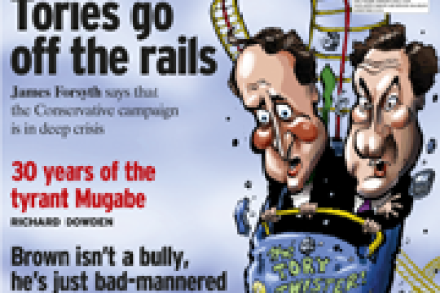
Conservative party

Even the Pakistanis are “Soft” on Torture…

Meanwhile, today’s missive from the Party of Torture is written by Dana Perino and Bill Burck, Press Secretary and Special Counsel to George W Bush respectively.  The Obama administration is working with Pakistani intelligence to interrogate Mullah Baradar, reportedly the Taliban’s number-two man. We’ve been a little underwhelmed by the Left’s reaction to this news. […] The Left’s silence on Mullah Baradar is convenient. Gone are the hysterical cries of torture. Missing in action are the opponents of rendition. One searches in vain for impassioned denunciations of Obama’s outsourcing of interrogations to countries with long histories of torture. What happened to the sputtering self-righteousness of yesteryear, when Bush and Cheney

Some reasons to be cheerful about Cameron and the Tories

By way of a response to the comments on my post yesterday, here are some reasons to be cheerful about Cameron and the Tories. The poll lead dropping to six points is indeed a wake-up call, and Cameron probably worked out a while ago that things were going a bit Pete Tong. Indeed (Short the UK), there are signs that he has already started to act. Look at last Monday: three strong election videos, without a politician in sight. The perfect remedy to the Tragedy of Cameron’s Head poster. The policy of allowing management buy-outs of government departments is bold, radical and entirely in keeping with Cameron’s general policy of

Cameron’s first response to the bullying question

Cameron just got the question on Brown and bullying. His reply was well pitched, right tone of voice and all that. But it contained the suggestion that Sir Phillip Mawer, who polices the ministerial code, should be asked to investigate. This is the last thing No 10 wants, it just wants this to go away. But I suspect Cameron has just given the story a nudge along.

Cameron kicks off the transparency agenda

Here I am, in a cavernous “space” in East London, for a conference on the Post-Bureaucratic Age – or  “See-Through Government,” as Guido more evocatively put it. David Cameron has kicked things off with a speech on the issue, and there’ll be talks and panels throughout the day. It’s like Glastonbury for policy wonks. So how was Cameron? Well, he’s normally at his snappiest and most persuasive when he talks about all this tech stuff – and today was no exception. All the usual lines about “handing power to the people,” and eroding “the dull, stultifying presence of state control,” made an encouraging appearance. And he outlined what this would

How should the Tories respond to the Rawnsley allegations?

As James predicted last night, the ‘Bully boy Brown’ story is now at full steam and will speed on as phone-ins discuss bullying in the workplace. The National Bullying Helpline’s intervention, ethically dubious in view of the charity’s supposed confidentiality, has negated Labour’s damage limitation strategy. Both Peter Mandelson’s line that Brown is a passionate and demanding man and the PR campaign to soften Brown’s image have been blown clear out of the water. Brown has made significant progress recently: David Cameron’s personal ratings have halved since September. That brief resurgence will be reversed as this story rolls. The Sun’s hot-headed frontpage says it all.   Now is the time

Background politics

The Conservatives are at pains to emphasise that ‘it’s not where you’re from but where you’re going that’s important.’ A trite but pertinent phrase: background is neither a pre-requisite nor an impediment to a political career, nor should it be. Upbringing is important when it informs values. Many of the Shadow Cabinet have travelled together from the chapel pews of Eton to the Tory front bench; consequently, the Tories are wary of linking politics to background and experience. On the whole that is sensible, the exception is Michael Gove’s personal history, which is central to his Swedish market based education reforms. Gove may not wish to parade his life before the electorate, but to my mind his

Time for Cameron’s Lazarus act

Two seriously worrying polls for the Conservatives today. One is a Sunday Times/YouGov poll, showing a Labour recovery reducing the Tory lead to six points  well into hung parliament territory and the lowest since December 2008. The other is a PoliticsHome poll in the News of the World, according to which: Cameron’s approval rate has been steadily falling, and Brown’s similtaneously rising – the difference between them has halved, in recent months, from 90 points to 45 points. If the election is a 39-33 split, then the Tories end up with just ten more seats than Labour and are dependent on coalition with the LibDems. A result like this, against

Brown faces the Rawnsley revelations, while the Tories face the polls

The question tonight is: which piece of bad news will make the biggest impact?  The bad news for the Tories, or the bad news for Labour? Let’s take the second one first.  I’m referring, of course, to the first installment in Andrew Rawnsley’s revelations about Gordon Brown.  ConHome have already published some snippets – click here – and they give you plenty of juice for your buck.  Not only are there the expected allegations about Brown hitting his staff (much of which seems to have been covered in the Mail on Sunday a couple of weeks ago), but Rawsley also reveals that the Cabinet Secretary, Gus O’Donnell, investigated and reprimanded

Balkan business

Catherine Ashton is visiting the Western Balkans this week on her first foreign trip as the EU’s top diplomat. Though she has come in for criticism for not going somewhere more foreign, like the Middle East, her visit to the region is, in fact, timely and should be welcomed. The region has a few hurdles to clear on its journey away from the misery of the past and towards a more stable future. What can Ashton do to help that process along?  Well, her job is best described with historian Richard Neustadt’s moniker “Persuader-in-Chief”. She can cajole member-states, put issues on the EU’s agenda and suggest ideas. That is probably

No surprises – and much Tory-bashing – in Brown’s Big Speech

Move along, now – there’s nothing to see here.  Or rather, reading Gordon Brown’s Big Speech, there’s nothing that you hadn’t already seen in the papers, or that you wouldn’t have expected to see anyway.  The four election themes got a mention.  Labour’s record in government was pushed and promoted to the point of absurdity.  Words like “new”, “fair” and “change” were flung around like so much confetti.  And no election date was given.  No alarms, no surprises. More than anything, Brown set about attacking the Tories on every conceivable level.  He caricatured Cameron & Co. as a party of privilege and wealth, who are more concerned about fox-hunting than

Welcome to The Future Fair

So now we know.  Labour’s election slogan is A future fair for all.  And – as various folk, including Alex, have pointed out – it’s kinda screwy.  As in, “we’re all going to The Future Fair” kinda screwy.  So don’t expect it to catch on.  Unless, of course, there really are bright lights, big wheels and rollercoasters on offer. The slogan kickstarts a feverish weekend of activity.  Brown is going to set out the main themes of Labour’s campaign.  The Tories might try to sabotage it all.  And we may, possibly, perhaps, find out what the election date is.  Stay tuned, so to speak. P.S. I wouldn’t be too surprised

How much attention should politicians pay the competing groups of economists?

The recession has been intellectually thrilling, and I write that without a note of sarcasm. First, politicians argued as to whose understanding of Keynes was greatest; and now they’re in Keynes versus Hayek territory, over the timing and depth of cuts. The Chancellor and his Shadow have marshalled the various authorities who support their respective cases. The science of economics, if it is science, is in its adolescence. Should necessarily equivalent government policy be detirmined by pure intellectual opinions and reputations, especially as those are being forged for posterity by current events? Economics is as much history as science – like Coleridge’s lantern on the stern of the ship; it

Purnell leaves parliament but not politics

The news that James Purnell is to stand down is a shock. It is clear that Purnell was disenchanted with Brown’s continued leadership and with the direction in which the Labour party was heading. Purnell was marginalised in parliament and his much vaunted alliance with John Cruddas came to nothing. Plainly, he believes that he can exert more influence outside the parliamentary Labour party than within it. The Tories stole the limelight this week with their commitment to public sector co-operatives; Purnell’s response fell flat, caught in the contradictory statist language that even the most uber-Blairites cannot escape. Purnell’s journey into the wilderness is the firmest evidence that the Conservatives

Sunny side up?

Earlier this week I asked what Obama’s experience could teach a Cameron government. At the same time, there has been a well-argued debate in The Times about whether the Tories should go negative or not. There is one point where the two issues converge – and that is in how a newly-elected government should deal with the country’s economic legacy. Once in power, a Tory government will be tempted to be optimistic, to point to the sunny uplands. General Colin Powell said “positive thinking is a force multiplier” and the Cameron team come across as natural adherents to this viewpoint. There is also the fact that the modern Tory agenda

The numbers spoil Labour’s narrative

Labour have certainly come out of the traps snarling and gnashing this morning.  For one, they’re making the most of two letters in the FT, signed by 60 economists, which ostensibly support their position on the public finances.  And then there’s Gordon Brown’s speech to European leaders, in which he implores them to tackle the “hatred” of “the right”.  Naturally, by “the right”, he means “David Cameron”. It’s those letters which really grab the attention, though.  Not really because of what they say, or who has signed them, but because they’re suggestive of how the debate over the public finances is going to go.  Yep, the Tories get 20 economists

Cameron and the power of the bully pulpit

I must be one of the very few people who would genuinely like to see David Cameron give another speech on chocolate oranges. There was much mockery of it but it contained a very important point: there are some things that a business can do that have negative externalities to which the appropriate response is not taxation or regulation but social disapprobation. So, it was good to see Cameron promising both to use the power of his office to call out companies that sell age inappropriate products and to make it easier for people to protest against such behaviour. There are other areas where I expect social pressure could be

First class chaps

Bravo Sir Nicholas Winterton! It’s pernicious that no one will pay for me to travel First Class. As two separate scions of the same upper crust, it is mine and Sir Nicholas’ birthright. The country is going to the dogs with all this plebeian impertinence. It’s like turning up at the airport and being asked if you’ve packed your own bags, which forces you to admit that the dastardly Social Chapter means you can no longer afford a batman to do it for you. Myself, I commute to and from Sussex on the milk train and the sleeper, rubbing shoulders with hoi polloi – no children thank God, but a

Introducing Dave

Readers of the magazine will be familiar with Michael Heath’s series of ‘Flash Gordon’ cartoons, based on the life and sulks of our glorious Prime Minister.  Well, now it’s got a successor – ‘Dave’ – which, naturally enough, focuses on the Tory leader and would-be PM, Mr Cameron.  Here’s the first of them, from this week’s issue, for the benefit CoffeeHousers.  Just click on the image to make it bigger: