Conservative party

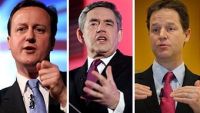
Cameron offers the hand of coalition to the Lib Dems

From our UK edition

Woah, I didn't think Cameron would go that far.  In his statement just now, the Tory leader started off by talking about minority government, as one might expect.  But he soon skipped past that, and onto what sounded like a more formal coalition with the Lib Dems.  He called it the Tories' "Big Comprehensive Offer". This offer trumped the one that Brown put forward ealier by virtue of its clarity.  Where Brown had hints and innuendo, Cameron had an itemised list of policies and specifications.  And so the Tory leader set out the areas where he wasn't willing to compromise with the Lib Dems: Europe, cutting the deficit and immgration.

Tim Montgomerie: Cameron must change his style of leadership

From our UK edition

There are rumours that Tory grandees are gathering to confront Cameron over his lacklustre campaign. The prospect of electoral reform, or another election amid autumnal austerity, has many reaching for the panic button in certain Tory circles.   Speaking to the BBC, Tim Montgomerie has just added his voice to the criticism of the campaign and Cameron’s single-minded leadership. He also added that the party wanted a radically different campaign to the one the leadership offered. The leadership gave reassurance that it knew what it was doing. Montgomerie argued that Cameron cannot expect to receive such leniency after this result. Con Home has surveyed party members this morning, they insist, overwhelmingly according to Montgomerie, that Cameron go it alone.

Nick Clegg gives the Tories the go-ahead

From our UK edition

So Nick Clegg has finally spoken – and his words will be welcomed by the Tories.  In an address outside of the Lib Dem HQ on Cowley St, he reiterated his previous argument that "whichever party gets the most votes and the most seats, without gaining a majority, has the first right to form a government."  But added that "it seems this morning that the Conservative Party have the most votes and the most seats ... it is for the Conservative Party to prove that it is capable of governing in the national interest." What this means in practice isn't 100 percent certain – although it doesn't sound good for Labour.

Massive Failure by the Tories and Lib Dems to Manage Expectations

From our UK edition

The old political hands in the Labour Party at least knew that they had to talk down their prospects (beyond the usual nonsense about fighting to win). Lord Mandelson was right to fight this election as the underdog because this now looks in some ways like a victory.  In fact this is a massive achievement for the Conservative Party. When David Cameron took over in 2005 many Tories would have settled for this result. They should always have been fighting a two-election strategy. But the Conservative Party allowed itself to get overexcited about the possibility of outright victory. The Liberal Democrats allowed themselves to dream and find themselves bitterly disappointed this morning.

There may be Tory trouble ahead

From our UK edition

Will the 1922 Committee of Tory MPs elect an emergency chairman today? If so, the mission would be to warn Cameron off doing any deal with the LibDems. Most Conservatives will wake up today judging the Cameron campaign to have failed. In the view of many, he will have failed to honour his "change to win" promise: they all changed, as he asked, but he didn't win. There will be a price to pay, and perhaps one of the heads around Cameron will have to roll to assuage the discontent. Any Lib-Con deal over voting reform will be anathema to many recently-elected as well as existing  Tory MPs. A new chairman of the 1922 Committee will want to make this point to Cameron before any damage is done. A deal with Northern Irish MPs would probably be as much as the party would wear.

Let the recriminations begin

From our UK edition

Let's rewind to 10pm yesterday evening, when the exit poll was released.  Most politicos - myself included - were incredulous.  We could just about believe that there might be a hung Parliament with the Tories as the largest party, but a reduced number of Lib Dem seats?  After Cleggmania and all those recent opinion polls?  Gedouttahere. But, this morning, that exit poll is looking a good deal more prescient.  After an evening of erratic results, Sky's projection matches it almost exactly: 309 seats for the Tories, 259 for Labour, and 54 for the Lib Dems.  So we're on for a hung parliament, and all the backroom discussion and subterfuge that that entails. Already, the dividing lines have been traced across Westminster.

Election Night live blog

From our UK edition

0843, JGF: The result in Hampstead and Kilburn is remarkable. The local Lib Dems were convinced that they would win. But Glenda Jackson survives by 42 votes with the Tories in second. 0639, PH: A dejected sounding speech from Nick Clegg. 0638, PH: Clegg says "this has been a disappointing night for the Lib Dems - and we obviously didn't achieve what we hoped to achieve." 0637, PH: In his acceptance speech, Nick Clegg is going big on the voting problems of last night. 0634, PH: Some good news for the Lib Dems: erm, Nick Clegg holds in Sheffield Hallam. With an increased majority. 0620, JGF: Jon Cruddas holds on, he'll have a big role to play in the Labour party machinations of the last few days.

The party leaders vote

From our UK edition

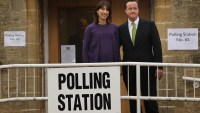
David and Samantha Cameron leaving the polling station in Spelsbury Gordon and Sarah Brown arrive to vote in North Queensferry Nick and Miriam Clegg vote in Sheffield.

Message to the Tories: Grow Up About the New Labour Era

From our UK edition

I have been deeply disappointed by Tory negative campaigning in the past few days. The Cameroon coup was inspired, in part, by Tony Blair, so to decry 13 years of New Labour is deeply hypocritical. The message, pioneered by Oliver Letwin, was that praise would be given where it was due. Britain has become a better place since 1997 and that is true for readers of the The Spectator as much as (and perhaps more than) anyone else. At the same time, Brown's leadership of the country and his party has been woeful. The Labour Party has only itself to blame for this. It should have put up a candidate against Gordon Brown in 2007 and it should have removed him a year later.  This blog is here to give you an insight into thinking on the left.

As the polls open, a topsy-turvy campaign closes

From our UK edition

Now's the time, dear CoffeeHouser. After nearly three years in Number Ten, Gordon Brown is finally subjecting himself to the wishes of the British public. And, signs are, he won't like what they've got to say. Putting the strong possibility of a hung parliament aside, last night's opinion polls had Labour on or around Michael Foot levels of support. A few folk, like Marbury, have observed that it's almost like the campaign didn't happen. And they're right: there is a peculiar symmetry to the electoral calculus. After all the mood shifts of the past four weeks, we're back broadly where we started: with the Tories looking to gain either a small majority, or be the largest party in a hung parliament. But it's worth remarking on some of the changes which have stuck.

Two more polls point towards a hung parliament

From our UK edition

Is this it? A couple more polls have been released, and – like all the others tonight – they point towards a hung parliament. An ICM poll for the Guardian has the Tories on 36 percent (up three points), Labour on 28 percent (no change), and the Lib Dems on 26 (down 2).  And a ComRes effort for the Independent and ITV has the parties on 37, 28 and 28, respectively. Most Tories I've spoken with this evening are, they say, mildly pleased with the opinion polls.  Not overjoyed, of course – but they feel their party's greater firepower in the marginals means that numbers like those above will translate to a small majority.  Either way, things are certainly very close.

And now YouGov…

From our UK edition

You want more numbers? Well, the YouGov figures for the Sun have just come in, and they are: the Tories on 35 percent (no change), Labour on 28 percent (down two), and the Lib Dems on 28 percent (up 4). So far tonight, all the polls have been in hung parliament territory (on an uniform national swing). And most have Labour and the Lib Dems more or less on level-pegging. More polls here and here.  There's a good handful still to come, so keep your seat calculators to hand. UPDATE: YouGov also conducted some marginals polling.

Times/Populus has the Tories close to a majority

From our UK edition

So the Times/Populus results are in, and they have the Tories on 37 percent (up one), Labour on 28 percent (up one), and the Lib Dems on 27 percent (down one). On a uniform national swing, this would leave us in hung parliament territory. But Tories I speak to are pretty confident that numbers like these, if replicated tomorrow, could give them a majority. Elsewhere, TNS-BMRB has the Tories on 33, Labour on 27 and the Lib Dems on 29.  Angus Reed for Political Betting has Tories on 36, Labour on 24, and the Lib Dems on 29.

Translating polls into seats

From our UK edition

There’s an odd disconnect at the moment. Pretty much everyone I’ve spoken to predicts that the Tories will win 300 seats plus (the one exception was someone on the Union side who thought that they could hold the Tories to 280) but the polls show them winning significantly less than that.   Now, this is partly because nobody is sure how you translate votes into seats in a three-way contest. People are also factoring in that the Tory vote is more certain to turn out and that the Tory operation is more confident that it knows where its voters are than the other parties. But it is a testament to how good people think the Tory field operation is that everyone has them getting more seats out of their voters than uniform national swing would suggest they would.

Niall Ferguson: Britain should call the IMF now

From our UK edition

Should David Cameron just call the IMF immediately? Like, on Monday? This argument has been doing the rounds in Tory circles and tomorrow's Spectator has an important contribution from Niall Ferguson. He advises that Cameron takes a two-pronged approach. Prong one is to 'axe ruthlessly' and prong two is to call the IMF. He says: 'There is a very real danger that [things] could now spiral, Greek style, out of all control if foreign confidence in sterling slumps and long-term interest rates rise. Mr Cameron needs to do two things right away. He must instruct George Osborne to wield the axe ruthlessly with the aim of returning to a balanced budget over a credible eight- to ten-year timeframe.

The Cameron Project: Three Views from America

From our UK edition

David Frum graciously plays the role of referee in this year's Massie vs O'Sullivan discussion and delivers what is, I think, a fair judgement. He grants that O'Sullivan is right to warn about the danger that the Cameron Project might seem inauthentic or cynical and that, as David puts it, "the extremity of the crisis" Britain faces has made some of Cameron's ideas and, more still, his style seem out of touch at times. Nevertheless, he concludes: A conservatism that fuses economic rationality with a concern for social cohesion is for Britain more than an electoral proposition. It is the kind of conservatism a riven and troubled society requires. Like John O’Sullivan, I feel my due share of nostalgia for the crusading conservatism of the Thatcher years.

The Tories would have to rely on the DUP in the event of a hung parliament

From our UK edition

Reg Empey may yet oust the DUP’s William McCrea in South Antrim, but the indications are that the UUP and Tory alliance will not win a seat. The Tories will have to rely on co-operation with the DUP. In truth, competition between three Unionist parties has left the Unionist cause divided. The TUV’s Jim Allister is giving the DUP’s Ian Paisley Jr a close race in North Antrim. Robinson’s DUP will emerge the largest Unionist party in Ulster, but with a point to prove to voters who are keen to protect Northern Ireland’s bloated public sector and generous funding. Conservative he may be, but Robinson is an Ulsterman first and foremost and has the most to gain by securing what's best for Northern Ireland.