Conservative party

Reasons for real hope amid the misplaced optimism

From our UK edition

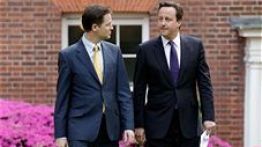
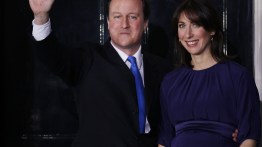
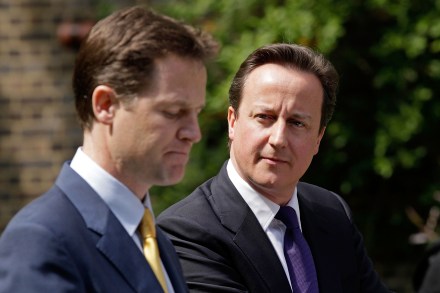
Today's civil partnership between two men who look uncannily like each other will, I suspect, be remembered as a festival of misplaced optimism. Cameron overdid it a little, making out that this was his ideal outcome. It seems rude to point it out, but there were two podiums in that rose garden because he flunked the election (see Tim Montgomerie's superlative report for details). The cost of his failure to win is having to do a deal with Nick Clegg. The country didn't vote for a new politics: the Lib Dems did worse than last time, so polls show most voters would have preferred Cameron to have formed a minority government. This is an alliance designed to stop Cameron fighting an election again soon, and repeating last week's jarring experience.
The story of the Tory campaign

From our UK edition

If you read only one thing today, then make a cup of tea, sit in a comfy armchair, and make sure it's Tim Montgomerie's 7,000-word review of the Conservative election campaign.  Tim has opened up his address book and spoken with many of the main players in the Tory operation - and the result isn't all that flattering.  Here's a summary passage which gives a sense of it all: "For a period, the 'Big Society' was put at the heart of the campaign. Amazingly, the Big Society was never tested in focus groups and it failed on the doorstep. One leading adviser to the campaign complained of a 'cavalier' approach to research. 'They latched on to research that backed their views and ignored any research that challenged it.

The coalition agreement at a glance

From our UK edition

I have just had a quick read through the coalition agreement and a few things jumped out at me. First, this new government will not abolish Lord Mandelson. The agreement states that while the parties are committed to a wholly or mainly elected Lords ‘likely there will be a grandfathering system for current Peers’.   The Tory manifesto commits a Conservative government to introducing ‘new rules so that legislation referring specifically to England, or to England and Wales, cannot be enacted without the consent of MPs representing constituencies of those countries.’ The coalition agreement has watered this commitment down significantly. The new government will merely ‘establish a commission to consider the ‘West Lothian question’.

Victory! | 12 May 2010

From our UK edition

This magazine had hoped for a Conservative government. We have what is arguably the next best thing: a government led by David Cameron but supported by some political mercenaries put in the positions where they inflict the least harm — and reform-minded Tories in positions where they can do most good. The strategy is fairly clear: give Lib Dems more Cabinet crowns and chauffeurs than they could have dreamed of. Tie them in for five years, and have them defend Tory policy on the airwaves. And then, crucially, let them share the blame for the Irish-style spending cuts to come. Three appointments make this government, on balance, a victory for Conservatism.

Game on for the Labour leadership

From our UK edition

The Coalition Cabinet remains unformed as yet - it's rumoured that Chris Huhne is going to environment and Michael Gove and David Laws are out doing one another in the 'I've no idea where I'll be' stakes. All the sounds are very positive but the contents of would-be ministers' statements are careful, as doubtless final decisions are being made. The Labour leadership has its own spot on Westminster's backdrop of delicate intrigue. Yesterday, Andy Burnham positioned himself as the candidate of sense, opposing Lib-Lab talks and acknowledging that Labour needed to reorganise itself in the aftermath of defeat. The preferred path to renewal is clearer this morning. Alan Johnson has declared he will not stand and has backed David Miliband.

The Deputy Prime Minister speaks

From our UK edition

Just as the midnight oil burns out, the Lib Dems have finally agreed to a coalition deal with the Tories.  Speaking in Transport House, Nick Clegg confirmed that the parliamentary party and federal executive had "overwhelmingly accepted" the deal.  And ... well, that was it, really.  There were few other specifics from the new Deputy Prime Minister.  No confirmations of other Cabinet positions, no firm indications about the Lib-Con policy trade-offs – just "thanks and admiration" for Gordon Brown, and a few assurances that the new government would work towards "fair" ends, even though " there will, of course, be problems".  I'm sure that full details will emerge in the morning.

The government takes shape

From our UK edition

Here are some details of the LibCon deal, and my brief comments: 1. Clegg as Deputy PM. It’s a non-job, but a senior one – it means Clegg will take PMQs in Cameron’s absence, and will defend all those nasty cuts (sharing the blame for these cuts is the main rationale for coalition). This follows the 1999 Lib-Lab deal in Scotland, where Jim Wallace was made Deputy First Minister to everyone’s surprise. 2. Laws replaces Gove in education. This has not been confirmed yet, and I will not believe it until I see it. Of all of tonight's moves this is potentially the most concerning – especially for all those (including myself) who had said that the Gove schools policy was the best single reason to vote Tory.

David Cameron is Prime Minister

From our UK edition

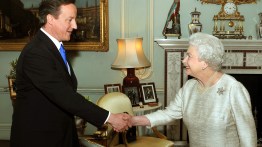
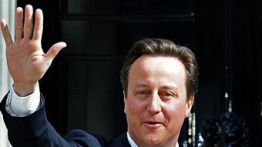
And he begins his tenure with an unfussy speech outside the door of No.10.  All of the main Tory touchstones were mentioned: the deficit, responsibility, political reform and social breakdown.  But this wasn't a strident or triumphant performance.  Cameron went out of his way to pay tribute to Gordon Brown and his "long record of public service," and to highlight the role that the Lib Dems will be playing in a "proper and full coalition".  Almost with a dash of regret, Cameron noted that this coalition will "throw up all sorts of challenges". Perhaps he's had a first taste of those challenges with the protestors who greeted his entry, with banners and boos, into Downing Street.

The waiting game | 11 May 2010

From our UK edition

Westminster is working itself into a frenzy as we wait for the official announcements, statements and rituals of state which will surely come in the next few hours.   The very latest is that Cabinet ministers are saying Brown will go either tonight or tomorrow morning; Vince Cable has suggested a Lib-Con deal is "very close"; and all the noises are about a full coalition, perhaps with Nick Clegg as deputy Prime Minister. But enough of that: we shall soon have something more concrete to grasp than all the rumours and helicopter imagery.  And it will be nothing less than the end of 13 years of Labour government.

The Labour Party Must Accept Defeat and Move On

From our UK edition

As I write, the Liberal Democrats and Tories are meeting in the Cabinet Office. The Labour Party should accept this is the end of any hope of a Rainbow Coalition. This election was lost and well lost. The Conservative achievement is substantial. There are now over a hundred extra Tory MPs in parliament and David Cameron has taken his party from being an unelectable basket case to the dominant political force in Westminster. It would be gracious at this stage to admit defeat.  The unwholesome sight of Labour grandees scrabbling around in search of  deal with the Lib Dems is an affront to democracy. The suggestion that Labour has the best interests of the nation at heart, when it has been so comprehensively rejected by the electorate is the party at its authoritarian worst.

The Tory right strikes back

From our UK edition

Sam Coates reports that the Tory right want Cameron to renege on the commitment to a referendum on AV. You can see why they want to do this but it’s ill-advised. The Lib Dems have destroyed their credibility by indulging blatant self-interest and the Tories should avoid making a similar mistake. The need for unity is absolute. It’s time to put-up and shut-up in the national interest. Right now, that means reaching an accommodation, either in coalition or in a minority government with Lib Dem backing or abstention. If that requires a referendum on voting reform then so be it. Besides, facilitating a referendum is not to endorse reform. The Tories have everything to gain - power and the moral high-ground.

The developing picture

From our UK edition

The emnity between Labour and the SNP is legendary. Scenting opportunity, Angus Robertson has tried to appeal to Labour's progressive instincts and substantial Scottish support to secure protection from cuts. John Reid and David Blunkett have talked sense about the damage a dalliance with nationalists would do to Labour's English position. Now Douglas Alexander has said that he can't envisage an deal with the SNP. This adds to the growing sense that the grand coalition will never form - a minority Lib-Lab coalition remains a possibility but an increasingly unlikely one. Boris has it right. This is the lurid politics of proportional representational laid bare.

Game on for a Lib-Con Coalition

From our UK edition

Gary Gibbon reports: 'Last night’s two-hour meeting of the Lib Dem MPs (with a sprinkling of peers) seems to have swung the party decisively behind a Lib-Con coalition deal. An announcement is widely expected now today.' It’s preferable to the alternative and as George Osborne made clear this morning the Tories can do nothing without Lib Dem support. There’s a suggestion that Clegg may have forced Cameron’s hand into further concessions with his sudden wooing of Labour, in which case he’s a very clever and brave shyster. I’ll believe it when it happens though. PS: A note of caution, as if one were needed. Clegg can't put a time on any deal. Incidently, there is no appetite for a Lib-Lab coalition among centre-left bloggers.

This isn’t English

From our UK edition

‘The Tories are stuffed,’ a resigned Shadow Cabinet minister tells Gary Gibbon. Endorsing any such view is premature but, with Lib Dem elders counselling Clegg to join Labour, the most likely outcome is a coalition of the losers, albeit nice progressive ones. Ah, the irony of the New Politics – plus ca change and all that. Politics has descended into a grotesque spectacle of blackmail, and bungled devolution is to blame. As James reported last night, talks with the Tories ran aground on sands that are the territory of Holyrood and Scottish Liberals presented every obstacle possible.

The Lib Dem big hitters pushing Clegg towards Labour

From our UK edition

Today's papers have the lowdown on the events of the past few days, and one thing is becoming increasingly clear: a Lib-Con deal faces not just the opposition of the Lib Dem base, but also some of the party's most influential figures.  In a Times account of a Lib Dem meeting yesterday, it's revealed that Sir Menzies Cambell "urged his successor not to bind the party into a irrevocable deal with the Tories."  Meanwhile, the Telegraph reports that "Vince Cable played a significant role in resisting an agreement [with the Tories]."  And Paddy Ashdown was across the airwaves this morning, explaining how a Lib-Lab coalition could provide "stability" and "legitimacy," against a "rabidly anti-European" Tory party.

The Scottish angle

From our UK edition

I am told that one of the Lib Dems groups most opposed to doing a deal with the Tories was its Scottish MPs. Their view was that Scotland had voted massively against the Tories and that any party seen as their representatives in Scotland would be massacred. This has set off chatter in Tory circles. There was already irritation that the party has a majority in England and Wales but was still having to compromise on issues that have been devolved to Scotland. But to not be able to make a coalition deal because of your unpopularity north of the border is to add insult to injury.