Conservative party

The Tories have their eyes on Iran

From our UK edition

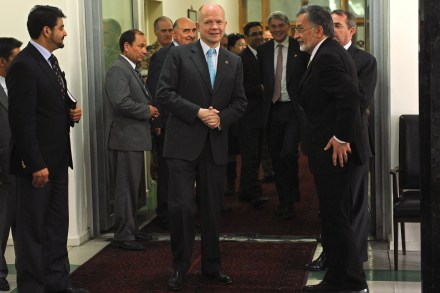
You may not have expected anything less, but it's still encouraging to see the new government pay so much attention to Afghanistan. After David Cameron's meeting with Hamid Karzai last week, no less than three ministers have visited the country today: William Hague, Liam Fox and Andrew Mitchell. And Whitehall's number-crunchers are busy trying to find extra money for the mission. There's a sense, though, that all the attention actually represents an underlying shift in focus.
The axeman speaketh

From our UK edition

There's an entire gaggle of noteworthy interviews in the papers this morning, but let's start with David Laws in the FT. It's generally quite hard to draw substantive conclusions about the actual interviewee in political interviews, but I'm sure you wouldn't come away from this one thinking anything but that Laws is a good man to have in the Treasury right now. Here, anyway, are five observations about what he actually said:  1. Sharing the blame. If people in Tory circles feel that there's one major consolation to working with the Lib Dems, then it's that they can share the blame over spending cut.

John Redwood “not sure” whether ministers will vote in 1922 Committee

From our UK edition

John Redwood is interviewed by Andrew Neil on Straight Talk this weekend, and there's a rather eyecatching exchange where the Tory MP claims that he's "not sure" whether ministers will be able to vote in the 1922 Committee, after all: John Redwood: ...as I understand the ballot, the ballot was about whether Ministers should come regularly to the 22 or not, and so I have no problem with that, and if that is the agreement, then fine. Andrew Neil: So are you not clear yet whether Ministers can come along as full members of the 22 Committee? JR: Well, I’m not sure whether they vote in 1922 elections, which is the point you were asserting, and we’ll have to see whether that’s true or not.

The Tories still need to do more to sell their school reforms

From our UK edition

It is quite telling that David Cameron's first newspaper article since becoming Prime Minister is for the Daily Mail, and even more telling that its central message is, "you still have a Conservative Prime Minister".  There then follows a series of reassurances about Dave's political motivations ("I believe the state is your servant, never your master. I believe in the common sense and decency of the British people") and about the policies contained in the coalition agreement. One line that jumped out at me, though, is this rather inspid description of the Tories' radical school reform agenda: "We're also giving parents, charities and other organisations the opportunity to set up their own new schools." Hardly inspiring, is it?

The civil service talks cuts

From our UK edition

Jonathan Baume is fast becoming one of the political celebrities of the LibCon era.  If you recall, he's the union chief who revealed that the senior civil servants had written letters to Labour ministers in concern at spending decisions made close to the election.  And now he's popped up again, with more unflattering comments about the previous administration.  Speaking at his union's annual conference, he said that "new ministers and MPs must begin to display the personal and moral integrity that was so obviously lacking in the previous Parliament, even within the Cabinet."  Hm, I wonder who he could mean.

Calling Osborne’s bluff

From our UK edition

I've just read through George Osborne's speech to the CBI annual dinner last night, and there's much in there about free markets and tax cuts that will encourage Tory supporters.  But one passsage seemed a little strange to me: "And on the subject of coalitions, let me be absolutely frank. As a member of the negotiating team, we did consider whether we could try to bluff our way into a minority government. But it was David Cameron’s bold vision and Nick Clegg’s great foresight which saw, before anyone else, that that option would be the greatest compromise of all. A weak, unstable government, risking defeat night after night in Parliament.

Cameron has won the 1922 Committee vote…

From our UK edition

...by 168 to 118 votes, according to Paul Waugh.  Comfortable, but not comfortable enough to suggest that there won't be a strong core of resentment to this change. UPDATE: This could rumble on. Here's the latest from PoliticsHome: A number of MPs, headed by the previous 1922 secretary Christopher Chope, are planning to challenge the surprisingly close result, and have not ruled out legal action. They point out that: 1. The difference between the winners and losers is more than bridged by members of the government (who they point out are not entitled to vote according to the current rules of the committee). 2.

How the coalition will work

From our UK edition

The full coalition agreement, released this morning, is fascinating enough in itself.  Here we have a step-by-step guide for how two different parties will operate together, what they will do, and, broadly speaking, when they will do it.  And, perhaps to ease the general uncertainty surrounding this type of government, it is considerably clearer than party manifestos tend to be.  One thing you can say, at least, is that this coalition appears keen to make itself more accountable. Skimming through the actual document, there seem to be few surprises, and a good handful of reviews designed to punt difficult policy areas into the long grass.

Graham Brady on 1922 and all that

From our UK edition

In tomorrow’s Spectator we have an interview with Graham Brady, tipped to be chairman of the 1922 Committee of backbench MPs – which David Cameron has just proposed to abolish in his 4.30pm meeting with MPs today. Technically, he is proposing to dilute its membership by including the payroll vote, thereby making it synonymous with the parliamentary party. So the backbenchers would not have a voice of their own. And Mr Brady’s position would be much less important. Here is an extract from tomorrow’s interview: In the era of Blair-style landslides, the likes and loves of backbench MPs mattered little: the government’s majority was big enough to force through most votes. But the loyalty of Tory MPs to a coalition government is untested.

David Lammy: Why Cameron has triumphed

From our UK edition

With Ed Balls and John McDonnell announcing their candidatures for the Labour leadership, it's clear that Labour's soul-searching period has now begun in earnest.  Speaking in front of the cameras just now, Balls reeled of the lines that he's been priming over the past week: "listening ... immigration ... listening ... beyond Blair and Brown," etc.  While McDonnell was keen to separate himself from the other candidates, describing them as the "sons of Blair and the sons of Brown". Both of them might care to read David Lammy's appraisal of where it went wrong for Labour – and where it went right for Cameron – in tomorrow's issue of the Spectator.

The Bill of Rights would be useless anyway

From our UK edition

I would like to defend the coalition from allegations that there has been a deplorable Tory concession on the Human Rights Act. Tearing it up was never in the Tory manifesto. Dominic Grieve, who drafted the Tory plan, is one of those lawyers who is rather passionate about the European Convention of Human Rights (ECHR) and praised it in his maiden speech. I had many conversations with him about this: for Britain to pull out of it, he said, would send an “odd” signal to the countries on the fringes of Europe whom we were trying to pull into our orbit. Grieve’s plan was to propose a Bill of Rights which would look and sound like something that would supplant the ECHR (put into British law by the Human Rights Act).

Mind the culture gap

From our UK edition

Danny Finkelstein’s column this morning is one of the most important things to have been written since the coalition was formed. Danny makes the point that the coalition has no ideas infrastructure in place. There’s nowhere for it to go to get new ideas. Think tanks will rush to fill this void. But as Danny notes, there will also have to be a cultural comfort with the other side. That there isn’t at the moment is demonstrated by the look on Tory MPs’ faces when you debate whether Nick Clegg should be invited to address Tory conference. One of the clever things that the coalition agreement has done is to make the main tax cut of this government a Lib Dem one. It is a reminder to the Tory party that the Lib Dems believe in freedom too.

Trouble averted or trouble ahead?

From our UK edition

"The biggest shake up of our democracy since 1832."  That's how Nick Clegg is describing the legislative package that he's announcing today.  And, even if that's pure bravado, there's certainly plenty of encouraging stuff in it.  Scrapping ID cards; restricting the storage of innocent people's DNA; and the government is even set to ask the public which laws they'd like to see repealed.  Sign me up. But it's one omission which is really ruffling Tory feathers today.  There will not, it seems, be an immediate move to supplant or even dilute the European Convention on Human Rights with a British Bill of Rights.  Speaking on Radio 4 this morning, Theresa May stressed that this is still a matter for negotiation within the coalition.

Is scorched earth politics now a thing of the past?

From our UK edition

Is the new government marching across scorched earth?  They certainly claim so, and now they seem to have the civil service backing them up.  Speaking to the Beeb this afternoon, Jonathan Baume, the leader of a civil service union, said that senior civil servants had written "letters of direction" to Labour ministers in concern at the spending decisions they took in the final months of their government.  As Baume put it: "It's not a decision that is taken very often to ask for such a letter of direction, which is why it is regarded something of a nuclear option. So when it happens it tends to be a big spending decision, where the civil service believes this is not the right thing to do." Good to know, even if only in retrospect.

Bercow remains Speaker, as Parliament reconvenes

From our UK edition

David Cameron sat alongside Nick Clegg on the government benches, with Harriet Harman two sword-lengths away as leader of the Opposition.  Even though the coalition has been around for a week now, it took the images from the Commons this afternoon to bring home just how extraordinary recent politics has been.  I mean, even the SNP's Angus Robertson got to make a speech now that the Lib Dems aren't a party of opposition.  This, plainly, is going to take some getting used to. They were all witness, today, to the re-election of John Bercow as Speaker.  In the end, it was easy for the Buckingham MP, as the "ayes" heavily outweighed a handful of "nos," and he was duly "dragged" to the Speaker's chair without a formal vote.

William Hague sets out the government’s Europe policy

From our UK edition

Those who hate the new Conservative-led government and those who love it seem to be united in one expectation: that Europe policy may be the coalition's downfall. David Lidington, the able new Europe minister, certainly has his work cut out for him. In the latest of the Brussels journal Europe's World, Foreign Secretary William Hague lays out the government's Europe policy, a policy best described as "pragmatic scepticism": "The EU is an institution of enormous importance to the United Kingdom and to British foreign policy.

Osborne’s inflationary problem

From our UK edition

Only a week into his new job, and George Osborne has already had to exchange letters with Mervyn King about inflation.  And here's why: the CPI index hit 3.7 percent in April, up from 3.4 percent in March.  Which is worrying enough when looked at in isolation – but when put alongside headline rates from other countries, it becomes damning.  In China, it's 2.8 percent.  In France, 1.9 percent.  In Germany, 1 percent.  In the Eurozone as a whole, 1.5 percent.  And in the US, 2.3 percent (for March, with the latest figures out tomorrow).  Indeed, thanks in part to quantitative easing and the removal of the VAT cut, inflation in the UK is now well ahead of almost any other major economy you could care to mention.