Conservative party

In the foothills of Brown’s debt mountain

From our UK edition

After the sunshine of the Downing St rose garden, the gloom of the public finances. This morning's newspapers are full of stories about the tax hikes and spending cuts that our coalition government is looking to introduce. The Sun and the Times dwell on yesterday's forecast for a rise in VAT. The Guardian outlines possible cuts to middle-class benefits. And there's plenty more besides. Two articles, though, are particularly indicative of the tensions that the government will face.  Interviewed in the Sun, David Cameron has to go on the defensive about tax rises; insisting that "The Conservative party is still a low-tax party, a tax-cutting party – and that's in the agreement.
The death knell for Unionism in Ulster?

From our UK edition

Last Thursday was a dreadful night for the Unionists in Ulster. Six months of unionist divisions, dissent and defections culminated in a near decimation of the Unionist vote. There was an 8.7 percent against the DUP, whose self-induced crisis was embodied by Peter Robinson’s humiliating defeat. The Ulster Unionists have been eradicated. Slyvia Hermon was one of many to resist Sir Reg Empey’s pact with the Tories and overall there was a 2.7 percent swing against the party. Infighting will prevail. The anti-Conservative Michael McGimpsey is apparently in the mix to succeed Empey. Blame must be apportioned to the Conservatives’ efforts to create a non-sectarian centre-right alliance in Ulster.

The emergency Budget will be the true measure of this coalition

From our UK edition

So who agrees with the economists forecasting that VAT will rise - perhaps to 20 percent - this year? I'm not normally one for making predictions but, as far as I can tell, this one seems pretty likely. Various politicos have been leaning towards this measure over the past year. And the new government will need quick ways to plug the fiscal gap while spending cuts filter slowly through the system. Problem is, it might make Vince Cable's silly attacks during the election look even sillier in retrospect. Oh well. This opens up the wider question of how the coalition will rebalance our public finances. The Lib Dems have said they'd do it only via spending cuts, while the Tories were aiming for a 80:20 split between cuts and tax rises.

Let the reforms begin today

From our UK edition

David Cameron and Nick Clegg want their coalition government to be seen as a reforming government. They can begin showing their seriousness today, as they fill out the junior ministerial posts in their government. Rather than appoint a slew of ministers, parliamentary secretaries etc, they should keep to one Secretary of State and one junior minister for each Department. Don’t listen to me; take the advice of such radicals as Sir John Major and Lord Douglas Hurd, who wrote in The Times in June 2009: "There are too many ministers. The total could be reduced by about a third. Only Cabinet ministers need parliamentary private secretaries. The Treasury should remain with two ministers, both in the Cabinet ....

Reasons for real hope amid the misplaced optimism

From our UK edition

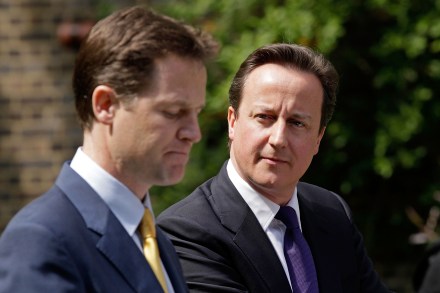
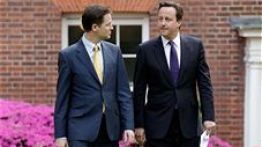
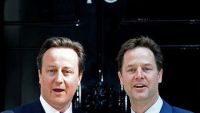
Today's civil partnership between two men who look uncannily like each other will, I suspect, be remembered as a festival of misplaced optimism. Cameron overdid it a little, making out that this was his ideal outcome. It seems rude to point it out, but there were two podiums in that rose garden because he flunked the election (see Tim Montgomerie's superlative report for details). The cost of his failure to win is having to do a deal with Nick Clegg. The country didn't vote for a new politics: the Lib Dems did worse than last time, so polls show most voters would have preferred Cameron to have formed a minority government. This is an alliance designed to stop Cameron fighting an election again soon, and repeating last week's jarring experience.

The story of the Tory campaign

From our UK edition

If you read only one thing today, then make a cup of tea, sit in a comfy armchair, and make sure it's Tim Montgomerie's 7,000-word review of the Conservative election campaign.  Tim has opened up his address book and spoken with many of the main players in the Tory operation - and the result isn't all that flattering.  Here's a summary passage which gives a sense of it all: "For a period, the 'Big Society' was put at the heart of the campaign. Amazingly, the Big Society was never tested in focus groups and it failed on the doorstep. One leading adviser to the campaign complained of a 'cavalier' approach to research. 'They latched on to research that backed their views and ignored any research that challenged it.

The coalition agreement at a glance

From our UK edition

I have just had a quick read through the coalition agreement and a few things jumped out at me. First, this new government will not abolish Lord Mandelson. The agreement states that while the parties are committed to a wholly or mainly elected Lords ‘likely there will be a grandfathering system for current Peers’.   The Tory manifesto commits a Conservative government to introducing ‘new rules so that legislation referring specifically to England, or to England and Wales, cannot be enacted without the consent of MPs representing constituencies of those countries.’ The coalition agreement has watered this commitment down significantly. The new government will merely ‘establish a commission to consider the ‘West Lothian question’.

Victory! | 12 May 2010

From our UK edition

This magazine had hoped for a Conservative government. We have what is arguably the next best thing: a government led by David Cameron but supported by some political mercenaries put in the positions where they inflict the least harm — and reform-minded Tories in positions where they can do most good. The strategy is fairly clear: give Lib Dems more Cabinet crowns and chauffeurs than they could have dreamed of. Tie them in for five years, and have them defend Tory policy on the airwaves. And then, crucially, let them share the blame for the Irish-style spending cuts to come. Three appointments make this government, on balance, a victory for Conservatism.

Game on for the Labour leadership

From our UK edition

The Coalition Cabinet remains unformed as yet - it's rumoured that Chris Huhne is going to environment and Michael Gove and David Laws are out doing one another in the 'I've no idea where I'll be' stakes. All the sounds are very positive but the contents of would-be ministers' statements are careful, as doubtless final decisions are being made. The Labour leadership has its own spot on Westminster's backdrop of delicate intrigue. Yesterday, Andy Burnham positioned himself as the candidate of sense, opposing Lib-Lab talks and acknowledging that Labour needed to reorganise itself in the aftermath of defeat. The preferred path to renewal is clearer this morning. Alan Johnson has declared he will not stand and has backed David Miliband.

The Deputy Prime Minister speaks

From our UK edition

Just as the midnight oil burns out, the Lib Dems have finally agreed to a coalition deal with the Tories.  Speaking in Transport House, Nick Clegg confirmed that the parliamentary party and federal executive had "overwhelmingly accepted" the deal.  And ... well, that was it, really.  There were few other specifics from the new Deputy Prime Minister.  No confirmations of other Cabinet positions, no firm indications about the Lib-Con policy trade-offs – just "thanks and admiration" for Gordon Brown, and a few assurances that the new government would work towards "fair" ends, even though " there will, of course, be problems".  I'm sure that full details will emerge in the morning.

The government takes shape

From our UK edition

Here are some details of the LibCon deal, and my brief comments: 1. Clegg as Deputy PM. It’s a non-job, but a senior one – it means Clegg will take PMQs in Cameron’s absence, and will defend all those nasty cuts (sharing the blame for these cuts is the main rationale for coalition). This follows the 1999 Lib-Lab deal in Scotland, where Jim Wallace was made Deputy First Minister to everyone’s surprise. 2. Laws replaces Gove in education. This has not been confirmed yet, and I will not believe it until I see it. Of all of tonight's moves this is potentially the most concerning – especially for all those (including myself) who had said that the Gove schools policy was the best single reason to vote Tory.

The waiting game | 11 May 2010

From our UK edition

Westminster is working itself into a frenzy as we wait for the official announcements, statements and rituals of state which will surely come in the next few hours.   The very latest is that Cabinet ministers are saying Brown will go either tonight or tomorrow morning; Vince Cable has suggested a Lib-Con deal is "very close"; and all the noises are about a full coalition, perhaps with Nick Clegg as deputy Prime Minister. But enough of that: we shall soon have something more concrete to grasp than all the rumours and helicopter imagery.  And it will be nothing less than the end of 13 years of Labour government.

Lib-Con deal in the bag

From our UK edition

The Lib Dems are holding a meeting of both their MPs and the Federal Executive at 7.30pm. It is now widely expected that this meeting will approve a coalition deal with the Conservatives. Those who have taken the temperature of the Lib Dem Federal Executive say that approval is in the bag.

The Labour Party Must Accept Defeat and Move On

From our UK edition

As I write, the Liberal Democrats and Tories are meeting in the Cabinet Office. The Labour Party should accept this is the end of any hope of a Rainbow Coalition. This election was lost and well lost. The Conservative achievement is substantial. There are now over a hundred extra Tory MPs in parliament and David Cameron has taken his party from being an unelectable basket case to the dominant political force in Westminster. It would be gracious at this stage to admit defeat.  The unwholesome sight of Labour grandees scrabbling around in search of  deal with the Lib Dems is an affront to democracy. The suggestion that Labour has the best interests of the nation at heart, when it has been so comprehensively rejected by the electorate is the party at its authoritarian worst.

The Tory right strikes back

From our UK edition

Sam Coates reports that the Tory right want Cameron to renege on the commitment to a referendum on AV. You can see why they want to do this but it’s ill-advised. The Lib Dems have destroyed their credibility by indulging blatant self-interest and the Tories should avoid making a similar mistake. The need for unity is absolute. It’s time to put-up and shut-up in the national interest. Right now, that means reaching an accommodation, either in coalition or in a minority government with Lib Dem backing or abstention. If that requires a referendum on voting reform then so be it. Besides, facilitating a referendum is not to endorse reform. The Tories have everything to gain - power and the moral high-ground.