Conservative party

Will Cable be selling the coalition’s cuts?

From our UK edition

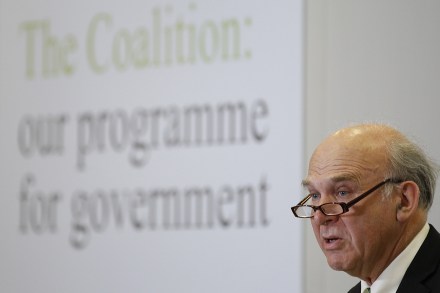
Compared to the major affairs of state, David Cameron's decision to spend part of this summer touring the nation to sell the coalition and its spending cuts may seem but a trifle. Yet it's a good move nonetheless. After the obfuscations from all sides before the election, Osborne's Budget swept in a more upfront approach to cuts. Cameron's roadshow, you hope, will keep that going. One thing to look out for is how Vince Cable gets on this summer. The Telegraph reports that he will also be involved in the coalition's big promotional drive, and will be holding his own public meetings during August. A recipe for trouble given Cable's singular approach to united government? Perhaps.

Francis Maude is right, but he must remain wary

From our UK edition

Big words from Francis Maude, as he tells today's Guardian that the current government is more radical than either Thatcher or Blair were in their first terms. But, to my mind, he's right. Even looking back on the past week – with the proposals to reform policing and benefits – there's a good deal of radical policy. And that's before we get onto the free schools revolution or GP commissioning – or, of course, to a Budget which took shears to the size of the state as few have done so before. But Maude shouldn't get too excited quite yet. It is all very well talking about good intentions and plans, but – as any fule kno – the real challenge will be in the implementation. The case of Michael Gove is instructive in this regard.

IDS’s welfare reforms aren’t perfect, but he’s right to be bold

From our UK edition

So, Iain Duncan Smith has set out proposals to comprehensively reform of the welfare system. The goal is to replace 51 benefits with a single and flexible allowance. It has been claimed that this reform would allow people with jobs to retain more of their benefits and ensure that people who work will always be better off than people on benefits.   There are problems with Iain Duncan Smith’s proposals. Fiscal cost is one, and the Work and Pensions Secretary has already clashed with George Osborne over the price of these proposals. Lowering taper rates to make work more rewarding could mean that more people receive more generous assistance – meaning costs go up.

The coalition can do more for less on benefits reform

From our UK edition

There is a lot to like about Iain Duncan Smith's new proposals for welfare reform.  The chance to move towards a radically simplified benefits system is enormously exciting.  As I wrote for Coffee House last week, the current system is a complete mess and failing on just about every criteria.  It is so complicated that £4.5 billion a year is lost to error and fraud; working at the minimum wage of £5.80 an hour can be worth as little as 26p an hour; and too many families slip through the net so that the number living in severe poverty has actually increased from 5 to 6 per cent in the last decade.

A Boris success story?

From our UK edition

As strange as it sounds, the launch of Boris's cycle hire scheme is a significant moment for the Mayor of London. It's exactly the kind of ruse which, if it fails, will provide his opponents with an exaggeratedly high-profile target to aim at come election time.

At last, IDS gets his chance to reform benefits

From our UK edition

For some time now, we on Coffee House have been raving about Iain Duncan Smith's plans for reforming benefits. And, today, it finally looks as though they – or something like them – will soon be put into action. The DWP is releasing a consultation document which aims to simplify and straighten out a benefits system which now acts as a barrier to work. Over the next few months, various think-tanks and other organisations will submit their own ideas for doing just that. Someone who will no doubt take part in that process, Policy Exchange's Neil O'Brien, has a written a very useful summary of the main questions and arguments here.

Match-maker Merv

From our UK edition

Mervyn King’s evidence to the Treasury select committee has Westminster’s tired tongues wagging this afternoon. King re-iterated his long-held position that market confidence will imperil long-term recovery unless the deficit was confronted immediately. Nick Clegg has said that a personal conversation with King changed his mind on cutting the deficit early. Paul Waugh, Jeremy Warner and James Macintyre have varying takes on the Governor’s remarks and their bearing on the coalition's formation. I’d just observe that King may have been Cameron and Clegg’s unwitting matchmaker. But equally, no party was honest about cuts during the election.

Who should make the concessions to appease the AV rebels? Cameron or Clegg?

From our UK edition

The honeymoon has been spoilt by a bout of food poisoning: Tory dining clubs have decided to obstruct the AV bill. More than 50 Tory MPs will rebel because they believe the referendum should be held on a day other than May 5th and that the referendum should not be binding unless turnout exceeds an agreed minimum. Labour, already masters at opposition, will oppose the bill on the grounds that it includes changes to electoral boundaries – a reform that would lessen the in-built bias in favour of Labour, but which it haughtily considers ‘gerrymandering’. For the sake of the coalition, Cameron owes it to Clegg to at least deliver a referendum, so he must quash this backbench dissent.

Never again should so much be wasted by so few

From our UK edition

If you tire quickly of the tediously lengthy build up to Christmas, which starts about now, then heaven help you in dealing with two years of hyperbole about the 2012 Olympics. Even the most enthusiastic synchronised swimming fan will find it hard to imagine that the actual event will live up to the billing. And as a keen follower of sport (well, proper sport like football or motor racing), I hope that the London Olympics absolutely bomb.   I want half empty stadia, feeble athletic performances (particularly from British competitors) and embarrassingly low television viewing figures.

More grist for the welfare reform mill

From our UK edition

How many incapacity benefit claimants could actually work? Well, we get a sense of the answer with some figures released by the Department for Work and Pensions today. They show that, of the people who have gone through the new Work Capability Assessments so far, some three-quarters are able to look for a job. Scale that up for everyone on incapacity benefits, and it suggests that around 1.8 million claimants could return to the labour market. Although the numbers are eye-catching, they're not entirely surprising: similar figures were published when the WCA was introduced under Labour.  And it could be worth holding fire until the necessary review of those assessment tests has reported back later this year.

Boris’ calculations

From our UK edition

There has been some speculation, most of it idle, that Boris Johnson will not stand for re-election as London Mayor in 2012. Speaking to the Today programme about the necessity of protecting the Olympics budget, Boris commented on his putative re-election campaign. He said: ‘If things are still going well I would be totally crackers not to have another go at it then. But I'm going to be making an announcement later on.’ Many would describe his tenure so far as a comedy of inertia. I don’t: Johnson battled hard to shield the City from puerile political indignation at the height of the financial crisis. It showed a seriousness and determination not usually associated with a panel show politician.

The coalition’s summer challenge

From our UK edition

How striking that, as another Parliamentary term draws to a close, all the talk is of some sort of union between the Tories and the Lib Dems.  There was Mark Field's blog post about an electoral pact, yesterday, of course.  But now Rachel Sylvester follows it up with an article in the Times outlining a possible "metrosexual merger" between the two parties.  And Paul Goodman has a piece in the Telegraph suggesting that such a merger may well be in the offing. In many repsects, all this chatter is testament to the early success of the coalition.  What we have seen over the past few months has, on the whole, been responsible and surefooted government by a group of people who seem to get on personally as well as politically.

The coalition must tread carefully over electoral pacts

From our UK edition

Well, Mark Field has certainly got Westminster talking with his suggestion that the Lib Dems and Conservatives might not oppose each other in marginal seats come 2015. It's the kind of idea that has been sloshing around for a few weeks now, but having it relayed through a Tory MP's blog post gives it a little extra punch. And so plenty of questions abound. What would this mean under AV? Who would do better out of it? Is it sensible for both parties to effectively make the next election a referendum on the coalition? etc. etc. But one question doesn't seem to be getting enough airtime: what would this mean for the voters themselves? You see, these electoral pacts may, more or less, make sense when it comes to strengthening the coalition.

Alistair Darling – a loss to the Labour party

From our UK edition

Alistair Darling was one of the ministers to emerge from the Brown years with his reputation enhanced. His honesty about the state of the economy, beginning with that extraordinarily stark interview about the coming collapse, contrasted with what is politely described as Brown’s eternal optimism. Darling also deserves commendation for fighting Brown and Balls’ shameless politicking, and for winning. However, Darling lost the battle over raising VAT hike. Darling told Andrew Marr this morning: ‘There's a choice really, you can put up VAT or you can put up an income-related tax which is what the National Insurance is... "The advantage of VAT is it brings in a lot of money.

AV, what is a Conservative to do?

From our UK edition

Matthew Parris and Charles Moore are the two of the most eloquent exponents of conservatism. But they represent different strands of conservative thought as their views on AV demonstrate. Matthew argues in his column in The Times today that the Conservative party should let AV pass if that is what it takes to keep the Lib Dems happy. He thinks that the Lib Dems are not only needed to make the Coalition work but that their presence is, in itself, a good thing. As he writes, ‘Lib Dems bring to government a distinct and healthy slant on politics. There is a reactionary component in the Tory make-up; I often share it, but it must always be kept in check.’ Charles, by contrast, remains a principled opponent of AV.

Bluntly speaking

From our UK edition

Crispin Blunt has been unceremoniously slapped down by No 10 for saying that the ban on parties in prisons will be lifted. The Coalition is following a liberal line on criminal justice but it has no desire to pick a fight on the question of whether prisoners should be allowed to party in jail. A look at The Sun and The Mail this morning show why Downing Street dumped on Blunt so fast. The Mail followed up yesterday’s critical coverage of the Coalition with a devastating front-page assault on Blunt and his arguments. The Sun, which has been extremely supportive of the Coalition, also went for Blunt.

If the Tories go on like this Labour will become the party of law and order

From our UK edition

Before such fripperies were banned, al-Qaeda terrorists were given lessons in stand-up comedy while in high-security prisons. I’d have thought that the exploding underpants fraternity had natural advantages in comedy, but never mind. What I want to know is who gave the lessons? It’d be ironic if it was a voluntary group. The Mail has worked itself into a panicked fury about that the ban on prison parties would be revoked. To be fair to the Mail, Crispin Blunt, the Prisons Minister claimed as much in speech last night, and he vowed to abolish Indeterminate Sentences for Public Protection - orders that incarcerate the sort of charmers who butcher you in the bus queue if you give 'em a look.

Another one in the eye for Vince

From our UK edition

I feel for Vince Cable, who has morphed from Sage to Crank in a matter of weeks. Imagining himself as the scourge of the tuition fee, Cable floated the idea of a graduate tax recently. This pre-empted the Browne report into university funding and disregarded the coalition agreement, which states that all questions would be deferred until the Browne report’s publication. It was, in other words, posturing. The BBC reports what has been rumoured in Whitehall: the government is not giving serious consideration to a graduate tax, which would have incurred enormous upfront costs. Politically, the Liberal Democrats must abolish tuition fees, or at least tame their impact on the poorest.

Howard versus Clarke

From our UK edition

Michael Howard appeared on today's Daily Politics and laid into Ken Clarke's 'caricature' of a policy to reduce prison places. There is, Howard argues and John Denham supported him, a correlation between increasing the number of those incarcerated and a fall in crime. In other words, prison still works. Howard criticised Clarke's 'rather foolish' denial of that link. Howard echoes the Spectator's editorial line that early release endangers society, and that it costs less in real terms to keep criminals in prison. Howard's off-message critique is the most total I have yet seen, particularly on the statistical case against the government's position.