Conservative party

Lord Ashcroft’s warnings about David Rowland

From our UK edition

Here in Westminster, the David Rowland story is the talk of the hour. It seems that Lord Ashcroft and Michael Spencer had both warned Cameron that Rowland would come in for unfavourable coverage from the media if appointed and that they worried that other donors would not want to deal with him. I’m informed that they feared that his appointment could undo much of the work they had done to strengthen the party’s finances. The media’s attention tonight is turning to the question of why David Cameron ignored the warnings about the controversy that this appointment would cause. Some senior Tories are questioning his judgement over the matter pointing out that the stories that have appeared about Rowland were entirely predictable.
Ed Miliband’s backhanded offer to the Lib Dems

From our UK edition

As Channel 4 reminds us, there have been two major trends in recent opinion polls. First, the precipitous decline in the Lib Dem vote share. And, second, a solidification of the Labour position, such that some polls even have them as the biggest party in a hung parliament. Predictably, this has stirred the omnipresent Simon Hughes, and some other folk around Westminster, into talking about a LibLab coalition. Which is why Ed Miliband's comments in the New Statesman today are so eyecatching. He tells Jason Cowley and Mehdi Hasan that he couldn't go into the coalition with the Lib Dems if they were led by Nick Clegg. He's got problems with "what [Clegg] is supporting," you understand. This is a new approach from one of the Labour leadership candidates.

The Tories tone down their rhetoric on A-levels

From our UK edition

The latest A-level results have been released and – surprise, surprise – success rates have risen. The proportion of papers marked at grade E or above increased to 97.6 percent from 97.5 percent last year. And 27 percent achieved an A or the new A* grade, with 8 percent at A* overall. So, naturally, and rightly, the usual arguments about "dumbing down" are out in force. The Tories used to love getting stuck into this debate, accusing the New Labour government of eroding exam standards. But it's noteworthy that, now they're in power, their rhetoric on the matter has become considerably less provocative.

This Parliament’s key dividing line?

From our UK edition

They may have faded from the front pages, but middle class benefits are still one of the most important stories in town. What we are witnessing here could be the birth of this Parliament's defining dividing line – a cuts vs investment for the new decade. In truth, the birthing process began before the election, with this Ed Miliband interview in the Guardian. In it, he made a distinction between a "residual welfare state that is just for the poor, which is the Tory position," and a "more inclusive welfare state" that encompasses the middle classes. His point was that the former goes against "all the evidence of maintaining public support [for the welfare state]" and, ergo, the Tories have got this wrong.

A solid enough start

From our UK edition

The Liberal-Conservative administration deserves to pass its 100 day probation. It hasn’t done much yet, but it has said some of the right things and sounds like it might even get round to doing a few of these things at some point in the not-too-distant future. I’d pretty much accept that from a new staff member, so I guess I should be half-pleased that I seem to be getting this level of performance from my government. The coalition partners were right to shelve their timid pre-election rhetoric about the size of the hole in the public finances. The Liberal Democrats’ implausible insistence that cuts shouldn’t start until next year was ditched as soon as they had “looked at the figures”.

The coalition’s choice over Winter Fuel Allowance

From our UK edition

The Winter Fuel Allowance has tapdanced back onto the political landscape today, and it's all thanks to some insightful work by the FT's Alex Barker. He had an article in this morning's pink 'un which suggested that IDS is lobbying to have it, and and some other "middle-class benefits", trimmed to help pay for his benefit reforms. And he's followed that up with a blog-post explaining how even an apparent "cut" in the allowance may not result in savings for the Treasury or the DWP. Strange but true, as they say. This could be a delicate situation for the coalition. In the background to it all is David Cameron's pre-election pledge that the Tories wouldn't cut Winter Fuel Allowance.

Is Cameron slowly winning the argument on public service reform?

From our UK edition

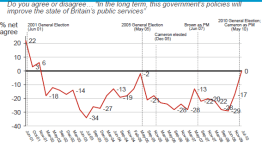
Guido has already highlighted one of the most important graphs from this Ipsos MORI treasure trove, showing that the public have overwhelmingly accepted the need for spending cuts. But this other graph forms a striking companion piece: Sure, the public may be split on whether the coalition will be good for public services. But the main thing to note is that overall optimism is at its highest level since 2001 – and rising. Maybe, contra Brown and Balls, people are realising that you can get more for less.

Ambition should be made of sterner stuff

From our UK edition

Few writers can make a silly season story read like official history, so it's worth drifting behind the Times’ paywall to read Rachel Sylvester on Boris and Dave's mutual emnity. It is no secret that BoJo and DC are united in rivalry, but Sylvester adds a second dimension with insider quotations - a mix of arch witticisms and savage partisanship. Here are several of many from today’s column: ‘Most people at Westminster assume that Boris — compared by one of his editors to Marilyn Monroe, “another egomaniacal blonde” — still harbours ambitions to lead his party.

The task facing UKIP’s next leader

From our UK edition

That didn't take long, did it? After only a year in charge of UKIP, Lord Pearson has quit the role even more abruptly than he took it. In his resignation statement, he confesses that he is "not much good" at party politics – and it is hard to disagree. A memorable low was his interview on the Campaign Show in which he was only dimly acquainted with his party's own policy. But more damaging, to my mind, was the general erosion of UKIP's identity: Pearson's policy of campaigning for Eurosceptic candidates from other parties may have been magananimous, but it also made you wonder whether UKIP are more a party or a pressure group. This morning, Nigel Farage hinted that he might put his name forward for the leadership.

The university funding debate continued

From our UK edition

University funding is beginning to dominate op-ed pages. Yesterday, Matthew d’Ancona put the case for a graduate tax from the conservative perspective; and to which Douglas Carswell has responded. Today, Professor Alison Wolf, a specialist in Public Sector Management at KCL, makes the point that any debate about higher education funding is prejudiced because Britain’s politicians and policy makers are predominantly Oxbridge educated, and the structure of Oxbridge undergraduate degrees is radically different from anywhere else. Writing in the Times (£), she asserts: ‘I’ve sat in many meetings, in Whitehall and Westminster, where people have talked up credit systems (a modular system of assessment) without the faintest idea that we have one.

An important fortnight for Nick Clegg

From our UK edition

Another reason to be glad of the Brown government's downfall is that there seems to be less silliness about the summer holidays. Today, Nick Clegg returns to London to steer government in David Cameron's absence – but there's no fanfare, nor energetic pretence that the Lib Dem leader is actually "running the country". Unlike those times when Harriet used to have a go at it, followed by Peter, followed by Alistair, followed by Jack, the overriding impression is just business as usual. But that doesn't mean that the next two weeks are insignificant for Clegg. Rather, he can make sweeping advances on a number of fronts. The most important, and least public, will be how he handles the ongoing spending review.

Simon Hughes and the deputy leader’s pulpit

From our UK edition

My, what a busy character Simon Hughes is at the moment. Seems like hardly a day goes by without some fresh observations from the Lib Dem deputy leader – and he doesn't even rest on a Sunday. Today, there are two Hughesbites worth noting down, both from an interview with Sky. The first: "We should have no preference at the next election between the Tories and Labour and other parties. We are going to stand on our own." And the second: "Our party is committed constitutionally to standing in every seat. We will be standing in every seat at the next election. There will be no deals, there will be no pacts…" So, no ruling out a LibLab coalition and no electoral pacts.

Readying the bombardment

From our UK edition

Westminster might be in holiday mode, but behind the scenes the coalition is preparing to take on the new Labour leader. As I say in the Mail on Sunday, the coalition is determined to hit whichever Miliband wins early and hard. The Cameroons believe that Tony Blair’s decision not to attack Cameron straight away in 2005 was crucial in allowing him to present himself to the public on his own terms. By contrast, both Hague and Duncan Smith were made to look like losers by the Labour attack machine within months of becoming leader of the opposition. The result of the Labour leadership election will be announced on the 25th of September.

The return of Alan Milburn

From our UK edition

Frank Field, John Hutton and now Alan Milburn – the red tinges to the coalition mix are like a Who's Who of reforming Labour politicians. Milburn, we learn today, is to return to government as an adviser to David Cameron on social mobility. It's a role he should be accumstomed to, as he was tasked with writing a report on the issue under Brown. That time, his suggestions were buried by a government which didn't want to face up to the sorry facts. This time, you hope they meet with a more constructive response. But why wasn't a Conservative (or conservative) appointed? That's the question which Iain Dale asks over at his blog – and you can see his point. There are plenty of people on the right who could have stepped into the role, not least someone like Jill Kirby.

The coalition’s university challenge

From our UK edition

The contours of an agreement on how to pay for university education are clearer today after Rachel Sylvester’s interview with David Willetts. Up-front fees look to be on the way out.  Willetts tells Sylvester, ‘It’s very important that it’s signaled very clearly that the money that is paid back comes out of your earnings once you have graduated and are in work.’ It also seems that different courses at different institutions will have different prices. Willetts proclaims that he wants something that ‘links you to your university and the course you did at that university.’   So far, this looks like simply collecting variable fees through the tax system.

What can Green achieve?

From our UK edition

Handbags across Whitehall this morning, as Vince Cable responds to the government's appointment of Sir Philip Green as an efficiency adviser in a disgruntled, if evasive, manner. He tells City AM: “There’s a lot I could say on this, but I’d better miss this one out ... I’m tempted to comment, but I think I’d better not.”   And it's clear why the Business Secretary, and many others, might be a little peeved. A hard-partying, perma-tanned, rotund and ostentatious figure, with question marks hanging over his tax status, Sir Philip is simply not designed for this age of austerity. He is nothing like the cadaverous technocrats who usually sift through Whitehall accounts.   Such concerns miss the point, though.

To Labour’s successors…

From our UK edition

Following this morning’s coalition press conference, the Tories’ have released this video: Labour’s Legacy. It’s effective, especially in view of Labour’s continued refusal to acknowledge that Gordon Brown did to Britain what Peter Ridsdale did to Leeds United, albeit on a grander scale.

The coalition gets political

From our UK edition

The joint Tory Lib Dem press conference to attack Labour’s legacy was a sign of how comfortable the two parties are becoming together. Chris Huhne and Sayeeda Warsi’s message was that the ‘unavoidable cuts that are coming are Labour’s cuts’ and that Labour is ‘irrelevant’ until it admits its responsibility for the deficit. The message was essentially the one that Chris Huhne and Michael Gove set out at the political Cabinet at Chequers last month. In a move that is bound to generate some headlines, Warsi has written to those Labour leadership contenders who were ministers asking them to forfeit their severance pay and to ask the ex-ministers supporting them to do the same.

The questions surrounding Cameron’s benefit crackdown

From our UK edition

There were hints of toughness in his article at the weekend, but now David Cameron has rolled up his shirt sleeves and pulled out the baseball bat. In a combative piece for the Manchester Evening News the PM outlines out a zero tolerance approach to welfare fraud and administrative error. The two problems "cost the taxpayer £5.2 billion a year," he says, "that's the cost of more than 200 secondary schools or over 150,000 nurses. It's absolutely outrageous and we can not stand for it." And so IDS is going to prepare "an uncompromising strategy for tackling fraud and error," which will be published this autumn.    Two things are worth keeping a close eye on. First, the Lib Dem reaction to all this.

The Treasury’s cutting difficulty

From our UK edition

Among the most eyecatching, and potentially important, stories of the day is this one in the Telegraph. It suggests that various departments have "failed" to outline a "worst case scenario" of 40 percent cuts that was demanded by the Treasury. And it even names and shames Caroline Spelman's Department for Environment, Farming and Rural Affairs as one of the offenders. Mrs Spelman, we're told, has now "been forced to use the time before her holiday to work up the projections with her officials and permanent secretary." Nothing like a last minute job, then. To be fair to Whitehall civil servants, there is a general sense that they have set about identifying cuts with some flair – although, obviously, the process won't go entirely smoothly.