Conservative party

The coalition will not be able to reduce net migration <br />

From our UK edition

The FT’s Alex Barker has made an important discovery in the OBR’s report. The coalition’s immigration cap will make no impact on net migration. ‘The interim OBR’s June Budget estimates of trend growth estimates were based on an average net inward migration assumption of 140,000 per annum…. Since June, the Government has announced a limit of 21,700 for non-EU migrants coming into the UK under the skilled and highly skilled routes from April 2011, a reduction of 6,300 on 2009. At this stage, we judge that there is insufficient reason to change our average net migration assumption of 140,000 per year from 2010, which remains well below the net inflows of 198,000 seen in 2009.

Lansley’s NHS revolution

From our UK edition

Round n in the transparency revolution: Andrew Lansley has welcomed the publication of the latest Dr Foster hospital list, detailing post-operative failures in NHS care. The Observer reports: 1) Almost 10,000 patients suffered an accidental puncture or laceration. 2) More than 2,000 had post-operative intestinal bleeding. 3) More than 13,000 mothers suffered an obstetric tear while giving birth. 4) Some 30,500 patients developed a blood clot. 5) 1,300 patients contracted blood poisoning after surgery. Despite record investment and targets for standards, the NHS still suffers setbacks in the mundane that have severe consequences - according to the report, several hospitals have 'dangerously high death rates'.

Tory and Labour grandees unite against AV

From our UK edition

The NOtoAV campaign has unveiled its patrons. It’s an impressive list. Margaret Beckett is the President, supported by Blunkett, Falconer, Prescott, Reid and Emily Thornberry on one side and Ken Clarke, Micheal Gove, William Hague, Steve Norris and Baroness Warsi on the other. The squeeze is on. The YEStoAV campaign has Labour supporters, but they aren’t quite so august. Iain Martin reckons that the YES team are faced with a cross-party opposition that can get these diverse big beasts working together. Iain calls it a pincer movement on the Lib Dems. The strategy is to characterise electoral reform as aan exclusively sectional interest: Clegg’s fixation.

Oh dear | 25 November 2010

From our UK edition

Howard Flight has always been an outspoken man. The new Conservative peer is reported to have said: ‘We're going to have a system where the middle classes are discouraged from breeding because it's jolly expensive. But for those on benefits, there is every incentive. Well, that's not very sensible.’ He may well be proved correct. But, plain-speaking and politics have never mixed, and especially not now. Following the Lord Young debacle, Downing Street has moved quickly to distance itself from Lord Flight’s comments. A grovelling apology won't be far away. UPDATE: The IFS did some very interesting work on the rising birthrate (15 percent) among what it termed 'low income households' under Labour.

The problem for Gove is that structures beget standards

From our UK edition

As you’d expect, Michael Gove’s White Paper is a feast of good sense. His speech in the Commons was powerful analysis, and his rebuttal of Labour MPs fun to watch. He’s all for making kids learn properly in primary school, retaining order in the classroom, making detention easier and better modern language teaching. Amen, amen, amen. But, I fear that the White Paper will not be transformative, for a simple reason: the schools system is broken. It doesn’t respond to instructions. The Education Secretary does not run education - power rests with local authorities and the teaching unions. They’re not too keen on Gove, and have allies in parliament ready to insert the odd amendment into legislation. Top-down instructions won’t work.

The corpse of Black Wednesday has been exhumed, and the demon exorcised 

From our UK edition

Cameron clearly doesn’t rate Ed Miliband. That may be a mistake in the long run but it worked fine today. The opposition leader returned to PMQs after a fortnight’s paternity leave and Cameron welcomed him with some warm ceremonial waffle about the new baby. Then came a joke. ‘I know what it’s like,’ said Cameron, ‘the noise; the mess; the chaos; trying to get the children to shut up,’ [Beat], ‘I’m sure he’s glad to have had two weeks away from it.’ This densely worded, carefully crafted, neatly timed quip had obviously been rehearsed at the Tory gag-conference this morning. The fact that Cameron had time to polish it suggests that he anticipated no trouble from Miliband today.

Gove starts the revolution

From our UK edition

The Spectator has been a long-term fan of Michael Gove – indeed, we named him the single best reason to vote Tory at the last election. His ‘free school’ reforms are laudable and the emphasis on improving standards is imperative. Under the previous government, Britain slid down the international rankings of educational attainment. A tide of politically correct initiatives robbed teachers of their classrooms and discipline suffered. The post code lottery under which state education operates sentences the poorest and most vulnerable in society to rot in under-funded sink schools. Reform is both a moral crusade and a necessity if Britain is to continuing punching above its weight in the future.

Who will benefit from the Royal wedding?

From our UK edition

David Cameron is playing down the effect the Royal Wedding will have on the 5th May elections, especially the AV referendum. Fleet Street’s having none of it however. On the one hand, Benedict Brogan can already hear the pops of champagne corks in the No to AV campaign offices. He reasons: ‘One consequence of the Royal wedding will be to make it even more difficult for AV supporters to get their campaign motoring in time for the referendum.’ On the other, Alex Barker makes the case for the Lib Dems’ Yes to AV campaign. He has a three point-plan, centring on low turnout following reduced campaign time. This, he thinks, will benefit those concerned about the injustice of the current system, rather than its die-hard defenders.

Coulson to stay

From our UK edition

The indefatigable Paul Waugh reports that Andy Coulson plans to break Tom Watson’s delicate heart: the government’s communications director is not going to resign for whatever it is that he is alleged to have done. Pity poor Tom. Coulson may be an anonymous figure, certainly by comparison with Alistair Campbell, and the government may have problems articulating a growth strategy. But Coulson’s survival will warm the cockles of Tory MPs, who rely on him to uphold those issues the leadership ignores. Witness Coulson’s savage reprimand for Crispin Blunt over the prisoners’ entertainment plans.

Miliband should re-examine Cameron’s playbook for the real lessons

From our UK edition

Ed Miliband has come roaring back from his paternity leave, keen to silence the growing chorus of criticism that he is not in control of his party and has let the Coalition determine the agenda.     To do so, he has come out in favour of a permanent top rate of income tax at 50 percent, but is otherwise taking a leaf out of the Cameron playbook - by establishing a number of policy reviews. But he might want to take another look at Cameron's experience. Reviews are a great tactical ploy - they show a willingness to "think big", allow a leader to reach out to a range party factions, aid front bench spokesmen to understand their portfolios and, perhaps most importantly, punts any serious policy discussions into the future.

Unite turns back the clock

From our UK edition

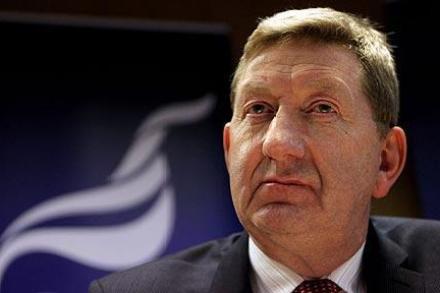
Len McCluskey has won the race to lead Unite, Britain’s largest union. McCluskey will therefore have a major role in how the left respond to cuts in public spending. It would premature to label McCluskey but he comes with a reputation for militancy. He cut his teeth at the Transport and General Workers Union in the 80s and was a confidant of Derek Hatton’s. And he hasn’t forsaken childish things – being an integral figure in the long running and wholely counter-productive BA dispute. So, impeccable credentials for a man of the old left; akin to the roll call of Wellington, Sandhurst and the City for those on the right. But McCluskey must resist temptation.

Full list of peerages

From our UK edition

Number 10 has published the full list of new peerages. There are 27 new Conservative peers, including Sir Patrick Cormack, Richard Spring, Julian Fellowes, Howard Flight, Michael Grade and Patience Wheatcroft. The Lib Dems and the Labour party have acquired15 and 10 respectively. General Dannatt is also to be ennobled, but will sit on the crossbenches, confirming his break-up from the Tory machine. Expect his strident voice to be a constant feature of the debate growing from the troubled strategic defence review.

You’ve never had it so good

From our UK edition

As Michael Gove said at the launch of the Conservative Party manifesto: “Britain in 2010 is a great place to live in many ways” (4:12 in on this video). Lord Young, The Spectator’s Peer of the Year, agrees: for many of us, we’ve never had it so good. He told the Telegraph: ‘For the vast majority of people in the country today, they have never had it so good ever since this recession - this so-called recession - started…Most people with a mortgage who were paying a lot of money each month, suddenly started paying very little each month. That could make three, four, five, six hundred pounds a month difference, free of tax. That is why the retail sales have kept very good all the way through.

The First 2012 Debate

From our UK edition

Will be held next spring at the Reagan Library. So soon! What joy! Andrew Sullivan notices that Hugh Hewitt thinks it's terrible that the questions will be asked by "mainstream journalists". Hewitt wants "different kinds of journalist" to set the agenda. By different he means the likes of Rush Limbaugh, Sean Hannity Mark Levin and Michael Medved. Andrew complains, hyperbolically to be sure, that this is "like Stalin being grilled by the Politburo". But actually, I would be interested in watching a Presidential debate moderated by the likes of Limbaugh and Levin and co. Lord knows, there will be plenty of opportunities for Wolf Blitzer and Brian Williams and the rest to ask dumb questions.

The Harman bounce

From our UK edition

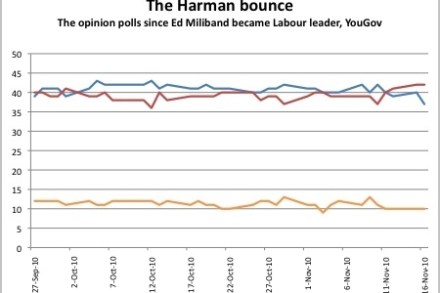
I kid, I kid – but it's still striking that Labour are pushing ahead in the polls as soon as Ed Miliband takes his paternity leave. According to today's YouGov poll, they are now 5 points ahead of the Tories: their biggest lead since 2007, and an escalation of the 2-point advantage they recorded in a couple of polls earlier this week. The question, of course, is whether this is a momentary blip, or representative of wider discontent over tuition fee rises and the like.

PMQs live blog | 17 November 2010

From our UK edition

VERDICT: Harriet Harman's questions must have looked quite clever on paper: a heavy emphasis on police cuts, followed by a quick dose of indigation over the vanity photographers. But, in reality, they were breezily repelled by Cameron. All he had to do was cite the words of Alan Johnson and refer to a list of Labour's own dodgy hires. By the time Harman attacked the cost of elected police commissioners, leaving Cameron to stand up for greater local democracy and accountability, it was clear who had won this bout: the Prime Minister, by some distance. Although, as Andrew Neil and Tim Montgomerie have noted, the absence of any talk about an Irish bailout was unsettling, to say the least. 1233: Labour are persistently talking down the economy, claims Cameron.

The divide over the Guantanamo settlements

From our UK edition

After being pre-empted by the morning newspapers, Ken Clarke's statement this afternoon contained nothing that was unexpected. "We've paid the money so we can move on," he said. And he went on to emphasise that the Guantanamo payouts are not an admission of culpability, but rather all about sparing the public's money and the spooks' time. More striking were some of the responses from Clarke's coalition stablemates. Take Tom Brake, the Lib Dem MP for Carshalton and Wallington, who suggested that the government wouldn't have made the payments if the UK didn't have a case to answer.

A royal wedding bounce?

From our UK edition

Slap all kinds of health warnings on this, but – in view of speculation that the Wills and Kate nuptials might work in the coalition's favour – I thought CoffeeHousers might like to see what happened to the the Tory government's poll rating in 1981, around when Prince Charles married Diana. So here's a graph I've put together from Ipsos MORI's figures. The dotted line represents the date of the wedding: PoliticsHome suggests that the "royal wedding worked wonders for Thatcher" – but, on the basis of the above, I'm not so sure. It's worth nothing, though, that the Tories surged ahead of Labour as soon as the Falklands War flared up in 1982. By June 1982, Thatcher's party were 27 points ahead of their rivals. P.S.

Bonfire of the vanity photographers

From our UK edition

Today is a very good day to bury bad news. Prince William and Kate Midddleton’s engagement is going to dominate the news and the front pages for at least the next 24 hours. Almost any other story can be slipped out unnoticed in the current circumstances. So it was a convenient time for Downing Street to announce that the photographer and the videographer would be moved off the public payroll and back onto the Tory one. This means that their work will not be able to appear on any government websites. Downing Street’s correction is welcome. But in reality, the damage has already been done by this story. It will be like the car following the bike, a story constantly advanced by those sceptical of the PM.

Cameron: it’s all about the economy

From our UK edition

A minor landmark for David Cameron tonight, as he delivers his first Mansion House speech as Prime Minister. Like occupants of No.10 before him, he will use the occasion to talk about foreign affairs – although the result may be rather more like the Chancellor's annual speech at the same venue. Judging by the extracts that have been released so far, Cameron's overall emphasis will be on the economy, and on Britain's fiscal standing. As he will say, "we need to sort out the economy if we are to carry weight in the world." Cameron develops this point by claiming that, "whenever I meet foreign leaders, they do not see a Britain shuffling apologetically off the world stage.