Conservative party

When u-turns matter

When I asked one Tory how things were going the other day, he replied “we’re living by that Silicon Valley phrase: ‘fail fast and fail often’.” His argument was that for all that we in the press work ourselves into a frenzy over u-turns, the public don’t much care about them and it is much better to get these things out of the way quickly.   When I challenged him that all these shifts made Cameron look weak, his rejoinder was that as long as the coalition stuck to its deficit reduction programme voters would know that it could hang tough when it needed to.   I suspect that this

Cameron muscles Clarke off the stage

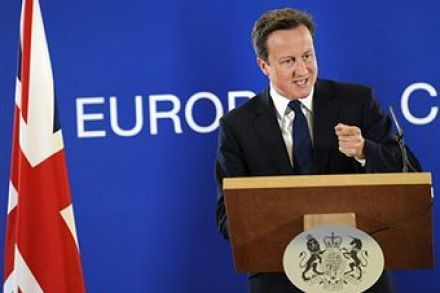
The toughening-up effort continued with David Cameron’s press conference just now. There he was, at the prime ministerial lectern, not just announcing a stricter sentencing system than Ken Clarke broached a few weeks ago, but explaining why the government’s change of mind was actually “a sign of strength”. Out are the 50 per cent sentence reductions for those who plead guilty early. In is a commtiment to jail those caught using a knife threateningly, as well as a bundle of tougher measures all round. “Being strong is about being prepared to admit that you didn’t get everything right the first time around,” said Mr Cameron, again and again. His other

Lib Dems wary of “Tory traps”

The government’s u-turn on sentencing reveals something quite important about the Lib Dems’ approach to coalition. Despite having backed Ken Clarke in private, they have stayed as far away as possible from the issue in public.   The Liberal Democrats were determined not to put themselves on the wrong side of the public on this issue, to end up copping the blame for ‘soft sentencing’. As one senior Liberal Democrat said to me recently, “we’re determined not to walk into any bear pits. If there is a big flashing neon sign above something saying ‘Tory trap’, we’ve got to be disciplined enough not to fall into it.”   Clegg’s circle

Cameron gets tough

Toughness, or at least the appearance of it, is clearly the theme of the week on Downing Street. After the vacillations over NHS reform, David Cameron seems to be going out of his way to sound that little bit more hard. There’s the headline on the front of today’s Times, for instance: “Cameron to Europe: not one penny more.” And there was the PM’s claim, yesterday, that a Tory majority government would be “tougher” on immigration and welfare. Even the recent hyperactivity of Michael Gove is, I’m sure, all part of the plan, given that schools reform is broadly one of the areas where the government will (probably) never apologise,

The limits of stigma

As James says, it’s been a day of high passions here at The Spectator. He feels strongly that many of the problems in Britain are societal, and require a cultural shift. Maybe so. I disagree with James when he says a Prime Minister’s role is to “lead society”. I disagree. We pay him to run the government, not offer his advice (or, worse, condemnation) on how society is running itself. Sure, society is shaped by government incentives. Cameron can fix these. But shaping society by exhortation is not what we expect of limited government. Fundamentally, it confuses what I see as the natural pecking order. In Britain, the people pass

Cameron is right to use the bully pulpit of his office

The normal Monday morning calm of The Spectator was disturbed today by an argument about David Cameron’s comments about fathers who go ‘AWOL’. I thought Cameron was right to say what he did, my editor didn’t. He felt that it wasn’t the Prime Minister’s job to moralise, and that him doing so was the beginning of a descent into totalitarianism.   The reason I think Cameron was right to speak out is that so many of the problems in this country are social or cultural. They can’t be solved by another piece of legislation or a government initiative. Rather, they require a broader cultural shift: a move away from the

Gove reaffirms his faith in free schools

Invigorating, that’s probably the best word for Policy Exchange’s event on free schools this morning. Right from Sir Michael Wilshaw’s opening address — which set out the reasons why he, as headteacher of Mossbourne Academy, is optimistic about education reform — to Michael Gove’s longer, more involved speech, this was all about celebrating and promoting the new freedoms that teachers are enjoying. There were some specifics about the schools that are opening, and the numbers of them, but very little of it was new. For the first time in a week, Gove wasn’t announcing policy, but instead referring back to it. Which isn’t to say that this was an ornamental

Boris’s one-two punch against the coalition

Boris, we know, has never had any compunctions about distinguishing his views from those of the coalition government. Take his recent proclamations on the unions or on the economy, for instance. But his latest remarks are still striking in their forthrightness. Exhibit A is the article he has written for today’s Sun, which — although it doesn’t mention Ken Clarke by name — clearly has the Justice Secretary in mind when it exhorts that “it’s time to stop offering shorter sentences and get-out clauses.” And Exhibit B is his column for the Telegraph, which waxes condemnatory about Greece and the euro. As George Osborne struggles to limit our involvment in

Cameron takes on bad dads

It’s Fathers’ Day today — and David Cameron is marking it with an extraordinary attack on those dads who are AWOL. It comes in one paragaph of an otherwise excellent and moving piece for the Sunday Telegraph (albeit one that downplays the role of the taxman), in which he says that men leaving their family is “beyond the pale”; that such fathers should feel the “full force” of society; and goes as far as comparing them to drunk drivers. This is a brave move — in the Sir Humphry sense of the word — for three reasons. 1. Britain has more absent fathers than any country in the EU. That’s

Gove keeps on going

My gosh, Michael Gove is hyperactive at the moment. From his interview with James in the latest issue of the Spectator, to his recent announcements about failing primary schools and secondary school standards, this is a man who just cannot stop. So stop he doesn’t. The Secretary of State for education is delivering yet another speech on Monday. And he has another interview (£), with Rachel Sylvester and Alice Thomson, in today’s Times. The Times interview, if you can vault across the paywall, is a worthwhile read. In it, Gove draws attention to the anti-reformist bent of local authoritarians; he warns that if we fail to adequately educate our population,

Don’t dismiss Davies out of hand

Touchpaper, meet match. That’s the explosive situation engendered by Tory MP Philip Davies and his comments about disabled people this afternoon. His suggestion, made in the Commons, was that disabled people could work for less than the national minimum wage. And his justification? That the minimum wage “prevents those people from being given the opportunity to get to the first rung on the employment ladder.” Charities such as Mind have since lambasted Davies for even broaching such a thing. The phrase “nasty party” is gushing around Twitter with tidal abandon. But before we pile on, it’s worth noting that Davies has identified an issue that is more shades of grey

How the Tories could capitalise on the eurozone’s woes

With events in Greece moving at pace, next week’s European Council meeting (which was scheduled to be a low-key affair) could be the place where attempts to resolve the crisis in the eurozone take place. I’m told that Number 10 has now woken up to this possibility and is doing some preparatory work on the matter.   But, frustratingly, there’s still no strategy for how David Cameron could use this crisis to advance the British national interest. As I wrote last week, if the eurozone countries decide that a solution will require a treaty change, then Britain has a veto over that — and could use the negotiations to secure

Why the battle of the bins matters

The government is, rightly, receiving a monstering from the papers for its u-turns on weekly bin collections. But what is at stake here is more than just the issue of bins. The government’s failure to honour its promise on this matter casts doubt on whether ministers are strong enough and tough enough to impose their will on their departments. The two ministries dealing with the rubbish question are the Department of Environment, Food and Rural Affairs and the Department of Communities and Local Government. Both are run by Conservative Secretaries of State. If this was not enough, both the Secretaries of State involved — Caroline Spelman and Eric Pickles —

PMQs live blog | 15 June 2011

VERDICT: The specifics of today’s exchange between David Cameron and Ed Miliband may have everyone rushing for this Macmillan press release, but the rhetorical positions were clear enough. There was the Labour leader, angrier and more indignant than usual, painting the government’s welfare reforms as cruel and insufficiently thought-through. And there was the PM, painting his opponent as yet another roadblock to reform. Neither really triumphed, although their battle will most likely set a template for in future. The coalition has extensive public backing for its changes to the welfare system. So, Miliband’s challenge is to attack certain aspects of them, without making Labour appear to be — as he

Osborne comes to a decision on the banks — but the story doesn’t end there

In his speech to Mansion House last year, George Osborne asked a question of his frosted and cumberbunded audience: “Should we restrict or split the activities of banks?” In his speech tonight, he looks set to deliver an answer of his own. As Robert Peston reports, the Chancellor is to announce that the investment and retail arms of banks will be ringfenced off from each other, so that the dice rolls of the Masters of the Universe cannot tumble across everyday savers’ cash. This does not mean a complete, Glass-Steagall-style separation between the two halves. But, rather, it follows the recommendations of the interim report of the Vickers Commision: banks

Those three little letters

The NHS saga is over at last, or so the government hopes. The coalition is expected to adopt the recommendations of the NHS Future Forum, which have been delineated by panel member Stephen Bubb in this morning’s Times (£). Last night, the prime minister and his deputy addressed their respective parliamentary brigades and each claimed the credit for re-shaping Andrew Lansley’s bill for partisan gain. The political saga continues. The Lib Dems have been crowing over their victory; the Tories are licking their wounds –a voluble Conservative MP has told Philip Johnston that a ‘once in a generation opportunity to reform the NHS has been lost.’ Some of the anger

Miliband borrows from the Cameroons for his most substantial speech so far

Thematically speaking, there wasn’t too much in Ed Miliband’s speech that we haven’t heard before. The middle is still squeezed, the Tories are still undermining the “Promise of Britain”, the bankers are still taking us for fools, and communities still need to be rebuilt. Even his remarks about benefit dependency bear comparion to those he made in February. But there was a difference here, and that was his punchiness. The Labour leader may not be the most freewheelin’ orator in town, but the text he delivered was less wonky than usual, more coherent and spikier. It was even — in parts — memorable. You do wonder whether Miliband has learnt

Balls bites back (with mixed success)

You certainly can’t fault Ed Balls for chutzpah. After the weekend he has just experienced, the shadow chancellor has an article in today’s Mirror accusing George Osborne of “spinning out of control”. It is pure, triple-distilled Balls: a fiery attack on both his political opponents and their policies. So let’s sup deep and read the whole thing, alongside my comments: THIS is the most exciting Formula 1 season for decades. Because it is not just about who has got the fastest car – it’s about race strategy, overtaking and adapting to the changing conditions. You can be the fastest driver on the track for 40 laps – but that’s no