Communism

Kneecap’s breathtaking Cuban hypocrisy

While most Cold War cultural battlegrounds have long been paved over or turned into a theme park, Cuba has retained a place in the hearts and minds of the West’s luxury leftists. Beautiful weather, sandy beaches, famous cigars and, of course, a long-standing enmity with the US have all ensured the country remains perhaps the last stubborn redoubt of revolutionary, western hipsterism. So it made perfect sense that leading the charge in last weekend’s much trumpeted "aid flotilla" to the island nation was the Irish language-speaking novelty rap act, Kneecap.

kneecap

In Cuba, a revolution is over

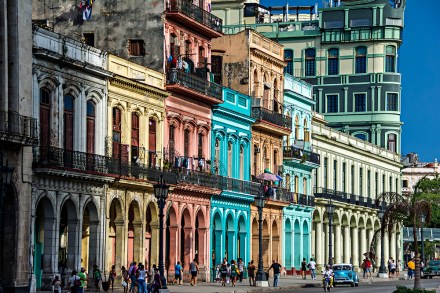
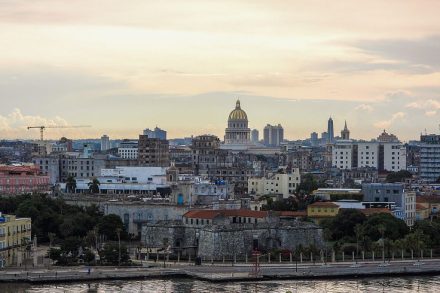
If you’ve ever thought of visiting the crocodile-shaped island of Cuba, or run into someone recently returned from sultry nights in the country’s salsa halls, there’s a good chance you’ll have heard the phrase “See it before it changes.” And I don’t mean because of Hurricane Melissa. The idea is that the centrally planned communist state, one of the last on Earth, will soon morph into America and a balmy Brigadoon full of people unencumbered by money, modern cars or Alexa will evaporate. I think most people, if they knew what Cubans have endured, wouldn’t use that phrase, which is up there in its lack of tact with “they’re poor but they’re happy.

cuba havana

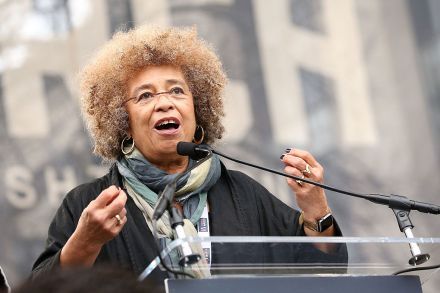
Cambridge University should be ashamed of itself for honoring Angela Davis

Remember Angela Davis? Few people under fifty do. Was Cambridge University counting on that historical ignorance when it decided to honor Angela Davis with an honorary degree?   In case you, Dear Reader, are a little fuzzy about Davis, I note for the record that the former Black Panther and two-time vice-presidential candidate on the Communist Party ticket with Gus Hall is the recipient of many honors, including the Soviet Union’s Lenin Peace Prize.  Cambridge University, of course, has long demonstrated a certain fondness for Commies, as the names “Kim Philby,” “Guy Burgess” and “Anthony Blunt” remind us.

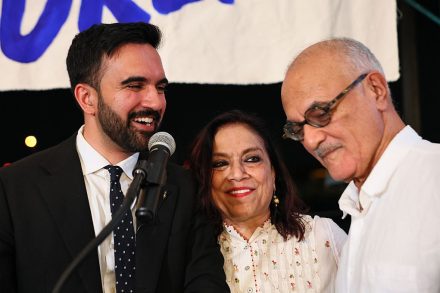
Zohran Mamdani’s radical parents

Voters often pay a premium for socialism. It’s the modern-day equivalent of free-range eggs or an electric car. Zohran Mamdani, a self-described “democratic socialist,” embodies that premium. In New York’s Democratic mayoral primary election, he got blown out of the water with lower-income voters – but won overwhelmingly with young, white, college-educated idealists desperate for the revolution. He would be the furthest left mayor New York City has ever seen if elected in November. While his policy prescriptions – city-run grocery stores, higher taxes on the wealthy and a diminished police presence – are radical proposals, it is his deep devotion to socialism that truly defies convention. There is no question that Mamdani loathes the West.

zohran Mamdani

Zohran Mamdani’s grocery chain will be a crime against New Yorkers

Of all the policies proposed by Zohran Mamdani, the socialist winner of last week’s New York’s Next Top Mayor competition, the idea of city-run grocery stores has proved the most divisive. If you want to reduce prices at halal carts by taking away regulations on street vendors, you’re going to get 80-plus percent approval rating. But state-owned groceries are another story. Modern history is strewn with tales of state-owned grocery disasters.

Zohran Mamdani

The Democratic war machine

To understand what’s wrong with the American left and the Democratic party – two different but entwined things, to be sure – look to Vladimir Ilyich Lenin. Look also to the work of the historian Sean McMeekin, including his latest book, To Overthrow the World: The Rise and Fall and Rise of Communism. Earlier this spring I emceed an event in McMeekin’s honor, as he received the award for “Conservative Book of the Year” from the Intercollegiate Studies Institute. It gave me the opportunity to chat with him about Lenin’s doctrine of “revolutionary defeatism” and much else, including the fairy tale the West tells itself about how communism ended.

Democratic

The United States cannot afford a 10 a.m. to 4 p.m. president

In 1927, Sigmund Freud published a book about religion called Die Zukunft einer Illusion (The Future of an Illusion). As a contribution to the understanding of religion, it is, like much of Freud’s work, both banal and outrageous. But it occurs to me that its catchy title as well as its main thesis — religion, Freud wrote, was invented to fulfill “the oldest, strongest and most urgent wishes of mankind” — has a certain pertinence to the large-scale entertainment now being offered to the public by Democrats eager to salvage the reputation of President Joe Biden.

president biden
shein

The useful influencers of Shein

The Soviets had a problem. On March 5, 1940, Stalin had given the order to massacre 14,700 Polish officers, which his vicious secret police NKVD happily did. Job well done; until they lost Poland to the Nazis, who discovered some mass graves in the Katyn forest. Goebbels began using this to paint Britain’s ally as monsters (which, in hindsight, was fair).  This was a disastrous public relations problem! And so, they turned to the press, and those like Ralph Parker of the Times of London, who traveled by caviar-supplied trains to Katyn, bedded Soviet honeypots and came back repeating the Soviet line.

Why Tucker Carlson should have been less excited about his groceries

Tucker Carlson has been radicalized by a Russian supermarket. There’s a sentence you never expected to read. As part of his tour of Moscow, the week before Putin critic Alexei Navalny “died in prison,” the firebrand commentator visited a grocery store and was stunned by the low prices. “That’s when you start to realize,” Carlson marveled: …that ideology maybe doesn’t matter as much as you thought… Corruption… If you take people’s standard of living and you tank it through filth and crime and inflation, and they literally can’t buy the groceries they want, at that point maybe it matters less what you say or whether you’re a good person or a bad person, you’re wrecking people’s lives and their country.

tucker carlson groceries

The Americans who defected to North Korea

Last summer, US Army soldier Travis King ran across the Korean Demilitarized Zone into the arms of the North Koreans. It wasn’t because of some mental break or as part of a spy operation. North Korean state media claims he was motivated by racism and mistreatment — of course they would. The DPRK’s outlets have previously criticized the US for its treatment of African Americans, around the same time they compared former president Barack Obama to a “wicked black monkey.” Like the six American servicemen who crossed the DMZ before him, King probably had a mixture of reasons for his flight. Unlike in the previous cases, however, King’s detention was a short one.

North Korea

New York Times sweetheart Calla Walsh turns violent

It's not often that the New York Times has a prophetic vision. In 2021, the paper ran a fawning profile of Calla Walsh, a high-schooler leading an "army of sixteen-year-olds" against Massachusetts's Democratic establishment. Now all grown up, Walsh has become a general to a fierce group of agitators. Walsh, now a committed communist, was arrested on Monday morning at a defense contractor facility in New Hampshire along with two other women. The three were arraigned on Tuesday on charges of riot, sabotage, criminal mischief, criminal trespass and disorderly conduct.   The women, along with a larger group of pro-Palestine protesters, had surrounded the Elbit Systems facility, which is allegedly involved in Israel's military campaign.

calla walsh

Milan Kundera’s ‘transcendental buffoonery’

I was just leaving France when I got the news that that the Czech novelist Milan Kundera had died, aged ninety-four. He had emigrated to Paris in 1975, when he was forty-six, a refugee from the crackdown in Prague following the Russian obliteration of the Prague Spring in 1968. He died in his adopted city on July 11, full of honors but also, or so it seems to me, largely forgotten.  I had not been following Kundera’s work for many years. But there was a moment, in the 1980s, when he was the talk of the posh, intellectual literary town. I wrote a longish essay about him for the New Criterion in 1986. I draw on that work here.  Kundera was in his late thirties when he published his first novel, The Joke, in Prague in 1967.

milan kundera

The Polish miracle

Poland’s Third Republic entered the world in 1989, after a dark period of occupation and oppression at the hands first of the Nazis and then the Soviets. As democracy was taking its first tentative steps in Warsaw, the USSR still had two years left to live and Germany was not yet unified. Yet somehow, over the next thirty-four years, Poland went from a poor post-communist state to a rapidly rising economic powerhouse and serious geopolitical force. Nothing about this rise was inevitable. Human agency, unforeseen events and providence play into every historical development — and Poland’s remarkable progress is no exception. It took leadership, will and luck. A central desire of the Polish people since long before 1989 has been to become a part of the West’s vision of Europe.

poland

Oneida: the nineteenth-century sex cult behind the flatware giant

If ever I write a sex farce — the demand so far has been muted — I need only head east 150 miles and detour back 150 years to the Oneida community, the utopian experiment in free love that thrived from 1848-80 before the colony’s unorthodox sexual arrangements led to its collapse — and, in a characteristically American turn of events, its road to riches. Headquartered in a sprawling mansion house — open today to visitors of all carnal habits — Oneida was a cerebral nineteenth-century soap opera awash in high-minded American radicalism and directed by the brilliant and charismatic megalomaniac John Humphrey Noyes. As a Yale Divinity School student, Noyes had declared himself free from sin: a perfected Christian.

Oneida

The strange ideology that could be driving Putin

Vladimir Putin’s motives in attacking Ukraine have become the subject of many deep and searching speculations. Is he seeking a personal legacy by attempting to reassemble the parts of the Soviet Union that fell asunder? Is he pursuing Russian national security by making sure Ukraine never becomes the frontline of NATO? Is he gleefully taking advantage of a weak and incompetent US president? Is he vindicating the glorious history of the KGB? These theories are not mutually exclusive, and there are many more possibilities. I want to enter the discussion from my nearly pristine ignorance of Russian geopolitical designs.

eurasianism

Russia is the West’s great tragedy

The books written about the tragedy of the Russo-Ukrainian War will be legion. In the meantime, there's another book that ought to have been written 20 years ago about a previous tragedy concerning Russia: how, following the collapse of the Soviet Union in 1991 and with it the demise of the communist regime, Russia and the West failed to “converge” in some way. Why did the two did not come to embrace each other politically, economically, and culturally? The rivalry between East and West has since 1917 been fundamentally an ideological and not a nationalist one. Historically, before the Bolshevik Revolution, Washington had been on cordial terms with Moscow, from which it had purchased the Russian territory of Alaska in 1867.

us-russia

Who won the Cold War, anyway?

Thirty years ago this December 26, the impossible happened. One of the bloodiest states of the twentieth century (a horrific and highly competitive category) dissolved without violence. The Union of Soviet Socialist Republics had all but ended months earlier, when Russians took to the streets to defy the communist hardliners who had seized the government from an impotent Mikhail Gorbachev. That popular countercoup was itself largely bloodless: the soldiers called upon to enforce the hardliners’ rule refused to shoot their own countrymen. The Cold War is often said to have ended with the toppling of the Berlin Wall in 1989. Had things turned out differently in Moscow two years later, the struggle might well have resumed.

Cold War
lévy

What Bernard-Henri Lévy sees for the West

I meet Bernard-Henri Lévy at his apartment in central Paris on a chilly autumn afternoon. Considerations of security prohibit me from revealing its location. A French Jew who is a public and vocal enemy of both Islamism and some of the world’s worst regimes, Lévy is both perhaps the most important public intellectual in Europe, and a man with enemies. I have come to ask him about the future of the West — if, that is, he feels there will be one. Lévy, internationally known by his initials BHL, is a philosopher who has been at the heart of French — and international — society for half a century. But he remains an idiosyncratic figure.

Communism dies at Current Affairs

Cockburn understands the appeal of communism. There are times when even he has dreamt of holding property in common — that ill-fated purchase of a timeshare in Cancun, for instance. So he understands the plight of the young idealists at Current Affairs, a magazine founded in 2016 with the mission to ‘help usher in a glorious era of democratic socialism’. Like the Soviet Union under Stalin, Current Affairs is the private kingdom of one man, in this case the dandy communist Nathan Robinson. For five years, Robinson has been all over Current Affairs like a cheap suit, while a small team of deluded volunteers has labored in his salt mine, generating content for the greater glory of the revolution, and their leader, the Potemkin page-turner. But even five-year plans go awry.

current

Hollywood’s vacuous moral turn

On today's market, we find a whole series of products deprived of their malignant property: coffee without caffeine, cream without fat, beer without alcohol... The list goes on: virtual sex as sex without sex, the art of expert administration as politics without politics, up to today’s tolerant liberal multiculturalism as an experience of 'Other' deprived of its disturbing Otherness. We should add to this series another key figure from our cultural space: a decaffeinated protester, a protester who says all the right things, but somehow deprives them of their critical edge.

black widow hollywood