Classical music

Wikipedia does more justice to this fascinating story than this film: Chevalier reviewed

From our UK edition

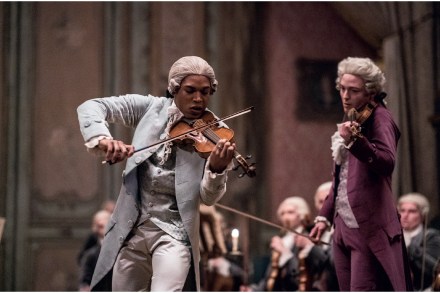
Chevalier is a biopic of Joseph Bologne, Chevalier de Saint-Georges, whom you’ve probably never heard of, as I hadn’t. He was an 18th-century French-African virtuoso violinist and composer who wowed everyone in his day – in 1779, John Adams, then the American ambassador to France, called him ‘the most accomplished Man in Europe’ – but was erased from history and is only lately being rediscovered. Fascinating, you would think, and he was fascinating. Even a cursory look at his Wikipedia entry is thrilling. But this is not a fascinating or thrilling film. It is handsomely mounted yet strangely bland and strikes too many false notes. I was going to say it’s as if Disney had made it but then remembered: this is Disney.

The lives of even anti-Putin Russian artists are being made impossible

From our UK edition

Swift and sure, the guillotine blade came down on Russians in the West on 24 February last year, the day Russia invaded Ukraine. The logic was clear as concerned Putin loyalists; cutting them off from western gravy trains in the face of their dear leader’s grotesque aggression made some sense. They could bed down with the devil, so to speak, but not on our buck. So one doesn’t weep much over the relegation to Europe’s fringes of the likes of openly pro-Putin musicians such as pianist Denis Matsuev or the former LSO and Munich Philharmonic chief conductor Valery Gergiev. Then there’s the soprano Anna Netrebko, who, seen as being close to Putin, was sacked immediately by the Met when she didn’t condemn the Russian President fast enough.

Why has the work of Franz Liszt fallen into such neglect?

From our UK edition

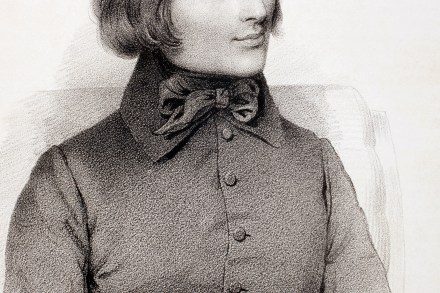
In 1875, Franz Liszt told a pupil of the kiss of consecration – the Weihekuss – that Beethoven bestowed upon him more than fifty years earlier. After watching the young Hungarian prodigy play works by Ries, Bach and Beethoven himself, he kissed Liszt on the forehead and said: ‘Go! You are one of the fortunate ones! For you will give joy and happiness to many other people.’ Liszt isn’t giving joy to many people these days. Take this year’s BBC Proms, which feature only one piece by Liszt, compared to two by Aaron Copland, four by Dora Pejacevic, and six by Samuel Taylor-Coleridge. Over the past decade, Liszt has appeared in eight Proms, while Rachmaninov has featured in 40.

Florid flummery: ETO’s Il viaggio a Reims reviewed

From our UK edition

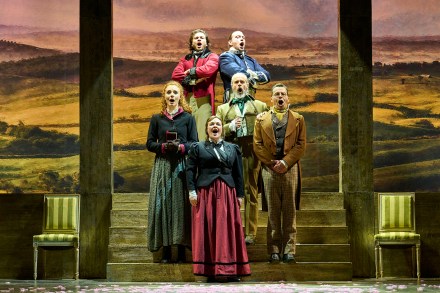
Lightning sometimes strikes twice. English Touring Opera hit topical gold last spring when, wholly by coincidence, they found themselves touring with Rimsky-Korsakov’s Russian anti-war satire The Golden Cockerel. Now the company’s general director Robin Norton-Hale insists that their current tour of Rossini’s Il viaggio a Reims – written in 1825 to celebrate the coronation of King Charles X of France – was fixed long before this month’s events at Westminster Abbey were even a glint in the Earl Marshal’s eye. Really? In truth, opera planning cycles generally operate in years rather than months. On the other hand, Il viaggio a Reims is an extravagant heap of dramatic (if not musical) flummery.

The coronation music was – mostly – a triumph

From our UK edition

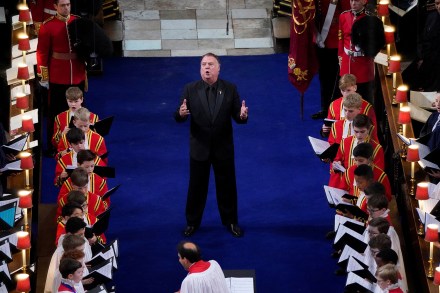
Sir Hubert Parry was upgraded from knight bachelor to baronet by King Edward VII in 1902, and my goodness he earned it. His anthem for Edward’s coronation, I was Glad when they Said Unto Me, begins with a thrilling brass fanfare – or it has done since George V’s coronation in 1911: Parry’s original introit wasn’t sufficiently attention-grabbing, so he beefed it up. But the most spine-tingling moment has been there from the beginning. ‘I was…’ sings the choir on the tonic chord of B flat major – and then the word ‘glad’ bursts out where we aren’t expecting it, in G major.

Tár is more than a #MeToo story

Life imitated art to a depressingly predictable degree when a clip from Todd Field’s Tár circulated online. It’s part of a scene where the film’s title character, superstar conductor Lydia Tár (played by Cate Blanchett), leads a masterclass at Juilliard. She haughtily dismisses students’ reluctance to learn the classical canon because of their difficulty “identifying” with its composers. To some, Lydia’s monologue was a vindication: a righteous tirade against "wokeness." To others, the speech exemplifies Lydia’s abuse of power, which includes not only dressing down students and mentees but sleeping with many of them and torpedoing their careers.  But oversimplified views of Lydia as a crusader or villain flatten the film’s wrenching complexities.

tar

A miniature rite of a very English spring: a Vaughan Williams rediscovery in Liverpool

From our UK edition

Imagine a folk dance without music. Actually, you don’t have to: poke about on YouTube and you’ll find footage from 1912 (there’s music dubbed on, but it’s a silent film) of Vaughan Williams’s friend George Butterworth in full Morris fig, going through the moves with Cecil Sharp and a pair of pinafore-wearing gals. Note the precision of his movements, that big Kitchener moustache: how seriously Butterworth is taking it, four years before he stopped a bullet on the Somme. And they really were sincere, those folk song pioneers.

Apocalypse chic: Autechre, Last Days and Southbank’s Xenakis day reviewed

From our UK edition

It was so dark, my friend noted, you could have had sex or done a Hitler salute. No stage lights, no stair lights, no desk lights, no door lights, no usher lights, no exit signs. The few wisps of illumination that did steal in created colossal shadows, giants freeze-framed on the walls. In these snatches the wooden ribcage interior of the Barbican Hall looked demonic. A few photons lit up the Autechre boys, Rob Brown and Sean Booth, who flickered like blue flames rising from a hob. A few more nudged into view the ceiling that had become a vast charcoal grisaille. When, occasionally, someone left, the tiny glowing portal that appeared made it feel as though we were at the bottom of a cavernous well.

Grey, grey and more grey: Aida, at the Royal Opera House, reviewed

From our UK edition

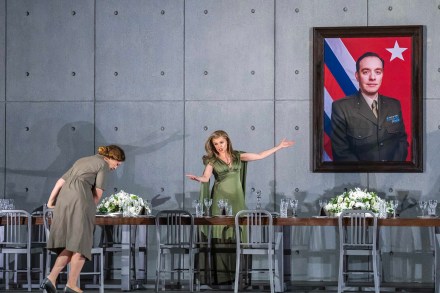
Grey. More grey. So very, very grey. That’s the main visual impression left by Robert Carsen’s new production of Verdi’s Aida. Possibly a few older operagoers still think of Aida as a fabulous spectacle: horses, temples, caparisoned elephants and all the gilded splendour of the Pharaohs. But if you cut your opera-going teeth more recently than 1990 – and unless you’re going to one of the more lavish Ellen Kent efforts – you’ll know by now to expect nothing of the sort. Carsen places the drama within the towering walls of a government bunker in some unspecified modern military dictatorship, with the cast (even Aida and Amneris) dressed almost entirely in shades of khaki.

Holds out huge promise for future seasons: If Opera’s La Rondine reviewed

From our UK edition

One swallow might not make a summer, but it certainly helps rounds the season off. ‘Perhaps, like the swallow, you will migrate towards a bright land, towards love,’ sings the poet Prunier to Magda, the heroine of La Rondine, but love itself is the real bird of passage in Puccini’s gorgeous Viennese operetta-manqué. Magda trades in her old lover for a younger, cuter model and after a summer of happiness leaves him too, without undue regret. That’s basically it. No death leaps from battlements, no ritual disembowelling; none of that stuff that we’re meant to find so regressive and problematic in an opera house, and so visceral and cool in an HBO drama. Just a simple, plausible romance, played out to glowing waltz melodies.

Apocalyptic minimalism: Carl Orff’s final opera, at Salzburg Festival, reviewed

From our UK edition

‘Germany’s greatest artistic asset, its music, is in danger,’ warned The Spectator in June 1937. Reporting from the leading new-music festival in Darmstadt, the correspondent mentioned only one première of the two dozen on offer: ‘The most important achievement was the scenic cantata Carmina Burana by Carl Orff, a piece that would have been impossible without the influence of the “cultural Bolshevik” Stravinsky.’ He’s not wrong: give Stravinsky’s Les Noces some nail clippers and a face scrub and you get Orff. Carmina Burana can today seem irredeemably boorish and kitsch. But you can see how the piece’s hiccupy primitivism might have once startled.

The joy of Franck’s Symphony in D Minor: BBCSO/Gabel, at the Proms, reviewed

From our UK edition

In the Rodgers and Hart musical On Your Toes, a Broadway hoofer is forced to work at a community college, teaching classical music like some kind of square. He picks out a melody on the piano: ‘Whom was this written by?’ ‘By Caesar Frank!’ chorus the students. ‘Pronounce it Fronk,’ he corrects them; and the audience, presumably, laughed in recognition. This was 1936, and César Franck’s Symphony in D minor was a hugely popular concert hall warhorse. Now: not so much. According to the stats in the programme book for this BBC Prom, it was performed 36 times in 50 years at the Proms, before falling off a cliff in 1959. This performance by the BBC Symphony Orchestra under Fabien Gabel was only its seventh Proms outing in as many decades.

Why is post-colonial guilt only applied to Western classical traditions? Radio 3’s World of Classical reviewed

From our UK edition

The blurb accompanying the Radio 3 series World of Classical, inviting us to ‘join the dots between classical music traditions of the world’, suggests an introduction to the field of comparative musicology. Such a noble venture – searching for commonalities in melodies, ornamentation, rhythms, use of instruments, vocal styles and techniques and so on – would once have been a vital part of Radio 3’s continued adherence to the Reithian ideals of informing and educating as well as entertaining. Jon Silpayamanant’s series however resembles more a series of episodes of Late Junction, married to a moralising and historically unbalanced commentary.

A bleeding, inch-thick hunk of verismo sirloin: Royal Opera’s Cav and Pag reviewed

From our UK edition

One legacy of lockdown in the classical music world has been the sheer length of the 21-22 season. In a typical year, most orchestras and urban opera companies would be winding down by mid-May. Not this time: after two years of postponements, and with lost income to recoup, seasons are stretching out like the finale of Dvorak’s Cello Concerto. Rumour maintains that audiences are being stretched too thinly, and although it’d be naive to infer anything fundamental from a smattering of vacant seats, it did feel surprising to see empty patches for the first night of the Royal Opera’s Cav and Pag. Absent Kaufmaniacs, disappointed by Jonas’s latest no-show?

A concert begun in darkness

It was all glitter at Blues Alley in Washington, DC when the trumpeter Terence Blanchard, who is the composer of a widely hailed opera called Fire Shut Up in My Bones that was recently performed at the Met, appeared in March with his E-Collective band as well as the Turtle Island Quartet to play several sets. Blanchard wore iridescent tennis shoes and played a miked trumpet with extra reverb that almost looked as though it was glowing in the dark. Periodically, he would tap his right foot onto an electronic device on the floor that manipulated his tones to extend them into the ether. Indeed, his audacious high notes lingered on long after he had stopped blowing. The collective is Blanchard’s foray into the world of deep funk. It definitely makes an impact.

Schächter

An intimate, lucid and unforgettable new James MacMillan work

From our UK edition

On Tuesday night I was at the world première of a motet by Sir James MacMillan and I don’t think I’ve ever heard a more haunting piece of music. It begins in half-light, with pinpricks from the organ so widely spaced that you could be listening to a forbidding tone row from the Second Viennese School. A four-part choir enters in close harmony and you realise that those apparently unrelated notes hint at austerely beautiful chords encircling the melody. In Carmel’s Shade is one of the smallest but brightest jewels in the MacMillan collection There are moments when we could be listening to Palestrina, to César Franck, to Benjamin Britten – a reminder that MacMillan is fluent in more musical languages than most living composers.

Claude Vivier ought to be a modern classic. Why isn’t he?

From our UK edition

April is the cruellest month, but May is shaping up quite pleasantly and the daylight streamed in through the east window of St Martin-in-the-Fields at the start of I Fagiolini’s latest concept-concert, Re-Wilding The Waste Land. The centenary of Eliot’s poem is the obvious hook. But whether you’re counting from the Rite of Spring riot in 1913, Schoenberg’s Skandalkonzert the same year, or further back to Strauss’s Salome or Debussy’s Faune, music’s modernist moment occurred some time earlier. Which is helpful, in a way, because it freed the group’s director Robert Hollingworth from the limitations of chronological programming and gave him scope to do something a bit more interesting, and possibly a bit more Eliot-esque.

Even Nelsons’s miscalculations are fascinating: Leipzig Gewandhaus/Andris Nelsons, at the Barbican, reviewed

From our UK edition

Imagine growing up with a whole orchestra as your plaything. Richard Strauss’s father was the principal horn of the Munich Opera, and doting relatives funded publication of the teenage Richard’s earliest compositions. At the age of 19 he was assistant conductor of the Court Orchestra in Meiningen, and had rather got used to having world-class musicians at his command.

Too affectionate, not enough cruelty: Don Pasquale, at the Royal Opera House, reviewed

From our UK edition

There are many things to enjoy in the Royal Opera’s revival of Donizetti’s Don Pasquale, but perhaps the most surprising is that the director plays it straight. This was my first encounter with Damiano Michieletto’s newish (2019) staging, and the plan was to approach it without preconceptions. (If we’re about to experience, say, a Bold Feminist Re-Imagining, I’d prefer to deduce it from the evidence on stage.) But for an opera premièred in 1843, Don Pasquale is distinctly old-school, with all its commedia dell’arte assumptions intact and whirring away like clockwork. The elderly miser Don Pasquale disinherits his lovelorn nephew and marries a compliant young bride who instantly becomes an abusive shopaholic scold.

Why I booed Birtwistle

From our UK edition

With the passing of Sir Harrison Birtwistle last month we are witness to a changing of the guard in new classical music. For 70-odd years contemporary music in the West was dominated by a highly exclusive atonal mode of thought that produced works that were hostile to the wider music-loving public and written for a small but highly subsidised cultural circle. If it was spontaneous when it began, the atonal idiom – meaning a highly dissonant style – quickly ossified into a kind of luxury backwater of music, so obscure it couldn’t even be questioned, yet endlessly backed by public subsidy which the public could nevertheless never challenge.