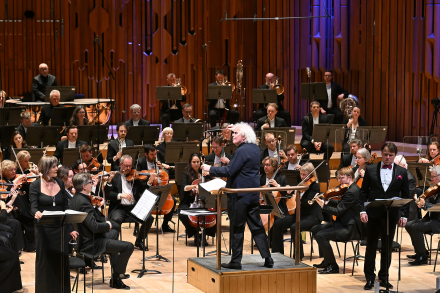
Classical music

The magnificence of Beare’s Chamber Music Festival

The quartet is the basic unit of string chamber music. Two violins, a viola and a cello: subtract any one of those, and you’re walking a tightrope. Add further players and the issue is redundancy: you’d better know precisely what you want to do with those additional voices, because otherwise they’ll congeal like cold gravy. When it comes to the string octet – two string quartets fused together – only the 16-year-old Mendelssohn really cracked it, going all out for transparency, daring and youthful verve. The Romanian George Enescu took the opposite approach. His Octet of 1900 is chamber music as epic construction project, wrought from steel, not spindrift. ‘No

The genius of Morton Feldman

To accompany an exhibition of paintings by Philip Guston at the Royal Academy of Arts in London in 2004, a performance was arranged of Morton Feldman’s composition written in homage to Guston, for which I was persuaded to page-turn. For Philip Guston runs non-stop for four hours and the thick A3 bundle of manuscript paper balanced precariously on a flimsy music-stand was a matter of concern: what could possibly go wrong? Once the performance ended, I snatched the bundle of £20 notes that I’d been promised, sprinted to the bathroom, then fortified myself with the chunkiest slice of cheesecake I could find in Patisserie Valerie on Old Compton Street. Nothing

Can Karl Loxley make classical music cool?

I’m backstage with classical crossover singer Karl Loxley and his pianist Tim Abel at Stratford-Upon-Avon’s Rother Street Arts House. The sound and lighting team are setting up in the empty theatre for what will be one of the final shows in Loxley’s ‘Songs of Christmas’ tour. Since 2015, when Loxley sung Puccini’s ‘Nessun Dorma’ on the TV talent show The Voice, he’s been on a mission to make classical music cool. I’m here to see exactly what that involves – and if he’s succeeding.  Loxley is charming, expansive and – at least when I interview him, a couple of hours before showtime – relaxed. Appearing on The Voice, he tells

The joy of composers’ graves

I called on Hugo Wolf the other week, and he didn’t look too great. He wouldn’t, of course; he died in a mental asylum in 1903 after suicide attempts, professional disappointment and the slow poison of tertiary syphilis. His face gazes glumly out from his monument in Vienna: above him, a single laurel branch, beneath him an eternal flame. But at least he’s not alone. A muscular youth, semi-ripped, looks away at one side. And on the other, a naked couple clinch in a passionate embrace. Talk about rubbing it in. It’s not that I make a habit of hanging around composers’ graves, you understand. But somewhere along the way

Intoxicating Elgar from the London Phil

By all accounts, the world première of Elgar’s Sea Pictures at the October 1899 Norwich Festival made quite a splash. Elgar conducted, and the soloist was the 27-year-old contralto Clara Butt – dressed in a silky, sinuous number which drew gasps in those corseted late-Victorian days. Elgar thought she looked ‘like a mermaid’; the critics, of course (of course!) confined themselves to the music. They reported that Elgar and Butt were called back four times, and the second of the five songs – the delicate ‘In Haven’, to words by Elgar’s wife Caroline Alice – was singled out for particular praise Interesting how tastes change. When Edward Gardner and the

Bruckner on Ozempic – and the première of the year

Bruckner at the Wigmore Hall. Yes, you heard right: a Bruckner symphony – his second: usually performed by 80-odd musicians – on a stage scarcely larger than my bedroom. How? Welcome to Anthony Payne’s very smart 2013 chamber arrangement. Bruckner on Ozempic. Composition is an Alice in Wonderland activity. A key duty is mastering how to make things bigger and smaller, how to stretch and compress and bend – time and space and sound. Bruckner understood this well. If you know anything about his symphonies, it’s that they’re vast – and that critics are mandated to compare them to cathedrals or mountain ranges. What survives after such an extreme trim?

A Spectator poll: What is the greatest artwork of the century so far?

Slavoj Zizek        Hegel thought that, in the movement of history, the world spirit passes from one country to another, from the East to the West. Something similar happened at the beginning of the 21st century: the world spirit passed from cinema, the art of the 20th century, to the TV series. At the top of my list are three sci-fi dystopias: Charlie Brooker’s Black Mirror, which takes place in a world just a little ahead of ours where tendencies we clearly discern today have become reality; Patrick Somerville’s Station Eleven, a uniquely optimistic utopia depicting how performing art can save the human spirit after a global apocalypse; and Three-Body, a

The orchestra that makes pros go weak at the knees

Stravinsky’s The Firebird begins in darkness, and it might be the softest, deepest darkness in all music. Basses and cellos rock slowly, pianissimo, in their lowest register; using mutes to give the sound that added touch of velvet. Far beneath them rumbles the bass drum: a halo of blackness, perceptible only at the very edge of the senses. In Liverpool Philharmonic Hall, with Sir Simon Rattle conducting the Bavarian Radio Symphony Orchestra, you felt your hairs tingle before you discerned a note. Seconds later, the very air within the hall seemed to be quivering with sensuous, engulfing bass warmth. You can be sure that Rattle anticipated that sensation; planned for

My unofficial music teacher

In the early 1970s my father moved offices and I was plucked out of my cosy prep school in Surrey to land in the eccentric surroundings of Presentation College. My new school’s modern block was surrounded by decaying Edwardian villas occupied by Irish teaching brothers with impenetrable accents. There was a broken aeroplane on one of the lawns; I never found out how it got there. Talk about a culture shock. Already I was besotted with classical music; to say that the brothers didn’t share my enthusiasm is putting it mildly. There wasn’t a flicker of interest in eight years – something that puzzled me until I read Thomas Day’s

Violin concertos from two Broadway legends

Grade: B+ The 20th century, eh? What a lark that was. Vladimir Dukelsky studied in Kiev under Glière and looked set to be one of the smarter Russian composers of his generation. He even wrote a ballet for Diaghilev. Then communism happened and Dukelsky ended up in the USA where to the bemusement of his friend Prokofiev he reinvented himself as Vernon Duke, Broadway songsmith. ‘Autumn in New York’ and ‘Taking a Chance on Love’ are both by Duke; classic Americana by way of Tsarist Ukraine.  Duke’s Violin Concerto (1943) is recorded here alongside the 1941 concerto by Robert Russell Bennett – better known as the king of Broadway orchestrators;

A cracking little 1967 opera that we ought to see more often

Ravel’s L’heure espagnole is set in a clockmaker’s shop and the first thing you hear is ticking and chiming. It’s not just a sound effect; with Ravel, it never is. He was an inventor’s son, half-Swiss, half-Basque, and timepieces, toys and Dresden figurines were in his soul. For Ravel, they seem to have possessed souls in their own right. ‘Does it not occur to people that one may be artificial by nature?’ he remarked, and few artists have shown such tenderness towards these small, lovingly made things that strive so tirelessly, and so hopelessly, to be alive. So that was something to think about, as Alexandra Cravero conducted the opening

Why was the 19th century so full of bigots and weirdos? 

Da Vinci’s Laundry is based on an art world rumour. In 2017, Leonardo’s ‘Salvator Mundi’ sold at Christie’s for $450 million but some experts claimed that the attribution was inaccurate. Could the world’s costliest artwork be a fake? Writer, Keelan Kember, considers the provenance of a fictional Leonardo owned by a thuggish oligarch, Boris, who claims to have bought the masterpiece at a flea market. He invites two posh British experts, Christopher and Milly, to authenticate the painting and when Christopher questions its origins he earns Boris’s instant displeasure. Boris threatens to toss Christopher from the roof of his luxury mansion. Enter a brash American, named Tony, who wants to

A Magic Flute that will make you weep

English Touring Opera has begun its autumn season and the miracle isn’t so much that they’re touring at all these days, but that they do it so well. Two generations back, this was the natural condition of opera in the UK: not Netrebko at Covent Garden, but agile, medium-scale companies playing at the Wolverhampton Grand or the Sheffield Lyceum alongside the panto and the 1950s equivalent of Friends: The Musical and An Evening with Sandi Toksvig. Don’t believe it? It’s all in Alexandra Wilson’s new book Someone Else’s Music, which is out now, and which all British opera buffs should read because it’ll make their jaws drop. Case in point:

Why piano competitions strike a controversial note

The USA’s Eric Lu has beaten more than 600 other pianists to win the 19th International Chopin Piano Competition. Held every five years in Warsaw around the anniversary of the Polish composer’s death on 17 October, this is one of several piano tournaments that often launch major careers, along with Moscow’s Tchaikovsky Competition, the Van Cliburn in Texas and the Leeds International. Unlike any of those, however, the Chopin competition requires contestants to perform the music of just one composer. Lu, 27, didn’t exactly need this win. He took first prize at the Leeds International in 2018 and has already released two records on the Warner Classics label. After his

The mind-bendingly creative works of Louis Couperin

The French lutenist Charles Fleury, Sieur de Blancrocher, is one of those unfortunate historical figures who are chiefly remembered because of how they died. He was climbing the stairs to his apartment near the Louvre after a court dinner in November 1652 when he slipped, fell head over heels and was dead a few hours later. We don’t know, though people have wondered, whether the wine was to blame. Only one piece of music by him survives, and he would probably be forgotten if he hadn’t been memorialised in several tombeaux – slow memorial dances – by royal composers, one of whom was a young harpsichordist whose genius is only

Robin Holloway lambasts some of our most beloved composers

Irreverent, outspoken and unfailingly opinionated, with knowledge as broad as his vocabulary, Robin Holloway is exactly the person you’d want to sit next to at a concert. The warmest of interval chardonnays would spontaneously chill and fizz at his exhilarating put-downs; the music would be brighter, clearer and more compelling for his idiosyncratic analysis. But travel companions are a different breed. Would you set out on an odyssey through the history of western music with him as your sole guide and companion? Holloway is a fixture of British classical music – as a significant composer, teacher of other yet more significant composers and, since 1975, one of the longest standing

Pure feelgood: ENO's Cinderella reviewed

‘Goodness Triumphant’ is the alternative title of Rossini’s La Cenerentola, and you’d better believe he meant it. Possibly my reaction was coloured by last week’s experience with the weapons-grade cynicism of Stephen Sondheim’s Follies, but honestly – it’s just so sweet. A gentle, put-upon girl gets her fairy-tale ending in the face of stepsisters and a stepfather who are basically buffoons rather than outright villains. We’re in the realm of panto, or children’s TV: nothing really dark can happen here and the only sorcery is worked by Rossini, whose fountain of laughing, crystal-bright invention is as life-affirming as Haydn, if he’d been born 50 years later and in Italy. Pure

A revelation: Delius’s Mass of Life at the Proms reviewed

Regarding Frederick Delius, how do we stand? In the 1930s, Sir Henry Wood believed that Proms audiences much preferred Delius to Holst, and most critics back then would have described him as a major British composer. Times change: if you took your music GCSE in the late 1980s, you’ll have sensed that the Bradford lad was no longer quite up there. But you might well have been taught by people who still remembered him as a giant, and there was also the legacy of that greatest of composer biopics, Ken Russell’s Song of Summer, in which Delius’s music explodes in sunbursts of passion and colour against Russell’s austere black and

A new Beethoven cycle to keep – but hide

Grade: C In the 1990s the young Italian pianist Giovanni Bellucci gave us a reading of Beethoven’s Hammerklavier Sonata whose thrilling athleticism bore comparison with those of Maurizio Pollini and Charles Rosen. A few years later Bellucci began a complete cycle of the piano sonatas – but, rather than include his existing Hammerklavier, he produced a version that was in keeping with the style of the cycle: deliberately perverse, reinterpreting (that is, ignoring) the composer’s precise instructions in the score. Only now has Bellucci finished the cycle, explaining in his pretentious liner notes that he was held up by his meditations on Beethoven’s true intentions. So, for example, the first

The decline of Edinburgh International Festival

Edinburgh International Festival was established to champion the civilising power of European high culture in a spirit of postwar healing. But its lustre and mission have now been largely eclipsed by the viral spread of its anarchic bastard offspring, the Fringe. In competition with the latter’s potty-mouthed stand-ups and numberless student hopefuls, the dignified old Festival proper struggles to make much mark on the hordes who descend on the city in August, inflating prices and infuriating the residents. Perhaps the kids will love it, but if this is the future of ballet, then count me out Nicola Benedetti, a splendid woman and a wonderful violinist, is now in her third