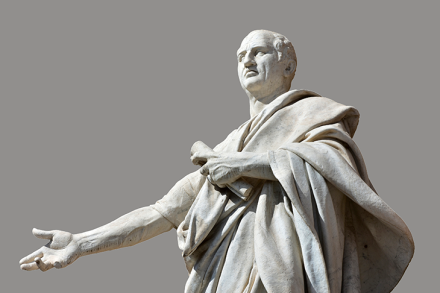
Cicero

Is America a republic in name only?

Is the United States a one-party state? Surely not. Just look at the ballots the next time you vote. There are nearly always Republican as well as Democratic candidates, and often there are candidates from other parties as well (Green, Working Families, Libertarian, etc.). But when you go beyond the labels, what do you find? Tucker Carlson, a recent victim of the uniparty monopoly, put it very well. “Suddenly, the United States looks very much like a one-party state,” he said in a post-Fox video. “That’s a depressing realization,” he added. “But it’s not permanent.” I think he is right about both things: the depressing reality that the United States looks more and more like a one-party state and the fact that the situation is not, at least not necessarily, permanent.

republic

Joe Biden in the metaverse

Meta is meant to be better — better than Facebook, better even than reality. In the future, a second Edward Gibbon may wonder not just whether it was a good idea for the federal government to encourage Mark Zuckerberg and a handful of talented techies to launch a Revenge of the Nerds coup against the minds and manners of America, but also what it was about reality that made us want to escape it so badly in the first place. There has never been a society more blessed than that of the United States.

metaverse

Cicero on rejecting the 1619 Project

“Why are the Wisest ever the most easy and content to die, and the Weak and Foolish the utmost unwilling? Is it not, think you, because the most Knowing perceive, they are going to change for a happier State, of which the more Stupid and Ignorant are uncapable of being sensible?” Thus wrote Cicero in On a Life Well Spent, a 2,000-year-old essay. The English version I possess was published by Benjamin Franklin in 1744, and it was beloved by the Founders, one of the most remarkable generations to have graced the North American continent. Well, so people used to think.

Dead letters

In a plea for vocational education, Sen. Marco Rubio famously remarked that we could use ‘more welders and less philosophers’. Doesn’t everyone know that ‘skills pay the bills’? If things weren’t bad enough, the rise of deconstruction and critical theory has created a generation of humanities scholars who themselves see little value in the works they study, insisting that famous art and literature emerged from racist and sexist power structures. What sensible young person would borrow $100,000 to be educated in these pointless disciplines? Eric Adler, a classicist at the University of Maryland, has the answer: anyone who wants to understand his own humanity. Adler’s invaluable survey not only defends the humanities: it even lays out how their allies have fallen short.

classics