Christianity

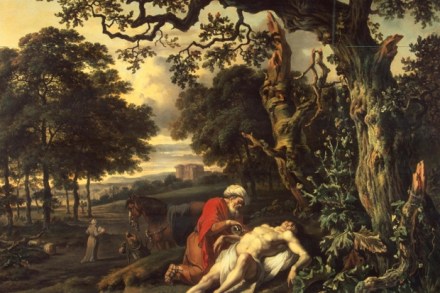
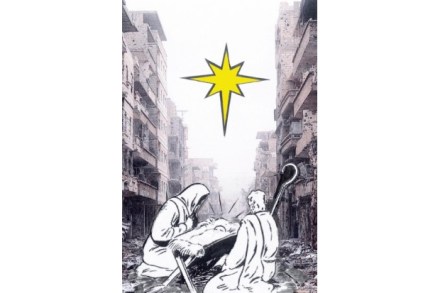
The question Christianity fails to answer: ‘Who is my neighbour?’

‘Fine old Christmas,’ wrote George Eliot, ‘with the snowy hair and ruddy face, had done his duty that year in the noblest fashion, and had set off his rich gifts of warmth and colour with all the heightening contrast of frost and snow.’ Thus opens the second chapter of Book II of The Mill on the Floss. I had found the passage when searching for a secular reading for my newspaper column’s readers at a carol service at St Bride’s church in Fleet Street a couple of nights ago. I knew at once I’d found what I wanted. Eliot had been my first port of call. You can be confident
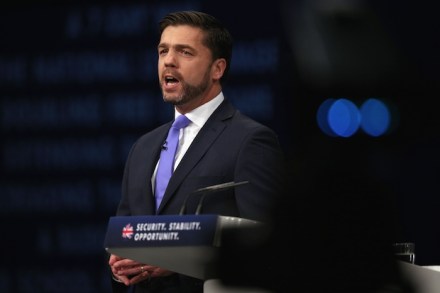
‘Creeping intolerance’ towards religion could push young British Muslims to Islamic State, Cabinet Minister warns

What do politicians find it harder to admit to doing in Britain today: smoking weed or praying? Welsh Secretary Stephen Crabb thinks it’s the latter, and that this is part of a ‘creeping intolerance’ in Britain that makes our society less able to resist religious extremists. In a lecture last night to the Conservative Christian Fellowship, Crabb argued that ‘Britain in 2015 is… increasingly characterised I believe by a creeping intolerance towards Christianity, and towards religion more generally, which we should be deeply concerned about’. He believes that the marginalisation of religious faith and discussion ‘risks pushing more young Muslims into the arms of Isil’ because it delegitimises their faith.

Why it is wrong for Christians to eat their wives

In his column last week, Rod Liddle suggested that an alleged fatwa by a Saudi Arabian cleric had said it was permissible to eat one’s wife when suffering from ‘severe hunger’ gave him (Rod) the go-ahead to eat his own wife. Not so, surely. In the Christian religion and, indeed, the secular law of the United Kingdom, one can have only one wife at a time. If one has only one wife, it would be quite wrong to eat her. Under Islam, one can have up to four. Obviously this generous provision creates ‘spares’. Until recently, British marriage law was hidebound by tradition, but, before the last election, Parliament voted

The Spectator's Notes | 3 December 2015

Speaking on the Today programme on Monday, Sir David Attenborough, who wants a global agreement to control carbon emissions, pointed out that ‘Never in the history of humanity have all the people of the world got together to deal with a particular problem and agreed what the solution could be. Never, ever, ever.’ He is right. But he seemed to defy the logic of his own observation. They never have. Probably, since the truth is best arrived at through disagreement, they never should. The key point is that they never will. So it is a waste of time to try. When someone commits suicide, those close to that person naturally

Can Christianity incorporate Daleks into its iconography?

The Times has a story for the first week of Advent, about baby Jesus and golden Daleks.  An artist called Kate Richardson exhibited her work in a minor Cornish gallery. Some Christians complained about some of the paintings, and the exhibition was cancelled. The contentious works were copies of famous nativity paintings, in which a golden Dalek appeared – in one case in place of baby Jesus, in another as a bystander (or perhaps worshipper). She has now moved her work to a gallery in Cardiff, home of Doctor Who. I have a fairly strong opinion about this. Christians should never, ever complain about the weird, tasteless or ‘blasphemous’ recycling

Cultivating the fourth estate

Lord Palmerston is remembered today not for his foreign policy nor for his octogenarian philandering, but for his management of the press. He was the first prime minister to grasp that dealing with journalists was all about pragmatic negotiation and buttering people up. The deal between Palmerston and the newspapers was: ‘I’ll tell you something no one knows if you give me your support and a favourable report.’ It still works like that today. Most historians assume that Palmerston was the only Victorian prime minister to cultivate the fourth estate. Balfour loftily boasted that he never read the newspapers. But this was an affectation. As Paul Brighton shows in this

There's a good reason why humanism should be taught in schools

A confusing story about RS (religious studies in schools) from last week has come to my attention. A group of parents brought a court case against the Department for Education: they complained that its new GCSE syllabus failed to include humanism. They won the case – sort of. The judge said that schools should not be allowed to exclude atheism and humanism, but he also said: ‘It is not of itself unlawful to permit an RS GCSE to be created which is wholly devoted to the study of religion.’ This seems to mean that it’s OK for the actual content of the GCSE syllabus to be devoted to religion, but the

The many fights over the Lord’s Prayer

Amen corner Digital Cinema Media, a company which distributes adverts to cinemas, refused to allow an advert which involves the recitation of the Lord’s Prayer by, among others, the Archbishop of Canterbury. Some other battles over the prayer: — Campaigners want Alberta to follow other Canadian states, where recitation of the Lord’s Prayer in state schools is already banned. In the latest battle the Pembina Hills School Division voted by 30 to three to let the prayer still be recited. — Last year cheerleaders at a high school football game in Oneida, Tennessee, were accused of violating the US First Amendment, which forbids the state from promoting one form of religious

Is the Archbishop of Canterbury forsaking God?

The Archbishop of Canterbury, we heard during the BBC’s Songs of Praise broadcast last Sunday, ‘doubted God’ after the Paris attacks. On a walk on Saturday (he told listeners) he said to God, ‘Where are you in all this?’ As we are in confessional mood, here’s an anxiety of my own. The Paris atrocity has not occasioned me any new doubts, but Justin Welby’s remarks have caused me to doubt Archbishop Welby. Speaking on behalf of God, I have to ask the Archbishop: ‘Justin, where are you in all this?’ I’m not a believer, but I try to understand what believers believe. Christian theology has a long and distinguished intellectual

How can we defend our liberal heritage by abandoning its values?

Yusuf, when I last saw him, was still smiling, a middle-aged man with the greying pony-tail of a rock roadie. He described himself as a feminist: he met his wife through work, where, he told me proudly, she was a better computer engineer than he. Yusuf had the stoop of a tall man who’d spent most of his life under ceilings too low for him, and the corrugated iron hut his family now called home was no exception. So we sat cross-legged on the floor, while I asked him about religious tensions in a southern Turkish refugee camp. ‘If you want to know, I’m an atheist. I mean, in Damascus,

Has 'Islam's reformation' really begun?

Usama Hasan, an imam attached to the Quilliam Foundation, argues in the Times that Islam is steadily adapting to modernity. It has been doing so since the nineteenth century, when the Ottoman Empire launched certain reforms. Islam should not be judged by a few marginal hiccups in this process. ‘Isis follows a fundamentalist and selective reading of scripture which is ahistorical and heretical. They are linked to Islam and the Koran in the way the Ku Klux Klan and Anders Breivik are linked to Christianity and the Bible.’ This is not helpful. For extremely reactionary Christians have not gained power in a large proportion of the traditionally Christian world. He

Of gods and men

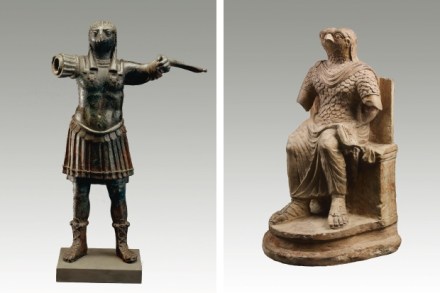
Over the stupefyingly long course of Egyptian history, gods have been born and they have died. Some 4,000 years ago, amid the chaos that marked the fragmentation of the original pharaonic state, an incantation was inscribed on the side of a coffin. It imagined a time when there had been nothing in existence save a single divine Creator. ‘I was alone in the emptiness,’ the god proclaimed, ‘and could find no place to stand.’ Nevertheless, beside him, he could feel the gods that were yet to exist. ‘They were with me, these deities waiting to be born. I came into being and Becoming became.’ The gods emerged, to reign first

Battle fatigue

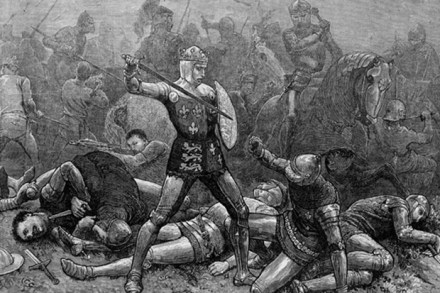
Can anyone explain this sudden enthusiasm for Agincourt, that unexpected victory over the French, now being celebrated, or rather commemorated, on radio, on digital, online? It was so weird to switch on Radio 4 on Sunday morning (which just happened to be St Crispin’s Day, the day on which the battle was fought) to discover that even Sunday Worship was being devoted to commemorating one of the bloodiest battles in that most bloodthirsty period. The service, old-fashioned Matins, came from the Chapel Royal at St James’s, and apparently the priests, choristers and vestrymen from that chapel were singing on the battlefield alongside Henry V in October 1415, when the English

Will Michael Gove dare to bring Christianity into his prison reform plans?

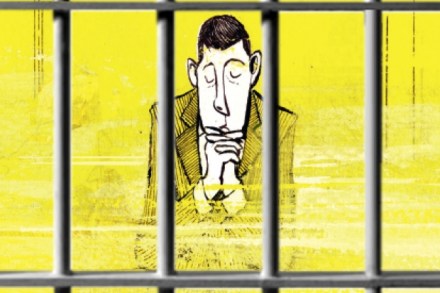
This April, Michael Gove wrote in The Spectator: ‘To call yourself a Christian in contemporary Britain is to invite pity, condescension or cool dismissal.’ Certainly, the titters it provoked in the more left-wing corners of Twitter rather proved his point (a white man? complaining of prejudice?). On faith, as in everything else, Britain today erodes into fragments, small landscapes inhabited by the mutually deaf. I carry no brief for the man: my instinctive sympathy with his school reforms is matched only by my frustration with what Ian Leslie, in a profile published this week, calls the temperament by which Gove ‘is drawn irresistibly to the theatre of battle’. But even his greatest enemies

Facebook posts about the migrant crisis should be the least of Angela Merkel's worries

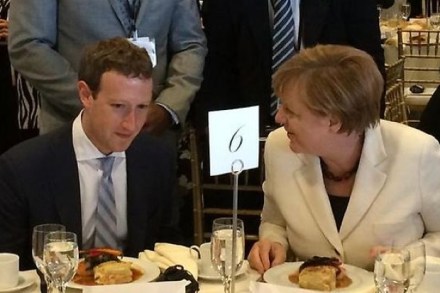
So the German Chancellor has just been caught on microphone talking with Facebook CEO Mark Zuckerberg: German Chancellor Angela Merkel was overheard confronting Zuckerberg over incendiary posts on the social network, Bloomberg reported on Sunday, amid complaints from her government about anti-immigrant posts in the midst of Europe’s refugee crisis. On the sidelines of a United Nations luncheon on Saturday, Merkel was caught on a hot mic pressing Zuckerberg about social media posts about the wave of Syrian refugees entering Germany, the publication reported. The Facebook CEO was overheard responding that “we need to do some work” on curtailing anti-immigrant posts about the refugee crisis. “Are you working on this?”

The Pope’s moment

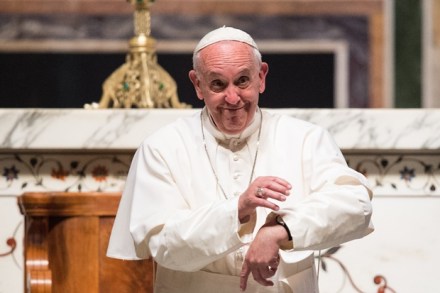
On Tuesday, Pope Francis set foot in the United States for the first time in his life. His plane touched down at Andrews Air Force Base, Maryland, where American presidents depart and arrive on Air Force One. But, according to a Spanish journalist on the papal plane, this was not how Francis had wanted to arrive. He would have preferred to cross over from Tijuana, the grubby Mexican city menaced by drug gangs from which countless migrants slip across the border into California. In other words, if the report is true, the Pope wished to turn his arrival into a political gesture, aligning himself with America’s 11.3 million ‘undocumented’ immigrants

Corbyn’s salvation

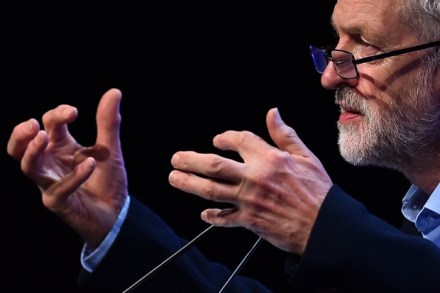
On religion, Jeremy Corbyn is interestingly moderate, circumspect — not the angry atheist you might expect. In a recent interview with the Christian magazine Third Way, he said his upbringing was quite religious: his mother was a ‘Bible-reading agnostic’ and his father a believer, and he went to a Christian school. ‘At what point did you decide that it wasn’t for you?’ he was asked. He replied very carefully, even challenging the premise of the question: ‘I’m not anti-religious at all. Not at all… I find religion very interesting. I find the power of faith very interesting. I have friends who are very strongly atheist and wouldn’t have anything to

Charity now begins at your second home

Mitres off to the Archbishop of Canterbury for inviting ‘a family or two’ of refugees into his home. Well, not specifically into his home but into a four-bedroom cottage that sits in the grounds of Lambeth Palace. Opening up your second home to refugees is becoming quite fashionable among people who have more houses than they have hats or, indeed, mitres. Bob Geldof has offered refugees use of his Kent home as well as his London flat. The Pope has instructed that Vatican lodgings should be made available to a few families. This refugee crisis is proving easier to solve than we first thought. By my quick calculation, that’s possibly up

Will Jeremy Corbyn boost his left-wing idealism with a religious message?

One major defect of Jeremy Corbyn has not yet been discussed. He’s not a religious believer. Why is this a defect?  Because these days left-wing idealism is hugely boosted by an alliance with religion. Only so can it widen its appeal beyond a chippy clique. Maybe he’s half-aware of this. In a recent interview with the Christian magazine Third Way, he said that his upbringing was quite religious, and that he retains some sympathy with faith: ‘I’m not anti-religious at all. Not at all… I find religion very interesting. I find the power of faith very interesting. I have friends who are very strongly atheist and wouldn’t have anything to do

Matthew Parris is wrong - the gospels do help us respond to the migrant crisis

‘I know our Lord told us to be wise as serpents and innocent as doves,’ muttered a colleague after a waspish College meeting; ‘but, being busy men, some of us find it advisable to specialise.’ I detected that approach in Matthew Parris’s contention, in The Spectator last week, that Christianity, particularly the Gospels, cannot help us prioritise when faced with the vast, terrible refugee crisis. We all want to help, he said, but the teachings of Jesus don’t tell us how to do it. All right: much popular reaction, Christian included, has been little more than anguished arm-waving. But soundbites are not the real clue. What counts is action. To