Charles moore

Margaret Thatcher: The Authorized Biography, by Charles Moore, and Not for Turning, by Robin Harris – review

It is a measure of Lady Thatcher’s standing that her death has been followed not only by the mealy-mouthed compliments from political opponents which are normally forthcoming on such occasions but also by robust denunciations. Nobody would have sung ‘Ding, dong, the Wizard is dead!’ after the deaths of Jim Callaghan, John Major or Alec Douglas-Home. Even the more controversial Harold Wilson got a bland send-off in his obituaries. Ted Heath was asked by a journalist whether it was true that, when he heard of Margaret Thatcher’s eviction from the party leadership, he had exclaimed ‘Rejoice! Rejoice!’. No, he replied, after some deliberation. ‘What I said was “Rejoice! Rejoice! Rejoice!
The Spectator’s Notes | 25 April 2013

The first volume of my biography of Margaret Thatcher was published on Tuesday. Since Lady Thatcher had stipulated that the book could appear only after her death, we were, in principle, ready. But it is still a huge undertaking to finish correcting a 900-page book on a Tuesday (the day before the funeral), and get back the printed book the following Monday. Reviewing my endnotes, I came across an interviewee called Rosie Cruikshank. She appeared in relation to Margaret Roberts’s most serious boyfriend. Who on earth was she? Just in time, I remembered. While writing all the ‘love interest’ passages, I had worried that they might fall into the wrong hands, and so I gave the characters pseudonyms. I chose names to fit the period.

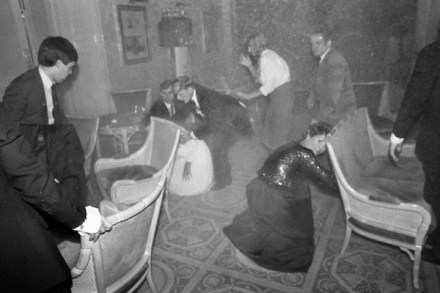
After the Brighton bomb

It is worth pointing out yet again that Mrs Thatcher really was very brave last Friday. It would have been no disgrace to her if, once she had realised how narrow had been her escape, she had felt weak and — as did a few of the Tory wives in the Grand Hotel — had sat down and cried. There would have been nothing cowardly in cancelling what remained of the Conference in honour of the dead and injured. But the fact that she did neither of these things and the way that she conducted herself that day confirms that she has an extraordinary amount of that particular kind of courage which rises to an occasion, appearing more magnificent the greater the challenge.

Mrs Thatcher goes to Brussels

‘Délégation Royaume Uni. Salle 4’ announces a scruffy piece of paper projected onto the black and white television screens of the Centre Charlemagne. The journalists hurry upstairs for the latest from Mr Bernard Ingham, Mrs Thatcher’s press secretary. Mr Ingham is not conspicuously communautaire. He tells us who spoke in the session — Mr Lubbers, Herr Kohl, Mrs Thatcher and ‘Mr Papandreou — I always call him Mr Papadopoulos’. A nodding acquaintance with recent Greek history would have made Mr Ingham realise that such a slip, though easier on the tongue, is as politically uncomfortable as calling M. Mitterrand ‘Marshal Pétain’. But then Mr Ingham is not paid to spread sweetness and light.

The Spectator’s Notes | 11 April 2013

It is strange how we are never ready for events which are, in principle, certain. The media have prepared for Margaret Thatcher’s death for years, and yet there was a rushed, improvised quality to much of the coverage when she actually did die. We have a curious habit of all saying the same thing, and feeling comforted by that, when really it is our job to say as many different things as possible. The BBC, which Mrs Thatcher, and even more Denis, detested, has been straining itself to be fair, but fairly bursting with frustration in the attempt. The way for it to express its subliminal opposition to her is by using the word ‘divisive’ all the time. By day two, this had become its dominant theme.

The Spectator’s Notes | 21 March 2013

There is supposed to be a Leveson Part II, although everyone has forgotten about it. As well as telling him to look into everything bad about newspapers (‘Please could you clean the Augean stables by Friday, Hercules’), David Cameron also asked Lord Justice Leveson to investigate who did what when over phone-hacking. This was postponed because of the forthcoming criminal trials, but I mention it because it is a reminder that things are back to front. Normally when you have an inquiry, you first work out what happened and then you work out what to do about it. Leveson is the opposite, hence the resulting chaos. The problem is particularly acute if you put a judge in charge. Judges like laws, so they propose new ones.