Catholic church

Who’s Afraid of Catholic Schools?

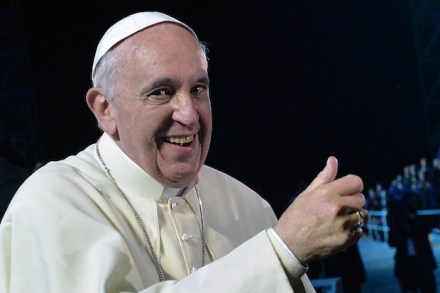
Since it’s Pope Day, let’s consider this tediously-hardy perennial too. Commenting on this post, Fifer asks: Since you’ve given this some thought, then, perhaps you can answer me this – why, exactly, are my taxes being used to fund an education system divided in Scotland on sectarian lines when, out of a population of 5 million, only 65,000 can be bothered turning up to see the head of their faith preach? Even Celtic can manage that turnout a few times a year. If we really are in the dire financial straits we’re told we are, perhaps it really is time to “think of the children” and educate them all as

Let’s move on from Stephen Fry’s Pope bashing

Stephen Fry is good at taking himself seriously while pretending not to take himself seriously. But slowly, as he gets older and grander, his self-effacing mask is slipping. He’s becoming less and less of a comedian, more and more a sanctimonious bore. Look at the way he has taken it upon himself to denounce, with such gravitas, Pope Benedict XVI’s visit to Britain. In his interview with the BBC yesterday – see above – Fry insists that the Pope should be free to come to Britain. “How could I hold my head up if I objected to that?” he says. What Fry cannot not accept, he explains, is that the Pope’s time

Mystery of the empty tomb

John Henry Newman was an electrifying personality who has attracted numerous biographers and commentators. John Cornwell, in his excellent guided tour around this well-ploughed field, recalls the young woman in Oxford in the 1830s who ‘wept with emotion’ at Newman’s very appearance. W. G. Ward recalls the awe which fell upon him and his undergraduate friends if Newman so much as passed them in the street. And figures such as Mark Pattison, James Anthony Froude and Matthew Arnold, none of them followers of the Newman cult in grown-up life, recollected similar feelings in their youth. When the mature George Eliot read Newman’s spiritual autobiography, she said it ‘breathed much life

The Vatican plays the “Jewish Card”

Speaking in a Good Friday homily, with the Pope listening, the Pontiff’s personal preacher, Fr Raniero Cantalamessa, likened the drive by the victims of abuse to seek justice from the Vatican, whose priests committed the sexual crimes, with the persecution of Jews. Victims’ groups and Jewish organisations have said it was inappropriate to liken the discomfort of the Catholic Church to hundreds of years of violence and abuse. But it is more than inappropriate. It shows either an ignorance of the history of anti-Semitism; a desire to relativise the Holocaust; a near-pathological disregards for other people’s suffering; or a wilful aspiration to shift the blame away from the Vatican. The

The Sins of the Fathers

The least surprising thing about the latest revelations of the Irish Catholic Church’s complicity in thousands of cases of horrific child abuse is that almost none of it is surprising at all. Shocking, yes, but not surprising. Even those of us with an appropriately cynical view of the Chuch, mind you, can only marvel at the breathtaking mendacity displayed by the Church. The Archbishop of Tuam, Michael Neary, says he is ” mindful of the perceived hollowness of repeated apologies” and he has a point. Because until they were caught, the Church displayed no remorse whatsoever. Time and time again, as the Murphy Commission’s report makes only too clear, the

Where the Sisters Have No Mercy and the Brothers No Christianity

Carol Sarler may be correct to argue, as she does in this week’s edition of the magazine, that we have an unhealthy fascination with sex crimes that is both prurient and puritanical. But I’d suggest that, whatever the merits of her wider argument, she doesn’t know very much about Ireland: In Ireland, some 2,000 adults who gave evidence of assault at the hands of Roman Catholic priests and nuns are, probably correctly, spitting tacks. The inquiry into their treatment when in children’s institutions has ruled that, although they did indeed suffer, no charges may be brought, no names shamed and, for what it’s worth, no bank balances swollen by damages