Britain

What the UK can learn from Trump’s second term

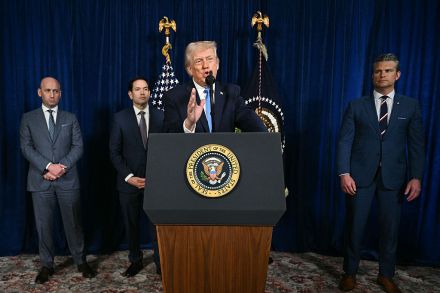
When John Swinney, the Scottish National Party leader, and former ambassador Peter Mandelson visited Donald Trump in the Oval Office a few months ago, the President showed them three different models for his planned renovation of the East Wing of the White House, which he has demolished to build a new ballroom. “If you’re going to do it,” Scotland’s First Minister suggested, “you might as well go big.” This Wednesday marked one year since Trump’s election victory, and going big captures the essence of his second term – bold and controversial moves, which have impressed even British politicians who thought him reckless in his first term.

toby young

Lord Young goes to Washington

I’m writing this from Washington, DC, where I’ve spent the best part of a week talking to politicos and think-tankers about the state of free speech in the mother country. Don’t believe our Prime Minister when he says it’s in rude health, I’ve been telling them. It’s on life support and any pressure that can be brought to bear on His Majesty’s Government to protect it would be hugely appreciated. Once again, it’s time for the new world to come to the rescue of the old. Not that they need much convincing. The view of Britain among Washington’s political class isn’t informed by diplomatic cables or articles in the Economist, but by viral videos on X.

Owen

How Wilfred Owen became a poet

Here is the opening of a sonnet written by Wilfred Owen in the spring of 1911: “Three colors have I known the Deep to wear;/ ’Tis well today that Purple grandeurs gloom.” Owen was eighteen and had just been on a pilgrimage to Teignmouth in England, where his hero John Keats had once stayed. The kindest thing to say about this poem is that it is heavy with the influence of Keats. Six years later, in a seaside hotel requisitioned by the army and waiting to be sent back to the Western Front, he begins a poem like this: “Sit on the bed. I’m blind, and three parts shell.” This looks so simple. The monosyllables carry the meter without fuss; “shell” here means both munitions and protection.

New York is not the city that Mamdani pretends it is

There is an unhappy history of left-wing Britons getting involved in US elections. Back in 2004, the Guardian – the flagship organ of the British left – organized a letter-writing campaign, urging voters in the swing state of Ohio not to re-elect George W. Bush. The good people of Ohio didn’t take kindly to a bunch of North Londoners telling them how to vote, and although the Guardian’s campaign probably can’t be given all the credit, the voters of Ohio duly went to the polls and swung firmly behind Bush. One wishes that London Mayor Sadiq Khan’s intervention in this week’s election in New York might have had a similar result.

New York

Do black lives still matter?

It was an ethnic massacre so bad that it could be seen from space. Satellites picked up bloodied patches of soil in North Darfur’s capital, El Fasher, after Sudan’s Rapid Support Forces (RSF) swept into the besieged city. Pools of blood and piles of bodies were identified. Thousands of people are feared to have died in the appalling violence. Many thousands more have fled for their lives. Others remain trapped in the city. The scenes of slaughter were so blatant that it should have brought marchers out onto the streets in passionate protest. But there wasn’t a peep from the usual suspects. Was this because the killings did not take place in Gaza or the West Bank, but in Sudan, one of Africa’s largest countries?

sudan darfur

Is Kemi Badenoch plotting an American move?

Brits who make a pivot to America tend to fall into two categories. There are those who seek a bigger stage – like Alfred Hitchcock or Christopher Hitchens. Then there are those who were in some sense “run out of town” back in Britain and now seek solace and refuge in the New World. Under this heading we can put the Pilgrim Fathers, Thomas Paine, Mark Thatcher (wayward son of Margaret Thatcher), and now, Kemi Badenoch – beleaguered leader of Britain’s Conservative Party. Badenoch has penned an odd op-ed for the New York Post celebrating the policies of the second Trump administration.

Kemi Badenoch

Do Jews have a future in Britain? 

I was on my way to synagogue yesterday when I got news that was surprising and unsurprising at the same time. That there had been an attack at a Manchester synagogue on Yom Kippur was a shock, but only the location and the timing. The fact that terror had struck our community felt like the confirmation of our worst fears – and something that was grimly predictable.  For as long as I can remember, Jewish life in the UK has been closely guarded and protected. My childhood synagogue in the leafy London suburb of Surbiton was behind locked gates with security guards posted outside when anyone was in the building. My Jewish newspaper office today has similar protections and an address we’re told must never be made public.

macron europe blame

Europe is more bark than bite on Ukraine

Last Friday, President Biden signed a spending bill that will keep the government’s lights on until December 16, when lawmakers will have to cobble together a funding resolution to avert a shutdown. Tucked into that law was another tranche of security and economic assistance to Ukraine, to the tune of $12.3 billion. The signing came two days after the Defense Department announced the release of an additional $1.1 billion military package for Kyiv, which will include 18 more HIMARS systems, 150 armored vehicles, and ammunition of various calibers. The Biden administration has provided the Ukrainians with over $16 billion in security assistance since Russia’s invasion in February. Washington’s hands have been cramping up from writing so many checks.

The death throes of free speech in Britain – and its opponents

Free speech, the very bedrock of constitutional democracy, is writhing on its deathbed in England. It will take a mass movement to restore its vitality. Fortunately, one can see that movement emerging among a once-free people, tired of government suppression. The dire state of British liberties was outlined Wednesday in Congressional testimony by British MP, Nigel Farage, who testified before the US House Judiciary Committee. He was backed by the committee’s Republican members and attacked, alas, by Democrats.

Britain free speech

J.D. Vance: proconsul to Britain?

Vice President J.D. Vance’s family vacation in Britain was disrupted by protesters who insisted that he was not welcome in the country. In the Cotswolds, an area northwest of Oxford and the British equivalent of Martha’s Vineyard, ultraliberal white protesters huddled together on August 12 to make their meager numbers look large for the cameras, wielding signs bearing such slogans as “End Genocide!” and “Stop Fascists!” One participant quoted by the Guardian explained: “I’m most worried about his environmental policies. They risk eliminating the whole of humanity, all the creatures on the Earth.

Vance Britain

Britain’s foreign secretary faces fine for fishing without a license

What people on the other side of the pond call "Brand Britain" has taken something of a knock in recent years – especially in the United States, which the British often still view as an errant son. With unnerving speed Britain's reputation has collapsed stateside, especially among the political right, from the country of Brideshead Revisited to a grotty Airstrip One. The symbol of the new Britain in the eyes of many Americans are the ubiquitous licenses (or, in the argot of a London copper, "loicenses") that citizens seem to need for everything – including, most notoriously, owning a TV. Now even the Foreign Secretary has been caught without a loicense. On Friday David Lammy went fishing with the now-Vice President J.D.

Lammy Vance
Thomas Skinner JD Vance

Essex-boy Elegy: J.D. Vance meets the Bosh man

Vice President Vance is currently receiving visitors at an 18th-century Georgian manor in the Cotswolds, an implausibly quaint patch of the English countryside. Petitioners so far have included James Orr, the Cambridge academic and right-wing activist, Robert Jenrick, likely the next leader of Britain's Tories, and Nigel Farage, likely the next UK Prime Minister. Also on the list was one Thomas Skinner, a gregarious wide boy from East London turned e-celebrity turned patriotic influencer. After a stint as a pillow and mattress merchant Skinner, 34, found fame as a contestant on the 15th series of the British version of The Apprentice.

A global MAGA crusade against web regulation?

“Censorship is not how we do things in Western civilization”. So said Congressman Scott Fitzgerald (R-WI) of the United Kingdom’s new Online Safety Act (OSA). Its effects on free expression are “dangerous and needs to be addressed,” possibly by means of an international “united front”. The Congressman was fresh from meetings with British and Irish lawmakers and US tech firms, held as part of a House Judiciary Committee fact-finding mission to investigate the impact of the OSA and the European Union’s new Digital Marketing Act on American businesses. The main event was a one-on-one between Committee chair Jim Jordan (R-OH) and Peter Kyle, the United Kingdom’s Secretary of State for Science, Innovation and Technology.

Online Safety Act

The UK censorship files: Jim Jordan’s crusade against Britain

The British Empire may be gone, but there is one area where the UK has not lost its global ambitions: online censorship. The latest vehicle is the Online Safety Act (OSA), a behemoth internet regulation law whose vast provisions are steadily coming into force – and increasingly drawing the ire of the Trump administration as it starts to impact US tech firms.  Under the OSA, “Britain has the power to shut down any platform” that breaks its content regulation rules, boasts secretary of state for technology Peter Kyle. The latest stage of its implementation began last week with new mandatory age-verification measures for social media platforms.  The Act is already curtailing what can be read online in the UK.

Free speech

Trumpism rules the world

Whatever loopiness there is in Donald Trump’s personality is a loopiness born of isolation. For ten years the history of the world has revolved around him, not he around it. The events of last November have left Trump as, for all intents and purposes, the only remaining historical actor – especially after Xi Jinping’s retreat into obscurantism since the pandemic.

Trump Starmer

The Europe of American imaginations no longer exists

Since the United Kingdom left the European Union five years ago, the pair have been in battle to prove who has performed better. But the real story of the past five years is not a stagnant UK falling behind a buoyant EU, but of Britain and Europe being trapped in the same cycle of relative decline. It’s America that has quietly raced ahead of Europe this century. Following the pandemic it has become impossible to ignore the gulf in economic vitality between the US and Europe, the former growing by 16.3 percent per capita since 2008. There are very good reasons for America’s success, or rather, Europe’s decline. The EU and the UK increasingly treat their industries as pieces of heritage which must be preserved against disruptors and foreign competition.

Europe

Have you ever heard of the St. Brice’s Day Massacre?

The St. Brice’s Day Massacre? I must admit I hadn’t heard of this “most just extermination” of Danes in Oxford at the instigation of King Aethelred the Unready in 1002, perhaps because the teaching of history in Britain tends to kick off in 1066. You certainly don’t think of Oxford as a place that pioneered techniques of ethnic cleansing. Crypt is a collection of seven essays that unearth details about how certain people lived and died in the past. If you didn’t already know Alice Roberts’s background as an anatomist and biological anthropologist, you’d have a good chance of deducing it from this book.

Roberts

The spy novelist who became an Irish nationalist

The period of the First World War was a golden age for the spy novel. There’s nothing like a really cataclysmic global conflict to stir any halfway attentive author. And perhaps the pick of the literary crop was 1903’s The Riddle of the Sands, by the Anglo-Irish writer, soldier, and politician Erskine Childers. The novel mixes some gentle satire about the graded snobberies of the Edwardian class system with a seafaring adventure involving a couple of topping British chaps going after German spies in the Baltic. It’s not only a riveting tale in itself, but so cogent in its account of the state of Britain’s maritime defenses that it prompted the Admiralty to hurriedly install a series of new coastal gun batteries.

She was the Queen of the West

For much of my life, I confess I didn’t pay much attention to Queen Elizabeth II. My Muslim upbringing in Somalia, Ethiopia, Kenya and Saudi Arabia meant that the idea of a female figurehead was utterly foreign to me. How could a woman be the head of a church or the leader or embodiment of a nation? This was not what my god taught. Allah, for me, was the ultimate patriarchal ruler. He would certainly not countenance a figure like the Queen. But once I left Islam and became a convert to the ideals of the West, I came to appreciate her. The massive crowds following her coffin as it wound its way down from Balmoral, through Edinburgh, to London and finally to Windsor show that I am far from alone. The Queen was beloved.

queen

The slumber of the Anglosphere

The countries we call Anglo-Saxon (Great Britain, the Commonwealth and the United States) have been known for centuries for their ability to govern themselves democratically, peacefully and efficiently. In the twenty-first century they have been doing less well. Britain and America are both in dreadful straits politically, economically and socially. The implosion of Boris Johnson and the search for a satisfactory successor have revealed the leadership of the Tory Party as a hapless and embarrassing collection of mediocrities devoid of coherent ideas. Across the Atlantic, one of the two major parties is a gerontocracy at the top and a gang of urban guerrillas with Molotov cocktails at its base.

anglosphere