Brexit

The Great Repeal Bill will bring both continuity and change

From our UK edition

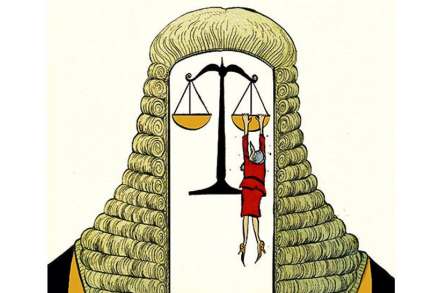
The Government has set out the White Paper in advance of its proposed Great Repeal Bill.  The Bill is not necessary for the UK to leave the EU.  The Prime Minister has triggered Article 50, relying on the European Union (Notification of Withdrawal) Act 2017, and the UK is now on its way out of the EU.  When the Article 50 process ends, the EU Treaties will cease to apply to the UK.   The expiry of the Treaties will change UK law in significant ways.  The Great Repeal Bill is intended to minimise legal discontinuity and to maximise certainty for business and citizens.

Watch: Jean-Claude Juncker threatens to promote the break-up of the USA

From our UK edition

He’s unstable. He’s an irrational hothead who is by some freak a president. And his inability to control his mouth is endangering world peace. I’m talking about Jean-Claude Juncker, of course, who just said that if Donald Trump carried on supporting Brexit, he would ‘promote the independence of Ohio and Austin, Texas, in the United States of America.' Wow, as they say on Twitter every time Trump says something silly, just wow. Juncker’s defenders, like the Donald’s defenders, will say he should be taken literally but not seriously -- he’s just kidding. But at some point the joke goes too far. Here's what Juncker said in full: 'Brexit isn’t the end.

Is the Government heading for trouble with its Great Repeal Bill?

From our UK edition

Britain’s biggest exercise in copying and pasting has begun in earnest. The Government has published its Great Repeal Bill White Paper, which it says is vital to ensuring that whether we end up with a ‘hard’ or ‘soft’ Brexit (or any other type of Brexit), it’ll be a ‘smooth’ Brexit. The scale of the task is no mean feat. The Times reported this morning a study by Reuters identifying 53,000 laws affecting those in the UK that originated in Brussels since 1990. All of these will need to be dealt with and passed over into UK law. But even that estimate could be downplaying what the Government needs to do. In its White Paper, we learn today that: ‘There is no single figure for how much EU law already forms part of UK law’.

How to write the perfect break-up letter

From our UK edition

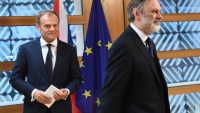
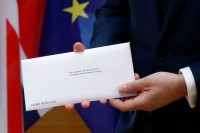
Yesterday, Sir Tim Barrow placed into Donald Tusk's hands the letter giving notice the UK will begin divorce proceedings with the EU. This missive now takes its place among the great relationship-ending letters of history. Today, Downing Street has said that European leaders appreciated the ‘warm, constructive’ tone of the Article 50 letter. But what makes for a good break-up letter?  And when you look at the most memorable break-up letters of history, what do they have in common? Lucy Hume from Debrett's says a relationship-ender should first of all reflect the relationship. 'The letter need not be very long but should be handwritten on writing paper, well-thought-out and appropriate to the relationship,' she says.

What the papers say: Theresa May’s pitch-perfect start to Brexit

From our UK edition

We’re off! The two year countdown until Brexit has begun. Theresa May’s triggering of Article 50 has been met with unanimous praise in the press, with the newspaper editorials saying the PM hit all the right notes in her letter. But there was controversy too. Some are saying the inclusion of a message suggesting Britain’s co-operation on security matters is at stake is an unhelpful threat to Brussels. Here's what the papers are saying about a historic day for Britain: Theresa May’s Article 50 letter was ‘pitch-perfect’, says the Sun, which argues that the Prime Minister succeeded in balancing generosity with a ‘flash of steel’. The onus now, the paper says, is for the EU to follow in May’s footsteps.

There will be a trade deal

From our UK edition

Most diplomats in Brussels will tell you that Theresa May has just embarked upon a fool’s errand, that Britain might wish for a free-trade deal with the European Union but will have to learn that it can’t cherry-pick. Anyway, they say, nothing of any value can be agreed in two years. This received wisdom can be heard, under various iterations, in most capitals in Europe — and it’s natural that the EU will be sore, perhaps a little defensive. But there is a free-trade deal to be struck. First, a declaration: I didn’t want Britain to leave the EU. I’m a Swede running a free-trade thinktank in Brussels and can tell you that the UK’s absence will be sorely felt by all of its allies.

The friendly alliance

From our UK edition

On 29 March 2019 the Queen should have a state dinner and invite the European Union’s 27 heads of state and its five presidents. The evening’s purpose would be to toast the new alliance between the United Kingdom and the EU: one based on free trade, security cooperation and shared democratic values. This celebration of the new alliance will be especially welcome after two years of negotiations which are bound to be fraught and, at times, ugly. The complexity and the sums of money involved pretty much guarantee this. There is, though, a particular onus on Britain to keep things civil. We have chosen to end this failed relationship, so we should brave the insults and not feel the need to respond to every Juncker jibe.

Brexit brings us endless little beakers of joy

From our UK edition

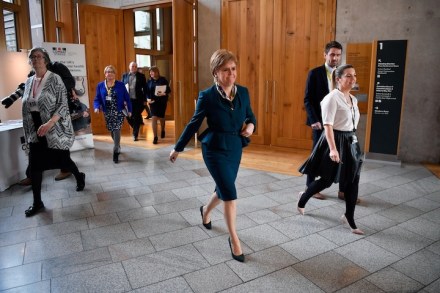
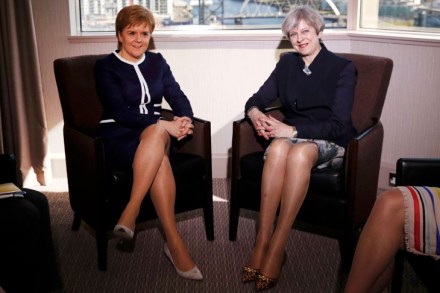
The thing that got me about the photo-graph which prompted the Daily Mail’s harmless but now infamous headline ‘Never mind Brexit — who won Legs-it!’ was what I shall call the Sturgeon Lower Limb Mystery. In the photograph, the SNP leader seemed to be possessed of two slender and very long legs indeed. Whereas we know from television news footage that her legs are only seven inches long from her toes to that bit where they join the rest of her body. Walking to Downing Street for meetings, or being interviewed on the hoof by camera crews, Nicola Sturgeon usually resembles a slightly deranged Oompa--Loompa, or, as many have commented before, Janette Krankie.

Jeremy Corbyn looks lost at the despatch box

From our UK edition

Tactics! At long last. Jeremy Corbyn actually used tactics at today’s PMQs. For the first time ever he divided his six questions into two three-ball overs. He spent the initial trio on last week’s terror attacks. Then, after an unsettling delay, he used three more on Mrs May’s fibs about school budgets. She says they’ve been ‘protected’. He says they’ve been ‘cut’. Protected. Cut. Cut. Protected. On it went. Mr Corbyn had a superb ally in the Public Accounts Committee which seems to support his view. The exchange might have been tricky for Mrs May but Mr Corbyn still can’t ram home a simple advantage. Rather than forcing her to repudiate the committee and its grandees he brought in a new, and far weaker, witness.

Parliament must take back control of Brexit

From our UK edition

In the early, sunlit days of New Labour, the left-wing comedian John O’Farrell had a skit on how the Tories, after a generation of dominating British politics, found their party and its principles rejected by the electoral mainstream. ‘Now the Conservatives are like a lunatic fringe party,' he said. 'Soon we can expect to see them outside Woolworths next to the Socialist Workers on a Saturday afternoon shouting "Daily Telegraph! Get your Daily Telegraph! Britain out of Europe!"'  A generation on, the Tories are in power, Woolworths is gone, the Socialist Workers are running the Labour Party, and Britain is indeed coming out of Europe.

A generous, globally-minded Brexit could reunite a divided country 

From our UK edition

Public opinion on Brexit remains evenly balanced, and there’s no point in any Conservative pretending otherwise.  About half the nation did not want their Prime Minister to trigger Article 50 today, and Theresa May should primarily concern herself with her fellow Remainers – especially in Scotland. Many of them will see, in Brexit, the triumph of ugly nativism or a nostalgic isolationism. Her Lancaster House speech in January laid out a compelling, globally minded vision of Brexit. Emphasising that message will be key to addressing the worst fears of Remain voters.  The triggering of Article 50 represents a great opportunity. We can now move on from whether Britain should or should not leave the EU: Article 50 has served irrevocable notice of our doing so.

Theresa May’s Article 50 letter strikes the right tone

From our UK edition

Theresa May is trying to play the role of the great conciliator today. She has avoided any hint of triumphalism or saying anything that the European Union would instantly reject. Instead, she has emphasised her desire for a ‘deep and special partnership’ with the European Union and that the UK wants to be the ‘best friend and neighbour’ to the EU. She has not repeated her Lancaster House message that she thinks ‘no deal is better than a bad deal’ or threatened to change the UK economic model if no free trade agreement with the EU can be struck. The Article 50 letter that May has sent to Tusk also strikes a conciliatory note.

Article 50 letter: full text

From our UK edition

On 23 June last year, the people of the United Kingdom voted to leave the European Union.  As I have said before, that decision was no rejection of the values we share as fellow Europeans.  Nor was it an attempt to do harm to the European Union or any of the remaining member states.  On the contrary, the United Kingdom wants the European Union to succeed and prosper.  Instead, the referendum was a vote to restore, as we see it, our national self-determination. We are leaving the European Union, but we are not leaving Europe – and we want to remain committed partners and allies to our friends across the continent.

The best thing about Brexit? None of it is my fault

From our UK edition

Brexit Britain fills me with calm. Six weeks on, there’s no point pretending otherwise. Losing is far better than winning. I am filled with enormous serenity at the thought of this terrible, terrible idea being not my fault at all. I didn’t expect to feel this way. Although there were signs, now I think back, on the night of the vote. I was at Glastonbury, obviously. (‘Of course you were!’ cried Rod Liddle, when I saw him a few weeks later.) Of course I was. There, with the rest of the metropolitan, liberal, bien-pensant yadda yadda. I found out at about 2 a.m., after a pleasant evening doing pleasant Glastonbury things. I’d wandered backstage, to meet a journalist friend who had secured access to Wi-Fi and a television.

A great day for British democracy

From our UK edition

Today is a great day for British democracy. One of the greatest ever, in fact. Tune out Project Fear, with its overblown claims that Brexit will cause economic collapse and possibly revive fascism, and just think about what is happening today. The largest democratic mandate in the history of this nation, the loudest, clearest, most populous democratic cry Britons have ever made, is finally being acted upon. The political class is starting the process of severing Britain’s ties with the EU not because it wants to — it desperately doesn’t want to — but because a great swarm of its people have told it that it must. This is amazing. This is wonderful. This is democracy. This is what generations of Britons fought for.

History teaches us that Brexit will be okay in the end. Probably.

From our UK edition

Happy Brexit Day everyone. I guess we'll be okay in the long term. March 29th is the bloodiest day in English history, a day on which a London-dominated clique funded by the City defeated an army raised from the north and Midlands; history has since come to know it as the War of the Roses although it barely affected people who weren't directly involved. (Historian John Gillingham even states that direct taxes went down and housebuilding continued, which is more than can be said for the past few years). On that date in 1461, in a snowstorm in Towton, north Yorkshire, the young usurper Edward IV - only 18 years old - beat Lancastrian forces loyal to the insane Henry VI and his French wife Margaret of Anjou.

Theresa May triggers Article 50

From our UK edition

Britain is on its way out of the European Union. In the last few moments, Theresa May stood up in the Commons and announced that Article 50 had been triggered. She told MPs: 'The Article 50 process is now underway. And in accordance with the wishes of the British People, the United Kingdom is leaving the European Union. This is an historic moment from which there can be no turning back. Britain is leaving the European Union. We are going to make our own decisions and our own laws. We are going to take control of the things that matter most to us. And we are going to take this opportunity to build a stronger, fairer Britain – a country that our children and grandchildren are proud to call home. That is our ambition and our opportunity.

What the papers say: Theresa May pulls the Article 50 trigger

From our UK edition

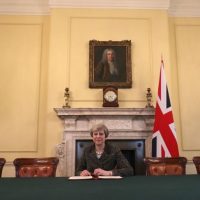
Theresa May has put pen to paper on the Article 50 letter that will kick-start the process of Brexit. March 29th, 2017, will join June 23rd, 2016, as a key date in Britain's modern history. The papers are unanimous in seeing today as a momentous moment. But they are also clear in their view that the challenges ahead will be big. On the day Theresa May formally pulls the Brexit trigger, here’s what the newspaper editorials have to say: ‘It's finally here,’ says the Sun. The paper hails today as ‘the most momentous day in Britain’s modern history’ - and marks the occasion by beaming the words ‘Dover and Out’ on the white cliffs of Dover. So, what can we expect?