Beijing

China has quietly taken over America’s food supply

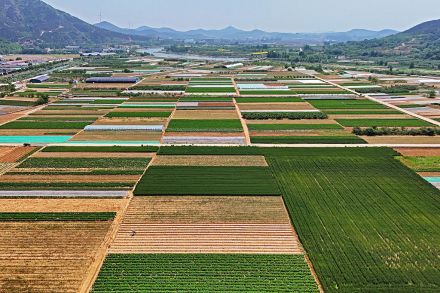
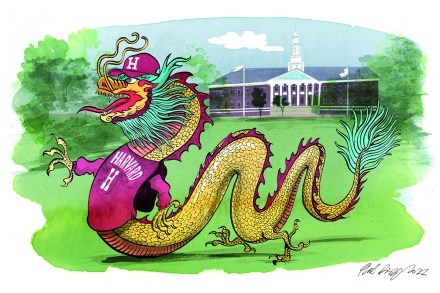
For all the talk about artificial intelligence and quantum supremacy, the fate of civilizations still depends on breakfast. ChatGPT can’t grow corn. Empires rise on stomachs as much as on silicon. And America’s food system – long dismissed as safe and self-sufficient – has quietly become a front line in the US-China rivalry. We act as if lunch is inevitable, but Beijing knows that food is power. A new report from the America First Policy Institute should wake us up. Washington long treated agriculture as a post-political space where globalization could do no harm, and was therefore happy to let much of the nation ship its growth to China. As Ambassador Kip Tom and Royce Hood argue, China has thus taken over critical pieces of the US agricultural system and food supply.

china america food supply

Deals, deals, deals vs China, China, China

How was your Liberation Month? It’s been almost 30 days since Donald Trump stood in the Rose Garden of the White House and announced a shocking set of massive tariffs on the world. The event caused huge convulsions in the economic universe: trillions were wiped off the stock market and, under huge pressure, Trump did agree to a 90-day pause on reciprocal tariffs. After that he exempted electrical goods, though his standard 10 percent remains, and the heads of most financial analysts are still spinning trying to figure out what it all means. Yet for all the angst and the apoplexy, yesterday the S&P 500 index closed just 1 percent down from where it was at the beginning of the month.

china ccp

The China influence puzzle

A “Chinese puzzle” in its classic version is a game where you must fit a variety of ill-assorted boxes inside other boxes. The term came to mean any intricate problem, especially one in which what looks like the way forward leads only to new obstacles.   These days, in which we are warned not to use ethnonyms for fear of giving offense, it might be safer to say something like “brainteaser.” But the efforts of the Chinese Communist Party (CCP) to manipulate American society genuinely deserve the old term. The news this past week adds a few curious details to those efforts. Details first; explanations to follow.

The case for moving SOUTHCOM back to Panama

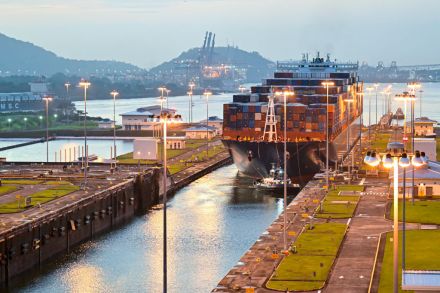
The recent American interest in the Panama Canal is grounded and rational — contrary to media characterizations of the renewed focus as a byproduct of the president’s impulsive fixations. The Canal, as President Trump has correctly noted, was an American development in a nation that existed mostly as a consequence of American intervention. Panama provided the setting for the Canal — and America provided the Canal itself, having taken on, in 1903, the project France failed to complete in 1890. In the 1960s, when the United States began preparing its handover — not its return — to the Panamanian state, the concession was understood as the price of peace with an ascendant Third World.

World events are not going America’s way

Contrary to the conventional wisdom, the world situation is grim for America. And it could actually get far worse. Why, then, are many of our national leaders acting as if things are going well? We need not doubling down but fundamental change. That starts with understanding that we are in serious trouble. The war in Ukraine, which is manifestly the Biden administration’s priority, is sadly likely to be protracted. While the Ukrainian counteroffensive is still ongoing, the best analysis indicates that the war has become a struggle of attrition. Russia is substantially mobilizing its economy and society for a long-haul war effort — and its armed forces appear to have at least partially adapted from their earlier failures.

world

The high odds of a Chinese black swan

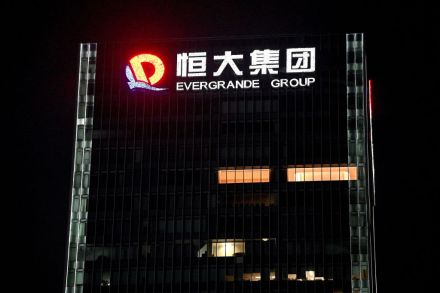
I have a memory picture of an urban highway in Shenzen, southern China. Recently built, with abundant flowering shrubs planted along its central reservation, it was lined as far as the eye could see by uncountable apartment towers, many of them unfinished. This was 2009 and it was my first glimpse of the debt-fueled property bonanza that had begun to grip the Chinese economy — alongside the export-led manufacturing boom that was also plainly visible, thanks to satellite maps of the vast agglomeration of factories surrounding the new-rich residential areas. It’s easy to be a permanent bear in any market, because history tells us they all come crashing down in the end.

Evergrande

After decades of waiting, China goes on the diplomatic offensive

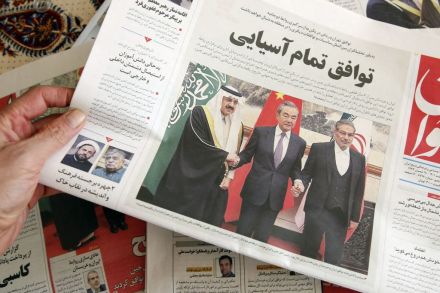
China has been an epicenter of diplomacy over the last month and American officials can’t help but take notice of the shift. Statesmen flying to China, hat in hand, to sign business deals with Chinese firms or enlist Chinese diplomats to assist in solving international disputes gives the foreign policy graybeards ulcers. The general rule seems to be: what’s good for China is bad for the United States. There’s no question that China’s Xi Jinping has had a good few weeks. After being occupied with a nationwide Covid-19 disaster that lasted for three years, Xi, a man whose entire legacy depends on China transforming into a superpower on par with or perhaps even surpassing the US, isn’t wasting any time before injecting his country back into the diplomatic arena.

syria peace

Macron tries to be the Xi whisperer

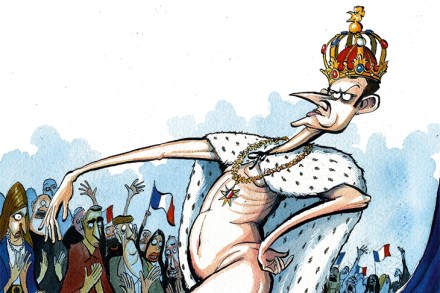
God bless Emmanuel Macron for his perseverance and self-confidence. The French president seeks to lead Europe and turn the continent into a strong, independent player in its own right. And he is eager to take on the hard, thankless diplomatic work that few of his peers are willing to do. Whether it was his ploy in 2019 to connect then-US president Donald Trump and then-Iranian president Hassan Rouhani on the phone or his months-long, intensive personal dialogue with Russian President Vladimir Putin before the war in Ukraine, Macron invests a lot of time and capital into these gambits. Unfortunately for him, many of them fail to accomplish anything of substance. Macron wasn’t able to convince Rouhani to speak with Trump (although Trump reportedly agreed to the call).

napoleon macron tantrum diplomacy

The truth comes out about Beijing’s balloon

Well, well, well. The world seems amazed at the news that the Chinese spy balloon that meandered over the entire continental United States this winter was, you know, spying. That’s what spy balloons do: they spy. They collect intelligence — in this case, information from some of America’s most sensitive sites (I was going to say “secure sites,” but that would clearly be inaccurate). What do they do then? Like bees collecting pollen, they transmit what they collected back to the hive, which, mirabile dictu, just happens to be located in Beijing.  Anyone who was paying attention knew this. Did secretary of state Antony Blinken? Did puppet-in-chief Joe “Chocolate-Chip” Biden? Probably.

spy balloon

The Paraguay predicament over Taiwan

On April 30, Paraguayans will go to the polls to select a new president. Though elections in the landlocked South American nation do not typically make headlines around the world, this vote carries outsized geopolitical importance: it could mean Taiwan loses yet another country to China. Opposition candidate Efraín Alegre of the Authentic Radical Liberal Party, or PLRA, has said that, should he win, he will retract Paraguay’s recognition of Taiwan as a country. At present, Paraguay is the largest of just fourteen countries to have formal diplomatic relations with Taiwan and the only one in South America. Paraguay first recognized Taipei in 1957 while under the dictatorship of Alfredo Stroessner.

paraguay

Germany’s Faustian entanglement with China

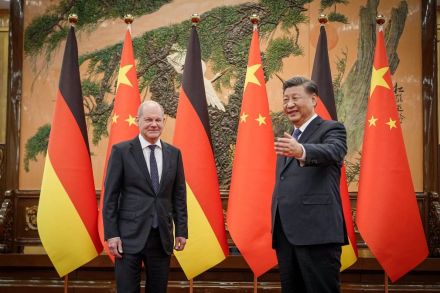
Back in November, German Chancellor Olaf Scholz met with Chinese Communist Party (CCP) chairman Xi Jinping. His visit to China was the first by a G7 leader in three years. Facing heated domestic and international pushback, Scholz framed his visit as an effort to “further develop” economic cooperation between Berlin and Beijing. In this context, such “further development” means further cementing Germany’s Faustian bargain with China, one in which European-based players, like Airbus and Volkswagen, claim immediate revenue — but at their long-term expense and at great strategic cost.

The Biden-Xi meeting was long overdue

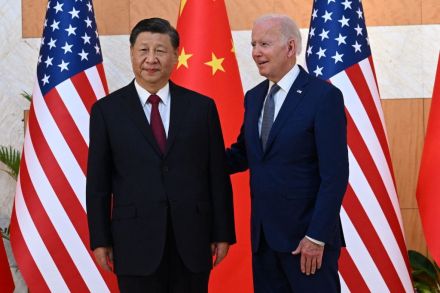
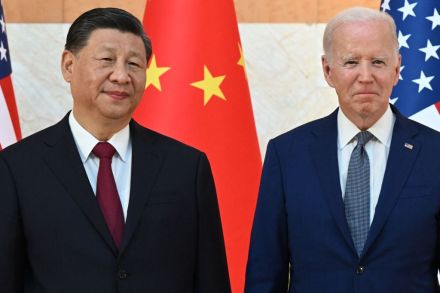
The bilateral relationship between the United States and China is arguably the most important in the world today. The two countries make up approximately 42 percent of the world’s economic output and more than half of global military expenditure (at $801 billion, the US share of that total dwarfs China’s). The Biden administration’s recently released National Security Strategy names China as "the only competitor with both the intent to reshape the international order and, increasingly, the economic, diplomatic, military, and technological power to do it." The central objective from Washington’s standpoint is to compete vigorously with Beijing, prevent China from attaining hegemonic status in the Asia-Pacific, and ensure this competition doesn’t slide into conflict.

China delayed its 2008 financial crisis until 2022

The year 2008 was consequential by many measures. The collapse of the US investment bank Lehman Brothers sparked a worldwide financial crisis. Yet China appeared to emerge out of it relatively unscratched after Beijing introduced a massive stimulus package in the world, about three times the size of the United States government's rescue program. Thanks to this expansionary fiscal policy and the easy credit that came with it, the Chinese economy quickly returned to its robust growth by growing 8.7 percent in 2009 and 10.4 percent in 2010. After 2008, the Chinese Communist Party leaders concluded that China "escaped" the financial crisis because of its outstanding leadership and the superiority of the Chinese political system over deeply flawed western democracies.

Hong Kong is now a police state

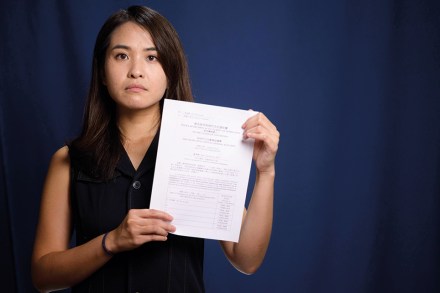
No one now denies that Hong Kong is a fiefdom of Beijing. Its democratic leaders have been packed off to prison on spurious grounds or have left the territory, and its street protests have long been beaten to pieces with batons. The 2020 national security law has made mockery of Hong Kong's last shreds of freedom of expression, rendering all criticism of the Chinese Communist Party akin to terrorism; and its uncensored homegrown newspapers are now closed by the state — their proprietors inexorably marched off to jail. Any pretense of adherence to the treaties signed by Britain and China around the time of the handover in 1997 — treaties that guaranteed Hong Kong autonomy — has long fallen away. Hong Kong is a subject province of the People's Republic now, and nothing more.

Nancy takes a knee for Beijing at the Winter Olympics

Nancy Pelosi, stock-trader extraordinaire, doubles as an adviser to America’s Olympic athletes. And her wise, nuanced advice to them is simple: “Shut up.” It would be a very bad idea, she says, to voice any political criticism at the games of the Chinese Communist Party or its glorious rule. You may have missed her similar advice to LeBron James, as he kissed the backside of Beijing’s dictators. You may have missed her critique of the NBA, as it protected its highly-profitable franchise in China. They were as compliant as any US multinational operating in Germany in the 1930s, eager to retain their profitable operations.

pelosi nancy

No love for the gays at the Beijing Winter Olympics

The nights are about to get a lot colder for men’s figure skaters at the Winter Games. Gay hookup app Grindr was removed from app stores in China this month just ahead of the 2022 Olympics in Beijing. Olympians are famously hot to trot. As far back as 1988, the International Olympic Committee banned outdoor sex after condoms were found littering the rooftops of the Olympic Village in Seoul. Complimentary condoms remained a staple at the Games, reaching a record at Rio in 2016 where 450,000 "little shirts," as they’re called in local slang, were supplied to the Olympic Village — that’s forty-two per athlete.

grindr

The China reckoning

Fifteen years ago, I remarked to an acquaintance over lunch that it looked like China might eat America’s lunch in naval power. My interlocutor, a person well-known in leadership positions in the China studies community, scoffed at my comment. Over the next few years, he never missed an opportunity to ridicule my wild-eyed prediction. I often wonder what he thought in February 2021 when, less than a month after becoming president, Joe Biden warned US senators that if America didn’t “get moving, [China is] going to eat our lunch.” I claim no credit for prescience, just a historian’s sensitivity to trends over time. The fiftieth anniversary of President Richard Nixon’s visit to China falls in February 2022.

china

Boycott the 2022 China Olympics

Anything short of a full boycott of the 2022 Beijing Olympics is an abdication of America’s responsibilities and a rejection of its values. Dispatching athletes to China in February would also violate the Olympic spirit. In a November 2 social media post, three-time Olympian Peng Shuai accused former Chinese vice premier Zhang Gaoli of sexual assault. That post was deleted within minutes and Peng promptly disappeared. The Chinese government has clearly seized control of her and her whereabouts, while Chinese state media has taken control of her story, releasing an email, purportedly from Peng, rescinding her allegations. It's also published photos, purportedly from her friends’ social media, as claimed evidence that she is happy and healthy.

How China targets Uighur expats in the US

It has been more than two years since Ziba Murat has heard the voice of her ailing mother, Gulshan Abbas, a retired physician who was abruptly ‘disappeared’ in September 2018 in Xinjiang province, China. While exact facts and figures are hard to come by, it is widely reported that at least three million Uighurs in China have been forced into concentration camps, which Beijing calls ‘reeducation’ facilities for stamping out ‘Islamic extremism’. The scale of the ongoing atrocities is bone-chilling: from forced sterilizations and sexual violence to beatings and indoctrination. The Chinese government’s assault extends to Uighurs abroad.

uighurs