Assisted dying

At death’s door

From our UK edition

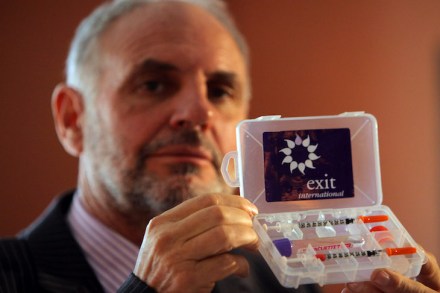
It is a sunny Saturday afternoon in Covent Garden and we are all learning how to kill ourselves. The venue is a nondescript community centre in Stukeley Street. It usually hosts activities for children, so there are crayon drawings and anti-bullying posters on the noticeboard. Today, however, a purple pop-up banner displays the Exit International logo and its mission statement: ‘A peaceful death is everybody’s right.’ Admittance to the four-hour workshop costs £50 and is reserved for those over the age of 50 and the seriously ill. The company collects around the tea hatch, everyone fanning themselves with their copies of the Exit International magazine, Deliverance. There are 80 or so men and women, grey-haired and crepe-soled.
Letters | 24 September 2015

From our UK edition

Have faith, Nick Sir: Rarely have I read an article as powerful as Nick Cohen’s (‘Why I left’, 19 September). As a lifelong Tory, all I feel qualified to say is that I think I understand. I am certain, however, that Messrs Corbyn, McDonnell et al will soon be consumed by the fire of their own hatred, and disappear in a puff of acrid smoke. Have faith in the British electorate, Nick. Jem Raison Shipston on Stour, Warwickshire No mention of Paula Sir: With regards to Simon Barnes’s article about drugs in sport (‘Our drugs cheat’, 19 September), I have not ‘outed’ Paula Radcliffe as anything, let alone as a drugs cheat.

Down with slippery slopes!

From our UK edition

Well, of course the Assisted Dying Bill failed. It mattered not a jot that an overwhelming majority of public opinion urged its success; it was always going to fail and the only surprising thing is that anybody is surprised. I’ll bet my teeth on a few more certainties, too. Last week the required 200,000 people put down their spliffs long enough to sign a petition in favour of decriminalising cannabis and thus, in October, the matter will be debated by MPs. Proponents, however, really should not bother — they will lose, regardless.

Letters | 17 September 2015

From our UK edition

What firefighters do Sir: Leo McKinstry’s vicious, misleading article ‘Out of the ashes’ (12 September) shows that he has no understanding of the real issues facing firefighters today. He implies firefighters sit around doing nothing while other emergency services are doing the real work. Nothing could be further from the truth. Firefighters rescue more than 38,000 people every year, working regularly with paramedics, ambulance staff and police. There has been reluctance in the past from the Fire Brigades Union (FBU) to sanction firefighters stepping in to help with medical rescues as a matter of course, since such moves need to be made carefully, with assurances that proper training will be given and equipment issued so that no lives are put at risk.

Podcast: the death of the left and Jeremy Corbyn’s first few days as leader

From our UK edition

What has happened to the left-wing of British politics? On this week’s View from 22 podcast, Nick Cohen discusses his Spectator cover feature with Fraser Nelson on why he is resigning from the left, following the election of Jeremy Corbyn as Labour leader. Why have some activists become intolerable of views that differ slightly from their hard-left perspective? Should those who have had enough of the Labour party join the Conservatives? And is Labour's shift to the left a temporary blip or a longer trend? James Forsyth and Isabel Hardman also discuss Corbyn’s first week as Labour leader and whether his new take on PMQs is something that will stick. Has Corbyn's poor performance in his first few days shortened how long he will remain leader?

Soon we will accept that useless lives should end

From our UK edition

[audioplayer src="http://rss.acast.com/viewfrom22/thedeathoftheleft/media.mp3" title="Matthew Parris and Freddy Gray debate whether assisted dying will ever become accepted" startat=1781] Listen [/audioplayer]Throughout the short life of the Assisted Dying Bill which failed last week in the Commons, the ‘faith community’ (a quaint term for that category of human beings who throughout history have been more assiduous than any other in trying to kill each other) have with skill and persistence deployed an argument of great potency. Such is the argument’s intuitive appeal that the pro-assisted-dying brigade never found a way of countering it. They have resorted simply to denying that what the faith squad say would happen, could happen. But it could.

The best arguments from the assisted dying debate

From our UK edition

The debate currently taking place on the second reading of the Assisted Dying Bill in the Commons is one of the best ones MPs have conducted in recent times. It is full of vehement, passionate disagreement. But it is also well-informed, not absurdly tribal or rowdy, and a debate that focuses on scrutinising the legislation itself, rather than slinging mud at the other side's motives. Here are the best speeches so far, as they come - on both sides of the debate.

No, doctors are not already upping painkillers to help their patients die

From our UK edition

The Assisted Dying debate in the House of Commons will be well worth re-reading or watching in full: it has been one of the best. The Bill will not progress any further, after MPs voted 330 to 118 against giving it a second reading. You can listen to some of the very best speeches from a morning of thoughtful, respectful, passionate debate here. But one speech that elicited unusually loud noises of dissent from across the Chamber was from Labour’s Paul Flynn, who suggested that assisted dying is already happening in hospitals.

Many people feel their life is worthless. The Assisted Dying Bill tells them they might just be right

From our UK edition

As Charles Killick Millard conceded, there was an issue about grandparents. Millard, the leading figure of the Voluntary Euthanasia Legalisation Society back in the 30s, realised that people might cajole their elderly relatives into choosing death. But this had its benefits, he argued: ‘It would make querulous old folk more careful how they dilated upon their aches and pains.’ Havelock Ellis, one of the Society’s celebrity supporters, was blunter: he expressed his annoyance that ‘we are terribly afraid of killing those citizens whom we all regard as financially unpromising.' There is a callousness in those remarks which resurfaces whenever assisted suicide is put forward.

The Spectator’s notes | 10 September 2015

From our UK edition

Presumably Britain has some sort of policy on immigration, asylum and refugees, but instead of struggling to understand it, you can save time by following its media presentation, since that is what seems to concern the government most. Essentially, the line is that Labour lets them all in and the Tories don’t and won’t (‘No ifs, no buts’). When, as at the last election, it turns out that net immigration has been rising under David Cameron, he apologises shyly and sounds tough again. He was sounding very tough until last week, when the photograph of the dead boy on the Turkish beach suddenly turned him all soft.

Letters | 10 September 2015

From our UK edition

Biblical suggestions Sir: I wish to offer a couple of comments on Matthew Parris’s observation that although his ‘Christian atheism’ provides him with a moral framework, he feels the urge to help people in need, yet feels let down because Jesus offers no guidance about who to help and to what degree (‘Christianity is silent on my great moral dilemma’, 5 September). Jesus wants us to use our minds and our experiences, rather than simply applying set rules, and here is an example of how this works. Take the golden rule of ‘Do unto others’, add to it the Good Samaritan, and stir in the parable of the sheep and the goats, and there’s a fighting chance that the Syrian refugees will not be left to drown.

Letters | 3 September 2015

From our UK edition

Suicide and assisted dying Sir: As a mental health practitioner, I am grateful to Douglas Murray (‘Death watch’, 29 August) for his incisive commentary on the impact of legalised euthanasia on people with psychiatric conditions. Supporters of assisted dying argue that a permissive act would be tightly framed, but the scope would inevitably widen, as has occurred in Holland. Although Lord Falconer and fellow travellers would bar people of unsound mind from the intended provision, this would soon be challenged as discriminatory: because effectively, a person would be punished for losing decision-making capacity. If proponents of euthanasia are really so rational, while their opponents are blinded by emotion or faith, how can this anomaly be justified?

Podcast: Charlie Falconer vs Douglas Murray on assisted dying

From our UK edition

The Assisted Dying Bill will return to the Commons and Lords in the near future – are we prepared for the consequences? On the latest View from 22 podcast, Douglas Murray debates this week’s cover feature with Lord Falconer, the former Justice Secretary and Lord Chancellor who has been a key proponent of the bill. Are there lessons to be learnt from euthanasia legislation in Holland, Belgium and Oregon? What impact will the law have on the mentalities of older people? And are there enough provisions in the bill to stop assisted dying becoming a ‘slippery slope’? Isabel Hardman and James Cleverly, the Conservative MP for Braintree, also discuss the 2015 intake of Conservative MPs and how they differ from previous generations.

Death watch | 27 August 2015

From our UK edition

[audioplayer src="http://rss.acast.com/viewfrom22/thereturnofassisteddying/media.mp3" title="Lord Falconer and Douglas Murray debate 'assisted dying'" startat=42] Listen [/audioplayer]A couple of years ago I contacted Holland’s top pro-euthanasia organisation. Our House of Lords looks likely to approve a bill legalising euthanasia here, I told them. ‘Very exciting!’ came the reply. Next month Parliament will again be discussing ‘assisted dying’, and although the tone of the British debate is not yet quite like the Dutch one, a shift in tone has undoubtedly occurred. In the past few years euthanasia has been renamed ‘assisted dying’ and become part of the ‘progressive’ cause.

The Spectator’s Notes: this is the worst reshuffle since 1989

From our UK edition

[audioplayer src="http://traffic.libsyn.com/spectator/TheViewFrom22_17_July_2014_v4.mp3" title="Charles Moore and Fraser Nelson discuss the reshuffle" startat=851] Listen [/audioplayer]This must be the worst reshuffle since Mrs Thatcher demoted Geoffrey Howe in 1989. Unlike that one, its errors are unforced. This year, David Cameron had established a surprisingly strong position as the leader whose unpopular but necessary policies were starting to work. He and his team seemed steadier and more able than their opponents. Now he has thrown that away with changes so large that he looks as if he disrespects what he has achieved.

By supporting assisted dying, Lord Carey has united Christians against it

From our UK edition

He didn't mean to, but Lord Carey, the outspoken and unpopular former Archbishop of Canterbury, may just have carried out a minor miracle. By coming out in the Daily Mail in favour of assisted suicide, he has succeeded in bringing together Christians of all denominations and political persuasions to oppose him. Trendy evangelicals, Catholics, Anglo-Catholics, and the Orthodox may have profound differences, but one thing they know is that disagree with Lord Carey, especially when he makes out that the truly Christian position is to support this first step towards legal euthanasia in Britain, which will be debated in the House of Lords this week.

Assisted dying? Ancient religion was all for it

From our UK edition

There is something mildly unexpected about religious groups’ hostility to euthanasia. After all, in the ancient world one of the major differences between e.g. Christians and pagans was that Christians were renowned for welcoming, indeed rejoicing at, death. Pagans found this incomprehensible. Not that pagans feared the afterlife. Although, in the absence of sacred texts, there were no received views on the matter, Greeks reckoned that if the gods were displeased with you, they would demonstrate it in this life rather than the next.

Spectator letters: A surgeon writes on assisted dying, and an estate agent answers Harry Mount

From our UK edition

Real help for those in pain Sir: The fickleness of existence is exemplified by the fact that being Tony Blair’s ex-flatmate puts you in the position of further eroding the moral fabric of the nation without ever having had stood for office. An advert for Charlie Falconer’s Assisted Dying Bill is rather cynically placed opposite Jenny McCartney’s nuanced examination of the implications of this potential legislation (‘Terminally confused’, 5 July). Among other points, Ms McCartney quite correctly reprises the ‘slippery slope’ argument, which in the case of legalised abortion turned out to have been prophetic. One of her issues is the involvement of medical staff.

How should we describe ‘assisted dying’?

From our UK edition

There is, I realise, no perfect, neutral way of describing ‘assisted dying’, the substance of Lord Falconer’s bill which comes up for its second reading on 18th July. ‘Right to die’ is a bit tricky; dying is one of those rights that are thrust upon us without our even asking. It’s part of the human condition; just wait long enough, and it’s yours. And as Jenny McCartney eloquently makes clear in her piece on the subject, it’s actually assisted suicide — the assistance being provided by a doctor – or if you prefer, killing by request.

The terminal confusion of Dignity in Dying

From our UK edition

[audioplayer src="http://traffic.libsyn.com/spectator/TheViewFrom22_3_July_2014_v4.mp3" title="James Harris and Madeleine Teahan discuss the Assisted Dying Bill" startat=874] Listen [/audioplayer]If you were around in the days when the US series M*A*S*H was a regular feature on British television, its sing-song theme is probably still lodged in your memory: ‘Suicide is painless/ It brings on many changes/ And I can take or leave it if I please’. However catchy, it is broadly untrue. The human life force is stubborn, and it takes a visceral struggle to extinguish it.