Art exhibitions

A cultural summer in the city

New York is gilded in beguiling art. It has an excess of riches and though summer is one of the best times to visit, quenching your cultural thirst can be difficult, as the arts patrons decamp to the Hamptons and watering holes ending in -an. From museums to galleries to street art at subway stations or parks, each borough is a canvas, so much so that it is often an afterthought against a landscape of pavement and honking cars. Will you be uptown for the first Monday in May? While the performances on the Met Gala’s red carpet are an art form in themselves, the exhibit the gala underwrites offers plenty to check out uptown as the tulips bloom on Park Avenue.

New York

The divine Dalí and his ‘Christ’

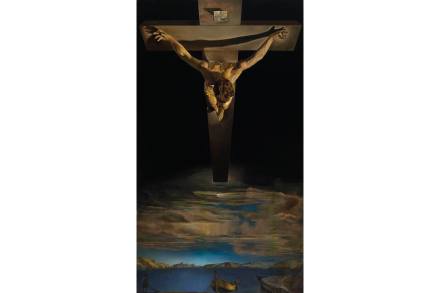
I arrived in the city of Figueres early one January morning to visit one of the most popular, and bizarre, art museums in the world, the Teatre-Museu Gala Salvador Dalí. It houses a dreamlike picture that, for the first time since it left over seventy years ago, has made a temporary return journey to Spain. Originally simply titled “The Christ,” the 1951 canvas depicting the giant figure of a man on a cross, shown at an overhead angle hovering over a moody seascape, was painted by the most famous son of Figueres, Salvador Dalí. Through April 30, it forms the centerpiece of a show exploring its creation, history, local connections and symbolism.

Dalí

The value — and worthlessness — of contemporary art

“This is why I hate art.” “Why, because this is pants?” A friend and I were at a contemporary art show, standing before a mixed-media work featuring trite sayings, glittery flowers and a spaniel. A few days earlier I had suggested to her — once rather ominously described to me as an “art philistine” — that a visit to a few local galleries might provide an opportunity to acquire art for the new home that she and her fiancé recently purchased in the area. Somewhat to my surprise she agreed, so one evening we trundled along to some exhibition openings, to see what we might find. Our first venue, housing three exhibition under one roof, was quite crowded when we arrived. The works ran the gamut from installations and video art to painting, drawing and collage.

art

Georgia O’Keeffe wants you to take your time

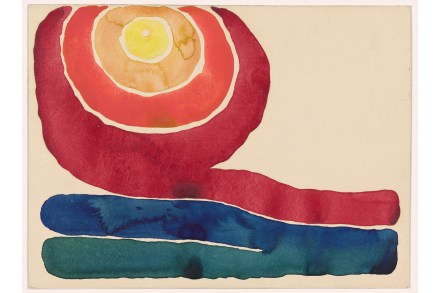
Georgia O’Keeffe is beloved for her oil paintings on canvas showing flowers and animal skulls: the first all soft, sensual openings; the second, spiky points and hardness.  Her works on paper are less well known. Yet, as MoMA’s exhibition, Georgia O’Keeffe: To See Takes Time, argues, paper played a key role in her early experimentation and art. As she told Alfred Stieglitz, the influential art gallerist and photographer who became her husband, “Why — it’s just like scrap paper. I throw it in the scrap heap and go on to something else.”  Paper is the beating heart of this retrospective, which shows 120 of O’Keeffe’s works from fifty-eight separate lenders, and which range from charcoal sketches to candy-colored pastels, rich watercolors to grainy graphite.

‘Evening Star No. III,’ 1917, by Georgia O’Keeffe (MoMa)

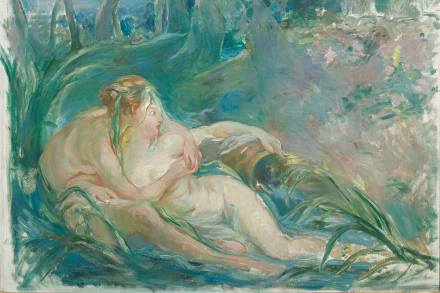
What makes Berthe Morisot’s nudes so unique?

In the years before the French Revolution saw heads roll down the boulevards, revolutionaries murdered in the bath, and endless numbers of fluffy lap dogs forced to fend for themselves after their mamans met their untimely ends, one art critic made his name with his fearless criticism of Paris’s annual art exhibition, the “Salon.” The prominent style in mid- and late-eighteenth century France was Rococo — think impossibly ornate, gold-swirled furniture; paintings of pink, fluffy nymphs in gilt-edged, asymmetrical frames; and portraits of women in dresses so large, and so embellished, that they resemble iced wedding cakes more than human beings. In the face of endless walls of this style of art, the critic Denis Diderot was caustic.

Morisot

Murillo the masterful

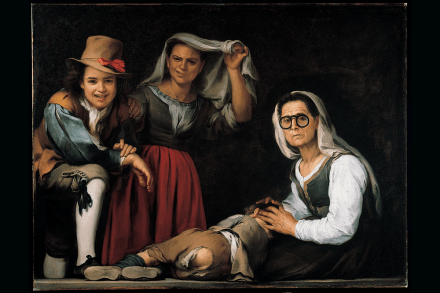
Murillo: From Heaven to Earth, an exhibition at the Kimbell Art Museum in Fort Worth, Texas, is, at its core, a cunning display of institutional braggadocio. How much better to amplify a mainstay of the permanent collection — that would be “Four Figures on a Step” (c. 1658-60) — than to mount a show dedicated to the artist responsible for it? “Four Figures on a Step” is, if not Murillo’s masterpiece, then a distinctive painting all the same. It is distinctive because it is odd: though attempts have been made to peg the image as some-or-other lesson in morals, the canvas has consistently resisted explication. The title, a bland descriptor superimposed by an outside source, points up how the picture’s thematic basis remains firmly contained within its own peculiar logic.

Murillo

Dawn party

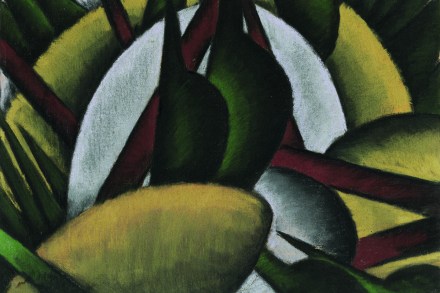
What a difference a century makes. That’s the upshot of At the Dawn of a New Age: Early Twentieth-Century American Modernism, an exhibition at The Whitney Museum of American Art culled from its own holdings. In-house ventures can sometimes come off as so much house-cleaning, an opportunity to air out the storage racks and take stock of inventory. Which is, in fact, exactly what Whitney curator Barbara Haskell has done. But by adding select loans from other institutions and private collections, she’s put together a show that has its own Gestalt. Though the fervor of artistic innovation has a limited shelf life, the work on display here continues to radiate a klutzy, almost childlike audacity. There’s a naivete at the heart of At the Dawn of a New Age, and it is winning.

dawn
baskin

A chronicler of enormities

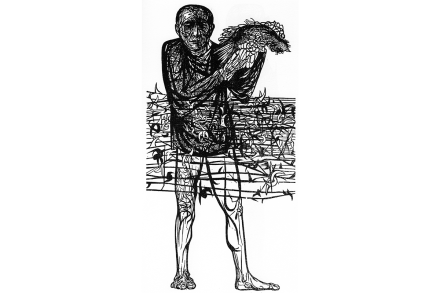
The Farnsworth Museum of Art, subject to New England winters up in Rockland, Maine, and consequently confined to a shorter calendar than most museums, made one of the bolder institutional decisions in recent memory: devoting part of its precious summer schedule to showing prints about the Holocaust. Moreover, these are the sublime and horrifying woodcuts of Leonard Baskin (1922-2000), executed in the last years of the artist’s life, which he spent contemplating the ravenous appetite that Death has for the Jews. Baskin was not to everyone’s taste, and the feeling was mutual. The critic Hilton Kramer called him a “macabre sentimentalist,” and that was only to denigrate the other artist he was reviewing at the time.

Philip Guston in the padded room

It was once a cliché of modern art that its principal aims included shocking its audience. Aesthetic aggression was the correlative of class warfare. It’s no accident, as the Marxists say, that avant-garde comes from the military lexicon. In painting, Gustave Courbet’s 1866 “L’origine du monde,” a rudely realistic, closely cropped view of an anonymous woman’s nude genitals, is often hailed as an early shot across the bow. Five years later, the artist would lead the Paris Commune in toppling over the Napoleonic Vendôme Column. For pugnacious creatives like Courbet and his descendants, consciousness-raising was always going to be a little bit uncomfortable. One can imagine how easily this gets out of hand.

guston

The one-note wonder

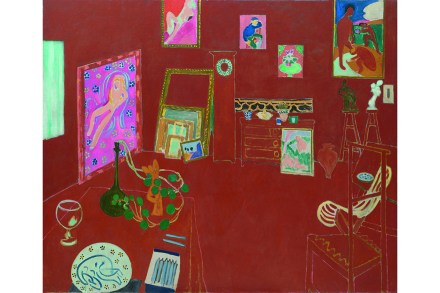
Art museums normally organize career surveys or thematic exhibitions, but this spring the Museum of Modern Art has departed from this practice to focus on a single work. Matisse: The Red Studio examines the pivotal painting of the same name that Henri Matisse (1869-1954) created in 1911. Exhibitions are normally years in the making, so while this one was in the works long before the Covid-induced lockdown, it offers a model for institutions struggling in the wake of the pandemic. Rather than expending scarce resources on an expensive blockbuster loan show, do a deep dive into something in your own collection. And what a dive this is.

matisse

Blues for Pablo

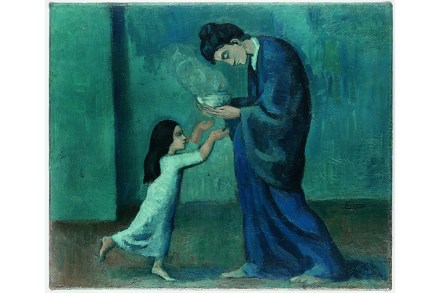
What is there left to say about Picasso? This question, posed by a colleague apropos of Picasso: Painting the Blue Period, an exhibition on display at the Phillips Collection in Washington, DC, is inevitable. There are few cultural figures whose life and accomplishments have been as exhaustively accounted for as the man born — take a breath! — Pablo Diego José Francisco de Paula Juan Nepomuceno María de los Remedios Cipriano de la Santísima Trinidad Ruiz y Picasso. Innumerable exhibitions, books, scholarly tracts and films have been devoted to this relentlessly protean artist. Even after his death almost fifty years ago — Picasso died in 1973 at the age of ninety-one — he looms large in the public consciousness.

picasso

Holbein at the Morgan

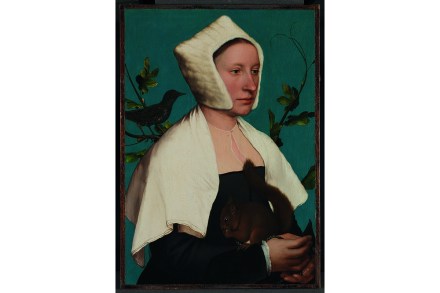
There’s a moment in portraiture when people started having a mind of their own. All of a sudden you see it in the faces: the eyes, the brow, the lip. We are no longer looking at a figure for all time — or even a sitter in a moment in time — but at something more like “me time.” The focus is not on outward appearances but inward looking. These people are lost in thought. That’s just where Hans Holbein the Younger, the great portraitist of the early sixteenth century, found them. The German artist, born into a family of painters around 1497, could conjure the smallest details at his fingertips. He quickly became the most sought-after portraitist in Europe and, by 1536, the court painter of Henry VIII (at a time when Henry himself was courting).

Holbein

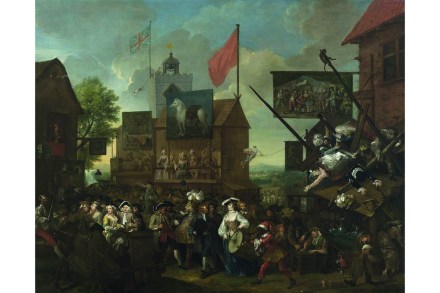
Hogarth framed

Visiting public art galleries has become a dangerous undertaking — at least if one wishes not to be accosted by ludicrously woke signage and unnecessary trigger warnings. In the past, one might have, justifiably, seen warnings before entering a room exhibiting, say, the garish and pornographic sculptures and photos of Jeff Koons going hard at it with Hungarian-Italian “actress” and part-time politician Ilona Staller, aka Cicciolina. Today, such warnings are found outside galleries exhibiting not such ephemera but the greatest works in the Western canon. Last autumn’s Titian show at the Isabella Stewart Gardner Museum in Boston warned visitors before entering that “Titian: Women, Myth and Power explores themes of sexual assault and violence.

Hogarth

How did Walt Disney learn from Ancien Régime decoration?

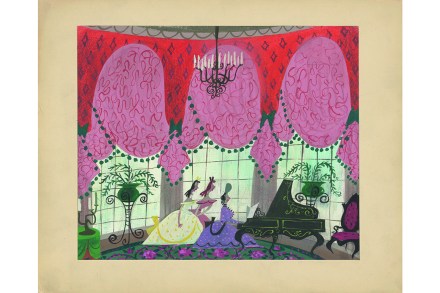
"Make it pink! Make it pink!” says the chubby fairy Flora, aiming her wand at Princess Aurora’s new ball gown in Walt Disney’s Sleeping Beauty (1959). A few magic sparks must have fallen on the walls of Disneyland’s Sleeping Beauty Castle in Anaheim, California, which have been painted (and repainted) in several shades of cotton-candy pink since the faux fortress opened in the summer of 1955, well before the film itself was completed. Two centuries earlier, in 1757, Jean Hellot, the general inspector of the porcelain factory at Sèvres, invented the slightly deeper “rose Pompadour,” a ground color named in honor of Louis XV’s chief mistress and the factory’s most important patron. This pink appears on the scallop-patterned lids of two large Sèvres vases (c.

disney

A brush with Joan Mitchell

“I am not a member of the make-it-ugly school,” Joan Mitchell told Irving Sandler for an ARTnews article in 1957. No argument there. As the major retrospective of more than eighty significant paintings by the second-generation Abstract Expressionist (1925-92), now on at the San Francisco Museum of Modern Art, reminds us, Mitchell’s artistic life was an unabashed pursuit of the beautiful. Her paintings, derived from nature but fired in the kiln of memory and intuition, are testaments to that pursuit, showing us at once just how devilishly out-of-reach true beauty can be, and just how important it is to stretch one’s arms and go for it.

mitchell
prints

Prints of Wales and elsewhere

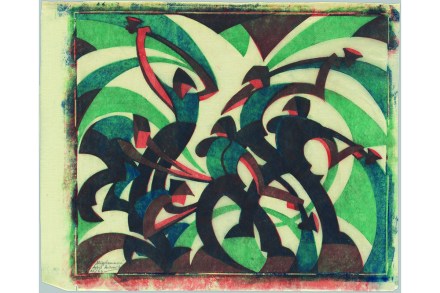
The print is a curious category in the world of art. Prints are not singular, of course — not typically at least. They are not ubiquitous, either — at least, again, not typically. They exist somewhere between art objects and art products. Printmakers often use the tools of sculpture to create works on paper. Three-dimensional carved objects become two-dimensional printed products. Think about it and you realize prints are far more curious than they let on. While art history typically does not know what to do with its curiosities, artists can sometimes make much out of the opportunities of hybrid creation.