Angela merkel

Support for Merkel’s party is crumbling

From our UK edition

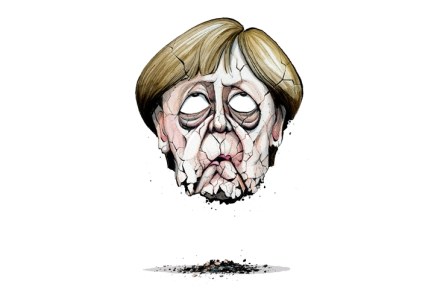
On Sunday, Angela Merkel’s Christian Democratic Union of Germany (CDU) suffered a historic election defeat in their former heartlands of Baden-Württemberg and Rhineland-Palatinate. ‘The state elections struck deep at the heart of the union of the CDU and CSU,’ said Markus Söder, leader of the CDU’s Bavarian sister party, the Christian Social Union. To an increasingly frustrated public, the ruling parties in the capital look tired and devoid of ideas. There is no incentive for Merkel and her cabinet to turn things around. After 16 years in government and on the brink of retirement, she has become a lame-duck chancellor. Some German journalists have even begun to call the whole sorry saga ‘the duck tales’.
The rapid fall of Germany’s health minister

From our UK edition

Young, polished and confident, Germany’s health minister became the country’s most popular politician in 2020. A darling of the conservative right, Jens Spahn, was even tipped as a candidate to succeed Angela Merkel as chancellor. At the peak of his popularity last November, surveys indicated approval from nearly two-thirds of all Germans. He seemed to reflect the success story that was Germany’s handling of the pandemic, the personification of friendly German efficiency. Fast forward to last week, and you find a defensive Spahn facing a hostile one-hour long grilling in parliament. His arms crossed and his jaw set, the 40-year-old was visibly tense as he braced himself for questions from angry MPs.

Biden vs Merkel: the battle over Russian gas is heating up

From our UK edition

Two months ago, a Russian pipe-laying ship called the Akademik Cherskiy left the Baltic island of Rügen to finish the last few miles of the most controversial gas pipeline in the world. Germany hopes that Nord Stream 2 will improve its access to Russia’s vast reserves of natural gas. In America, however, the project is seen as a way for Moscow to exert influence over Europe. Its completion marks the biggest diplomatic crisis in transatlantic relations since the Iraq War and now, as then, we see Germany pitched against the US. But this time, Germany is far more determined. Since its inception, the pipeline —which runs directly from Russia to Germany — has been opposed by many in Europe who share America’s concerns about dependency on Russian energy.

The EU is a divided house

From our UK edition

What does 2021 hold for the European Union? At the end of 2020 Brussels has gone out of its way to engage in unity-signalling, announcing that all 27 members will begin vaccination on the same day and feigning a united front in the face of the UK’s new strain of coronavirus. But in truth its 27 member states are confronted by serious structural divisions in three fundamental areas: economics, culture, defence. Deep economic divisions surfaced in the EU after the 2008 financial crash along a north-south axis. The split between the richer ‘frugal’ northern economies and the ‘profligate’ southerners was starkest in 2012-13 over Brussels’ treatment of Greece.

Germans face a ‘lockdown light’ for Christmas

From our UK edition

Germans, just like Britons, will have to cope with restrictions during this year’s Christmas holidays. Yesterday, Angela Merkel and the heads of Germany’s federal states agreed on an updated catalogue of regulations that will allow ten adults to meet for a Christmas party. After three weeks of what is widely called a ‘lockdown light’, the infection rates in German cities and regions continue to remain above the threshold that has been set by medical experts. The vast majority of Landkreise (regional districts) have recorded an incidence proportion of higher than 50 cases per 1,000 inhabitants within the last week.

Is this the man who will replace Angela Merkel?

From our UK edition

Markus Söder is the one to watch in German politics. The ascent of the Bavarian Minister-President and leader of the Bavarian Christian Social Union is probably the closest modern Germany has come to Macron-style disruption. The situation is less dramatic than France in 2017 — there is no great disaffection with Chancellor Angela Merkel or with politics in general — but there is a sense that the country needs a shift in direction. Bavaria symbolises that new direction. When I grew up in Germany’s deep west in the 1960s and 1970s, we went to Bavaria on holiday and admired its quaint backwardness. We did not take it very seriously until the Munich Olympics in 1972.

Is Germany really such a role model?

From our UK edition

The British romance with Germany has always been an on-off affair. At the turn of the century, Kaiser Bill enjoyed brief popularity, based on dynastic ties, until his bombastic militarism set Germany on a path to war. Thirty years on, as Tim Bouverie reminds us in his book Appeasing Hitler, many in the English ruling class favoured Nazi Germany over revanchist France. After the war, Rhenish capitalism, Germany’s social contract between management and labour, appeared to offer a soothing alternative to strike-torn Britain. Then Mrs Thatcher arrived with stiffer medicine. John Kampfner’s Why the Germans Do It Better is a beguiling title because the British have undoubtedly hit a bad patch.

Trump’s German troop withdrawal will hurt America

From our UK edition

Tensions between Germany and the United States have increased considerably since Donald Trump became president. Trump has repeatedly criticised Berlin for a variety of things, most vocally accusing the German government of failing to pay its way on defence. Trump has said that Europe’s Nato members, including Germany, should no longer rely so heavily on the US to shoulder the costs of maintaining the alliance. The debate has focused on the target agreed by all alliance members that defence spending should reach 2 per cent of each country’s GDP by 2024. Germany’s military expenditure equalled 1.4 per cent of its GDP in 2019.

Can Germany spend its way out of the corona crisis?

From our UK edition

Coronavirus is grim news for all major economies and Germany is no exception. The country’s economic output decreased by 2.2 per cent during the first quarter of the year, the sharpest fall since the 2008 crash and the second biggest since German reunification in 1990. A double-digit dip in the second quarter, when the full impact of the lockdown restrictions introduced in March become more visible, seems likely. But while Germany is not alone in facing up to grim economic statistics, it is using its economic clout – unavailable to poorer countries in Europe – to try and spend its way out of the crisis. Many German employers have been able to switch staff to shorter working hours during the outbreak, avoiding mass layoffs, under the terms of a government rescue package.

What British bureaucrats can learn from German efficiency

From our UK edition

We have often heard over the past weeks how Germany's impressive testing capacity has proven central to combating the coronavirus at such speed. But equally impressive is the speed at which its state and federal governments have reacted financially to save the economy. Like some of the UK's support schemes, Germany has provided various aid packages or Soforthilfe to businesses large and small. Unlike the UK, however, Germany has already managed to pay out billions of euros to those in need. For the self-employed and small businesses with up to ten workers, this has essentially meant free money arriving in their bank accounts within 24 hours of applying, for which they complete only a short online form with their name and tax ID with hardly any further checks.

Will coronavirus kill the eurozone?

The familiar should be a consolation amid the terrible novelties of COVID-19, but the pandemic’s effects on the European Union threaten to turn familiar fiasco into dangerous novelty. As a weakened Angela Merkel faces Germany’s crisis of economic responsibility, and France floats the idea of issuing its own ‘corona bond’, the EU and its currency face what Emmanuel Macron would probably not want to call its Waterloo.Henry Kissinger’s remark — ‘Who do I call if I want to speak to Europe?’ — has never seemed more true. Britain is leaving.

eurozone

Frightened people love their leaders

‘The Trump presidency is over’, said Peter Wehner, in the Atlantic. The great wizards of liberal punditry stroked their beards and agreed. These are suddenly serious times and the president is a joke. He cannot survive, surely.‘The coronavirus is quite likely to be the Trump presidency’s inflection point,' wrote Wehner, 'when everything changed, when the bluster and ignorance and shallowness of America’s 45th president became undeniable, an empirical reality, as indisputable as the laws of science or a mathematical equation.’Run that paragraph back through the journalistic ego-filter and it translates as: ‘I told you so! Why didn’t everyone listen to me?’The trouble is, Peter, the public still won’t listen.

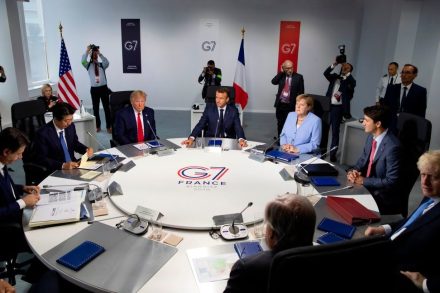
g7 leaders

What a relief to no longer have to pretend to be sociable

From our UK edition

Hulking fat chavs pushing shopping trolleys full of lavatory paper back to their Nissan Micras. I can’t think of a better image to sum up the coronavirus crisis right now. I saw a bunch of them outside my local branch of Morrisons on Sunday morning, their expressions uniformly defiant and smug. One family had at least ten multipacks in their trolley — and nothing else. Surely one cannot live on toilet tissue alone, no matter how agreeably scented it might be? I assumed they were part of the panic-buying crowd, although having seen the size of their arses it may well be that this was simply their requisite amount for a single day of copious wiping. I had driven to the supermarket in time for its opening, at 10 a.m. All I needed were a few breakfast rolls and some cigarettes.

The last Brexit heave

From our UK edition

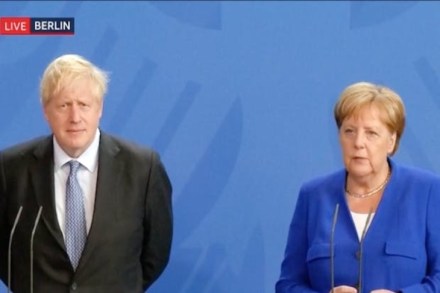
The past few months have been characterised by high drama which, for all the excitement, has resolved nothing. We are back in a familiar cycle: posturing, bluster and a last-minute burst of Brexit talks. It's possible that Boris Johnson will emerge with a deal and declare triumph by 31 October: he has always regarded this as possible, even likely, no matter how high the odds are stacked against it. But it's just as likely that this will all end in failure. If Britain does end up leaving the EU without a deal, the moment when such an outcome became inevitable will be traced back to Tuesday’s telephone call between Boris Johnson and Angela Merkel. In that call, according to No.

Germany’s ailing economy can’t afford a no-deal Brexit

From our UK edition

The UK was the ‘sick man’ when we ‘joined Europe’ in 1973. Now, with Britain on the cusp of leaving, the European Union’s largest economy is decidedly out of sorts. After failing to recover over the summer, Germany is now almost certainly in recession. The state of the fourth biggest economy on earth always matters — but with Germany dragging down the broader eurozone, its declining health could decisively impact Brexit negotiations too. Politically, Brussels and Dublin are bullish. They have dismissed Boris Johnson’s proposals, gambling on an extension and perhaps Brexit being cancelled entirely. But such intransigence could yet cause a disorderly no-deal Brexit — which would have a pretty big impact on all major economies on the continent.

Stop thinking Merkel will save us, Dominic Cummings warns

From our UK edition

Is Boris Johnson more likely to get a Brexit deal after his meetings with Angela Merkel and Emmanuel Macron? The Prime Minister today tried to dampen hopes, saying that while the 'mood music' had been 'very good' during his meetings with the two leaders this week, it was still going to be hard to persuade the EU to give way. Speaking during a visit to Devon, Johnson said: 'This is not going to be a cinch, this is not going to be easy. We will have to work very hard to get this thing done.' Much of the week has been spent trying to work out what various comments and bits of body language really mean. Was Johnson celebrating successful talks or just having a stretch when he arrived back in Downing Street after his meetings?

Merkel’s immigrant boom wreaks havoc in Germany’s prisons

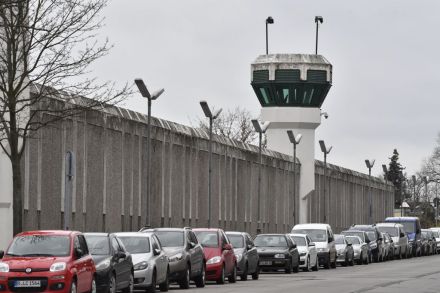
Angela Merkel’s decision to allow more than one million migrants into Germany has caused a crisis in Germany’s prison system. About half the prisoners in Berlin and Hamburg are now foreign-born, according to the latest figures in the German press, and in prisons across the country, German is becoming a foreign language. This surge in outsiders on the inside coincides neatly with the 2015 decision to allow in migrants from the Middle East, Africa and Asia. All regions of Germany report a ‘very strong increase’ in the number of foreign and stateless prisoners, according to data from the past three to five years. Prisons throughout Germany are overcrowded and struggling to handle the influx in population.

germany prisons

Letters | 8 November 2018

From our UK edition

Hubris and nemesis Sir: Douglas Murray’s assessment of Angela Merkel’s decision to stand down as German Chancellor (‘Europe’s empty throne’, 3 November) suggests a certain symmetry with the fate of our own former Prime Minister. David Cameron also declared that he would leave office at a time of his own choosing, but circumstances conspired against him. Mutti shows a great deal of presumption in announcing she will stay until the next election. If German politics bears any resemblance to our own, the very act of announcing a long goodbye will ensure that she leaves before her chosen moment. Cameron brought about his own demise by hubris, thinking he could renegotiate the terms of EU membership.

Portrait of the Week – 1 November 2018

From our UK edition

Home Austerity was ‘finally coming to an end’, Philip Hammond, the Chancellor of the Exchequer, said in the Budget. He was helped by what he did not call a magic money sapling, in the form of revised estimates of public borrowing in 2018, £11.6 billion lower than forecast. Debt as a share of GDP, from a peak of 85.2 per cent in 2016-17, would still be 74.1 per cent by 2024. Mr Hammond repeated a pledge of an extra £20.5 billion for the NHS over the next five years, with an extra £2 billion a year for mental health services. Councils would get £700 million more for care. The personal tax allowance would rise from £11,850 to £12,500, a year earlier than announced, benefiting 31 million employed people by at least £130 a year.

How Cameron’s misreading of Merkel led to Brexit | 29 October 2018

From our UK edition

It is impossible to overstate Angela Merkel’s significance, to Germany, to the EU, and to Britain. Others are better qualified than me to talk about the first two of those, but as she announces her (slow, deliberate) departure from office, I offer a thought about Merkel and Britain, which is that the modern history of Britain’s European policy has been a story of misunderstanding Angela Merkel, and therefore Germany. This story starts in 2005, when David Cameron stood for the Tory leadership. As a moderate, he was keen to woo the Right, especially on Europe. So he promised to pull the Tory MEPs out of the European People’s Party grouping in the European Parliament.