Angela merkel

Why Angela Merkel doesn’t want a haircut

From our UK edition

The announcement by Angela Merkel last week that there would be no second haircut for Greece may have surprised some readers unfamiliar with financial jargon. But once you know that ‘haircut’ means a debt write-down, nothing could be less surprising. Not because it’s a preposterous idea - in fact it’s almost bound to happen - but because two months before a general election, Merkel couldn’t say anything else. It’s pure Realpolitik. For a long time, speaking against European integration was taboo in Germany. In a country crippled by guilt for its past, insisting on German national interest or criticising European neighbours had too many uncomfortable echoes. The result was not so much public consensus as lack of public discussion.
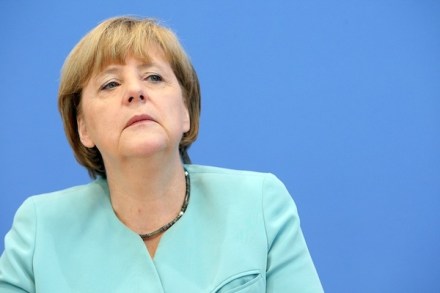
Cameron confident of common ground with Merkel

From our UK edition

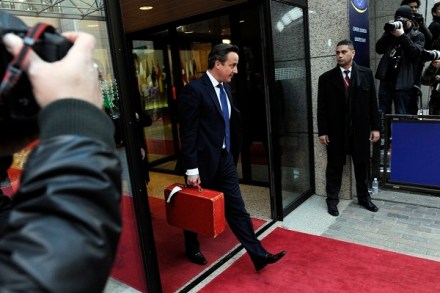
David Cameron is setting off with his children to visit Angela Merkel on Friday. It's part of his EU reform mission that started and was thrown off course on Monday following the death of Margaret Thatcher. As I blogged back then, the circumstances aren't perfect, and one of the reasons for that is that France and Germany recently snubbed an invitation to be involved in the UK's 'balance of competences' review. But today Cameron tried to play down the significance of this. He told Adam Boulton: 'Our review of competences was always and will be a British exercise. We didn't particularly, that story was… anyone's free to feed into our review, but that piece of work is a British piece of work. For years people said you'll never have the European budget cut, I've got it cut.

David Cameron makes the case for reform in Europe

From our UK edition

Germany has elections on the way, Spain is just about holding a lid on its economic crisis while keeping a wary eye on the uphill struggle that its neighbour Portugal faces to avoid a second bailout, and François Hollande has his own political crisis to deal with (and is apparently also mourning the death of a camel). So is now really the best time for David Cameron to pitch up in Madrid, Paris and Berlin to argue for reform of the European Union? The PM visits the first two cities today, with a meeting with Angela Merkel planned for later this week on the same topic.

Angela Merkel’s domestic imperative

From our UK edition

The Cyprus situation has demonstrated that until the elections in the autumn, Angela Merkel’s primary focus is on a domestic audience. She clearly wanted to show that Germany is now prepared to take a far tougher line. As Open Europe notes the need for this is fast becoming the consensus view in Germany. So, the question now for the Eurozone is will we see any more crunch moments this side of the German election? If we do, then I think we could see the end of the Euro. The Cypriot parliament’s rejection of the initial bailout deal, at the insistence of the voters, shows that there is a limit to the pain that the weaker Eurozone economies are prepared to take for economic and monetary union.

Cyprus: This isn’t a tax, it’s a bank raid

From our UK edition

You know this levy on Cyprus bank deposits? It’s not a levy. A levy is a kind of tax, and what is happening to the people with bank deposits in Cyprus is no kind of tax, although today the European Commission spokesmen have been insisting it is. How can it be a tax when the depositors are going to be ‘compensated’ with shares in the bank? I mean, when you pay your income tax, George Osborne doesn’t compensate you with shares in RBS.

Europe Minister won’t give renegotiation specifics

From our UK edition

There’s ‘no secret plot to get Britain out of the EU’ declared David Lidington on the Sunday Politics. In an interview with Andrew Neil, the Europe Minister was determinedly vague on the issue of what powers the next Conservative manifesto will seek a mandate to repatriate. But he made clear that the free movement of people is not going to be part of the renegotiation nor will Britain seek the right to strike its own trade deals with other countries. Having given the speech, David Cameron and his team don’t want to give a running commentary on what they might or might not seek to change about Britain’s terms of EU membership. Indeed, I suspect that they would like to go into the next election seeking as vague as possible a mandate.

Cameron & co relieved by Merkel reaction to speech

From our UK edition

Angela Merkel’s statement yesterday was a big fillip to David Cameron’s European strategy as it suggested renegotiation was possible. One senior government source called it ‘as good as we could have hoped for'. I understand that Merkel and her officials have indicated to the Cameron circle that they want Britain to stay in the EU and are prepared to consider Britain’s concerns. But Merkel does not wish to look like she is interfering in British domestic politics; she doesn’t want to appear to be endorsing the Cameron approach. Secondly, she does not yet know how much room for manoeuvre she has.

Merkel ally’s referendum warning underlines Cameron’s precarious position

From our UK edition

The major gamble that David Cameron is taking with his strategy on Europe is, as James explains in this week's magazine, that he's relying on signals from Angela Merkel that she is keen to help him with a renegotiation. She has certainly given a few of those in recent months. But today one of her colleagues in the Christian Democrat party undermined some of the confidence that has been building about Merkel's position. Gunther Krichbaum is the chair of the Bundestag's European Affairs Committee, and is leading a two-day cross-party delegation to Britain. He believes a renegotiation would open a 'Pandora's Box', and that Britain should tread carefully: 'There is certainly a risk that [a referendum] could paralyse efforts for a better Europe and deeper integration.

Nick ‘the fibber’ Clegg faces the fibbed-to

From our UK edition

Trying out new career options on LBC this morning, Nick Clegg inadvertently illustrated several serious political truths. A caller claimed to have been a member of the ‘Liberal Democrat’ party – indeed an ex county-councillor in Surrey.  But he said that he had recently ripped up his party membership card.  Happily, however, he proceeded to read from it. Before this morning I had never heard anyone recite this hilarious document.  But if the caller was telling the truth the card says: ‘The Liberal Democrats exist to build and safeguard a fair, free and open society in which we seek to balance the fundamental values of liberty, equality and community in which no one shall be enslaved by poverty, ignorance or conformity.

A satisfactory outcome at the EU budget talks for David Cameron

From our UK edition

So, the EU budget summit has — as expected — broken up without agreement. We await the date of the next discussion of the matter. But for the moment it means there is nothing that David Cameron will have to try to pilot through parliament. Talking to those close to the Prime Minister, I sense that they are not unhappy with this conclusion. In Downing Street, they feel that their criticisms of the running costs of the EU bureaucracy have struck a chord with other contributor countries. They’re also pleased that Cameron has managed to strike a tough negotiating position without isolating himself. But what is giving them the greatest satisfaction is how solicitous of the British position Angela Merkel was. They regard this as a promising sign for the coming renegotiation.

David Cameron under attack from voters, Ed Miliband, David Davis and Angela Merkel on Europe

From our UK edition

The Sunday Papers and the broadcast shows are packed with accounts of Britain’s fractious relationship with the European Union, and what that means for David Cameron. The Observer gives space to a poll, the headline of which says that 56 per cent of Britons would ‘probably or definitely’ vote to leave the EU against 30 per cent who would probably or definitely vote to remain in the union. The Independent on Sunday carries a ComRes poll on the more immediate question of next week’s EU budget discussions. The findings will give Mr Cameron a headache: 66 per cent of voters want the budget ‘cut rather than frozen’. The voters will be disappointed: a cut is a fantasy. Even a freeze is looking unlikely because recipient countries are likely to oppose it.

The View from 22 — Britain vs. Germany, kicking the Lib Dems and the BBC 28

From our UK edition

Are Britain and Germany heading for an almightily clash over the future of the EU? In this week's Spectator, Christopher Caldwell argues that Angela Merkel has had enough of Britain's position and is out to give David Cameron a kicking over Britain's lack of solidarity with her nation. On the latest View from 22 podcast, Fraser Nelson explains the significance of about is about to happen: 'The [problem is the] extent to which Europeans don't understand us, they can not get that for Britain, it is an issue of sovereignty. They keep thinking well the Brits don't want to agree the next budget, let's give them a few sweeteners — a subsidy here, a commissioner there. They are trying to horse trade with us, where for us now it's gone beyond that.

‘Cameron will not turn back’: EU budget summit under threat

From our UK edition

Will David Cameron be denied his veto moment after all? Brussels sources appear to think the European Union budget summit on 22 and 23 November could still be cancelled. A report from Italian wire service ANSA quotes one source saying 'everything indicates that it will be impossible to overcome the British veto' and that cancelling the summit remains an option. This follows reports recently that Angela Merkel was threatening to cancel the summit as it was pointless if Britain was going to veto any increase above one in line with inflation. The German Chancellor had a lengthy dinner with Cameron to discuss the summit on Wednesday night, but their talks haven't stopped the European rumour mill.

Angela Merkel: I can’t imagine UK quitting the EU

From our UK edition

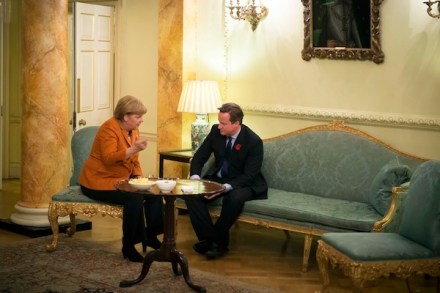
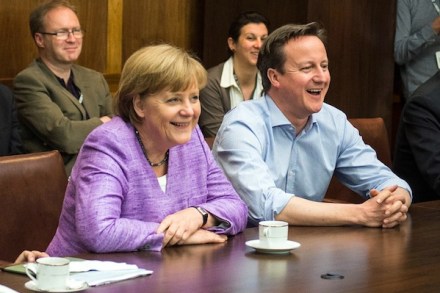
David Cameron and Angela Merkel are eating dinner together tonight, over which they will discuss the forthcoming European Budget summit. The discussion may make even the sweetest crème brûlée taste rather sour, with Cameron continuing to threaten to veto anything above a real-terms freeze in the budget. He has told reporters following him around on his tour of the Middle East that he will make the argument for a freeze 'with vigour'. As she arrives in Downing Street, Merkel will be mindful, though, that she has a key role in trying to reach a consensus between the British position and the desire of other countries in the union for more money.

The Brussels budget imbroglio

From our UK edition

The EU budget negotiation, now a month away, promises to be David Cameron’s next big European test. The Prime Minister has repeatedly declared that he wants to see the EU budget frozen at 2011 levels and that he’s prepared to use the need for unanimity to achieve that. The Economist this week has a very useful scene-setter for the budget talks. It sketches the contours thus: ‘Countries are coalescing around loose (yet often divided) groups. There are the 'friends of cohesion': the net recipients of regional spending, such as Poland, Hungary and the Baltic states. And there are the 'friends of better spending': the net contributors, such as Germany, France, Britain and several northern European states.

Dave vs Angela, round 2

From our UK edition

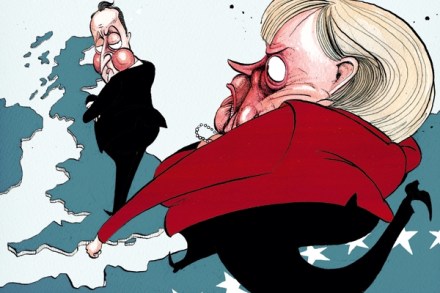
David Cameron appears to be looking for a suite of examples for his party that he's still fighting their corner. He's about to deliver his speech on offenders, and his spokesman has just suggested he's up for a real scrap on the European Union budget, too. The FT's splash this morning is that Angela Merkel is threatening to cancel next month's European budget summit if Britain refuses to approve any other deal than a total freeze on spending. The paper reports that Merkel believes there is no point in holding the summit if Cameron is going to veto any deal on the table. The problem for the German Chancellor is that if Cameron vetoes a deal, it will be good for him politically, but bad for Merkel as Germany will lose its rebate and therefore will have to contribute more.

Angela Merkel’s nerves about Britain’s future in the EU

From our UK edition

The Prime Minister and Angela Merkel spoke last night on the phone to discuss the European Council meeting later this week. Downing Street said the pair 'agreed that further work is needed before agreement can be reached' on banking union, which is a coded acknowledgement that David Cameron is concerned the current proposals are not in Britain's interest and do not currently protect the single market and that he will push for greater compromise when leaders meet. This is all part of the Prime Minister's big Europe week. He has a Cabinet meeting this morning, and as its members are increasingly piling pressure on Cameron for a referendum on Britain's membership of the European Union, the topic may well come up.

The EU wins the Nobel Peace Prize

From our UK edition

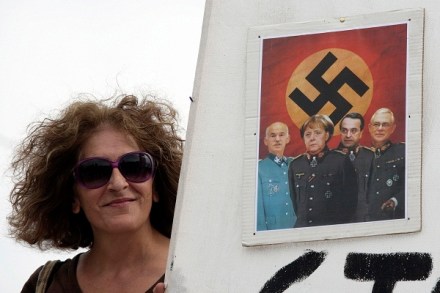
Today is not April the first; but the European Union has indeed won the Nobel Peace Prize. It is a bizarre decision given what is going on in Europe right now. Watching the reaction of the Greek crowd to Angela Merkel on her visit there this week, it was hard not to worry that the European project was now a threat to peace and stability on the continent. To be sure, France and Germany have not gone to war again since 1945. But to chalk that up solely to the European Union is a profound misreading of history. I suspect that the decision to award the prize to the European Union was a product of the desire of the Norwegian elite to rebuke the people there for not wanting to join the European Union. They are raging against the dying of the light.

Whitehall’s mistake over BAE and EADS

From our UK edition

There have been some sharp responses to the demise of the proposed BAE EADS merger. My personal favourite is John Redwood’s pithy: ‘Several of you wrote in expressing dismay at the proposed tie up between BAE and the Franco German civil aviation company. I did not write about it, as I assumed it would be an impossible deal to execute. The documentation was very voluminous, so I did not bother to read it. The politics were always likely to bring it down, so there was no need to analyse the business, economic and strategic issues.’ There seems to be little surprise that the deal collapsed. Most commentators welcome the failure, despite the commercial sense of the proposal.

Whatever it takes to save the euro

From our UK edition

In case you were in any doubt about how committed eurozone leaders are to the survival of the single currency, Angela Merkel has put out another statement on doing 'everything possible to protect the eurozone', this time with Italian Prime Minister Mario Monti. The pair had a phone conversation on Sunday and their remarks follow the joint statement released by Merkel and François Hollande on Friday, and Mario Draghi's announcement last Thursday that the European Central Bank would do 'whatever it takes' to protect the euro. The markets are looking forward to something decisive later today as US Treasury Secretary Tim Geithner arrives in Europe to meet German finance minister Wolfgang Schaeuble and then Draghi later on.